10 diseases to know -OMED midterm
 Call Kai
 Learn
Learn Practice Test
 Spaced Repetition
 Match
Match Flashcards
 Knowt Play
1/73

There's no tags or description
Looks like no tags are added yet.
Name | Mastery | Learn | Test | Matching | Spaced | Call with Kai | Chat |
|---|
No analytics yet
Send a link to your students to track their progress
74 Terms
All of the following are clinical presentations of a patient with a stroke/TIA EXCEPT:
a. Difficulty speaking, slurred speech, or speech loss
b. Instability, ataxia, and hemiparesis
c. Blurred vision, sudden temporary vision loss in both eyes
d. Contralateral muscle weakness and facial droop
e. Difficulty swallowing, severe headache with no known cause, and nystagmus
f. None (all are true)
c. Blurred vision, sudden temporary vision loss in both eyes
*presents with sudden temporary loss in ONE eye
What diagnostic tests are used to assess strokes/TIA?
1. Doppler blood flow
2. ECG
3. Cerebral angiography
4. CT & MRI
Stroke Tx
1. First line treatment is prevention:
-Identify risk factors for stroke: HTN, diabetes, atherosclerosis,
smoking
-Drugs: anti-HTN, antiplatelet, and statins
Treatment right after a stroke:(5)
1. Sustain life/get patient to hospital
2. Prevent further thrombosis or hemorrhage (whichever caused the stroke) and lyse clot if caused from emboli/thrombi
3. Acute stroke care: recanalization of occluded vessel, optimize collateral flow, and avoid secondary brain injury
-IV t-PA given for thrombolysis
-IV Heparin given after TIA
4. anticoagulants , corticosteroids, anticonvulsants
5. Surgery: removal of superficial hematoma or vascular
obstruction
-Thromboendarterectomy or bypass graft in neck or
thorax
Pharmacological & non-pharmacological tx of stroke/TIA (6)
1. Aspirin/Anticoagulant & Antiplatelet drugs (ex= clopidogrel/Plavix)
2. Corticosteroids
3. Statins & antihypertensive (preventive therapy)
4. Recanalization of occluded vessels (stents)
5. Carotid endarterectomy (removes plaque build up)
6. Smoking cessation, HTN control, & lower cholesterol
Med consults needed for all patients with a history of CVA or for patients with a history of TIA who are not actively seeing a physician why?
Confirm: specific diagnosis, timing, hospitalizations, post-CVA status and stability, residual deficits (specifically impairment of gag reflex and dysphagia), presence of current risk factors
Patient may take anticoagulants to prevent thrombosis =
risk of excessive post op bleeding(warfarin and coumadin)
Gag reflex may be impaired =
increased risk of aspiration
dental managment(6) of stroke pts:
1. Med consult to know underlying disease that caused stroke and risk
factors for stroke = create specific tx mods according to underlying
disease
2. Pre and peri operative vital signs, short morning appointments, stress
and anxiety reduction- benzos or nitrous, supplemental oxygen via
nasal cannula, LAs with epi dose reduced
3. Know if patient takes anticoagulants = bleeding risk and NSAIDs
contraindicated
4. Test for presence of an intact bilateral pharyngeal gag reflex and strong voluntary cough to evaluate risk of aspiration
-Other ways to reduce aspiration risk: upright chair position,
high speed suction, rubber dam
5. Effective communication techniques
6. OHI specific recommendations: electric toothbrush, large handled toothbrush, water irrigation, flossing aids, frequent in office prophys
What is the ASA classification of a patient with:
-a hx of TIA/stroke 3+ months ago that has adequately controlled risk factors AND is deemed stable
-a pt that is 30+ days post TIA/stroke AND has adequately controlled risk factors AND is deemed stable by physician
ASA III
What is the ASA classification of a patient with:
-recent hx of TIA/stroke (< 3 months) and NOT deemed stable
-any patient with unstable post-CVA status
ASA IV
What are some important considerations when treating a pt with hx of stroke/TIA?
1. Dose reduction for vasoconstrictors if pt on anticoagulants or antiplatelet therapy
2. Assess pts ability to swallow; bilateral gag reflex may be affected (can result in aspiration)
T/F-- vasoconstrictors are contraindicated in pts with a hx of stroke/TIA
False; they are NOT contraindicated
HTN definition
two/more readings of elevated BP on two/more occasions
Which of the following is TRUE in regards to the clinical presentation of Hypertension?
a. Usually symptomatic
b. Low BP
c. Symptoms include headache, dizziness, and tinnitus
d. Early symptoms include blurred vision, angina, proteinuria, renal failure, dementia, encephalopathy, and stroke
e. None of the above (all are false)
c. Symptoms include headache, dizziness, and tinnitus
-usually asymptomatic
-high BP
-advanced cases present with the symptoms on "d"
What diagnostic tests/labs should be ordered for pts with hypertension? (4)
1. ECG
2. CBC
3. Lipid profile
4. Urinalysis
What are the medications that can be used to treat hypertension?
1. Diuretics
2. ACE inhibitors
3. Angiotensin receptor blocker
4. Long-acting calcium channel blocker
5. Beta blockers
6. Alpha-1 adrenergic blockers
7. Central a2 agonist
*note that most patients require 2 drug combo (usually diuretic + another agent*
Do HTN pts have an increases risk of adverse events during dental tx?
-HTN patients have an increased risk of adverse events during dental treatment
-Stress and anxiety cause endogenous epi release which elevates pt's
BP potentially leading to stroke or MI
-Epi from LAs or gingival retraction cord are exogenous
sources that can also spike pt's BP
Dental Management/Treatment Modifications for HTN
-Reduce stress/anxiety before treatment with benzos
-Reduce stress/anxiety during treatment with nitrous
-Obtain profound anesthesia (to reduce endogenous epi release)
-ASA class 4 = LAs with epi are contraindicated
-For patients with controlled HTN = LAs with epi require dose
reduction
T/F-- vasoconstrictors are NOT contraindicated in a patient with a BP of 181/100
False; pt is ASA IV (BP of 180+/110+) and vasoconstrictors are contraindicated
For a patient with hypertension taking ACE inhibitors or Beta blockers, they can get a _____ or _____.
Vasoconstrictors can interact with ______, therefore there is a relative contraindication to their use.
_____ can cause gingival hyperplasia.
You CANNOT use ____ with calcium channel blockers.
-bad taste
-lichenoid rx
-non-selective beta blockers
-calcium channel blockers
-clarithromycin
CAD/angina pectoris
-chest pain/discomfort due to lack of oxygen in the heart (ischemia)
-Lack of oxygen/blood flow due to CAD
S+S of CAD/Angina Pectoris
-pts report squeezing, pressure, burning, indigestion, tightness, choking in chest
-Discomfort felt can radiate to neck, mandible, teeth, arms, back
-Levine's sign
What tests can be done to dx & treat angina/CAD?
1. CBC
2. Thyroid & renal fx tests
3. Lipid & glucose screening
4. Serum markers for C-reactive protein, fibrinogen, plasminogen activator inhibitor, and apolipoprotein B
5. ECT, chest CT, exercise stress test, echocardiogram, etc.
What meds can be prescribed for angina/CAD? (6)
1. Nitroglycerin
2. Beta blockers
3. Calcium channel blockers
4. Antiplatelet agents (aspirin)
5. Statins
6. ACE inhibitors
What medical intervention (surgeries) can be done to treat angina/CAD?
1. PCTA (percutaneous transluminal angioplasty with stenting)
2. CABG (coronary artery bypass graft)
What is the ASA classification of a patient who does NOT experience angina with ordinary physical activity?
ASA II --> Class I angina
What is the ASA classification of a patient who experiences angina symptoms when walking up stairs rapidly or walking > 2 blocks?
ASA III --> Class II angina OR vasospastic angina
What is the ASA classification of a patient who experiences angina at rest or is unable to perform physical activity w/out experiencing symptoms?
ASA IV --> Class III/IV angina
How do you modify treatment of a patient who has Class I or II angina?
1. Limit vasoconstrictor dose
2. Check & record vitals 5 mins after delivering LA
3. Ensure appropriate pt position, stress reduction, adequate O2, and pre-tx nitrate if needed
4. Do NOT discontinue antiplatelet drugs/DOAC
5. If pt is on Warfarin--> evaluate INR
6. Do NOT give NSAIDs if patient is on Warfarin or DOAC
How do you modify treatment of a patient who has Class III or IV angina?
-NOT acceptable for elective, invasive tx
-vasoconstrictors CONTRAINDICATED
What can be seen on an ECG that can indicate that a person has experienced an MI?
Pathologic Q waves
MI ASA 4=
MI ASA 3=
major risk:emergency dental treatment only in a hospital setting and must consult physician, epi is contraindicated
intermediate risk:record pretreatment vitals, record vitals during treatment, short appointments, possibly use nitrous, possibly use oxygen, profound local anesthesia, epi dose reduction
AFib shows rapid, disorganized, ineffective atrial contraction of 350-600 beats/min. Which of the following is NOT a symptom of AFib?
a. Anxiety, palpations, fatigue
b. Tinnitus & visual changes
c. CHF (SOB, orthopnea, PE)
d. Dizziness, feeling faint, syncope, angina
e. None (all are true)
e. None (all are true)
What is the primary tool to ID & dx arrhythmias?
12 lead ECG
What surgical interventions are used to treat arrhythmias?
1. Cardioversion--> treats AFib
2. Pacemakers & implanted cardio-defibrillators
3. Radiofrequency catheter ablation
If a patient has a pacemaker or implanted cardioverter defibrillator, what is their automatic ASA classification?
ASA III
What medications can be prescribed to treat arrhythmias? (6)
1. Warfarin
2. Direct oral anticoagulation (Dabigatran, Rivaroxaban, Apixaban, Edoxaban)
3. Fast sodium channel blockers
4. Beta-adrenergic blockers
5. Potassium channel blockers
6. Slow calcium channel blockers
If a patient has valvular AFib, what medication(s) will they be on?
If a patient has non-valvular AFib, what medication(s) will they be on?
-Warfarin
-DOACs (Dabigatran, Rivaroxaban (Xarelto), Apixaban (Eliquis), Edoxaban) OR Warfarin
What is the ASA classification for:
-an arrhythmia that requires NO chronic meds AND with no/mild/infrequent/paroxysmal symptoms
-examples= 1st degree AV block, young active person w/sinus bradycardia, or minor paroxysmal atrial arrhythmias
asa ii
What is the ASA classification for:
-an arrhythmia that requires antiarrhythmic meds and/or tx AND is asymptomatic
-ex= chronic AFib or Rate-controlled paroxysmal arrhythmia
ASA III
What is the ASA classification for:
-an arrhythmia that is untreated
-symptomatic arrhythmia
-an arrhythmia that remains symptomatic despite tx (refractory)
-abnormal pulse rate and/or rhythms w/out medical eval
-high risk arrhythmias
ASA IV
What 3 arrhythmias are considered high risk (ASA IV)?
1. Symptomatic ventricular arrhythmia (w/underlying heart disease)
2. Supraventricular arrhythmia w/uncontrolled ventricular rate OR in the presence of underlying heart disease
3. Untreated Mobitz type II 2nd or 3rd degree AV block
T/F-- vasoconstrictors are ALWAYS contraindicated in pts with arrhythmias
False; vasoconstrictors can trigger arrhythmias
-follow dose reduction for ASA II & III
-vasoconstrictors are CONTRAINDICATED for ASA IV pts
Pts who have arrhythmias taking Digoxin (cardiac glycoside) can have an increased _____.
Should you give antibiotic prophylaxis to a patient with a pacemaker?
-gag reflex
-no
Are the following presentations seen in left or right-sided heart failure?
-exertional dyspnea OR dyspnea at rest
-orthopnea
-paroxysmal nocturnal dyspnea
-cough
-hemoptysis
Left-sided heart failure
Are the following presentations seen in left or right-sided heart failure?
-jugular venous distension
-enlarged, tender LNs
-Ascites
-Pitting edema of extremities
-Clubbing of fingers
Right-sided heart failure
What is the significance of BNP (B-type natriuretic peptide) in the dx & tx of CHF?
-measured because CHF is associated with a decline in renal fx, hyponatremia, hypoalbuminemia, and hepatic congestion
-BNP is a hormone released by the heart; it's produced in the ventricles in response to increased pressure/stretching (usually due to heart failure)
Elevated BNP helps differentiate dyspnea of cardiac vs. pulmonary origin as well as severity & prognosis of CHF in response to therapy.
Normal BNP-->
Elevated BNP-->
Normal BNP= < 100 ng/mL (no heart failure)
Elevated BNP= > 400 ng/mL (heart failure)
*for values between 100-400, need further evaluation*
What medications can be used to treat CHF? (9)
1. ACE inhibitors or Angiotensin receptor blockers
2. Diuretics
3. Beta blockers
4. Aldosterone inhibitors
5. Angiotensin receptor-nepilysin inhibitors
6. HCN channel blocker
7. Digitalis
8. Vasodilators
9. Anticoagulants
What are 4 surgical interventions for CHF?
1. Intra-aortic balloon couterpulsation
2. Left ventricular assist device
3. Heart transplant
4. Implantable cardio defibrillator or pacemaker
What drugs should be avoided in pts with CHF? (3)
1. NSAIDs
2. Antiarrhythmic drugs
3. Calcium channel blockers
Which of the following is NOT true in regards to aortic stenosis?
a. Patients are usually asymptomatic for years
b. Early symptoms--> decreased exercise tolerance, dyspnea on exertion, exertional dizziness with possible syncope
c. Late symptoms--> exertional angina, syncope, and left-sided CHF
d. Bleeding into GI tract or skin that's associated with defect in vWF
e. None (all are true)
a. Patients are usually asymptomatic for years
*this is more common in pts with aortic regurgitation, mitral valve prolapse, and mitral regurgitation*
Which of the following is NOT true in regards to Aortic regurgitation?
a. Usually asymptomatic for years
b. Symptoms include dyspnea on exertion, syncope, palpations, and chest pain
c. Bleeding into GI tract or skin that's associated with defect in vWF
d. None (all are true)
c. Bleeding into GI tract or skin that's associated with defect in vWF
*this is occasionally seen in pts with Aortic Stenosis*
Which of the following is NOT true in regards to Mitral Valve Prolapse?
a. Usually benign & asymptomatic
b. Symptoms--> chest pain, palpations, fatigue, dyspnea, and anxiety
c. Symptoms are accentuated when sitting
d. None (all are true)
c. Symptoms are accentuated when sitting
*they are accentuated when standing*
Which of the following is NOT true in regards to Mitral Regurgitation?
a. Can be asymptomatic for years
b. Pts are at an increased risk of VFib
c. Some pts have symptoms of CHF (dyspnea, orthopnea, fatigue, edema)
d. None (all are true)
b. Pts are at an increased risk of VFib
*increased risk for AFib*
Symptoms of Mitral Stenosis are usually associated with _____, which leads to ___ and _____.
Symptoms become severe when the orifice approaches ____.
-moderate exercise
-fatigue
-exertional dyspnea
- 1 cm^2
If patient has severe valve dysfunction, what is their ASA classification?
ASA IV
T/F-- antibiotic prophylaxis is required for any type of valve replacement for an indefinite time after placement
true
In what condition are the following seen?
-malar rash
-Raynaud's phenomenon
-digital ischemia or infarcts
-antiphospholipid syndrome
-lichenoid-appearing lesions
SLE
What ASA classification is someone with antiphospholipid antibody syndrome?
ASA III
All of the following are seen in a patient with SLE. Which is the most specific?
a. Rheumatoid factor
b. Anti-double stranded DNA (or Anti-native DNA)
c. Anti-Sm antibodies
d. Anti-Ro & Anti-La antibodies
e. Antinuclear antibodies
f. Anti-citrullinated protein antibodies
b. Anti-double stranded DNA (or Anti-native DNA)
A CBC count must be ordered before performing dental tx on a pt with SLE. What does the PC need to be for dental tx? The absolute neutrophil count?
PC must by > 50,000
Absolute neutrophil count must be > 500 (if less than 500, give pre-tx antibiotic prophylaxis)
List 6 types of medications a pt with SLE might be on
1. Antimalarials (hydroxychloroquine)
2. Corticosteroids (prednisone)
3. Methotrexate
4. Immunosuppressive agents (cyclophosphamide, MMF, azathioprine)
5. Warfarin
6. Belimumab (monoclonal ab--> immunosuppressive)
When should you give antibiotic prophylaxis to a patient with SLE (because there is increased risk of infection)? (4)
1. High disease activity (SLEDAI-2K > 8)
2. Treated with immunosuppressive agents (cyclophosphamide, belimumab, or high doses (> 10 mg/day) of prednisone/corticosteroids)
3. ANC (absolute neutrophil count) < 500/mm^3
4. WBC < 2000/mm^3
Which of the following is NOT true in the dental management of a pt with SLE?
a. ANC must be > 500/mm^3 to perform elective OS procedures
b. PC should be 50,000/mm^3 or more to avoid bleeding concerns
c. If patient is taking Warfarin, INR must be 3.5 or less
d. CBC should be assessed and hemoglobin should be > 11 g/dL (patients can with SLE can develop anemias)
e. Renal fx should be tested (BUN, serum creatine, and eGFR)
f. It is recommended to prescribe sulfonamides and tetracycline
g. None of the above are false (all are true)
f. It is recommended to prescribe sulfonamides and tetracycline
*these drugs have photosensitizing potential, which can increase the risk of flare-ups*
For a pt with RA, what tests must be performed if a patient is on a DMARD (disease modifying antirheumatic drugs)?
1. CBC w/differential & PC
2. Liver fx tests--> ALT, AST, serum bilirubin, & albumin
3. Renal fx tests--> eGFR, BUN, serum creatinine
All of the following are seen in a patient with RA. Which is the most specific?
a. Rheumatoid factor
b. Anti-double stranded DNA (or Anti-native DNA)
c. Anti-Sm antibodies
d. Anti-Ro & Anti-La antibodies
e. Antinuclear antibodies
f. Anti-citrullinated protein antibodies
f. Anti-citrullinated protein antibodies
Which of the following is NOT true of Sjogren's Syndrome?
a. Pts present with xeropthalmia and xerostomia
b. Painful, intermittent bilateral enlargement of the parotid
c. Stomatitis & glossodynia
d. Extraglandular manifestations
e. None (all are true)
b. Painful, intermittent bilateral enlargement of the parotid
*usually presents with unilateral, painless, intermittent enlargement of parotid*
All of the following are seen in a patient with Sjogren's Syndrome. Which is the most specific?
a. Rheumatoid factor
b. Anti-double stranded DNA (or Anti-native DNA)
c. Anti-Sm antibodies
d. Anti-Ro & Anti-La antibodies
e. Antinuclear antibodies
f. Anti-citrullinated protein antibodies
d. Anti-Ro & Anti-La antibodies
Which of the following features must be seen to diagnose a patient with Sjogren's?
a. +Ro and/or +La or +RF and + ANA > 1:320
b. Labial minor salivary gland biopsy showing focal sialadenitis (chronic inflammation)
c. Keratoconjunctivitis sicca with an ocular staining score > 3
d. + for anti-citrullinated proteins
a. +Ro and/or +La or +RF and + ANA > 1:320
b. Labial minor salivary gland biopsy showing focal sialadenitis (chronic inflammation)
c. Keratoconjunctivitis sicca with an ocular staining score > 3
**note--> must have 2+ of theses symptoms**
What test can be performed to measure xeropthalmia in a patient with Sjogren's?
Schirmer test
Which of the following is NOT a contraindication for use of secretagogues?
a. Severe asthma
b. CAD
c. Narrow-angle glaucoma
d. Acute iritis
e. Parkinson's
f. Significant/uncontrolled cardiovascular or renal disease
g. COPD
b. CAD
*note that the answers for E & F are not contraindicated, but should be handled with caution*
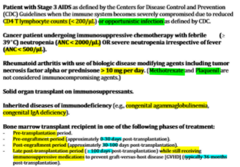
List 6 severely immunocompromised conditions that REQUIRE antibiotic prophylaxis before dental tx
1. Stage 3 AIDS
2. Cancer pt undergoing immunosuppressive chemo with febrile neutropenia OR severe neutropenia (irrespective of fever)
3. RA with use of biologic DMARDs (including tumor necrosis factor alpha or prednisone > 10 mg/day)--> Methotrexate or Plaquenil are NOT considered immunosuppressive agents
4. Solid organ transplant on immunosuppressants
5. Inherited diseases of immunodeficiency
6. Bone marrow transplant recipient (see image)