Recorded Lecture: Pulmonary Examination
 Call Kai
 Learn
Learn Practice Test
 Spaced Repetition
 Match
Match Flashcards
 Knowt Play
1/17

There's no tags or description
Looks like no tags are added yet.
Name | Mastery | Learn | Test | Matching | Spaced | Call with Kai | Chat |
|---|
No analytics yet
Send a link to your students to track their progress
18 Terms
Describe all the lung volumes.
Inspiratory reserve volume - ~5-6x TV, deep inhale fill lungs w/ air, inspired OVER AND ABOVE TV
Tidal volume - normal, relaxed breathing
Expiratory reserve volume - ~2-3x TV, deep exhale let air out, expired OVER TV
Residual volume - air reserve so lungs stay inflated, always present
Functional reserve capacity = ERV + RV, air remaining in lungs after normal expiration
Inspiratory capacity = TV + IRV, max you can inspire
Vital capacity = IRV + TV + ERV, total amount that can be expired after fully inhaling, varies w/ age and body size, decreases w/ aquatic therapy
Total lung capacity = IRV + TV + ERV + RV, max amount of air that can fill the lungs
Describe how obstructive and restrictive conditions affect lung volumes.
Obstructive
Increased: TV*, FRC, RV, TLC
Decreased: IC, IRV, ERV, VC, FEV1, FVC
Restrictive
Decreased: TV, IC, IRV, ERV, VC, FRC, RV, TLC, FVC
Normal: FEV1
What are examples of obstructive vs restrictive lung conditions?
Obstructive - hyperinflated, chronic hypoventilation, hard to get air out “CBABE”, slower exhalation, holding onto more CO2
Cystic fibrosis (sometimes)
Bronchitis, chronic
Asthma
Bronchiectasis
Emphysema
Restrictive - hard to get air in
Sarcoidosis, lung fibrosis, ankylosing spondylitis, obesity, burns, pneumonia, pneumothorax, hemothorax, pulmonary effusion, pregnancy
Describe the gold classification FEV1/FVC, FEV1, and symptoms at each stage of COPD.
Mild COPD
FEV1/FVC: <70%
FEV1: >80%
Sx: w/ or w/o production of cough and sputum
Moderate COPD
FEV1/FVC: <70%
FEV1: 50-80%
Sx: SOB w/ exertion, w/ or w/o production of cough and sputum
Severe COPD
FEV1/FVC: <70%
FEV1: 30-50%
Sx: greater SOB w/ exercise, decreased exercise capacity, fatigue and repeated exacerbation of disease
Very severe COPD
FEV1/FVC: <70%
FEV1: <30% OR <50% w/ chronic resp failure
Sx: respiratory failure, signs of R HF/cor pulmonale
What FEV1/FVC is required to diagnose COPD?
<70%
If a patient has a weak, wet cough, what is the best way to clear secretions?
Huffing
Describe the 4 normal breath sounds, the duration, intensity, pitch of expiratory, and location.
Vesicular
Insp longer
Soft intensity
Low pitch
Over most of lungs
Broncho-vesicular
Insp & exp equal
Intermediate intensity
Intermediate pitch
Between 1st & 2nd IC anteriorly & between the scapulae
Bronchial
Exp longer
Loud intensity
High pitch
Over manubrium
Tracheal
Insp & exp equal
Very loud intensity
Relatively high pitch
Over trachea in the neck
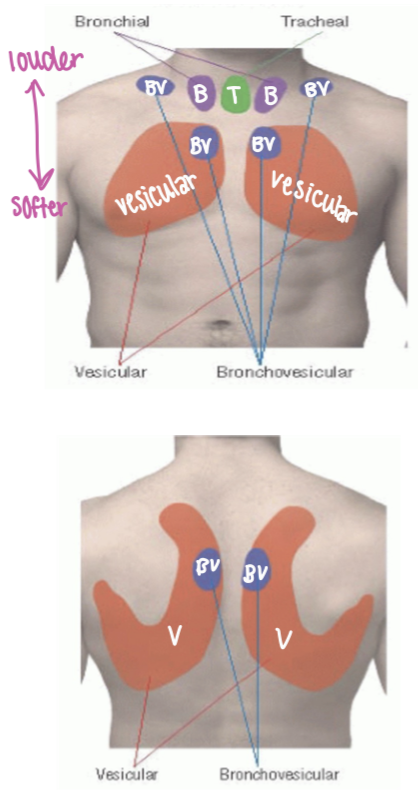
Describe the 4 abnormal respiratory sounds.
Rhonchi - continuous, low pitched, rattling lung sounds that often resemble snoring. They can be heard in pts w/ COPD, bronchiectasis, pneumonia, CB, or CF (obstructive)
Wheeze - high-pitched sound heard in expiration, caused by airway obstruction (asthma, COPD, aspiration of foreign body); if severe → inspiration too
Crackles - brief, discontinuous, popping lung sounds that are high-pitched. Previously termed rales, heard in insp & exp
Pleural rub - auscultation in the lower lateral chest areas, occurs w/ insp & exp, indication of pleural inflammation, sounds like sandpaper
What breath sound is associated with CHF? Heart sound?
Crackles - high pitched, discontinuous, heard in insp, indicate pulmonary edema associated w/ L side HF, fluid overload
S3
Describe the 3 voice sounds.
Bronchophony - increased vocal resonance w/ greater clarity and loudness i.e. 99
Muffled/quiet = normal
Loud = abnormal
Egophony - form of bronchophony where long “E” sounds change to a long “A” sound
E sounds like E = normal
E sounds like A = abnormal
Whispered pectoriloquy - increased loudness of whispering i.e. 1,2,3
Muffled/quiet = normal
Loud/clear = abnormal
If a patient’s E sounds like an A, what condition does this indicate?
Pneumonia - fluid, secretions, more sound transmission
Describe the acidic, normal, and alkaline ABGs.
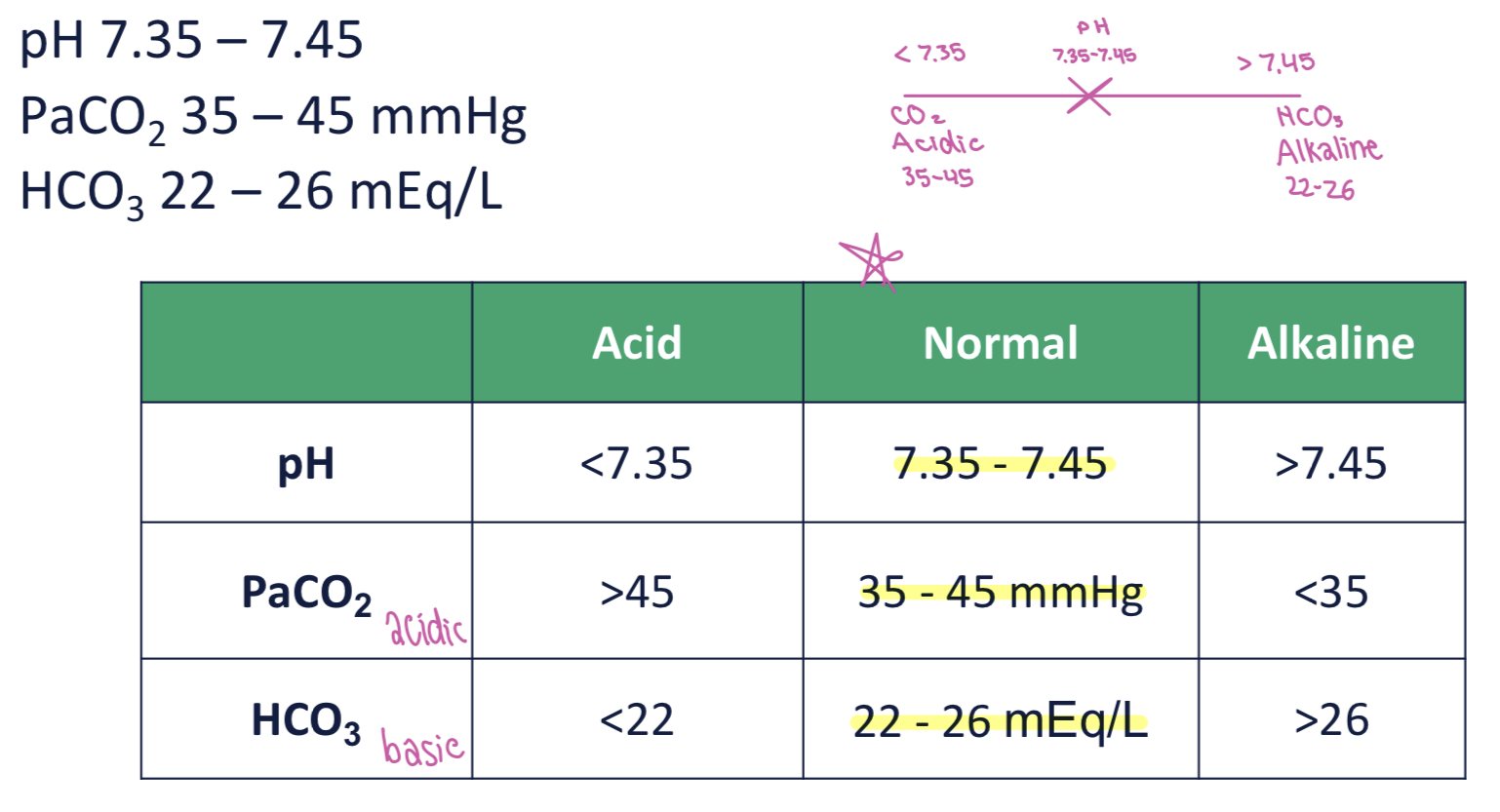
Describe the changes in pH, PaCO2, and HCO3 during uncompensated respiratory/metabolic acidosis/alkalosis. Mneumonic?
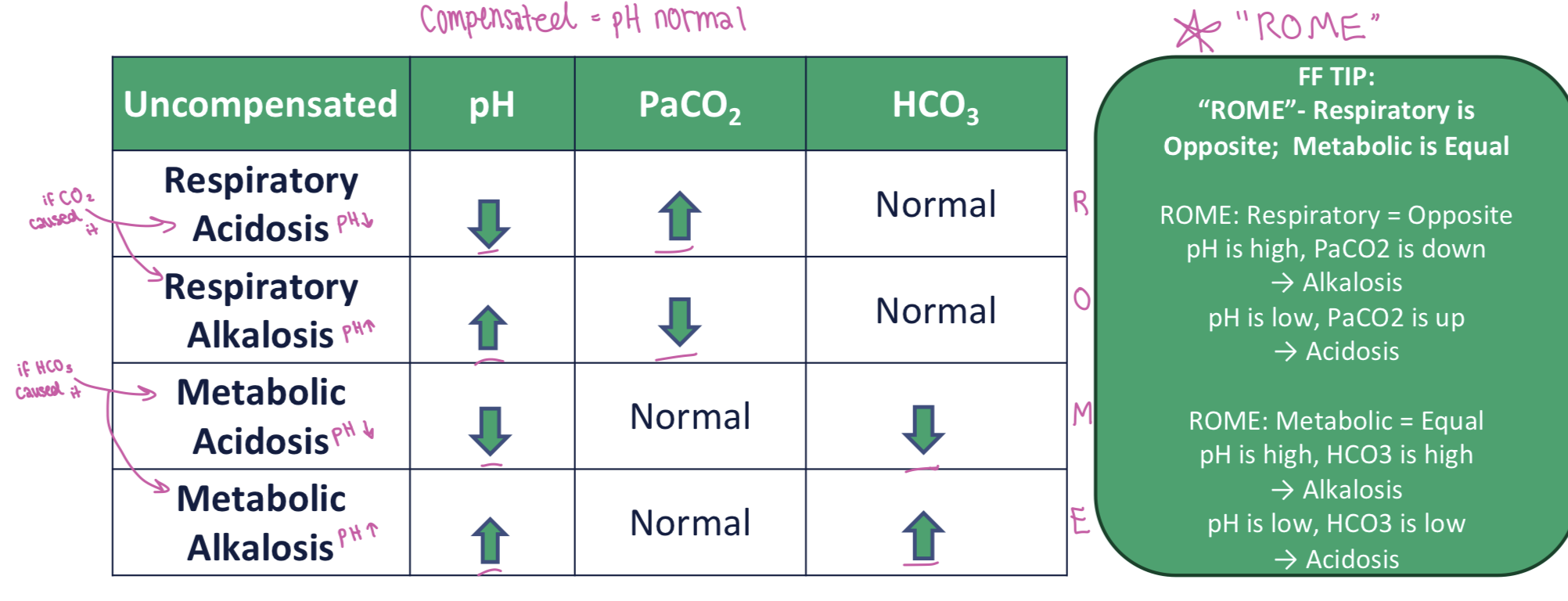
If pH, PaCO2, and HCO3 are all abnormal what does this mean?
Partially compensated
If HCO3 is normal what does this mean?
Respiratory condition, uncompensated if pH abnormal
If PaCO2 is normal what does this mean?
Metabolic condition, uncompensated if pH abnormal
If pH is normal what does this mean?
Fully compensated
Describe the sxs of respiratory/metabolic acidosis/alkalosis. Mneumonics?
Respiratory acidosis: CARBS confused
Confused
Agitation
Restlessness
Blurred vision
Seizures
Respiratory alkalosis: NO CARDS bp, anxious
Numbness
OTH
Confusion
Anxiety
Rapid breathing
Dizziness
Seizures
Metabolic acidosis: SHAMED heart
Stupor (decreased consciousness)
Hyperkalemia
Arrhythmia
Muscle twitching
Emesis
Decreased CO
Metabolic alkalosis: QUAD T nerves & heart
Tingling
Tremor
Tetany
Tachy