Chemsitry - 3.1.3 Bonding
 Call Kai
 Learn
Learn Practice Test
 Spaced Repetition
 Match
Match Flashcards
 Knowt Play
1/36

There's no tags or description
Looks like no tags are added yet.
Name | Mastery | Learn | Test | Matching | Spaced | Call with Kai | Chat |
|---|
No analytics yet
Send a link to your students to track their progress
37 Terms
Define what an ionic bond is and what is it caused by
a bonding between a metal and a non-metal due to the electrostatic force of attraction between oppositely charged ions formed by electron transfer
Give examples of ionic compounds
sodium chloride
calcium sulfide
lead nitride
aluminium iodide
Explain why an ionic compound is a solid at room temperature/ has high m.p and b.p.
it is a giant ionic lattice structure
which has strong electrostatic forces of attraction between oppositely charged ions
in all directions
that require lots of energy to overcome
Explain why ionic compounds can only conduct electricity when molten and not when solid
when solid the ions are held in a fixed position and so are not free, thus cannot move around and carry electric charge
when motlen the ions are free to move and carry electrical charge
Explain why ionic compounds are brittle and shatter easily
when a force / stress is applied ions of the same charge are brought side by side and so repel each other as like charges repel
What is the difference in strength of the ionic bond and the melting point between magnesium oxide and sodium chloride
Ionic bonding is stronger and the melting points higher when the ions are smaller and/ or have higher charges.
E.g. MgO has a higher melting point than NaCl as the ions involved (Mg2+& O2- are smaller and have higher charges than those in NaCl , Na+& Cl- )
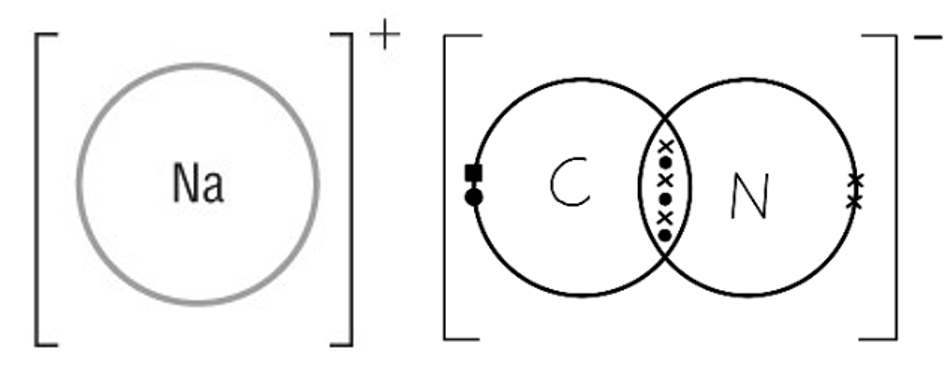
Draw the dot and cross diagram for sodium cyanide (NaCN)
Draw the dot and cross diagram for lithium hydroxide (LiOH)

Write down the charge of the following ions
hydrogen
lithium
sodium
potassium
silver
magnesium
calcium
zinc
lead
copper(II)
iron (II)
iron (III)
aluminium
fluoride
chloride
oxide
sulfide
nitride
hydroxide
nitrite
nitrate
hydrogencarbonate
hydrogen sulfate
cyanide
sulfate
sulfite
carbonate
phosphate
ammonium
hydronium

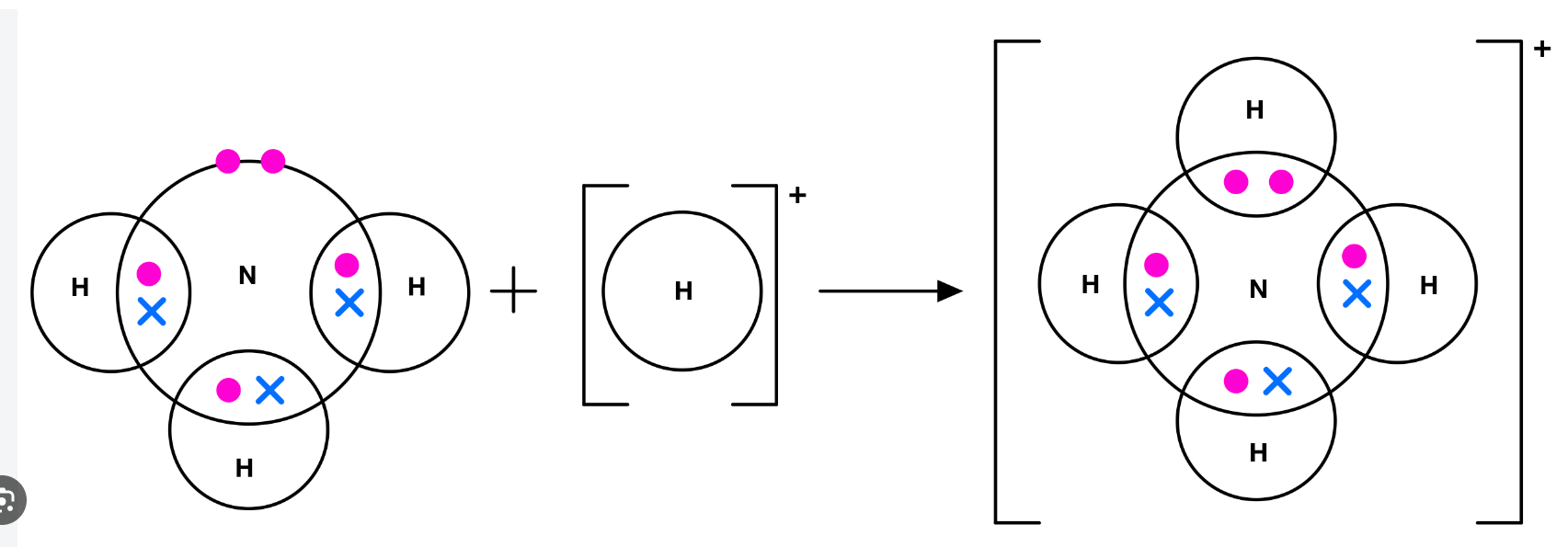
What is a covalent bond and what is a dative covalent bond? give and draw an example
covalent bond - a shared pair of electrons
dative /co-ordiante bond - contains a shared pair of electrons with both electrons donated by one atom. e.g the ammonium ion
The ion H2F+ is formed when hydrogen fluoride gains a proton as shown in the equation
HF + H+ → H2F+
Name the type of bond formed when HF reacts with H+ Explain how this bond is formed.
dative covalent bond
the fluorine atom in HF donates a pair of electrons to the electron deficient H+ ion
What are alloptropes of carbon, give examples?
allotrope - a different structural form of the same element in the same physical shape
diamond
graphite
graphene
State and and explain the structure and properties of diamond
giant covalent structure (macromolecular)
each carbon atom is covalently bonded to 4 other carbon atoms —→ has strong covalent bonds which require lots of energy to overcome hence has a high melting point
has many strong covalent bonds and so is hard
does not conduct electrcity —→ no delocalised electrons present to move through the structure and carry electric charge
tetrahedral structure —→ the bond angle about each atom is 109.5 degrees
State and and explain the structure and properties of graphite
giant covalent structure (macromolecular)
each carbon atom is covalently bonded to 3 other carbon atoms —→ has strong covalent bonds that require lots of energy to overcome hence has a high m.p. point
can conduct electricity —→ due to the presence of one delocalised electron per carbon atom that can move through the structure and carry electric charge
soft and slippery, used as a lubricant —→ arranged in layers that have weak van Der Waal forces between the layers and so can slide past one another
trigonal planar structure - the bond angle about each atom is 120 degrees
Describe the structure and bonding in graphite and explain why the melting point in graphite is so high
a gaint covalent structure
carbon atoms are arranged in layers
which are connected by covalent bonds (within each layer)
van der waal forces are present between layers
there are many covalent bonds that need to be broken
State and explain the structure and properties of silicon dioxide
giant covalent structure (macromolecular)
each silicon atom is covalently bonded to 4 oxygen atoms, and each oxygen atom is covalently bonded to 2 silicon atoms
has a high m.p. —→ due to the presence of many covalent bonds
What is a metallic bonding? and state the block in which metals are found
found in metals due to the strong electrostatic force of attraction between the positive ions and the negative sea of delocalised electrons
metals are found in the d-block
Explain why nickel has a high melting point, refer to structure and bonding
a giant metallic structure
whereby there is a strong electrostatic force of attraction between the positive metal ions and the negative sea of delocalised electrons
hence requires a lot of energy to overcome
Explain why metals are ductile (can be stretched into wires) or malleable
positive metal are identical and so ions are arranged in layers that can slide past each other
Explain the difference in melting point between Na and Mg
Magnesium ions has a higher charge of +2 compared to Na of +1
Magnesium has more electrons
thus magnesium has a greater electrostatic force of attraction between the positive ion and electrons
hence requires more energy to overcome
State the four crystal structures and give examples of each
ionic - sodium chloride / sodium nitride
giant covalent (macromolecular) - diamond / graphite
metallic - aluminium / gallium
molecular - iodine
State the forces or bonds found in each crystal structure
ionic - electrostatic force of attraction between oppositely charged ions
giant covalent - covalent bonds (in diamond and graphite) / van der waal forces between the layers in graphite
metallic - electrostatic force of attraction between the positive metal ions and the negative sea of electrons
molecular - weak van der waal forces between molecules so are easily broken
Define the term electronegativity
the relative ability for an atom to attract the bonding pair of electrons in a covalent bond
Describe and explain the trend of electronegativity in the periodic table as you go across a period
As you go across a period (from left to right), electronegativity increases
this is because the nuclear charge (number of protons) increases
but the shielding remains constant, yet the number of electrons on the outer shell increases
therefore a smaller atomic radius = so bonding electrons are closer to the nucleus
smaller atomic radius have less electron shielding
less shielding = stronger attraction between nucleus and bonding pair of electrons
therefore smaller atoms have a higher elctronegativity
Describe and explain the trend of electronegativity in the periodic table as you go down a group
as you go down a group the atoms become bigger due to more electrons and so have fewer bonding electrons that are closer to the nucleus
larger atoms have greater electron shielding
greater electron shielding = weaker attraction between nucleus and bonding pair of electrons
therefore bigger atoms have a lower electronegativity
How is a polar covalent bond produced?
The distribution of electron density in a covalent bond between elements with different electronegativities will be unsymmetrical —→ this causes a polar covalent bond
Explain why the C–Cl bond is polar. [2]
Chlorine has a higher electronegativity (than carbon)
so chlorine becomes δ- and carbon becomes δ+
Explain why the O-H bond in a methanol molecule is polar
oxygen is delta negative whilst hydrogen is delta positive
this causes electron density arround oxygen resulting in an unsymmetrical molecule
State the difference between a polar and non-polar molecule
polar molecules:
Polar molecules have a permanent dipole.
Polar molecules are asymmetrical and have a bond where there is a significant difference in electronegativity between the atoms.
non-polar molecules:
A symmetrical molecule will not be polar even if individual bonds within the molecular are polar.
The individual dipoles on the bonds ‘cancel out’ due to the symmetrical shape of the molecule. There is no net dipole moment: the molecule is non-polar
State the three types of intermolecular forces and state which one is the strongest and which one is the weakest
van der waal forces (also known as induced dipole-dipole or London or dispersion forces)
hydrogen bonding
permanent dipole-dipole
strongest - hydrogen bonding
weakest - van der waal forces
what is meant by the term permanent dipole?
polar molecules have permanent dipoles
when a molecule has a δ+ region and a δ- region, this creates a polar molecule
the δ+ end of a molecule is attracted to the δ- of another molecule
There are van der Waals forces between non-polar molecules.
Explain what causes these forces.
there is a random movement of electrons in one molecule which creates a dipole
this induces a dipole in another molecule
Thus there is a temporary attraction between δ+ and δ- in different molecules
Describe and explain hydrogen bonding
a type of permanent dipole-dipole force
which is the attraction between the lone pair of electrons on either a O,N,F atom and δ+ H of OH on another molecule
Suggest, in terms of the intermolecular forces for each compound, why CBr4 has a higher boiling point than CHBr3 (3)
CBr4 has van Der Waal forces
CHBr3 has van Der Waal forces and permanent dipole-dipole forces
yet the van Der Waal forces in CBr4 are stronger than the combined van Der Waal and permanent dipole dipole forces in CHBr3
hence requires more energy to break
What is the shape and angle between atoms where the central atom is bonded to two atoms with no lone pairs? give examples
a linear shape
bond angle is 180o
examples: carbon dioxide CO2, berrylium chloride BeCl2

What is the shape and angle between atoms where the central atom is bonded to three atoms with no lone pairs? give examples
a trigonal planar shape
bond angle is 120o
examples - boron triflouride BF3

What is the shape and angle between atoms where the central atom is bonded to three atoms with no lone pairs? give examples
tetrahedral shape
bond angle is 109.5o
examples - methane CH4
