reactivity 2.3 YUH HOWFAR the extent of chem change
 Call Kai
 Learn
Learn Practice Test
 Spaced Repetition
 Match
Match Flashcards
 Knowt Play
1/22

There's no tags or description
Looks like no tags are added yet.
Name | Mastery | Learn | Test | Matching | Spaced | Call with Kai | Chat |
|---|
No analytics yet
Send a link to your students to track their progress
23 Terms
describe reversible reaciton in one sentence
reaciton where it proceeds in both forward and backword directions, will not go the completion → product can form reactants, reactants can form back products
give an example of physical system characteristic → 1 state change example + 1 equation
in a closed system, the rate of condensation and evaporation is EQUAL → the system is at equilibrium
H2(l) ⇌ H2(g)
given this example of chemical system equilibrium, draw/describe how the graphs should look like for each + state 1 characteristic
(a) H2 + I2 ⇌ 2HI
(b) 2HI ⇌ H2 + I2
at equilibrium, HI, H2 and I2 are all constant,
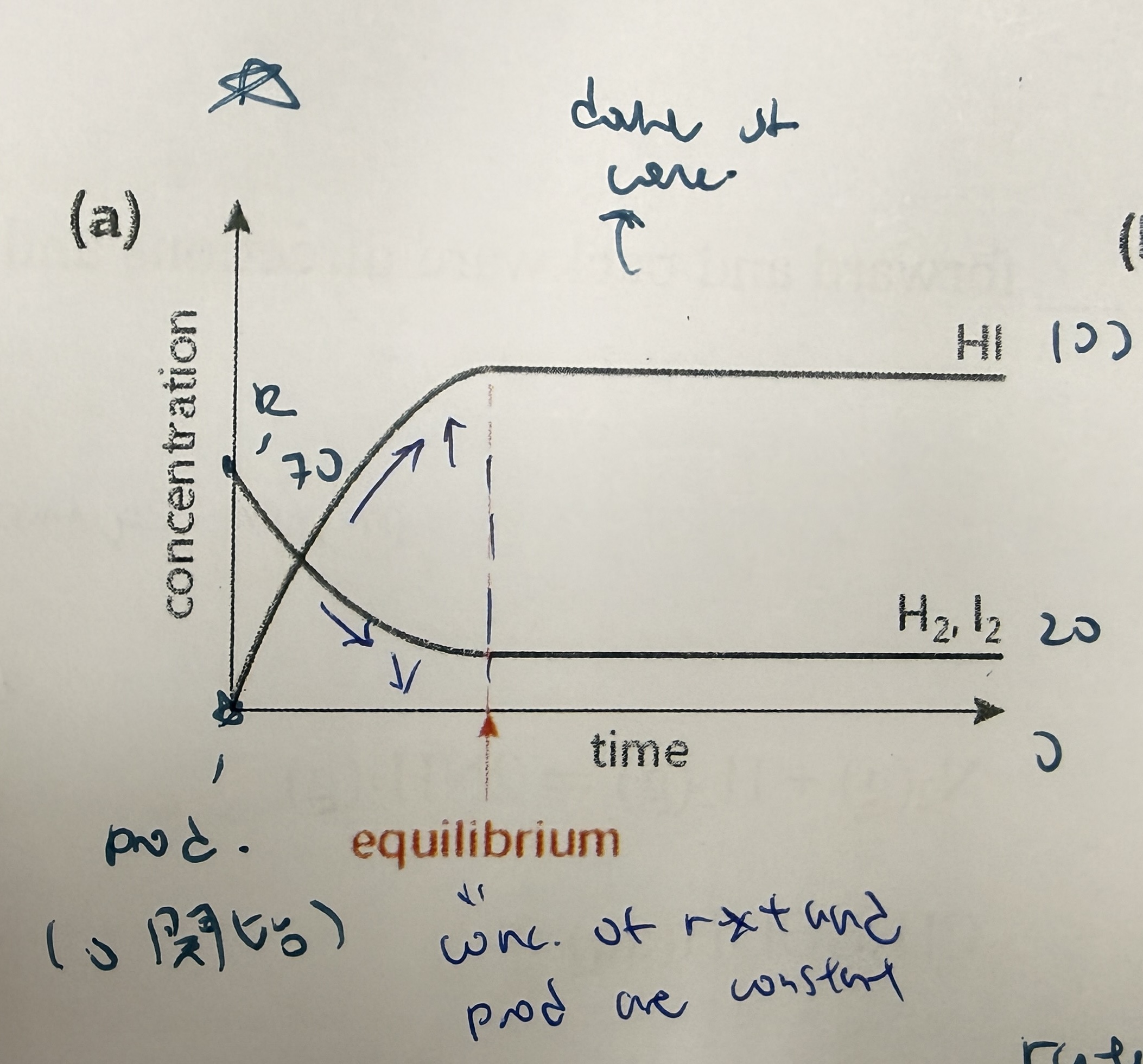
STATE the characteristics of a system in dynamic equilibrium: when a state of eqiulibrium is reached in a closed system (3)
at equilibrium the rate of forward and reverse reaction are equal
the concentration of reactants and products remain constant
no change in microscopic properties (aka no change in physical stuff like pH or colour)
state the law of equilibrium
states that at a given temperature the ratio of the concentration of products to the concentration of reactants (aka PRODUCT OVER REACTANT BRUH)
STATE THE equation used in determining the product over reactant thing
aA + bB ⇌ cC + dD
[C]c [D]d / [A]a [B]b
what do u need to do if its K for inverse relation? and what do u need to do if its K for multiple reaction?
2 RULES:
inverse: 1/K
IF ANY change in coefficient → halved? ROOT it, doubled? SQUARE IT. eaz
position in equilibrium: waht happens in very high value and high high dei geh value
extreme high value of K → lies on the right, reaciton goes to completion, a LOT more products than reactants
higher value of K → lies on right, products concentration is proportionately MORE than reactants
continuing.. SMALL ASS value of K vs small small dei geh value of K
VERY SMALL value → forward reaction can hardly proceed Reactants are holy more proportionately GREATER than products
small small dei → reactants are proportionately greater than prodcuts, lies on the left of the graph
how does value of K relate to acids? (strong? weak?)
weak acids → low values of K, very little dissociation
strong acids → high values of K, dissociation TO LARGE EXTENT
phrase that mr shaiq’s always says/aka the Le Chatelier’s principle
a system at equilibirum when subjected to change will respond in a way that minimizes the effect of the change
AKA: whatever we do to a system at equilibrium, it responds in the opposite way.
identify the factors that could affect the reaction’s equilbiurm or even K (3) + the thing that lowers the Ea
concentration
pressure/volume → inverse relation
temperature
catalyst
explain what happens if there is 1. increase in concentration of reactant 2. decrease concentration of reactant (3 small points each)
increase in reactant conc.
increase in reactant → system decreases, as a result, → reactant decreases while increases products
shifts the equilibrium to the right, favours the forward reaction/products
greater proportion of products compared to reactants
BUT K WILL NOT CHANGE
decrease in reactant conc.
decrease in reactant → system increases → increase in reactant, decrease in product
equilibirum shifts to the left, favouors reactant reverse reaction
greater proportion of reactant compared to products
AGAIN, K WILL NOT CHANGE
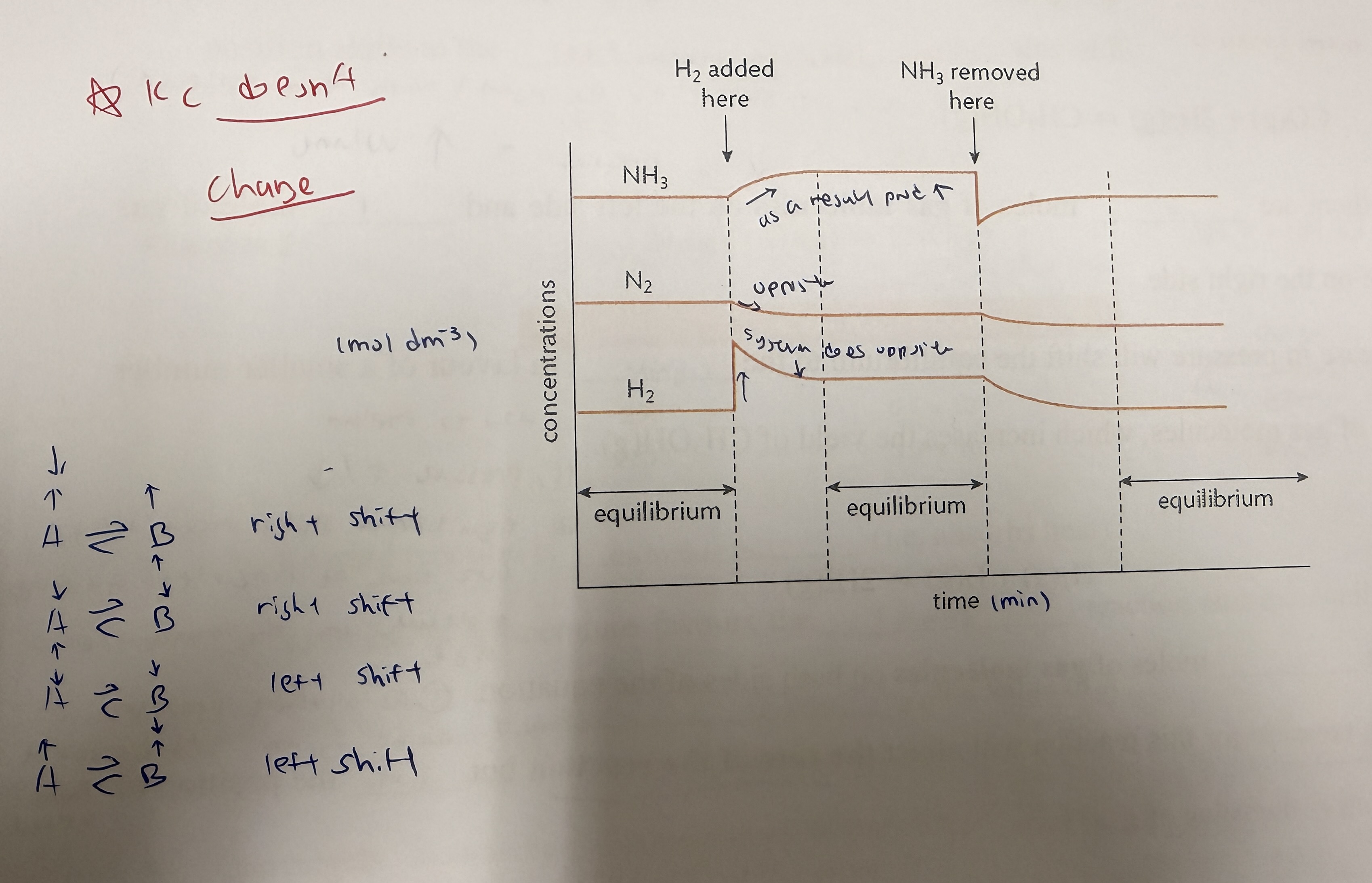
can you like describe what is happneing in this graph.
what are the 2 factors that can affect pressure
adding/removing a reactant/product → increase reactant? Increase particles → increase pressure
changing volume → increase volume = decrease pressure, vice versa
describe what happens to reaction’s equilibiurm and K if there is 1. increase in pressure 2. decrease in pressure 3. what happens if the moles of product side and reactant side are the same
increase in pressure
increase in pressure → favours the side with less number of moles of gas molecules, if the the reactant side have less moles of gas, then this favours the forward reaction and product side
decrease in pressure
decrease in pressure → favours the side with more number of moles of gas molecules, if the reactant side have less numbe of moles of gas, then this favours reverse reaction and reactant side
same no. of moles for both side
change in pressure will affect rate of reaction, but there is NO EFFEECT ON EQUILIBIURM NOR THE K
how does change in temperature affect the reaction, value of K and equilibiurm? 1. increase of temp? 2. decrease in temp?
decrease of temperature:
forward reaction is exothermic, a decrease in temperature favours the forward reaction, hence the equilibium shifts to the right and since there will be increase of concentraiton of product and decrease conc. of reactants → [product](increase)/[rxt](decrease), the overall change in value of K will be INCREASED
increase of temperature:
reverse reaction is endothermic, an increase of temperature favours the reverse reaction and the reactant side, so the equilibrium shifts to the left, hence the value of K decreases
what does a catalyst do, what does it not do
do: catalyst decreases the activation energy by the same amount for forward and backward reacitons
don’t: since decreaes for both forward and reverse reaction, no change in equilibiurm or k
How to calculate Q?
using the same way when calculating k.
list the steps when calculating the equilibrium constant from initial and equilibrium concentrations
balance the equaiton
do the ICE table
find Kc frombalanced equation, substitude values..
what happens when K is very small, sth like 1.67 × 10-67
the concentration is gonna be approximately NO CHANGE so just keep it in the way it is.
which direction doe sthe reaction proceed if the Gibbs free energy is prositive, negative or equal to 0?
Gibbs = positive → reaction proceeds backwards (reactant increase, product decrease)
Gibbs = negative → reaction proceeds forward (product increase, reactant decrease)
Gibbs = 0 → at equilibrium
relationship between delta G and lnK/K: positive G, negative G, G=0
THINK about the Delta G=-RTlnK equation about the positive or negative relationships
negative G = positive K (K>1)
positive G = negative K (K<1)
G = 0 = K = 1 at equilibrium