Bio Lab 1
 Call Kai
 Learn
Learn Practice Test
 Spaced Repetition
 Match
Match Flashcards
 Knowt Play
1/66

There's no tags or description
Looks like no tags are added yet.
Name | Mastery | Learn | Test | Matching | Spaced | Call with Kai | Chat |
|---|
No analytics yet
Send a link to your students to track their progress
67 Terms
Why are bacterial smears heat-fixed prior to staining? ( Multiple answers)
To prevent contamination
To keep bacterial cell shape
To prevent bacteria from distortion
To kill bacteria
To attach bacteria to the slide
To revive bacteria
To kill bacteria
To attach bacteria to the slide
A Gram-positive organism stains what color
Yellow
Purple
Green
Pink
Red
Purple
The function of the mordant in the Gram stain is to combine crystal violet , forming a large complex that will more likely be retained in gram ___ bacterial cell walls than gram ____ bacterial cell walls during decolorization.
Positive
Negative

A Simple Stain that stains the bacteria is called direct stain. What is the name of the simple stain procedure that stains the background of the slide and leaves the organism unstained as shown in the image below?
Gram Stain
Flagella Stain
Background Stain
Negative Stain
Endospore Stain
Positive Stain
Negative Stain
Staining of the bacterial capsule cannot be accomplished by ordinary staining procedures because..
A. capsules are non-ionic and therefore won’t take up stain
B. capsules are shrunken or destroyed by high heat
C. capsules are made of numerous layers of peptidoglycin and are therefore resistant to take up stain.
A and B are true
A, B and C are true
A and B are true
The capsule staining procedure involves both ___ staining which stains the bacterial cell and ___ staining which stains the background. The ___ then appears as an unstained halo around the cell.
Positive staining
Negative staining
Capsule
Match the 4 steps to the chemicals or dyes used in the Gram stain procedure.
Primary Stain
Mordant
Decolorizer
Counterstain
Primary Stain - Crystal Violet
Mordant - Grams Iodine
Decolorizer - Ethyl Alcohol
Counterstain - Safranin
Primary dye for the Spore Staining is ____ and Counterstain is ____.
Malachite Green
Safranin

In the picture below round-shaped bacteria (cocci) are gram ___ and rod-shaped bacteria (bacilli) are gram ___.
Positive
Negative
( image color purple)

An acid fast bacterium stains a ___ color and a non-acid fast organism stains a ___ color.
Pink
Blue
( bright pink/red)
When performing a streak plate you should incinerate your loop between each section.
True
False
True
Endospores are extremely resistant to taking up stain, ___ is used in staining procedure to help drive stain into the endospore.
Water
Force
Vigorous smearing
Heat
Methanol fixation
Heat
___ involves the insertion of a gene into an organism’s genome in order to change the organism’s trait.
DNA mutation
Protein transformation
Genetic transformation
Species evolution
Genetic transformation
In pGLO transformation lab, a small circular piece of DNA that naturally occurs in bacteria was used as a vector to move genes from one organism to another. What is the name of this naturally occuring piece of extra chromosomal DNA?
Transformer
Transcript
Chromosome
Gene
Plasmid
Plasmid

Shown below is the setup of the transformation expirement. Indicate on each plate below what the results would be from a successful transformation.
WG
NG
WG
GG
Simple stains are commonly used to determine:
Cell size, arrangement, and gram reaction.
Cell size, arrangement, & presence of endospores.
Cells size, shape, and arrangement only.
Cell size, shape, arrangement, and presence of a capsule.
Cell size, shape, and arrangement only.
What is the function of the “streak plate” method? Why can’t bacteria be identified/tested directly from a broth?
The function is to get isolated colonies of bacteria; there are too many bacteria in the broth.
The function is to get isolated colonies of bacteria; one cannot tell if a broth contains a pure culture or if it is mixed/contaminated.
The function is to dilute out the bacterial until no growth is observed; there are too many bacteria in the broth.
The function is to dilute out the bacteria until no growth is observed; one cannot tell if a broth contains a pure culture or if it is mixed/contaminated.
The function is to get isolated colonies of bacteria; one cannot tell if a broth contains a pure or if it is mixed/contaminated.
The gene for GFP in the pGLO plasmid can be switch on in transformed cells by adding ___ to agar media.
Arabinose
Magic potion
UV light
Glucose
Antibiotics
Arabinose
Observe the image below, point “A” in the image showing a halo is pointing ___ and point “B” in the image (stained) is pointing to ___.
Capsule
Bacterial cell
The E. coli bacterium is naturally competent to uptake DNA.
True
False
False
In Endospore staining, after the decolonizing step, the endospores will be ___ in color while the bacterial cells will be ___ color.
Green
Colorless

Assume you stain bacillus by applying primary stain with heat which stains green and then counterstaining with dye which stains red. Through the microscope, the green structures in the image marked as “A” is (are) ___ and the red structures in the image marked as “B” is (are) ___.
Endospores
Vegetative cells
A student is looking at a bacterial specimen using the oil immersion lens but has forgotten to put immersion oil on the slide. The specimen will appear.
The same as it would if the immersion oil was used.
Smaller than it would if immersion oil was used.
Somewhat fuzzy and have poor resolution.
Larger than it would if immersion oil was used.
To have no color.
Somewhat fuzzy and have poor resolution.
Which of the following is not true regarding the acid-fast stain?
Non-acid fast microbes appear blue in a completed acid-fast stain.
Acid-fast cells appear red/pink in a completed acid-fast stain.
Acid-fast cells retain the primary dye after treatment with acid-alcohol.
Acid-fast cells will lose the primary dye after treatment with acid-alcohol.
Acid-fast cells will lose the primary dye after treatment with acid-alcohol.
Which of the following are the correct reasons for incubating the petri plates upside down? (Multiple answers)
To prevent bacteria from growing on the lid
To prevent condensation from directly falling on the bacterial colonies which could cause contamination from the lid.
Only fungal plates are incubated upside down.
To prevent colonies from mixing with each other due to moisture which interferes with colony counting or isolation.
To prevent condensation from directly falling on the bacterial colonies which could cause contamination from the lid.
To prevent colonies from mixing with each other due to moisture which interferes with colony counting or isolation.
Name the part of the microscope colored orange ocular lens. Name the part of the microscope that is colored blue object lens. Name the part of the microscope that is colored yellow course focus. Name the part of the microscope that is colored green iris diagram.
Ocular lens
Objective lens
Coarse focus
Iris diaphragm
Oil can be used on both the 40x and. -00x objectives.
True
False
False
Which in the micro lab, you are required to follow lab safety guidelines all the time. Which of the following lab safety rules are NOT to be followed.
You are always required to wear fives while working with bacteria.
Always clean your work with bleach and wash your hand when entering and leaving the lab.
Always knew your books and backpacks in the assigned cubicles and not on the bench tops.
When working with bacterial cultures for preparing slides you can have microscopes out and can use them at the same time, this will save you time.
You are always required to report all accidental cuts, burns, broken culture tubes, spilled culture et
Eating and drinking is allowed in the lab as along as open cultures are not in the bench top.
when working with bacterial cultures for preparing slides you can have microscopes out and can use them at the same time, this will save you time.
Eating and drinking is allowed in the lab as long as open cultures are not on the bench top.
If you happen to spill a bacterial culture on the floor during lab, which of the following in lab safety rules are NOT correct while following the steps for cleaning?
Immediately cover the spilled culture with disinfectant and paper towels.
You do not have to notify your instructor/lab IA
The paper towels and disinfectant over the spilled culture should be let to sit for at least 15 mins.
You dispose the paper towels over the spilled culture into a regular trash can.
Steps 1, 3 should not be followed
Only step 4 should not be followed
Only step 2 should not be followed
Steps 2, 4 should not be followed.
Steps 2, 4 should not be followed.
You are working with a culture of BSL-2 bacteria. What is NOT appropriate PPE for working with this biosafety level?
Gloves
Closed to shoes
Goggles
lab coat fully bottomed with sleeves rolled up to just past your elbows
All hair tied back securely with no sections of hair falling near the face.
Pants or if wearing shorts lab coat should go to the knees.
Lab coat fully bottomed with sleeves rolled up to just past your elbows.
When focusing with high dry and oil lenses it is okay to use the course focus knob.
True
False
False
Most modern microscopes are Parfocal, that is, an object in view under one objective will still be in view under the other objectives
True
False
True
Match
Ocular lenses
Objectives
Iris diaphragm and condenser
Condenser knob
Fine focus knob
Coarse focus knob
Mechanical stage adjustment knobs
Ocular lenses- magnify the image, usually 10x
Objectives - magnify the image usually 4x, 10x, 40x and 100x
Iris diaphragm and condenser - focus and regulate the amt of light reaching the specimen.
Condenser knob - raises and lowers the condenser to focus light on the specimen.
Fine focus knob - slowly brings the specimen into sharp focus.
Coarse focus knob - rapidly brings the specimen into gen focus.
Mechanical stage adjustment knobs - move the slide L/R and forward/backward in the stage.

This image of E. Coli was taken using the 100x lens which is also the __ lens. The microscope had a 10x ocular and a 15x ocular camera was used. What is the total magnification.
Oil immersion
1500x
Dinoflagellates and diatoms are commonly known as as ___.
Mushrooms
Fungi
Mold
Tapeworms
Plankton
Plankton
Match
Cyst
Endospore
Dimorhic
Hyphae
Yeast
Trophazite
Cyst - a resistant dormant stage.
Endospore - a highly resistant dormant structure.
Dimorphic - a fungus able to exist in two forms.
Hyphae - long, thin, microscopic filaments.
Yeast - unicellular fungi that reproduce by budding.
Trophazite - the active feeding stage.

To what genus does this organism belong?
Saccharomyces
Plasmodium
Rhizopus
Penicillium
Coprinus
Penicillium
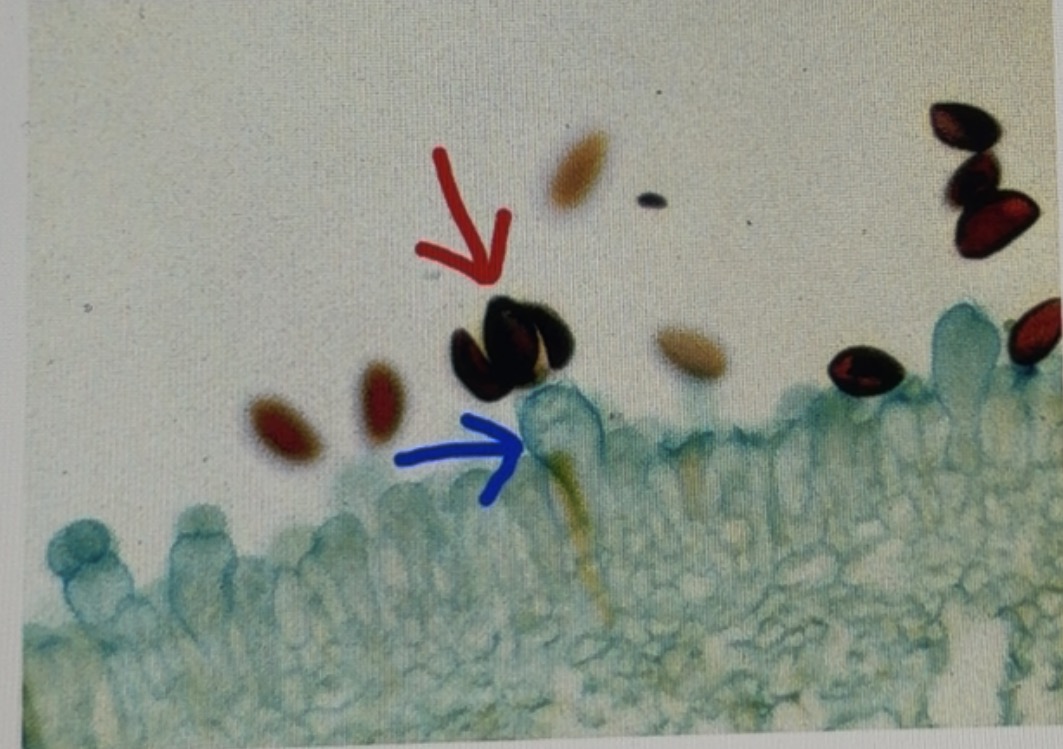
The red arrow is pointing to the ___ and the blue arrow is pointing to the ___. The common name of this organism is ___.
Basidiospores
Basidium
Mushroom

These organisms are found in aquatic environments, have cell walls made of silica, and are known as.
Fungi
Diatoms
Dinoflagellates
Archaea
Diatoms

Name the genus of this organism. ___ A is a trophozoite. B is a ___.
Giardia
Cyst

The common name of this worm is ___ and the structure at the end of the arrow is ___.
Hookworm
Teeth (cutting plate)

A is a/an erythrocyte an B is a/an ___. The disease caused by the organism is ___.
Erythrocyte
Plasmodium parasite
Malaria

This organism belongs to the kingdom ___ and the genus ___. A is pointing at ___ and B is pointing at tentacle.
Fungi
Rhizopus
Sporangium
Sporangiophore
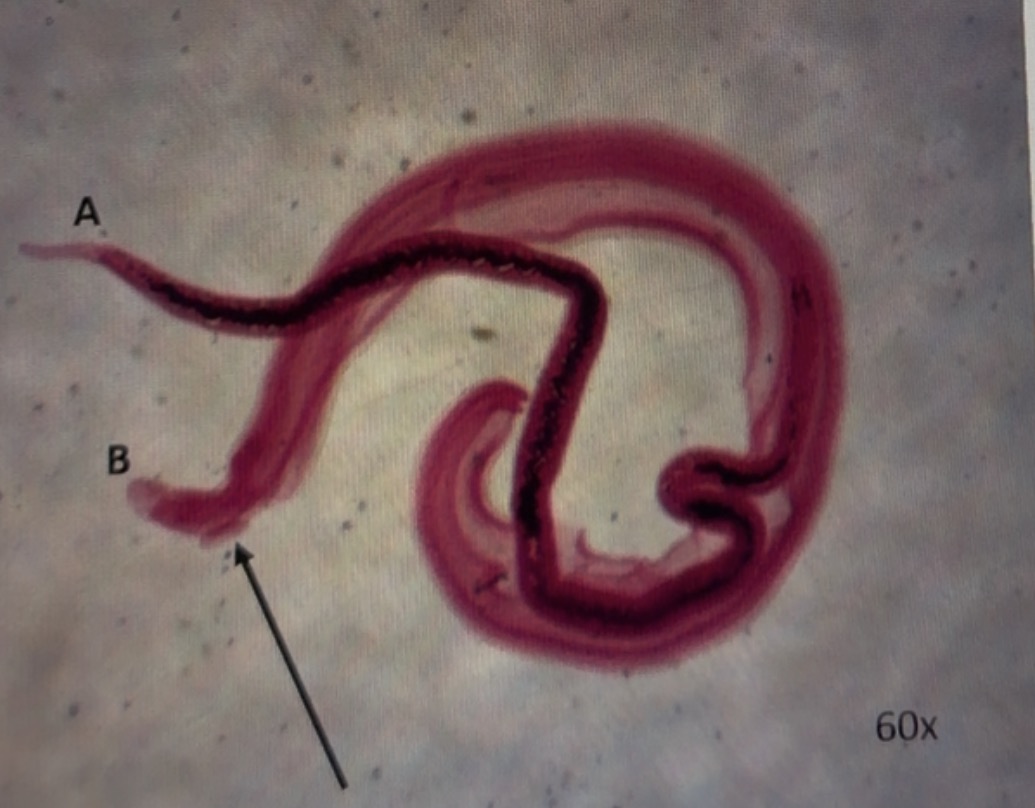
The female worm is ___. The male worm is A. The black arrow is pointing to the ___.
B
Vulva (Genital pore)

Name the genus of this organism___. These organisms are commonly known as ___.
Taenia
Tapeworm
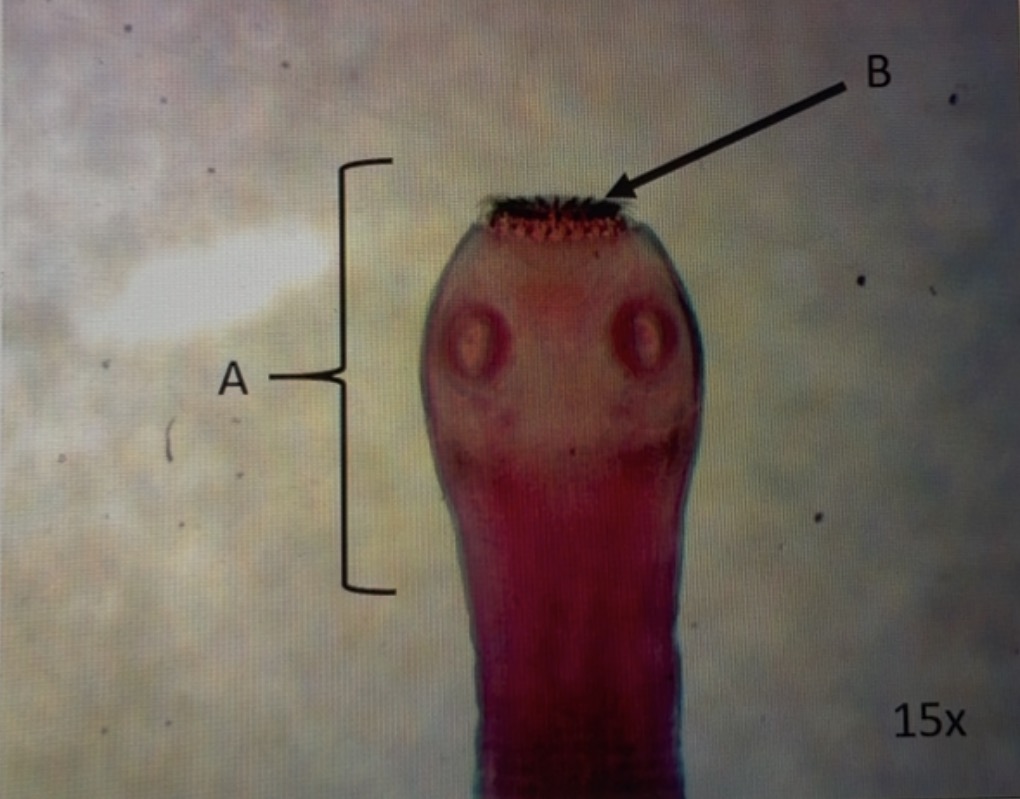
The structure indicated by the brackets “A”is the ___. The structure indicated by arrow “B” is ___.
Scolex
Hooks
What is a colony and how does a colony relate to a bacterial cell?
Of the same species.
Have some genetic identity.
Originate from the flow bacterial cells.
Just one microorganisms.
A group of microorganisms.
Originate from one bacterial cell.
Have different genetic identity due to mutations.
Of the different species.
Of the same species
Have the same genetic identity
A group of microorganisms
Originate from one bacterial cell

How many types of microbe colonies are present on each of the plates?
1
2
Crystal violet is a basic dye, it has a ___ charge and congo red is an acidic dye, it has a ___ charge. Since cell membranes have a slightly negative charge, ___ would stain the bacterial cell and ___ would stain the background.
Positive
Negative
Crystal violet
Congo red

Why do you sterilize the loop between streaking each quarter of the plate?
The bacteria needs to be warmed to boost growth.
To kill all bacteria on the plate.
To prevent and epidemic.
Reduce the number of bacteria in each starter of the plate.
Reduce the number of bacteria in each quarter of the plate.
What is the name for the technologies that must be followed when working with microorganisms in order to prevent the accidental or in arverted spread of microorganisms beyond the intended working environment? ___ technique.
Septic
Sterile
Safe
Aseptic
Proper
Aseptic
It’s okay to set caps and lids down while performing an aseptic technique.
True
False
False
Colony morphology refers to the colors and shapes of the bacteria that are seen when observing the bacteria through a microscope.
True
False
False
Under de-colorization would result in all bacteria appearing gram-negative and over-decolonization would result in all bacteria appearing gram-positive.
True
False
False
What type of paper only should you use to clean your microscope lenses?
Kimwipes
Lens paper
Paper towel
Kimtech
Lens paper
What is the function of the revolving nosepiece?
Is used to regulates to amount of light on the spicemen.
Is used to support the microscope when carried.
Holds the slide.
Holds the objectives, can be rotated to change magnification.
You look through to see the specimen.
Supports the slide being viewed.
Holds the objectives, can be rotated to change magnification.
The area that can be seen through the experience of a microscope is the ___.
Working distance
Magnification
Image
Field of view
Specimen
Aperture
Field of view
You have a specimen in focus, with the 10x objective, you now switch over to the 40x objective but the image is a little blurry, what do you need to do to get the image clearly focused?
Lower the condenser
Turn the light down
Use the fine focus knob
Switch back to the 10x objective
Switch to the 100x objective
Use the coarse focus knob
Use the fine focus knob
How long is the minimum recommended time for washing hands?
1 minute
Couple hours
30 seconds
10 seconds
20 seconds
20 seconds
Proper hand washing technique is not necessary when you simply get soap all over your hands.
True
False
False
When scraping bacteria using an inoculation loop/needle from a plate or slant, it is important to get as much bacteria as possible on the loop/needle in order to get a successful subculture transfer
True
False
False
Provide the reasons why the use of the aseptic technique is essential when handling microbial cultures in the laboratory. Mark all that apply.
So that no contaminants are introduced into cultures.
So that inoculated culture remains sterile.
So that individual performing the lab work does not contaminate themselves.
So that mixed cultures are never grown.
So that work environment remains sterile.
So that the individual performing the lab work does not contaminate their environment.
So that no contaminants are introduced into cultures.
So that the individual performing the lab work does not contaminate themselves.
So that the individual performance the lab work does not contaminate their environment.
One should hold tubes at an angle whenever the cap is off.
True
False
True
Why must the inoculating loop be cool before touching it to a culture? ___. Should you set in down to let it cool?__.
So I does not kill the culture
No
If you omit the Gram’s iodine step while performing the gram stain, Gram positive cells will most likely be ___ in color.
Red/pink
Green
Purple
Clear
Red/pink
How does the smear preparation of cells from a liquid medium differs from the preparation of cells from a solid medium?
Bacteria is first smeared onto the slide then water is added.
The bacteria is emulsified in a drop of water when taken from a solid medium, but not from a liquid medium.
Stain is applied to the cells in the culture tube and then they are applied to the slide.
A needle is used instead of an inoculating loop.
The bacteria is emulsified in a drop of water when taken from a solid medium, but not from a liquid medium.
Which lab was the most difficult for you? Explain
The most difficult lab for me was the Gram staining lab. It required several steps that had to be done carefully and in the correct order. I found it challenging to apply the stains for the right amount of time and avoid washing them off too much or too little. Interpreting the results under the microscope was also difficult because some cells did not stain as clearly as expected. This lab taught me the importance of following procedures closely and paying attention to details. Even though it was challenging, it helped me improve my microscope skills and better understand the differences between Gram-positive and Gram-negative bacteria.