Infection Prevention and Control
 Call Kai
 Learn
Learn Practice Test
 Spaced Repetition
 Match
Match Flashcards
 Knowt Play
1/63

There's no tags or description
Looks like no tags are added yet.
Name | Mastery | Learn | Test | Matching | Spaced | Call with Kai | Chat |
|---|
No analytics yet
Send a link to your students to track their progress
64 Terms
microorganisms
living organisms too small to be seen with the naked eye
mouth
upper respiratory tract
intestines
Specific permanent flora are found in:
Pathogenic microorganisms
microorganisms that are capable of causing/producing infection or disease by destroying cells or tissues, or secreting toxins.
can be transmitted from one host to another
antisepsis
is a practice that inhibit the growth of pathogenic microorganisms
medical asepsis
reduces the likelihood of transferring pathogenic microorganisms to a vulnerable individual
destruction of bacteria through the use of disinfectants/antiseptics
disinfection
The destruction of pathogens through the use of chemical materials
hydrogen peroxide
chlorine
iodine
chlorhexidine
formaldehyde
Examples of disinfectants:
Surgical asepsis (sterilization)
refers to the REMOVAL of ALL microorganisms and their spores (reproductive cells) and is practiced in the SURGICAL SUITE
lower than the elbows
When washing hands, the hands and forearms should always be kept _____
proper and timely hand washing
The single, most effective means of controlling the spread of infectious microorganisms.
Hand lotion
What can be used to prevent hands from chapping?
hard surfaces
Disinfectants and germicides are often used for ______
antiseptics
are generally used for tissue
Wear clean uniforms
Limit jewelry as microorganisms can find safe harbor in jewelry especially in rings with stones and crevices
Artificial nails may be prohibited for they can harbor
Some items to consider for personal care:
Gram-negative pathogens on their fingertips
Staff that wear artificial nails are more likely to harbor what?
sterile corridor
the area between the draped patient and the instrument table.
Only the surgeon and the instrument nurse occupy this area.
Factors in Infection Transmission/Cycle of Infection
An infectious organism/pathogen
A reservoir of infection and environment for pathogen to live and multiply
A portal of exit from the reservoir
A means of transmission
A susceptible host
A portal of entry into the susceptible new host
Pathogens
are causative agents — microorganisms capable of producing disease.
Pathogens opportunistic
Pathogens that are usually harmless, but can be harmful
a part of the body where they do not normally reside
an immunocompromised host
The pathogens opportunistic can be harmful if introduced to:
Blood-borne pathogens
pathogens that reside in blood and can be transmitted to an individual exposed to the blood or body fluids of the exposed individual.
hepatitis C virus (HCV)
hepatitis B virus (HBV)
human immunodeficiency virus (HIV)
Blood-borne pathogens include the following:
Reservoir (source)
a chain of infection: in any environment where pathogens can survive and reproduce, and ultimately pose a risk of transmission to a susceptible host.
an appropriate temperature
moisture
nutrients
The reservoir environment must afford the following:
a patient w/ active TB
a visitor with an upper respiratory infection
a health care professional with conjunctivitis
Examples of reservoirs of infection include:
A portal of exit from the reservoir
a chain of infection: can be any pathway by which pathogens are able to leave the reservoir
Urine
feces
blood
respiratory droplets
contaminated solutions
examples of portals of exit:
The most susceptible hosts
a chain of infection: are all who have a diminished natural resistance to infection
Health care-associated infections (HAIs) or nosocomial infections
are infections acquired by patients (susceptible hosts) while they are in the hospital, unrelated to the condition for which the patients were hospitalized.
remain
Microorganisms can ______ infectious while awaiting transmission to another host
portal of entry
a chain of infection: the pathway by which infectious organisms gain entry to the body
breaks in the skin
GI tract
mucous membranes of eyes, nose, or mouth
respiratory tract
urinary tract
Potential portals of entry include:
ingestion
injection
inhalation
across mucous membrane
entry can be accomplished by:
placenta
serves as a portal entry between the mother and the fetus
droplet
airborne
contact (direct/indirect)
three modes of transmission:
Vector
Vehicle
Other sources of infection:
droplets
pathogenic microorganisms expelled from the respiratory tract through the mouth or nose through the air
can be carried as evaporated.
LARGE droplets
fomite
a contaminated inanimate object
ex. food utensil, doorknob, IV pole
indirect contact
fomite can be transmission via
vector
an insect or animal carrier of infectious organism
rabid animal
mosquito that carries malaria
tick that carries Lyme disease
vehicle
transmission includes anything that transmits infectious microorganisms
ex. contaminated blood, water, food, and drugs
disinfectants (germicides)
what are used in hand-washing liquids to kill microorganisms
HIV-infected individuals
individuals may be symptomless and go undiagnosed for 10 years or more, yet they are carriers of the infection and have the potential to spread the disease.
intimate contact with blood or body fluids of a infected individual
sharing contaminated needles
sexual contact
between mother to baby at childbirth
transfusion of contaminated blood
how is HIV infection can be transmitted?
cannot
Inanimate objects, such as water fountains, telephones surfaces, or toilet seats ______ transmit HIV
Hepatitis B
a blood-borne infection that affects the liver and can transmit the disease to others
standard precautions
the rationale that treats all body fluids and substances as infectious and serves to prevent the spread of microorganisms to other patients by the radiographer from contamination
iatrogenic
infection resulting from physician intervention
urinary tract infection
the most common HAI is the ________
sepsis
wound infection
respiratory tract infection
other types of HAIs:
way of hands
microorganisms are most commonly spread by:
Transmission-Based Precautions
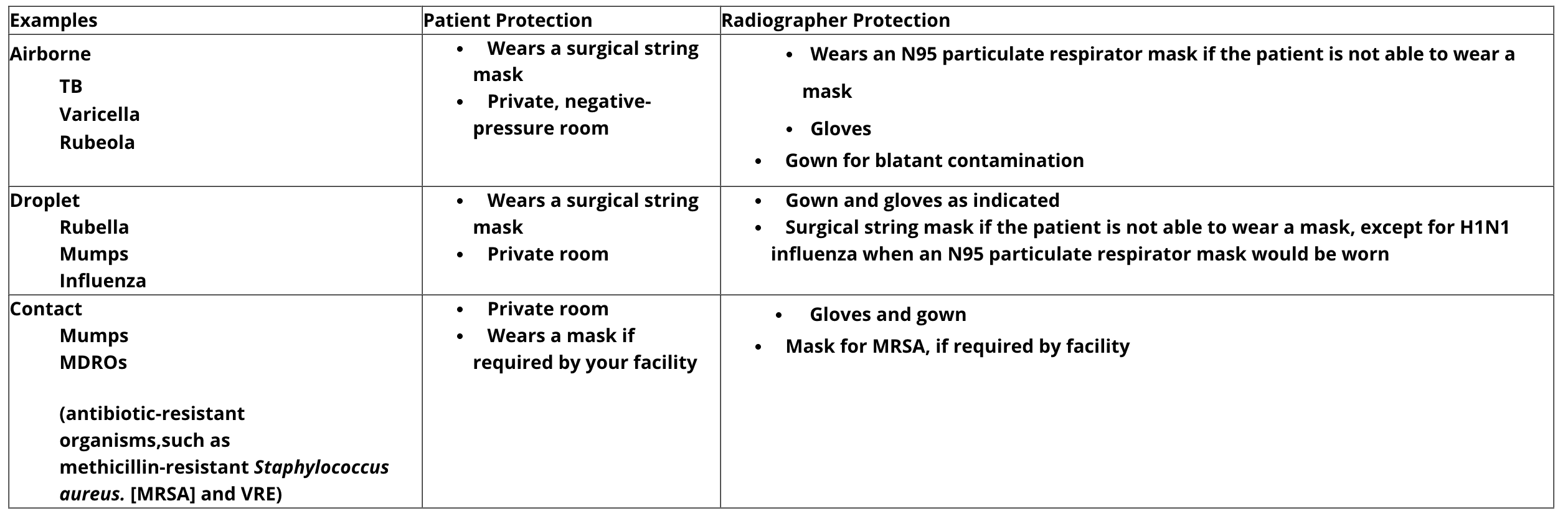
tubercle bacillus (TB)
chickenpox (varicella)
measles (rubeola)
examples of airborne precautions
air-purifying respirator (PAPR)
Those who cannot be fitted for an N95 mask may need to wear what instead?
negative-pressure room
Patients infected with airborne disease require a private, specially ventilated, what pressure room?
rubella (German measles)
mumps
influenza
examples of droplet contact:
dons a gown, gloves, and a mask
For contact isolation, the first radiographer (or “dirty) does what?
disinfectant
The mobile unit must be thoroughly cleaned w/ a _____
grasp the UNCOVERED IP
the second radiographer (clean) should ___________
remove by folding the gown FORWARD (with the dirty surfaces touching)
pull the sleeves inside out
roll the gown into a ball with the clean side now on the outside of the rolled gown.
How do you remove a donned gown?
lab waste
pathology waste
used bandages and dressings
discarded gloves
all sharp objects
liquid waste from suction
bladder catheters
chest tubes
IV tubes
drainage containers
What are included in the disposal of biomedical waste?
special, easily identifiable, impermeable bags and removed from the premised by an approved biomedical waste hauler
Biomedical waste must be packaged in ______
neutropenic (protective or reverse) isolation
this isolation is used to keep the susceptible patient whose immune system is compromised from becoming infected
Transplant recipient
Chemotherapy recipient
Leukemia
Burned skin
In which of the following conditions is protective, or reverse, isolation indicated?