Chemistry 9476
 Call Kai
 Learn
Learn Practice Test
 Spaced Repetition
 Match
Match Flashcards
 Knowt Play
1/13

There's no tags or description
Looks like no tags are added yet.
Name | Mastery | Learn | Test | Matching | Spaced | Call with Kai | Chat |
|---|
No analytics yet
Send a link to your students to track their progress
14 Terms
[Atomic structure]
Behaviour of beams of protons, neutrons and electrons in electric fields.
How to determine extent of deflection?
Protons (+) deflect towards (-) field
Neutrons do not deflect to any fields
Electrons (-) deflect towards (+) field
Extent of deflection:

[Atomic structure]
What are isotopes?
Atoms of the same element with different numbers of neutrons, hence different mass
[Atomic structure]
Number & relative energy of s, p & d orbitals for principle quantum numbers 1, 2 and 3, as well as 4s & 4p orbitals
S — 1s, 2s, 3s, 4s (2 electrons)
lowest energy in its respective quantum numbers
p — 2p, 3p, 4p (6 electrons)
d — 3d (10 electrons = break octet structure)
highest energy in its respective quantum numbers
*4s —> must be filled first (lower energy than 3d when unfilled) & removed from first
[Atomic structure]
Shape of s, p & d orbitals

[Atomic structure]
Factors affecting ionisation energy of elements
Nuclear charge
Total sum of positive charge in the nucleus of the atom
Electron shielding effect
Repulsion of outer electron shells by inner shells
Effective nuclear charge
Net amount of attraction between electrons and protons in the nucleus
[Chemical bonding]
Describe:
Ionic bonding
Covalent bonding
Metallic bonding
Strong electrostatic forces of attraction between oppositely charged ions in a giant ionic lattice structure
Electrostatic attraction between a shared pair of electrons & positively charged nuclei
Strong electrostatic forces of attraction between cations & sea of delocalised electrons in a giant metallic lattice structure
[Chemical bonding]
What are the types of s & p orbital overlaps in covalent bonding
π: head-on overlap over the axis with electron density concentrated between the nucleus — must have only 1 per bond
σ: 2-p orbitals overlap side-on (not along axis) with electron density concentrated above & below axis — multiple per bond

[Chemical bonding]
Definition of Valence Shell Electron Pair Repulsion Theory (VSEPR theory)
Electron pairs around central atom arranges themselves as far as possible to minimise repulsion — determines shape of molecules
Lone pair-lone pair > lone pair- bond pair > bond pair- bond pair
[Chemical bonding]
Shape & angle of 2 bond pair (e.g. CO₂)
CO₂: 2 bond pair, 0 lone pair around central atom C (angle 180)

[Chemical bonding]
Shape & angle of 3 pair (e.g BF₃ SO₂)
BF₃ : 3 bond pair, 0 lone pair around central atom B (angle 120)
SO₂: 2 bond pair, 1 lone pair around central atom S (angle 119)

[Chemical bonding]
Shape & angle of 4 pair (e.g. CH₄, NH₃, H₂O)
CH₄: 4 bond pair, 0 lone pair around central atom C (angle 109.5)
NH₃: 3 bond pair, 1 lone pair around central atom N (angle 107)
H₂O: 2 bond pair, 2 lone pair around central atom O (angle 104.5)

[Chemical Bonding]
Shape & structure of 5 pair
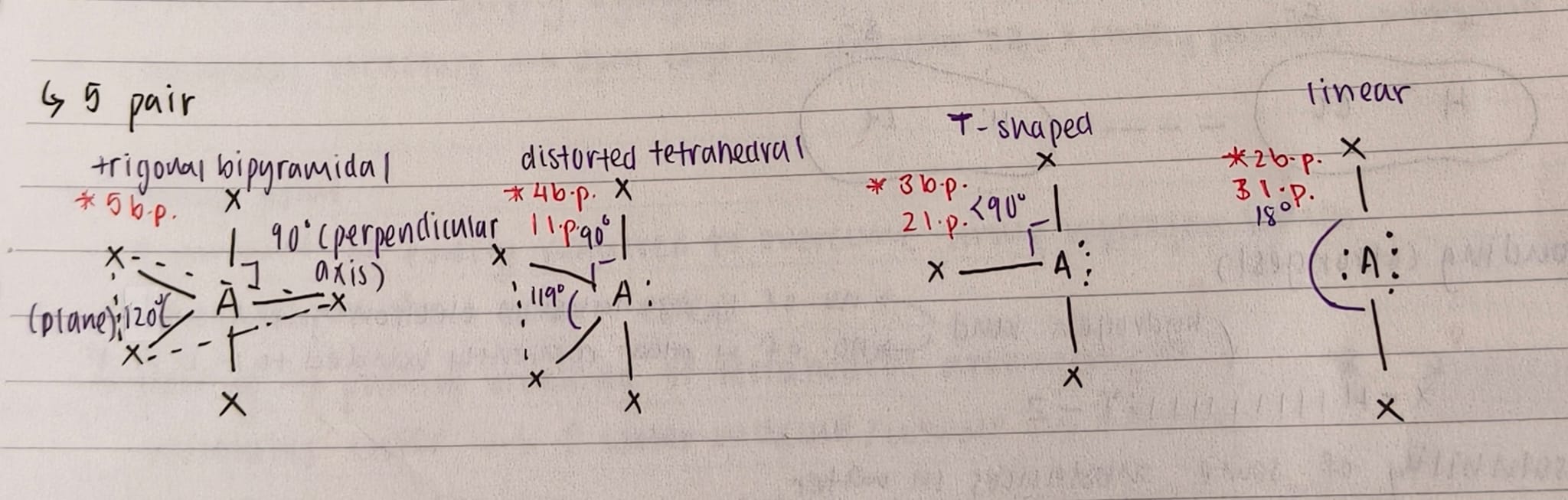
Shape & structure of 6 pair (e.g. SF₆)
SF₆: 6 bond pair, 0 lone pair around central atom S (angle 90)

[Chemical bonding]
How to determine bond polarity & its definition
It is a measure of how equally electrons are shared between 2 bonded atoms, heavily dependent on difference in electronegativity
Polar: different electronegativity —> bonding electrons not shared equally (net dipole ≠ 0)
Non-polar: same electronegativity —> bonding electrons shared equally (net dipole = 0)