Autonomic Nervous System & Special Senses: Key Concepts and Transduction Mechanisms
 Call Kai
 Learn
Learn Practice Test
 Spaced Repetition
 Match
Match Flashcards
 Knowt Play
1/94

There's no tags or description
Looks like no tags are added yet.
Name | Mastery | Learn | Test | Matching | Spaced | Call with Kai | Chat |
|---|
No analytics yet
Send a link to your students to track their progress
95 Terms
What is the primary function of the Somatic Nervous System (SNS)?
Voluntary, conscious control of skeletal muscles.
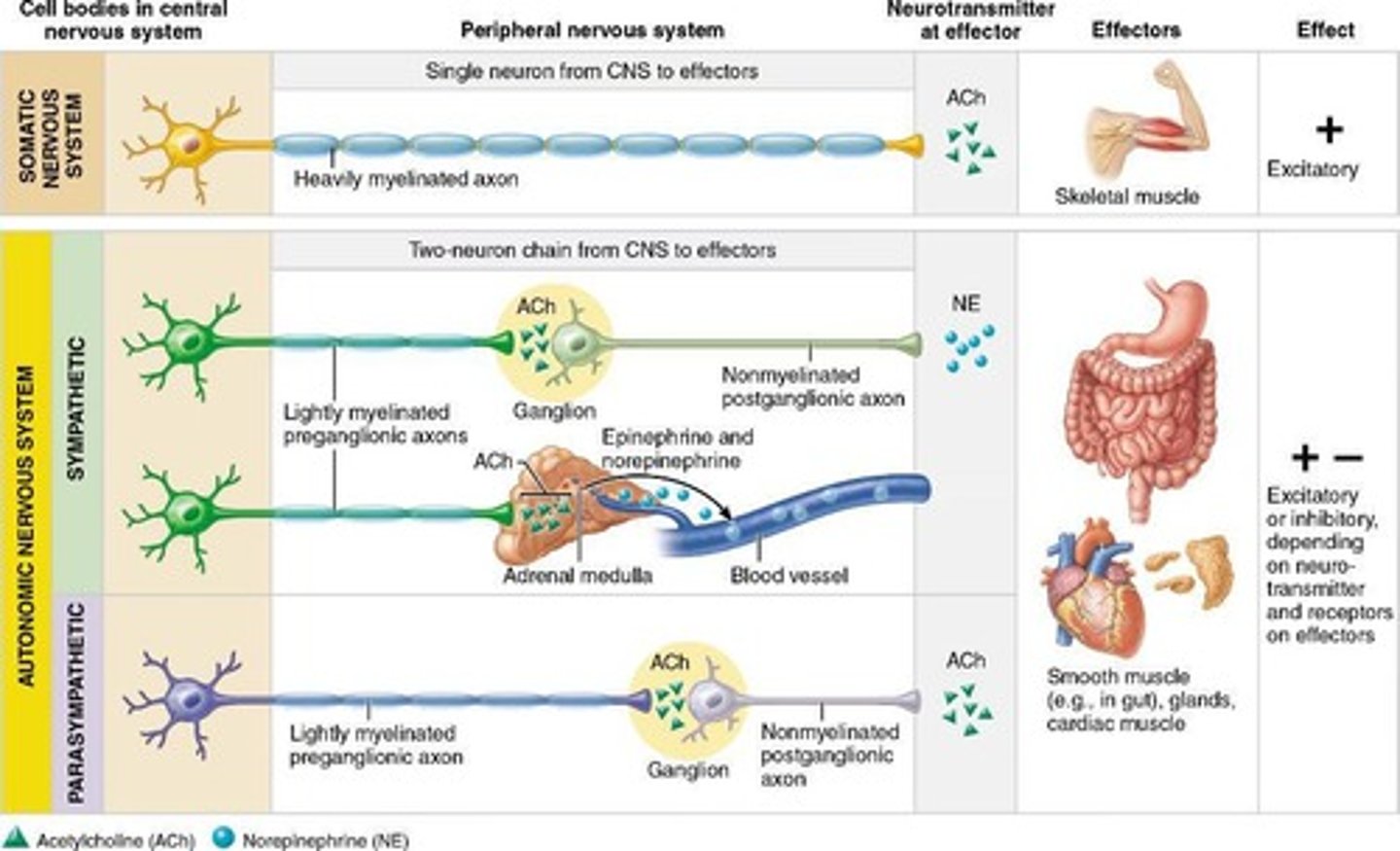
What is the primary function of the Autonomic Nervous System (ANS)?
Involuntary, unconscious regulation of smooth muscle, cardiac muscle, and glands.
How do the SNS and ANS differ in terms of control?
SNS is voluntary while ANS is involuntary.
What neurotransmitter is released by all somatic motor neurons?
Acetylcholine (ACh).
What is the effect of ACh on skeletal muscle?
Always excitatory (induces contraction).
What neurotransmitter do postganglionic sympathetic fibers typically release?
Norepinephrine (NE).
What neurotransmitter do postganglionic parasympathetic fibers release?
Acetylcholine (ACh).
What determines the effect of neurotransmitters in the ANS?
The specific receptors on the target tissue.
What are adrenergic receptors responsive to?
Norepinephrine (NE).
What are cholinergic receptors responsive to?
Acetylcholine (ACh).
What is the role of the parasympathetic division?
Supports relaxation, energy conservation, and normal body maintenance.
What are some key responses of the parasympathetic division?
Decreases heart rate, constricts pupils, stimulates digestion.
What is the role of the sympathetic division?
Prepares the body for stress, emergencies, and increased activity.
What are some key responses of the sympathetic division?
Increases heart rate and blood pressure, dilates bronchioles, mobilizes energy.
What is the anatomical origin of the parasympathetic division?
Craniosacral: brain and sacral spinal cord (S2-S4).
What is the anatomical origin of the sympathetic division?
Thoracolumbar: thoracic and lumbar regions of the spinal cord (T1-L2).
How do the fiber lengths differ between the parasympathetic and sympathetic divisions?
Parasympathetic has long preganglionic and short postganglionic fibers; sympathetic has short preganglionic and long postganglionic fibers.
Where are the ganglia located in the parasympathetic division?
In or very close to the visceral effector organs (intramural ganglia).
Where are the ganglia located in the sympathetic division?
Close to the spinal cord, in sympathetic chain or prevertebral ganglia.
What are the five basic components of reflex arcs?
Receptor, sensory neuron, integration center, motor neuron(s), effector.
How does the motor pathway differ between visceral and somatic reflex arcs?
Visceral has two motor neurons (preganglionic and postganglionic); somatic has one motor neuron.
What type of effectors are involved in visceral reflex arcs?
Smooth muscle, cardiac muscle, or glands.
What type of effectors are involved in somatic reflex arcs?
Skeletal muscles.
What is the function of acetylcholine (ACh) in the ANS?
Released by preganglionic neurons in both divisions and by parasympathetic postganglionic neurons.
What is a unique exception regarding ACh in the sympathetic division?
Sympathetic postganglionic neurons release ACh to sweat glands.
What are the two main types of neurotransmitters released by autonomic neurons?
Acetylcholine (ACh) and Norepinephrine (NE)
What type of receptors do norepinephrine act on?
Adrenergic receptors (α and β)
What is the primary function of epinephrine when released into the bloodstream?
Acts as a hormone to trigger widespread sympathetic 'fight-or-flight' responses.
What is the effect of sympathetic activation on heart rate?
Increases heart rate and contractility via β1 receptors.
How does the sympathetic division respond to high body temperature?
Dilates skin blood vessels and activates sweat glands for cooling.
What is autonomic tone?
The baseline activity of both sympathetic and parasympathetic divisions at all times.
What is dynamic antagonism in the autonomic nervous system?
The opposing effects of sympathetic and parasympathetic divisions on target organs.
What is the role of the hypothalamus in the autonomic nervous system?
It integrates emotional, endocrine, and autonomic responses to maintain homeostasis.
What are the effects of the parasympathetic division on target organs?
Precise, localized actions primarily through the release of ACh.
What is the primary neurotransmitter released by somatic motor neurons?
Acetylcholine (ACh)
What is the effect of sympathetic activation on blood vessels in skeletal muscles?
Vasodilation via β2 receptors.
What are the symptoms of autonomic dysreflexia?
Severe hypertension, headache, sweating, and flushed skin.
What is Raynaud's Disease?
Episodic spasms of small arteries due to excessive sympathetic stimulation.
What do beta blockers do?
Block β-adrenergic receptors, reducing heart rate and blood pressure.
In what types of sports are beta blockers commonly used?
Fine motor control sports like archery and shooting.
What is the effect of sympathetic impulses on kidneys?
Stimulate the release of renin, which increases blood pressure.
What is the effect of the sympathetic division on metabolic rate?
Increases metabolic rate, raises blood glucose levels, and mobilizes fats for energy.
What is the primary function of the brainstem in the autonomic nervous system?
Regulates essential visceral functions like heart rate and breathing.
What is the effect of the parasympathetic division on heart rate?
Decreases heart rate.
What is the role of feedback from sensory receptors in the ANS?
Monitors internal conditions and adjusts ANS activity dynamically.
What is the primary neurotransmitter of the sympathetic division?
Norepinephrine (NE)
What are the effects of epinephrine on bronchodilation?
Causes bronchodilation via β2 receptors.
What is the primary effect of sympathetic activation on blood vessels?
Vasoconstriction in most vessels, except for vasodilation in skeletal muscles.
What is the difference in control patterns between the sympathetic and parasympathetic divisions?
Sympathetic is broad and systemic; parasympathetic is precise and localized.
What is the role of the spinal cord in the autonomic nervous system?
Mediates simple autonomic reflexes such as defecation and urination.
How does the sympathetic division help maintain homeostasis under stress?
By regulating blood pressure and supporting energy mobilization.
What is the primary action of the sympathetic division during 'fight-or-flight'?
Prepares the body for rapid response to stressors.
What are the special senses?
Vision, taste, smell, hearing, and equilibrium.
What is the first step in visual transduction?
Light enters the eye and passes through the cornea, pupil, and lens to focus on the retina.
What types of photoreceptors are involved in vision?
Rods (for dim light) and cones (for color and detail).
What happens to rhodopsin when it absorbs a photon?
11-cis-retinal changes into all-trans-retinal, activating opsin.
What is the role of transducin in visual transduction?
Transducin is activated by opsin and stimulates phosphodiesterase (PDE).
What effect does phosphodiesterase (PDE) have on cGMP levels?
PDE decreases cGMP levels, leading to the closure of cGMP-gated Na⁺/Ca²⁺ channels.
What occurs to photoreceptors in light?
Photoreceptors hyperpolarize, reducing glutamate release.
What are the two types of bipolar cells in the retina?
ON bipolar cells (activated when glutamate decreases) and OFF bipolar cells (activated when glutamate increases).
What do ganglion cells do in the visual pathway?
Ganglion cells generate action potentials that travel down the optic nerve to the brain.
Where does most visual information go in the brain?
To the lateral geniculate nucleus (LGN) of the thalamus and then to the primary visual cortex (V1) in the occipital lobe.
What is the first step in auditory transduction?
Sound waves enter the ear and travel down the external auditory meatus to the tympanic membrane.
What happens to the tympanic membrane during auditory transduction?
It vibrates and moves the three ossicles (malleus, incus, stapes).
What is tonotopy in the basilar membrane?
Different parts of the basilar membrane vibrate best at different frequencies (base for high frequencies, apex for low frequencies).
What is the role of the organ of Corti in hearing?
It contains hair cells that detect movement of the basilar membrane.
What occurs when stereocilia bend in hair cells?
Mechanically gated (MET) channels open, allowing K⁺ influx and depolarization of the hair cell.
What triggers neurotransmitter release in auditory transduction?
Depolarization opens voltage-gated Ca²⁺ channels, leading to glutamate release from hair cells.
What is the central auditory pathway?
Signals travel from cochlear nucleus to superior olivary complex, lateral lemniscus, inferior colliculus, medial geniculate body, and primary auditory cortex.
What is static equilibrium and where is it detected?
Static equilibrium is detected by receptors in the utricle and saccule, which monitor head position relative to gravity.
What is dynamic equilibrium and where is it detected?
Dynamic equilibrium is detected by receptors in the semicircular canals, which monitor rotational movements of the head.
What do maculae in the vestibule monitor?
Head position in space and respond to linear acceleration.
What is the function of the crista ampullaris?
It detects rotational movements in the semicircular canals.
Where are the cristae located?
In the ampulla of each semicircular canal.
What type of equilibrium do the cristae provide input for?
Dynamic equilibrium.
How do signals from the vestibular system reach the brain?
Via the vestibular nerve to the brainstem and cerebellum.
What role do visual and proprioceptive inputs play in balance?
They help maintain balance, posture, and stable vision.
What happens to odor molecules when they enter the nose?
They dissolve in the mucus of the olfactory epithelium.
What type of receptors do olfactory receptor neurons (ORNs) have?
G-protein coupled receptors (GPCRs).
What initiates the depolarization in olfactory transduction?
Activation of Golf, which increases cAMP.
What ions enter the olfactory receptor neuron during depolarization?
Na⁺ and Ca²⁺.
What is the pathway of signals from ORNs to the brain?
ORN axons pass through the cribriform plate to the olfactory bulb, then to the primary olfactory cortex, amygdala, and entorhinal cortex.
What is unique about olfactory processing compared to other senses?
Olfaction does not relay through the thalamus first.
How do tastants interact with taste receptor cells?
They dissolve in saliva, enter the taste pore, and reach taste buds.
What is the transduction mechanism for salty tastes?
Na⁺ enters through ENaC channels, leading to depolarization and neurotransmitter release.
What pathway do sweet and umami tastes share?
They both activate GPCRs T1R2 + T1R3, leading to PLCβ2 and Ca²⁺ release.
What neurotransmitter is released by Type II taste cells?
ATP.
What cranial nerves are involved in taste signal transmission?
CN VII (facial), CN IX (glossopharyngeal), and CN X (vagus).
What is the main difference between air conduction and bone conduction?
Air conduction uses the outer and middle ear, while bone conduction bypasses them and stimulates the inner ear directly.
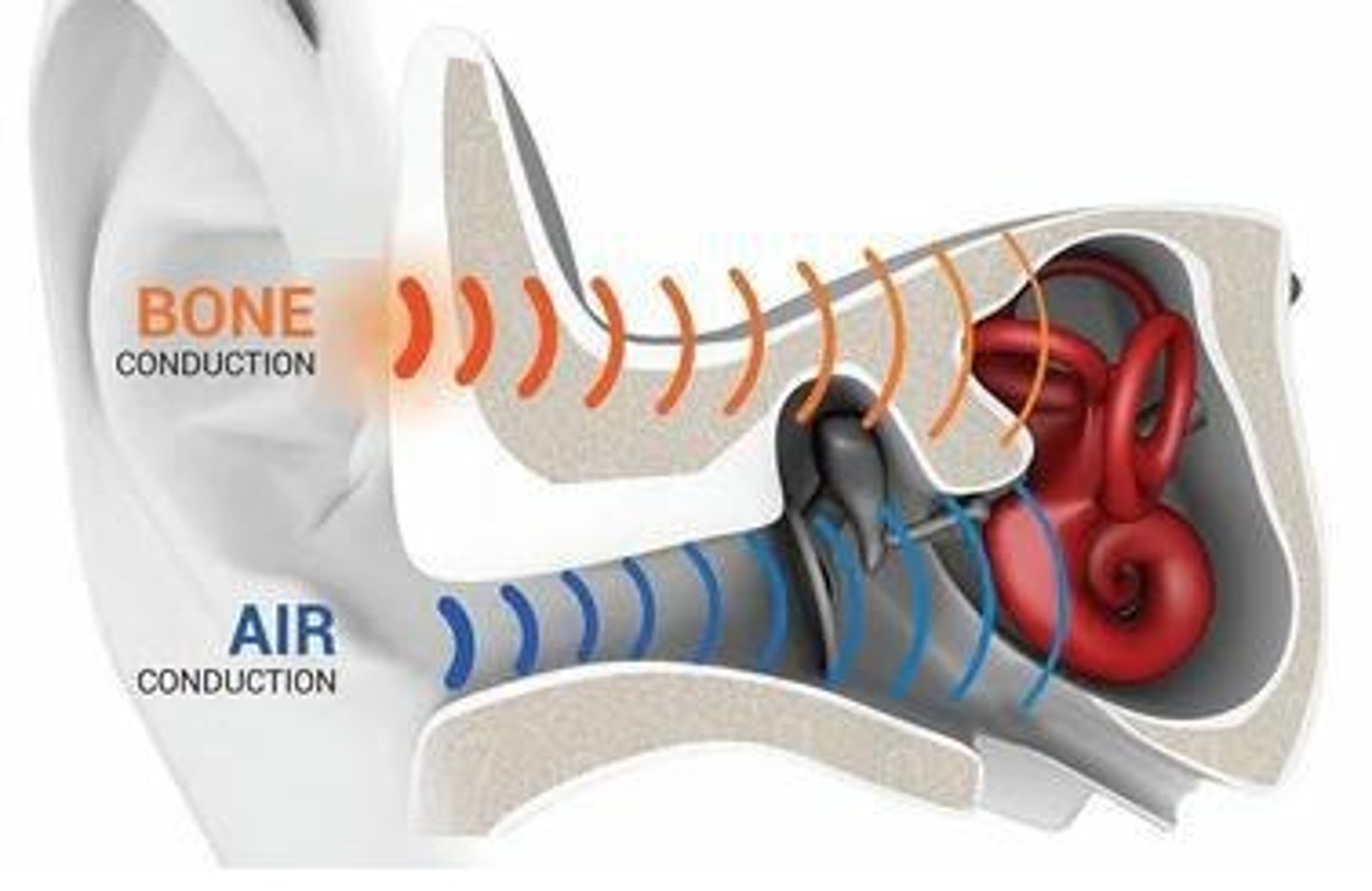
How do bone conduction headphones work?
They vibrate the skull bones directly, sending vibrations to the cochlea.
What is a key advantage of bone conduction headphones?
They allow users to hear ambient sounds while listening to audio.
What is the primary function of cochlear implants?
To create a new hearing pathway by bypassing damaged hair cells and stimulating the auditory nerve directly.
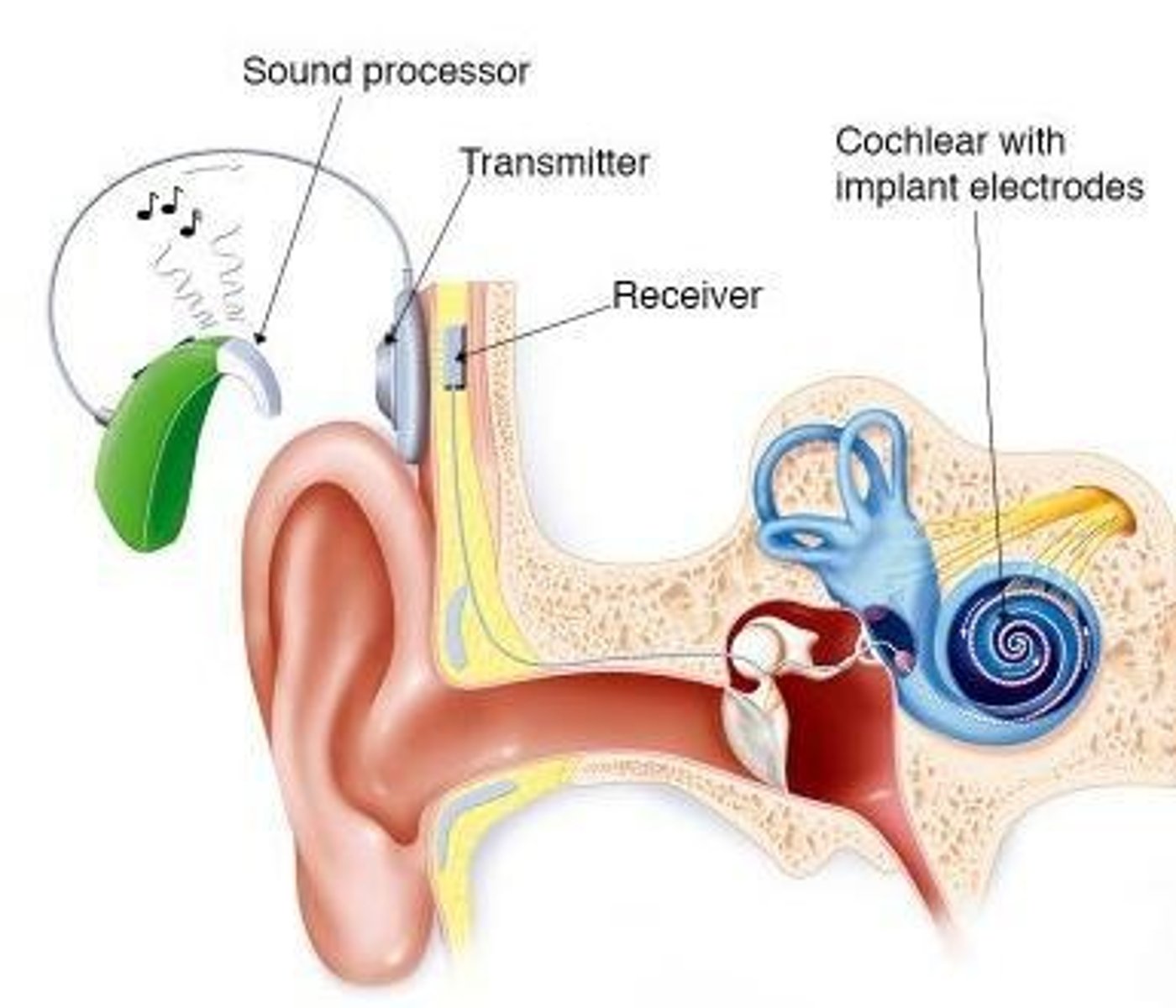
What are the components of a cochlear implant?
An external sound processor and an internal implant with a receiver/stimulator and electrode array.
What is the outcome of using cochlear implants?
They provide access to speech and sounds but do not restore natural hearing.
What is required for cochlear implant recipients to interpret new signals?
Auditory therapy.