Week 5 Cellular Excitation
 Call Kai
 Learn
Learn Practice Test
 Spaced Repetition
 Match
Match Flashcards
 Knowt Play
1/25

There's no tags or description
Looks like no tags are added yet.
Name | Mastery | Learn | Test | Matching | Spaced | Call with Kai | Chat |
|---|
No analytics yet
Send a link to your students to track their progress
26 Terms
Gibbs-Donnan Equilibrium
with a semipermeable membrane and an impermeant ion, the other ions in tend to distribute themselves to resolves concentration and charge differences, which may result in differences of concentration but still a charge difference of zero
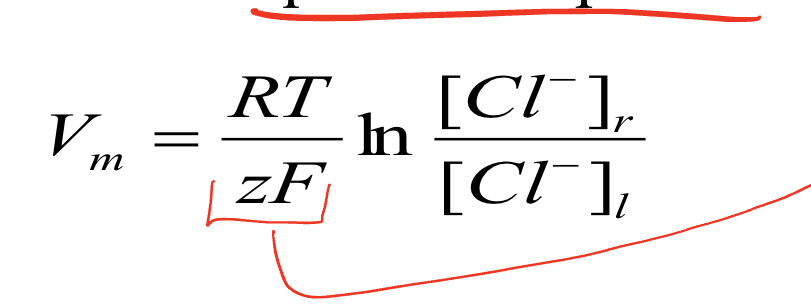
Nernst Equation
used to calculate the equilibrium potential of a single ion
equilibrium potential
when at equilibrium, the charge difference of the ion at the membrane
resting membrane potential
NOT equal to the equilibrium potentials of individual ions (K+, Cl-, or Na+), may differ some for different cell types, excess of positive charge on the outer surface of the membrane and negative charge on the inner surface, reflects the interactions of all three ions (more strongly potassium and sodium though, respectively)
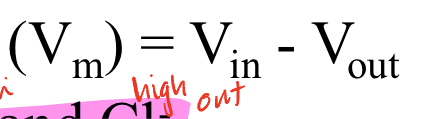
Equation of membrane potential
measured in voltage
resting ‘leak’ ion channels
movement of Na+, K+, Cl- passively through the membrane due to concentration gradients, Na+ is 10x greater outside, K+ is 30x greater inside, Cl- is 10x greater outside but is more variable
intracellular
where impermeant organic anions (proteins) are typically found
Na+/K+ Pump
maintains the concentration gradient needed for the resting membrane potention, overall charge imbalance of the pump activity only lowers Vm slightly (-4 mV), must burn ATP, pumps 3 Na+ out and 2 Na+ in
electrochemical gradient
differences in ion concentrations, chemical/diffusion forces, electrical forces, no net movement at equilibrium
Goldman- Hodgkin- Katz Equation
a more accurate equation to represent resting membrane potential, takes into account conductance and permeability factors of the ions, if the g is very much greater for one ion than the others the eq will reduce to the nernst equation (also g = p essentially)

Resting membrane potential of muscles, nerves in the PNS, and nerves in the CNS
-90 mV, -75 mV, -65 mV
relative permeabilities at rest PK:PNa: PCl
1.0: 0.04: 0.45, this means that K+ contributes most to the resting membrane potential at rest
gated ion channels
the action of these can alter the resting membrane potential, if altered enough that the change is enough to reach the threshold potential, an action potential will be generated, may be voltage gates or ligand gated receptors
action potential
basic signaling unit in nervous system, a binary signal, all or nothing!, self propagating
what would not cause an AP
weak stimuli, small, temporary change in Vm (local potential, passive)
what would cause an action potential
sufficiently strong stimulus achieves threshold of depolarization (typically a change in +20 mV), either a large stimulus or sufficient # of subthreshold stimuli
depolarizing
Na+ moves rapidly into cell, causes a positive increase in membrane potential due to the opening of voltage gates Na+ channels, until reaches around +35 mV, at this time frame Na+ has the greatest conductance
local, graded, generator, or receptor potential
environmental stimuli produces a local, graded change in the membrane potential, different that an action potential, examples are mechanical, pressure sensing, olfactory, retina
receptor potential characteristics
produces by opening of ion channels, depolarizing(excitatory) of hyperpolarizing (inhibitory), magnitide of potential proportional to magnitude of stimulus, AP are a result of local potential
local potential summation
can be temporal or spatial, stimulatory or inhibitory and may come from receptors or synapses with other neurons, outcome is an AP or no AP, typically occurs on the axon Hillock, whcih is on the soma, has a lower threshold for depolarization, and a higher density of voltage gates Na+ channels
Voltage gates K+ channels
open and close more slowly than Na+ channels, at the peak of the action potential, g of it has increase to near that of gNa+
Na+ inactivation gates
start closing soon after the activation gates open, reduces Na+ current, does not appear to be related to the duration of stimulus
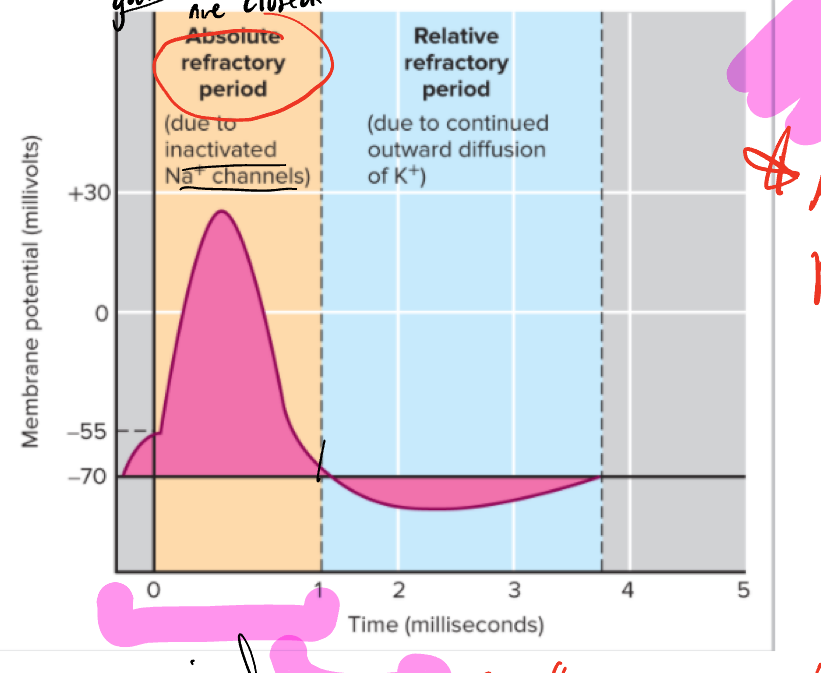
absolute refractory period
during the period in which the Na+ inactivation gates are closed, another action potential cannot be generated (also encompasses the rising phase of the action potential)
hyperpolarization
caused by the opening of the K+ channels, afterpotential, after the Na+ activation and inactivation gates have closed
relative refractory period
when the membrane potential is hyperpolarized still, even when the Na+ inactivation gates are open, a greater stimulus is needed to produce an action potential
AP travels to…
AP may be sent to another neuron, muscle, or gland, requires signal propagation, voltage change from initial AP will initiate others!