Laboratory Mathematics - Reagent Preparation (Lecture)
 Call Kai
 Learn
Learn Practice Test
 Spaced Repetition
 Match
Match Flashcards
 Knowt Play
1/45

Earn XP
Description and Tags
- Dilution factor, Percent Solutions, Molecular Weight, Molarity, and Molality and -Reagent Preparation
Name | Mastery | Learn | Test | Matching | Spaced | Call with Kai | Chat |
|---|
No analytics yet
Send a link to your students to track their progress
46 Terms
Percent Solutions:
% (W/V)
% (V/V)
% (W/W)
Molarity
Number of Moles of solute dissolved in one liter solution.
Molarity is widely used in:
Clinical chemistry
Analytical chemistry
Instrument preparation
Buffer Preparation
Most common type of solution in percent solution
Weight/Volume
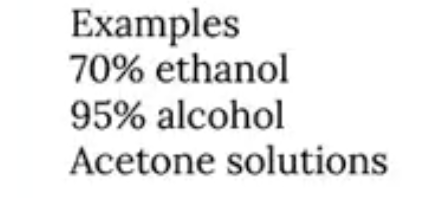
These are commonly used for disinfection and reagent preparation
v/v %
w/w % purpose:
Preparation of powder
Commercial reagent manufacture
Dry chemical formulations
Normality
Expresses the concentration of a solution in terms of Number of grams equivalent per Liter of solution.
Normality is commonly used for:
Acid-base
Oxidation-reduction
Molality (m)
Number of moles of solute dissolved in One kilogram of solvent.
It is independent of the temperature
Primarily used in PHYSICAL CHEMISTRY and studies involving COLLIGATIVE PROPERTIES.
Molality (m)
Based on Mass of the Solvent, Not the volume of the solution.
Molality (m)
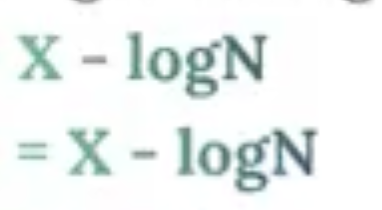
pH and POH
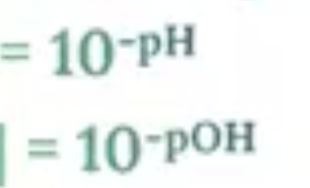
Formula mentioned above and below
[H+]
[OH]




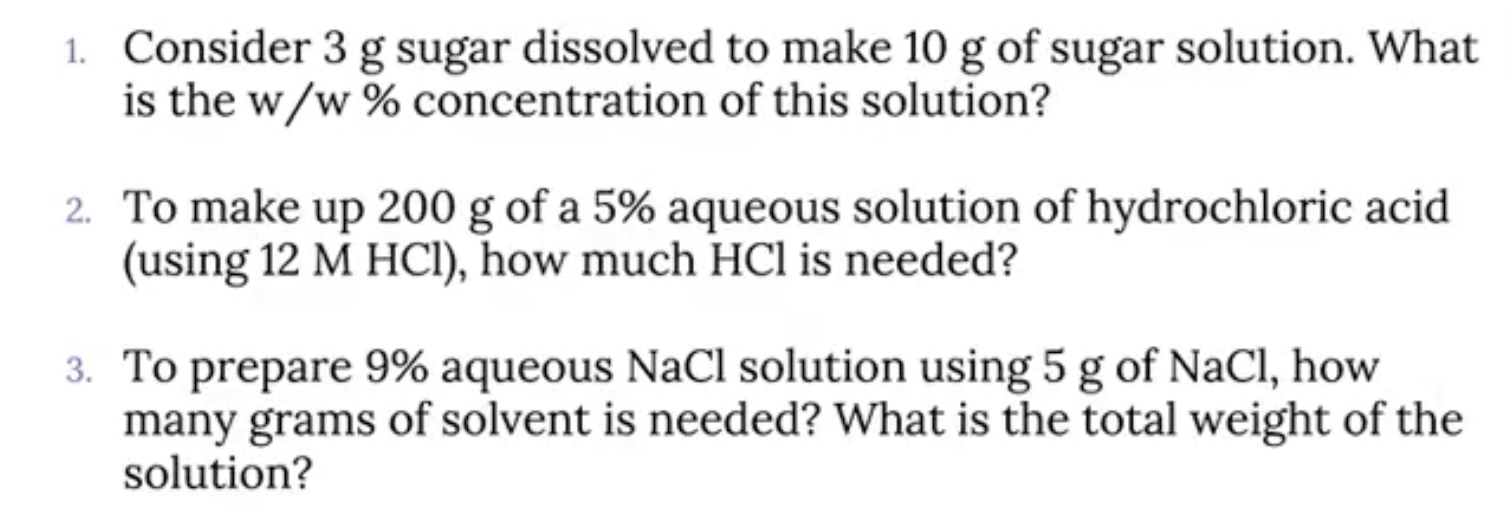
30% w/w
10 g
Solution: 55.56 g & Solvent: 50.56
% v/v
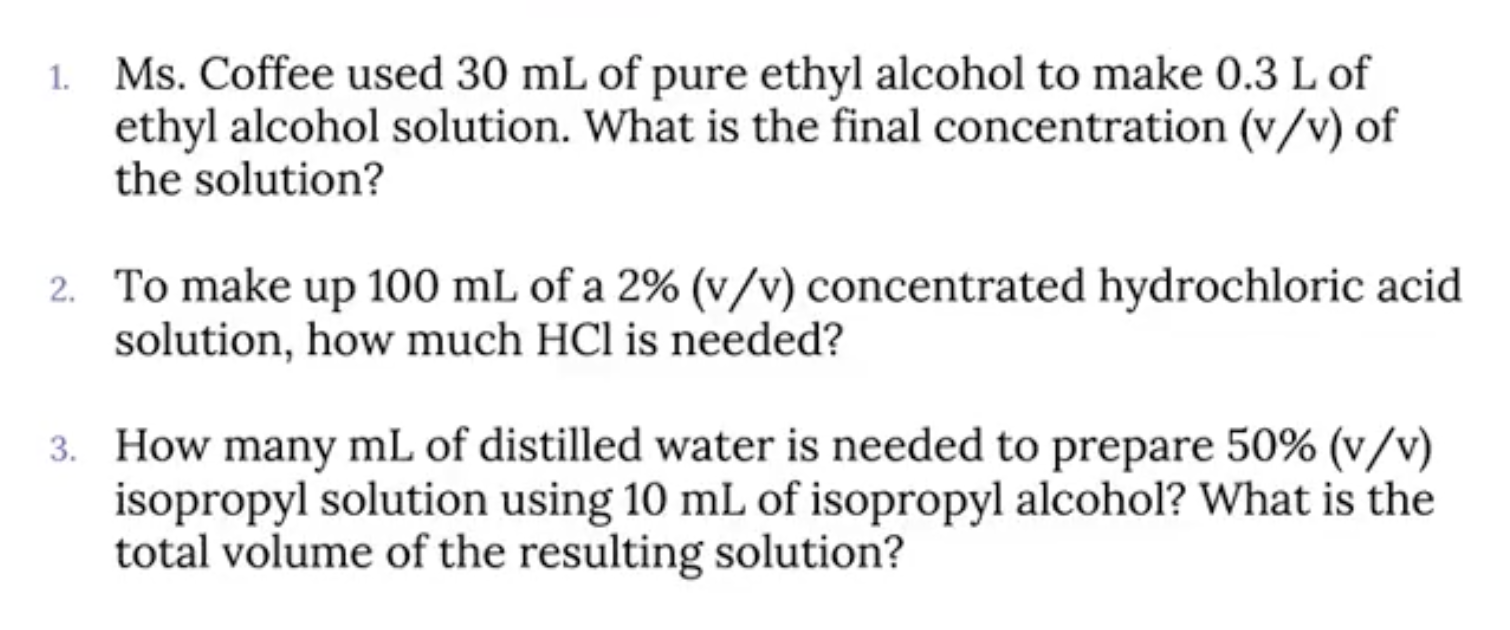
10% v/v
2 mL
20 mL
How to get molecular weight?
Add the atomic weight

1 mole
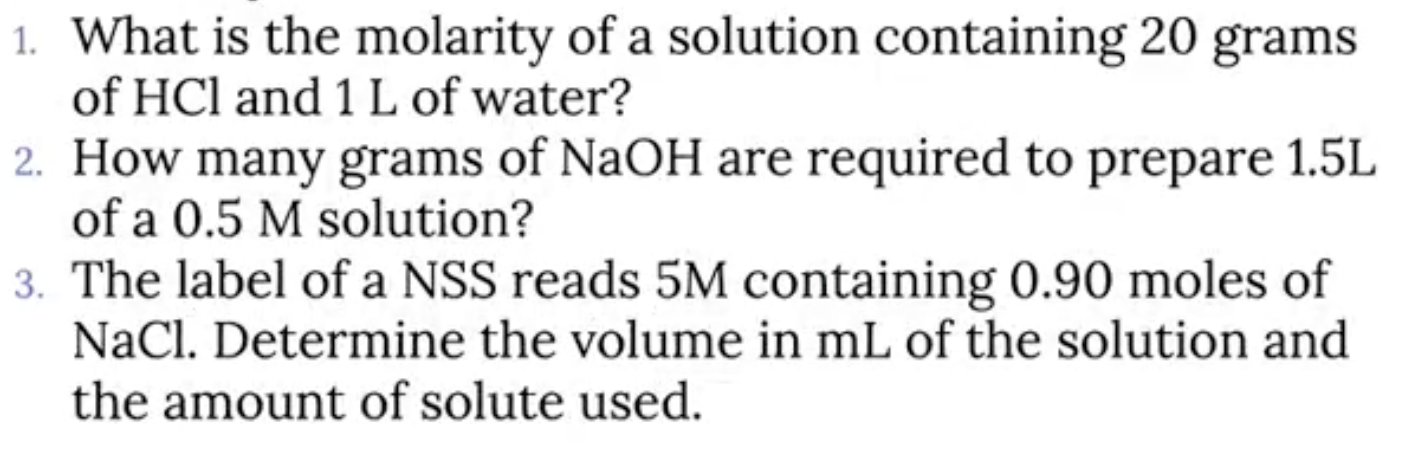
0.55 mol/L
30 g
52.65 g
Normality is commonly used as:
Acid-base
Oxidation - reduction
Most commonly used reagent in the clinical laboratory? (water specifications)
High Purity Water
Unsuitable for Lab Applications? (water specifications)
Tap Water
Most procedures, reagent and control preparations requires substantially, which is ?
Purified water, known as Reagent - Grade Water.
Type 1 (water)
critical, highly sensitive analytical procedures requiring absolute measurement precision.
Type 2 (water)
General clinical laboratory testing procedures and Standard active chemical reagent preparations.
Type 3 (water)
General lab glassware, pre-rinsing and direct feed lines feeding automated purification equipment.
Water to rinse your everyday laboratory glassware, and connect this same water supply directly to your automated chromatography machine via a dedicated pipe or tube.
Type 3
Distilled Water
Purified by boiling & vaporizing water.
Impurities remain in the boiling apparatus.
Water collected after condensation has less contamination
Distillation cycles can be repeated to remove additional impurities
Ultrafiltration and Nanofiltration remove:
Particles
Microorganisms
Endotoxins
What is a Dilution Ratio?
A parts-to-parts comparison format written as Solute :Solvent
What does a 1:4 dilution ratio mean?
Combine 1 part solute with 4 parts solvent (giving 5 total parts).
What is a Dilution Factor ?
A parts-to-total fraction format written as Solute/Total Volume or a whole number multiplier.
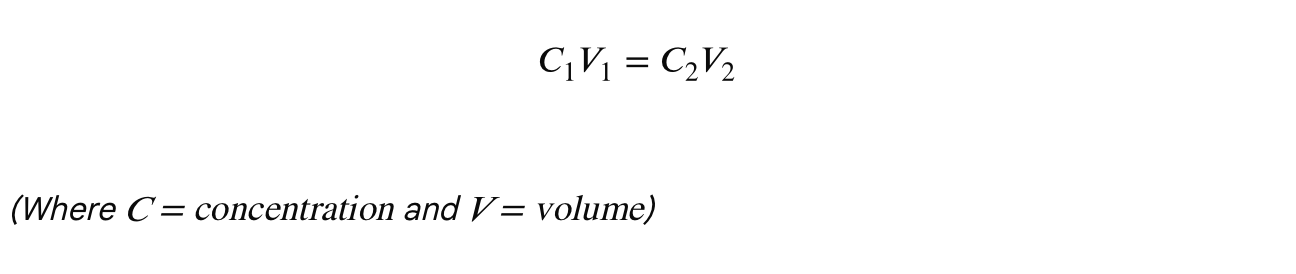
What is the golden dilution equation used to mix solutions?
Deionized Water
Has some or all ions removed from water
Not considered pure or sterile
Produced Using anion- or caution- exchange resins.
Excellent at removing dissolved ionized solids and dissolved gas.
Water that is excellent at removing dissolved ionized solids and dissolved gases.
Deionized Water
List Chemical Use for Reagent Preparation
Analytical Reagent Grade
Ultrapure Reagents
Chemically pure (CP) or Pure Grade
Technical or Commercial Grade
United States of Pharmacopoeia (USP) and National Formulary (NF)
Reference material : purpose
Standard with Assigned value
Calibrator : purpose
Adjust instrument response
Control Material
Monitor assay performance
Important for qualitative and quantitative analyses; essential for accuracy
AR (analytical reagent grade
It is not recommended for research and analytical chemistry unless further purification or a reagent blank is included
CP (chemically pure or pure grade
Reagent put through additional purification
Ultrapure Reagents
It is used primarily in MANUFACTURING.
Technical or commercial Grade
Uses for Drug Manufacturing
USP and NF