Lecture Questions for Final Exam
 Call Kai
 Learn
Learn Practice Test
 Spaced Repetition
 Match
Match Flashcards
 Knowt Play
1/76

There's no tags or description
Looks like no tags are added yet.
Name | Mastery | Learn | Test | Matching | Spaced | Call with Kai | Chat |
|---|
No analytics yet
Send a link to your students to track their progress
77 Terms
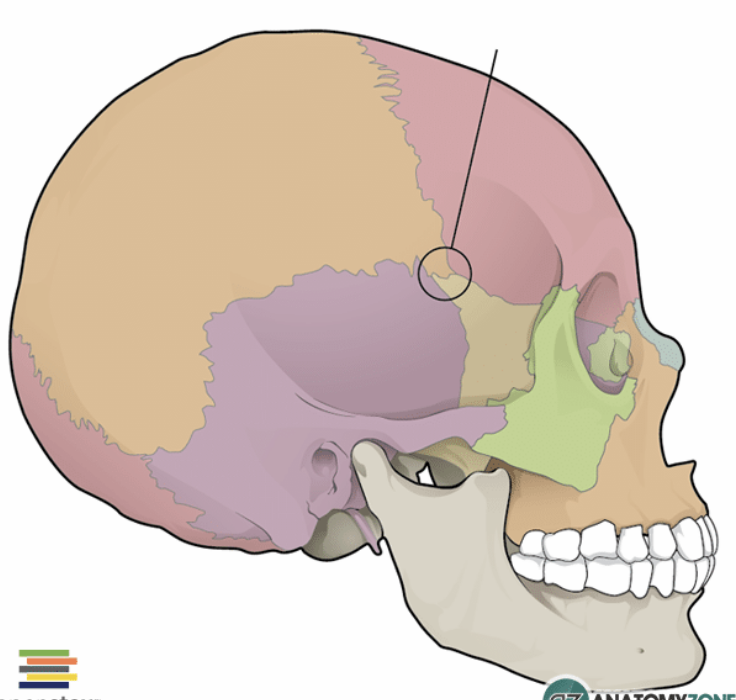
what landmarks is this area?
pterion
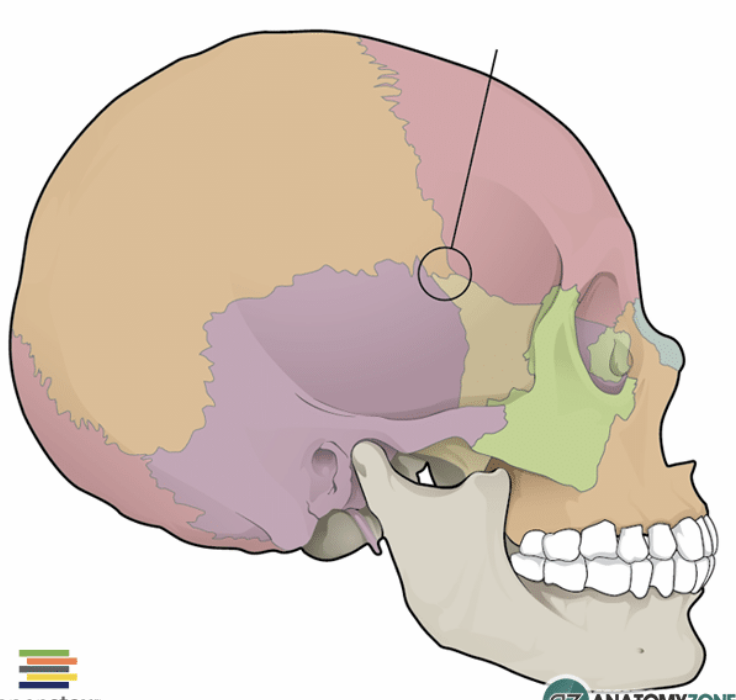
What vessel runs deep to the area?
middle meningeal artery
from maxillary artery branch of external carotid artery
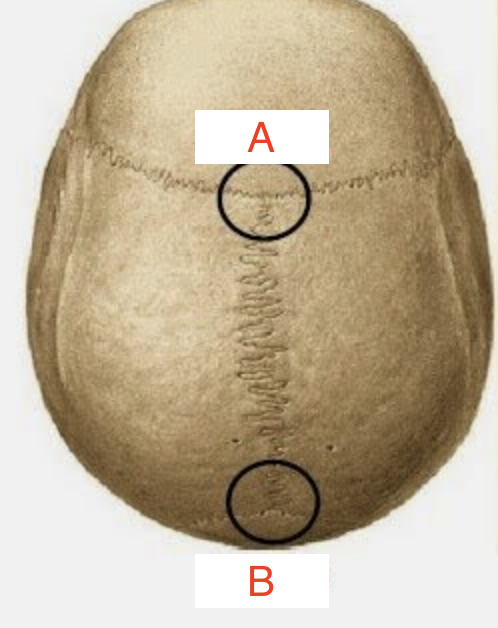
What landmark is A?
bregma
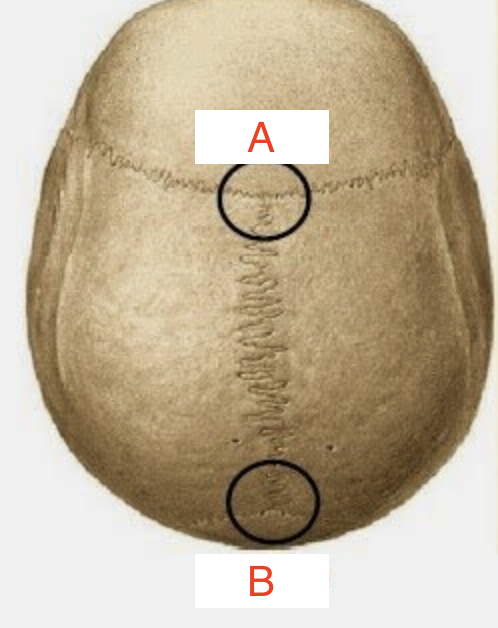
What location (in A) does this occur in infants?
anterior fontanelle
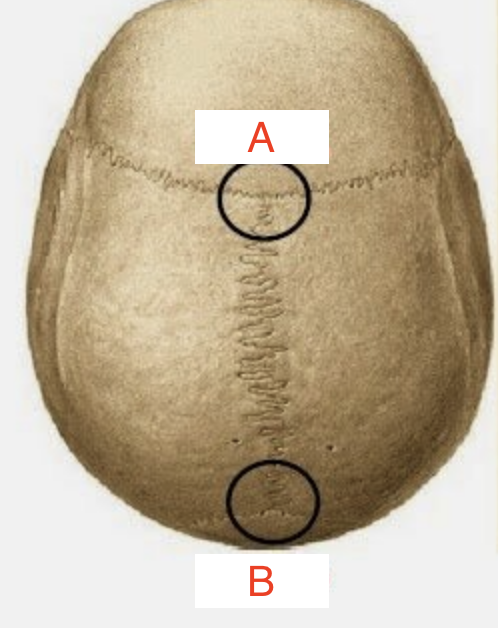
What landmark is B?
lambda
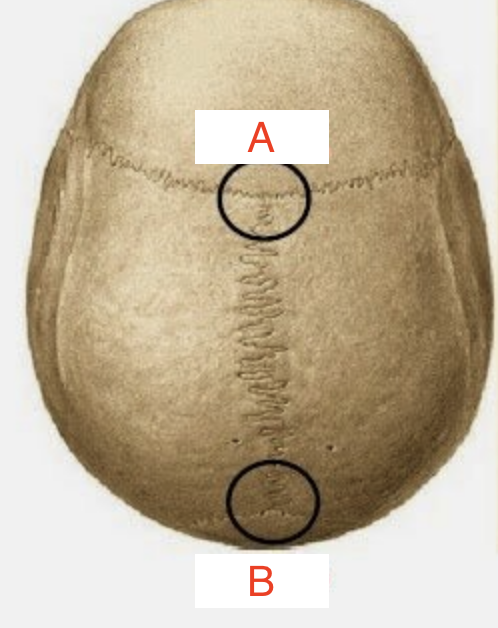
What location (in B) does this occur in infants?
posterior fontanelle
The coronal suture of the skull is located between which 2 bones?
frontal and parietal
The sagittal suture of the skull is located between which 2 bones?
parietal bones
The squamosal suture of the skull is located between which 2 bones?
temporal and parietal
The lambdoidal suture of the skull is located between which 2 bones?
parietal and occipital
The TMJ is classified as a ____ joint.
synovial; hinge joint
What structure does contain inside TMJ?
fibrocarilaginous disc
What does the structure separate right & left hemispheres?
Falx cerebri
What bones do attach to the Falx cerebri? (answer anteriorly and posteriorly)
anteriorly = crista galli of ethmoid; posteriorly = occipital bone
What does the structure separate cerebrum from cerebellum?
Tentorium cerebelli
What does the Tentorium cerebelli create compartments?
supratentorial and infratentorial compartments
What spaces of meninges do have from superficial to deep?
Epidural space → Subdural space → Subarachnoid space
What meninges do have from superficial to deep?
Dura mater → Arachnoid mater → Pia mater
Flow of CSF (cerebrospinal fluid)
lateral ventricle → interventricular foramen → 3rd ventricle → cerebral aqueduct → 4th ventricle → lateral aperture/SC central canal/ median aperture → subarachnoid space → arachnoid villi → venous system via jugular
Functions of CSF (4)
protection
buoyancy
homeostasis
nutrient & chemical transport
blood supply input comes from 4 vessels which are:
2 internal carotid arteries (comes from R/L common carotid arteries)
2 vertebral arteries
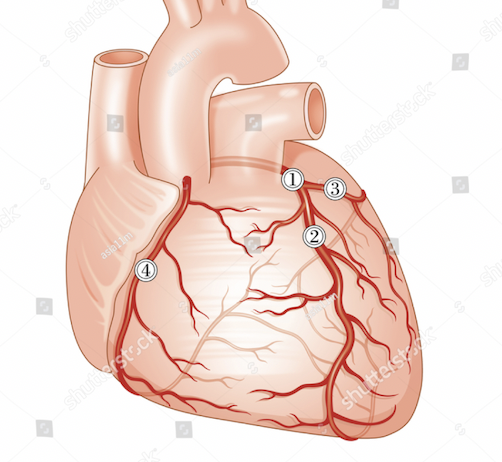
What is the coronary artery labeled as #1?
left coronary artery
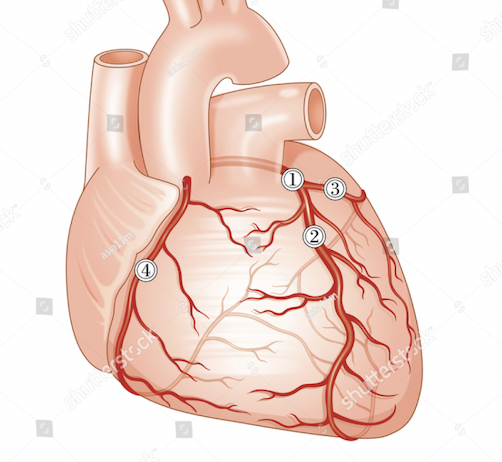
what is the coronary artery labeled as #4?
right coronary artery
Which of the following is NOT a function of cranial nerve VII facial nerve?
A. sensation to face
B. motor to the muscles of facial expression
C. taste from the anterior 2/3 of tongue
D. motor to stylohyoid and posterior digastric
A. sensation to face
Which cranial nerves travel through the superior orbital fissure?
CN III, CN IV, CN VI, CN V1
Which cranial nerves travel through the foramen rotundum?
CN V2
Which cranial nerves travel through the foramen ovale?
CN V3
Which vessel travels through the foramen spinosum?
middle meningeal artery
Which cranial nerves travel through the internal acoustic meatus?
CN VII, CN VIII
Which cranial nerves travel through the jugular foramen?
CN IX, CN X, CN XI
Which cranial nerve travels through the hypoglossal canal?
CN XII
What is the function of cranial nerve XI?
A. sense of sound, rotation, gravity
B. motor to the tongue
C. motor to sternocleidomastoid and trapezius
D. motor to lateral rectus muscle of eyeball
C. motor to sternocleidomastoid and trapezius
What is the function of cranial nerve VI?
A. sense of sound, rotation, gravity
B. motor to the tongue
C. motor to sternocleidomastoid and trapezius
D. motor to lateral rectus muscle of eyeball
D. motor to lateral rectus muscle of eyeball
What is the function of cranial nerve III?
A. sense of sound, rotation, gravity
B. motor to the tongue
C. motor to eyeball muscles
D. motor to lateral rectus muscle of eyeball
C. motor to eyeball muscles
What is the function of cranial nerve I?
A. sense of sound, rotation, gravity
B. motor to the tongue
C. motor to eyeball muscles
D. sense of smell
D. sense of smell
What is the function of cranial nerve IV?
A. sense of vision
B. motor to the tongue
C. motor to superior oblique muscle of eyeball
D. motor to eyeball muscles
C. motor to superior oblique muscle of eyeball
Functions of trigeminal nerve (CN V)
V1= sensation to face (off to the supraorbital nerve; ophthalmic)
V2 = sensation to face (off to the infraorbital nerve; maxillary)
V3= sensation to face, motor to mastication (off to the mental nerve; mandibular)
Function of Glossopharyngeal nerve (CN IX)
sensation to taste from posterior 1/3 of the tongue
motor to stylopharyngeus muscle
Function of Vagus nerve (CN X)
parasympathetic motor to most thoracic and abdominal viscera
motor to pharynx and larynx muscles
From the right atrium, blood flows through the ____ valve into the ____ ventricle
tricuspid; right
From the left atrium, blood flows through the ____ valve into the _____.
bicuspid valve; left
the right common carotid artery branches off of the _____
brachiocephalic trunk
When a patient rotates their trunk to the left, they are using which of the following muscles?
Right EAO, left IAO
When a patient rotates their trunk to the right, they are using which of the following muscles?
Left EAO, right IAO
The action of the posterior salene is:
laterally flex head and neck; elevate 2nd rib during forced inspiration
The action of the anterior and middle scalene is:
laterally flex head and neck to same side; elevate 1st rib during forced inspiration
The anterior belly of the digastric muscle is innervated by:
nerve to mylohyoid, a branch of the inferior alveolar nerve
Which of the following cranial nerves are purely sensory?
A. I, II, VIII
B. III, IV, VI
C. IV, V, VII
D. X, XI, XII
I, II, VIII
In humans there are ____ total ribs.
24
In humans, there are ___ total true ribs.
14
In humans, there are ___ total false ribs
10
In the false ribs, ribs 8-10 attach [directly or indirectly] to sternum through cartilage.
indirectly
In the true ribs, ribs 1-7 attach [directly or indirectly] to sternum
directly
In the false ribs, what is called for ribs 11 and 12?
floating ribs
What number of ribs are called typical ribs?
ribs 3-9
What number of ribs are called atypical ribs?
ribs 1,2, 10-12
A typical rib, such as rib #7, articulates with which of the following? (more than one answer)
A. vertebral body of T7
B. vertebral body of T6
C. Intervertebral disc between T7 and T6
D. Transverse process of T7
A. vertebral body of T7
B. vertebral body of T6
C. Intervertebral disc between T7 and T6
D. Transverse process of T7
The costovertebral joints are classified as ____ joint
gliding
The phrenic nerve is innervated by:
phrenic nerve C3,4,5
Female Pelvis has ___ subpubic angle, ____ prominent sacral curvature, and ____ pelvis than Male.
A. smaller; more; deeper
B. larger; less; shallower
C. smaller; less; deeper
D. larger; more; shallower
B. larger; less; shallower
Male Pelvis has ___ subpubic angle, ____ prominent sacral curvature, and ____ pelvis than Female.
A. smaller; more; deeper
B. larger; less; shallower
C. smaller; less; deeper
D. larger; more; shallower
A. smaller; more; deeper
The sternocostal joints for ribs 2-7 are classified as _____ joints.
synovial; gliding
The ______ stabilizes the articulation between the transverse process and the rib tubercle.
A. radiate ligament
B. articular capsule
C. intraarticular ligament
D. costotransverse ligament
D. costotransverse ligament
The intercostal nerves are…
A. motor; derived from ventral rami
B. mixed; derived from dorsal rami
C. mixed; derived from ventral rami
D. sensory; derived from dorsal rami
C. mixed; derived from ventral rami
Venous blood from the coronary circulation is returned to the right side of the heart by the______.
coronary sinus
The innervation of the internal abdominal oblique is:
A. Thoracoabdominal nerves (T7-T11 spinal nerves) and subcostal nerve
B. Thoracoabdominal nerves (T6-T12 spinal nerves) and 1st lumbar nerve
C. intercostal nerve
D. ventral rami of T12-L4 nerves
B. Thoracoabdominal nerves (T6-T12 spinal nerves) and 1st lumbar nerve
In females, the inguinal canal accommodates the ____
A. vas deferens
B. internal iliac artery
C. genitofemoral nerve
D. round ligament
round ligament
Sensation from the external genetalia of both sexes is carried by the:
A. genitofemoral nerve
B. ilioinguinal nerve
C. pudendal nerve
D. obturator nerve
pudendal nerve
A direct inguinal hernia occurs _____ to the epigastric vessels and is _______.
A. medial; congenital
B. medial; acquired
C. lateral; acquired
D. lateral; congenital
medial; acquired
What hormones does thyroid gland secrete?
T3, T4, calcitonin
What is the function of T3 & T4 of thyroid gland?
control metabolic rate
What is the function of calcitonin of thyroid gland?
control calcium homeostasis
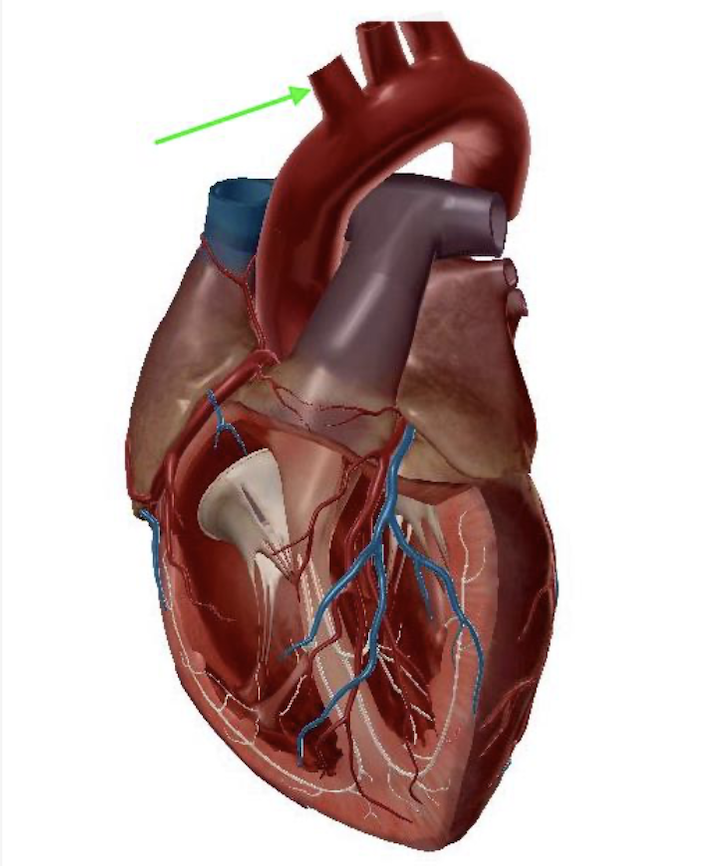
identify this vessel
brachiocephalic trunk
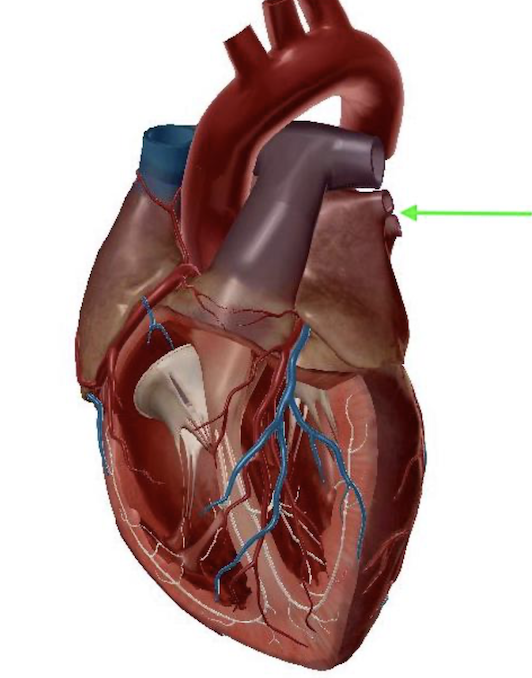
identify this vessel
pulmonary vein
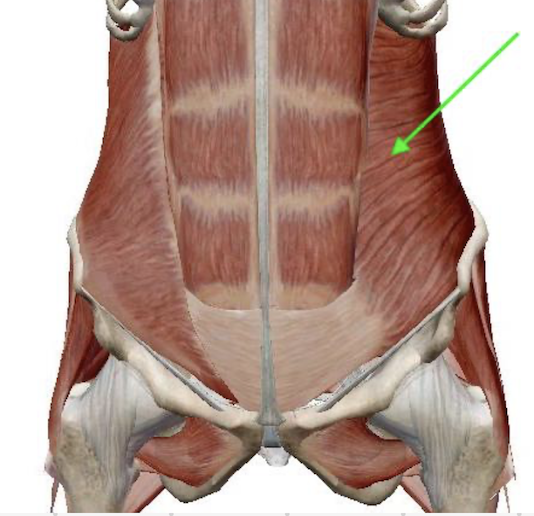
identify this muscle
transversus abdominis
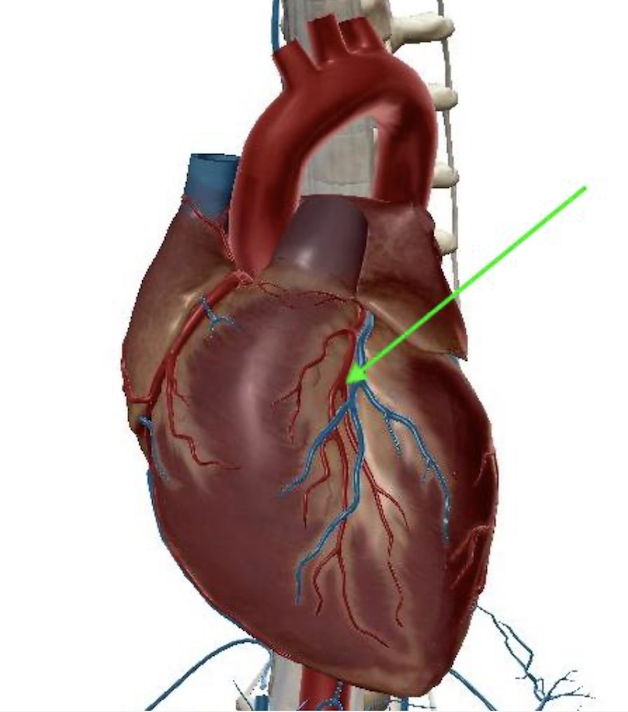
identify this vessel
left anterior descending artery
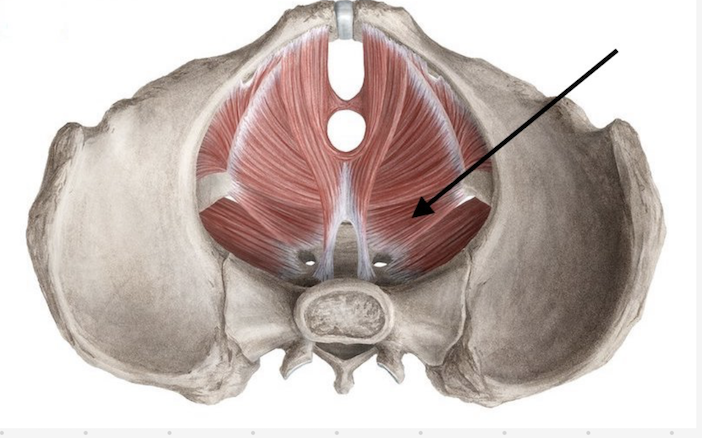
identify tagged muscle
ischiococcygeus (coccygeus)