03 Chemical Bonding
 Call Kai
 Learn
Learn Practice Test
 Spaced Repetition
 Match
Match Flashcards
 Knowt Play
1/32

There's no tags or description
Looks like no tags are added yet.
Name | Mastery | Learn | Test | Matching | Spaced | Call with Kai | Chat |
|---|
No analytics yet
Send a link to your students to track their progress
33 Terms
VSEPR: 2 bond pairs, 0 lone pairs
Linear, 180˚
VSEPR: 3 bond pairs, 0 lone pairs
Trigonal planar, 120˚
VSEPR: 2 bond pairs, 1 lone pair
Bent, <120˚
VSEPR: 4 bond pairs, 0 lone pairs
Tetrahedral, 109.5˚
VSEPR: 3 bond pairs, 1 lone pair
Trigonal pyramidal, ~107˚
VSEPR: 2 bond pairs, 2 lone pairs
Bent, ~105˚
VSEPR: 5 bond pairs, 0 lone pairs
Trigonal bipyramidal, 120˚ or 90˚
VSEPR: 4 bond pairs, 1 lone pair
See-saw, N.A. angle
VSEPR: 3 bond pairs, 2 lone pairs
T-shape, 90˚
VSEPR: 2 bond pairs, 3 lone pairs
Linear, 180˚
VSEPR: 6 bond pairs, 0 lone pairs
Octahedral, 90˚
VSEPR: 5 bond pairs, 1 lone pair
Square pyramidal, <90˚
VSEPR: 4 bond pairs, 2 lone pairs
Square planar, 90˚
Explain the shape of molecules using VSEPR theory.
Electron pairs are arranged as far as apart as possible in space to minimise mutual repulsion.
Explain the reasons for deviation in bond angles.
Lone pair-bond pair repulsion is greater than bond pair-bond pair repulsion. Lone pair of electrons on the central atom exerts greater repulsion than the bond pairs of electrons in the __ bond.
Electron pairs exert greater repulsion than the unpaired electron. Bond pair-bond pair repulsion is greater than bond pair-unpaired electron repulsion.
In a polar covalent bond, how are partial positive and negative ends distributed, how do they arise and how does this affect the bonding electrons?
Partial positive: Less electronegative atom. Partial negative: More electronegative atom. Arises due to unequal sharing of bonding electrons between two atoms. Bonding electrons are closer to the more electronegative atom.
What factors affect the strength of an ionic bond?
The greater the lattice energy, the stronger the ionic bond. Greater lattice energy = higher charge and smaller size/radius
What factors affect the strength of a metallic bond?
Stronger metallic bond = higher charge, smaller size/radius (higher charge density, greater attraction), greater no. of valence electrons
Why is graphite able to conduct electricity?
Each C atom covalently bonded to 3 other C atoms with weak intermolecular forces of attraction between layers. Presence of delocalised, unbonded electrons that act as mobile charge carriers to conduct electricity.
How can a dative covalent bond be formed?
The atom accepting the bonding electrons must have a vacant, low-lying orbital in the same subshell as the occupied valence orbitals.
For cations and anions with more than one atom, which atoms gain/lose electrons?
Cation: less electronegative atom (central atom) loses electrons
Anion: more electronegative atom gains electrons
What is the criteria for covalent bonds to occur? What types of bonds are there? What do single, double and triple bonds consist of?
When the valence orbitals of two atoms have an effective overlap.
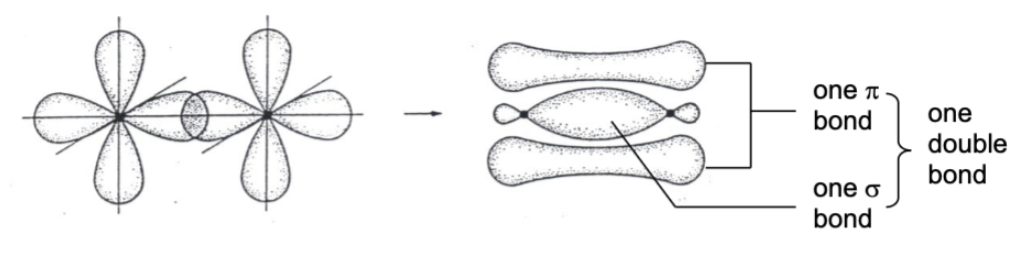
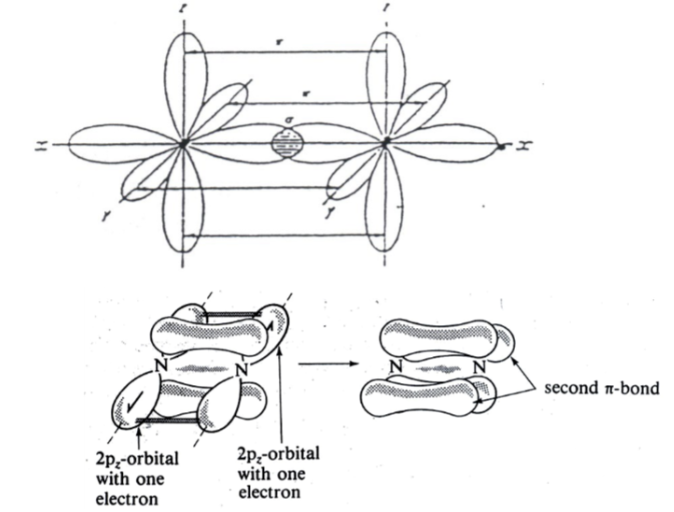
Sigma bond: head-on overlap. Pi bond: side-to-side overlap
Single: 1 sigma; Double: 1 sigma 1 pi; Triple: 1 sigma 2 pi
Draw a double covalent bond with a sigma and pi bond.
Draw a triple covalent bond with sigma and pi bonds.
What determines degree of covalent character of an ionic bond?
Greater polarising power of cation = more covalent character = higher charge, smaller size
Greater ease of polarisability of anion = more covalent character = larger electron cloud, easier to distort
How do instantaneous dipole-induced dipole interactions arise?
Electrons are constantly moving. At any given moment, the electron density of a particle can be asymmetrical, resulting in an instantaneous dipole which induces a short-lived dipole in a neighbouring molecule.
What produces a stronger id-id interaction?
Greater no. of electrons = greater size of electrons = greater ease of polarisability of electron cloud = greater strength of id-id interactions
Less branching of molecules = greater surface area for intermolecular interactions = greater strength of id-id
How do permanent dipole-permanent dipole interactions arise?
There is electrostatic attraction between the partial positive end of one molecule and partial negative end of another molecule.
What produces a stronger pd-pd interaction?
Greater difference in electronegativity = greater dipole moment = stronger pd-pd interaction
How do hydrogen bonds arise?
A hydrogen atom (partial positive) is covalently bonded to a F/O/N atom (partial negative).
What affects the strengths of hydrogen bonds?
Greater no. of average hydrogen bonds per molecule (average hydrogen bonds = smaller no. between no. of the lone pairs and the no. of H atoms) = more extensive and stronger hydrogen bonds
Why do the hydrogen bonds in ice make it less dense than liquid water?
Each O atom in ice is tetrahedrally bonded to 4 H atoms, 2 by covalent bonds and 2 by hydrogen bonds. The water molecules form rigid 3D networks which gives it an open structure, preventing molecules from getting close to each other. So ice occupies a larger volume.
How do intramolecular hydrogen bonds affect boiling point and solubility?
Formation of intramolecular bonds = less sites available for hydrogen bonds with other same molecules = less extensive intermolecular hydrogen bonds = lower boiling point
When added to water, less hydrogen bonds with water due to intramolecular hydrogen bonds = less soluble