07 - Precipitation hardening of Aluminium
 Call Kai
 Learn
Learn Practice Test
 Spaced Repetition
 Match
Match Flashcards
 Knowt Play
1/18

There's no tags or description
Looks like no tags are added yet.
Name | Mastery | Learn | Test | Matching | Spaced | Call with Kai | Chat |
|---|
No analytics yet
Send a link to your students to track their progress
19 Terms
What’s heat treatment?
Controlled process of heating / cooling a metal / alloy to alter its physical & mechanical properties w/ changing its shape
What’s precipitation (age) hardening?
Heat treatment used to strengthen & harden alloys
→ based on the precipitation of metastable phases in finely dispersed form, so that they represent an effective obstacle to dislocation motion
For which kind of metals is the precipitation (age) hardening process the most important?
For non-ferrous (iron is not the main element) materials → most important process to achieve high strength
Note: Aluminium alloys in particular would have almost no significance as construction materials w/ age hardening
Why is precipitation hardening the most important way of increasing the strength of aluminium alloys?
Because they can’t be hardened by martensitic transformation since they do not exhibit polymorphism as iron (change in the crystal structure)
What’s the main difference between precipitation hardening & hardening via martensitic transformation?
Martensitic transformation
→ doesn’t depend on diffusion (no diffusion or precipitation)
Precipitation hardening
→ diffusion-dependant (clusters form with diffusion of Cu atoms in Alu alloys)
What are the prerequisites for precipitation hardening?
alloying elements that have better solubility at higher temperature than at lower temperatures
precipitation of a 2nd phase during slow cooling from the annealing temperature
Quenchability of the alloy → ability to retain solute atoms when rapidly cooled (and thus strengthen)
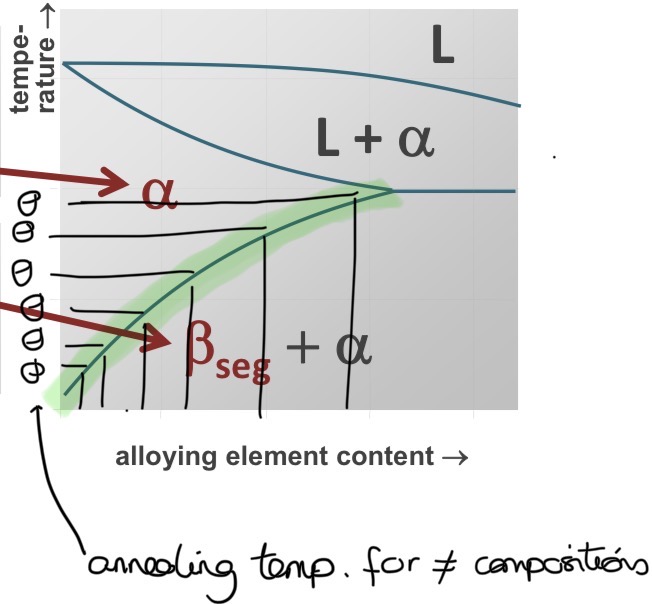
What are the different stages of precipitation hardening?
Explain them
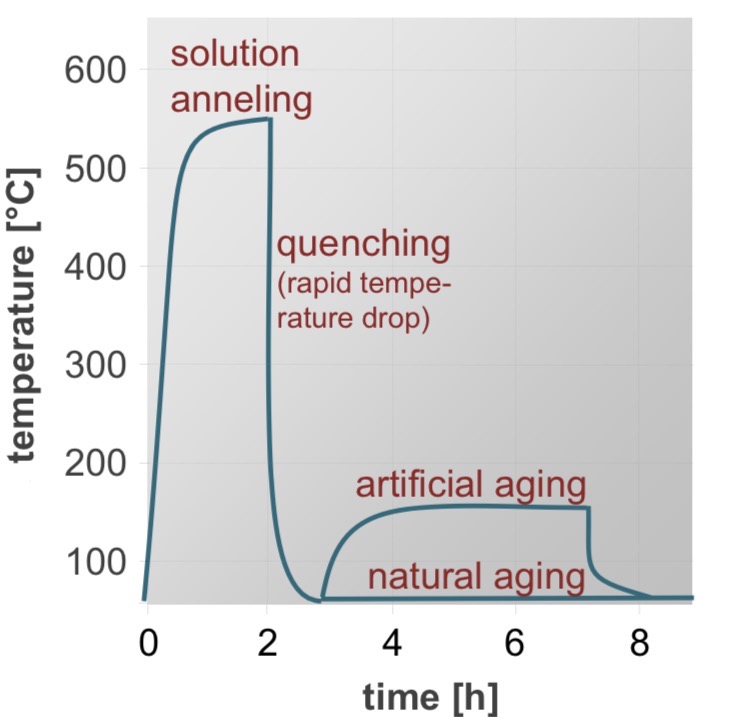
Draw a graph to illustrate it.
SOLUTION ANNEALING
→ the alloy is heated up to a temperature where alloying elements dissolve & form a homogeneous solid solution
→ ensures all solute atoms are uniformly distributed
QUENCHING
→ rapid cooling
→ “freezes” the alloying elements (dissolved in the homogeneous solid solution formed in the previous step) → no diffusion or precipitation
→ supersaturated solution (the solid holds more solute atoms than it would at equilibrium)
AGING
natural aging
→ occurs at low (room) temperature over an extended period of time (hours to days)
→ gradual precipitation & strengthening
→ uncontrolled process, depends on ambient conditions
artificial aging
→ heating the alloy to moderate temperature (above room temp, below annealing temp)
→ faster (minutes to hours)
→ accelerated diffusion, faster & more uniform precipitation
→ controlled temperature & time to get the desired properties
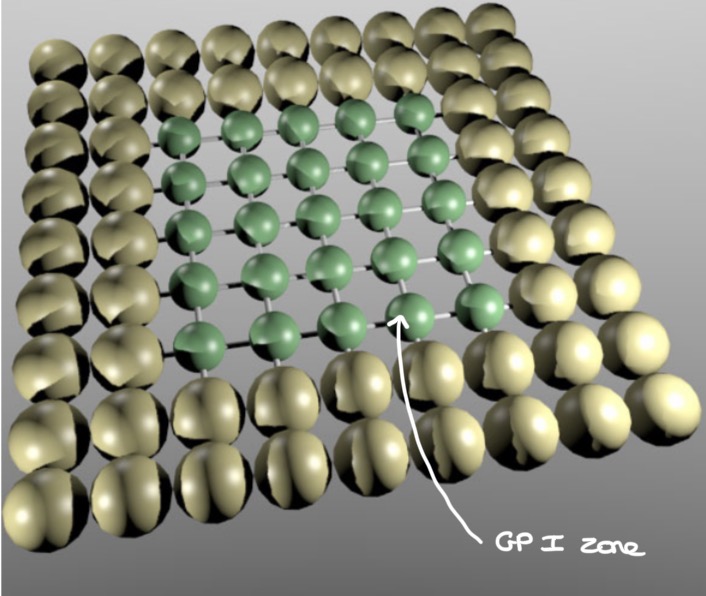
What actually happens at the atomic scale during aging?
What’s the difference between natural aging & artificial aging?
Alloying elements’ atoms diffuse & cluster in certain areas, forming precipitates
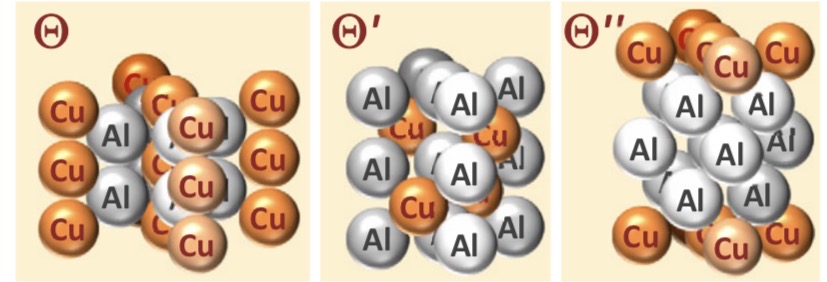
These precipitates appear following a specific order / sequence (for Alu):
Supersaturated solution → clusters → GP I → GP II (theta’’) → theta’ → theta
Each precipitate forms from a given temperature until a temperature where they’re no longer stable → at this point, they dissolve (go back to the surrounding Alu matrix)
These phases can coexist within a specific time-temperature range
Natural aging
→ GP I form first (monoatomic layers, with coherent lattice structure)
Artificial aging
→ GP II form first (several atomic layers thick, with coherent lattice structure)
When is the maximum hardness reached in artificial aging?
When GP II and theta’ phases coexist
What happens as time passes during aging?
The system tries to reach equilibrium (theta-phase)
→ the atoms rearrange into a more stable structure (GP I → GP II (theta’’) → theta’ → theta)
→ theta-phase is the “finish line”, the only stable phase. Every other phase is metastable: they only exist because the atoms didn’t have enough time to reach equilibrium
→ as a new phase grows, it consumes the copper from the previous phase, & their proportions change
How do we “freeze” the maximum hardness configuration when it’s been reached?
QUENCHING (again)
controlled precipitation using artificial aging (controlled temperature & time) to get GP II & theta’ coexisting
stopping at the peak hardness by quenching the material → rapid cooling that prevents atoms to have time to rearrange
Compare the different phases (precipitates) coherency with the Alu matrix
GP I & GP II: coherent
→ precipitate atoms (Cu) fit perfectly into the aluminium matrix
→ lattice planes are continuous across the boundaries
Theta’: partially coherent
→ some lattice planes line up, while other don’t
Theta: incoherent
→ the precipitate has its own unique crystal structure that doesn’t match the aluminium at all
→ distinct interface / boundary between them
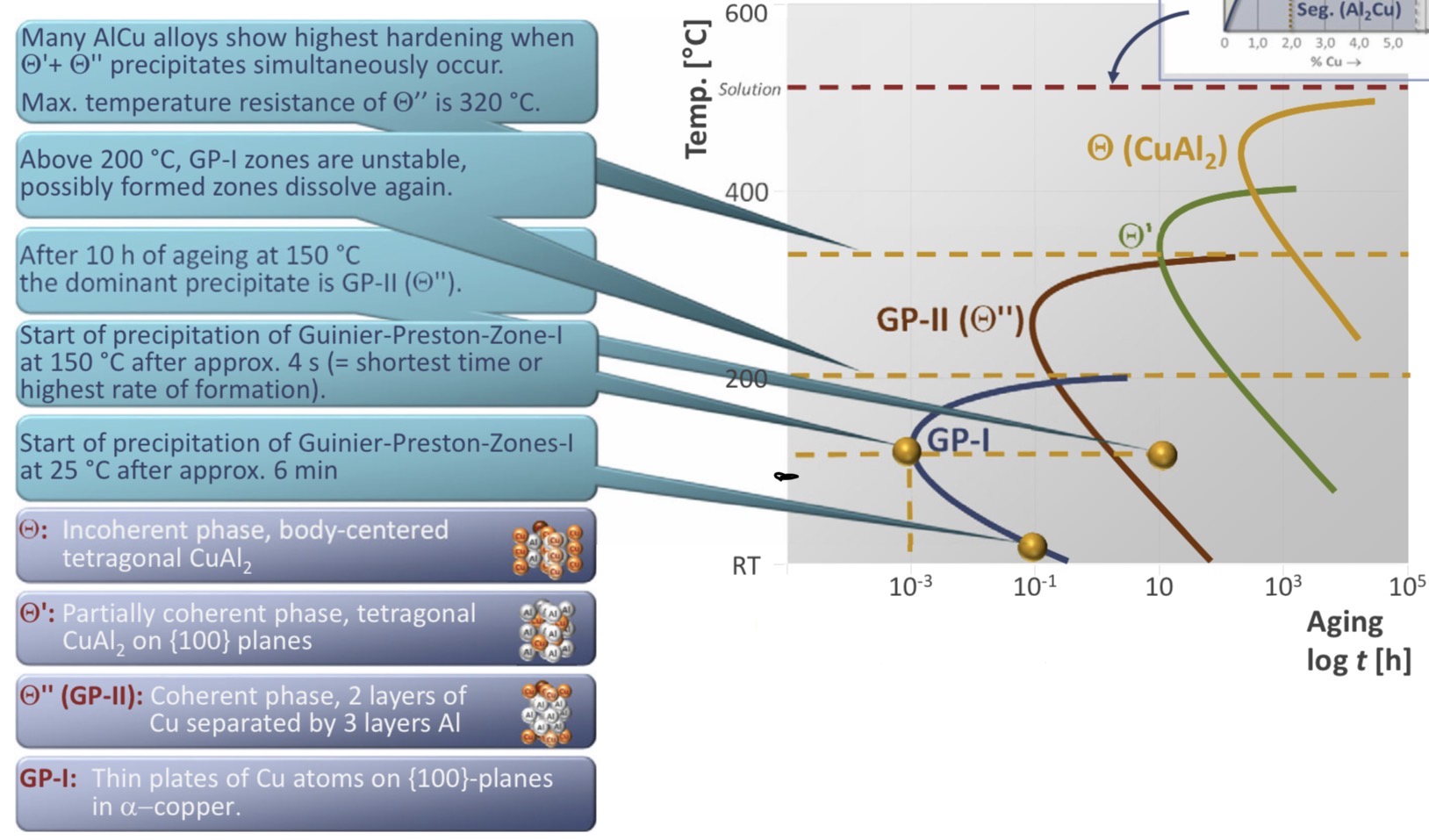
Draw the TT-precipitation diagram of Aluminium and explain it
Each phase exists in the right area of their curve
How does precipitation hardening actually strengthen a material?
What are the 2 involved mechanisms?
What’s the prerequisite for these to occur?
precipitations hinder dislocations movements and thus, make it more difficult to deform the material (since deformation occurs when dislocations move)
shearing mechanism (= cutting mechanism = Friedel effect)
Circumvention mechanism (= Orowan mechanism)
Prerequisite: small precipitations & finely dispersed (spread out homogeneously within the metal)
Explain how the shear & circumvention mechanisms work
SHEAR mechanism
External shear force pushes the dislocation through the crystal’s slip planes
When the dislocation hits the precipitates particles, it begins to bend slightly around them
The dislocation doesn’t go around the particles but moves through them
As the dislocation passes through, the 2 halves of the precipitate are irreversibly shifted against each other
CIRCUMVENTION mechanism
External shear force pushes the dislocation through the crystal’s slip planes
When the dislocation hits a precipitates particle, it bends around it
As the stress increases, the dislocation continue to bow until the 2 segments (with opposite orientation) meet on the opposite side of the particle, forming a closed loop which encloses the particle, leaving a dislocation ring around it
The free dislocation segments recombine & continue moving
What makes the material stronger in both shear & circumvention mechanisms?
They increase the external force required to cross the precipitations, and thus, deform
Bending a piece of Alu = forcing millions of dislocations to slide through the crystal lattice & to cross the precipitations particles
When precipitates are added to pure Aluminium, a low external force that was previously sufficient to deform the material, becomes insufficient → the dislocations get stuck because of the precipitates
Shear mechanism
slicing the particles in half requires higher stress
→ strengthening of the material
Circumvention mechanism
Bypassing the particles requires higher stress
→ strengthening of the material
Explain the influence of the particles’ size on the strengthening of the material for both shear & circumvention mechanisms
Shear mechanism
As the diameter increases, particles get bigger & harder to cut
→ required stress increases
→ strengthening
circumvention mechanism
As the diameter increases, particles get bigger & go further apart from each others
→ easier for the dislocation to squeeze between them
→ required stress decreases
→ weakening
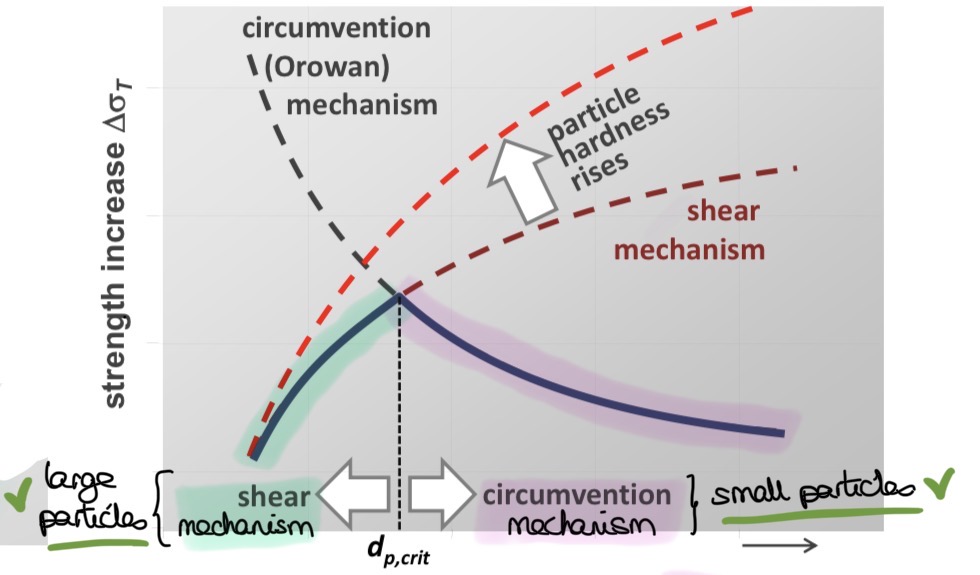
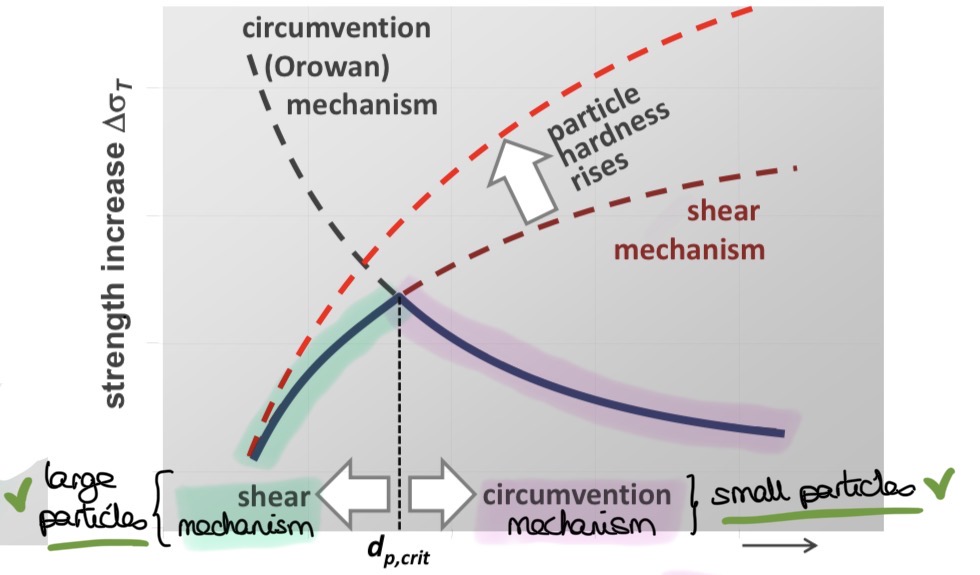
What’s the critical particle diameter d(p,crit)?
→ diameter at which the dominant strengthening mechanism shifts between shear & circumvention mechanism
→ optimal particle size for maximum strengthening
What’s over-aging?
How and when does it happen?
What does it do?
Occurs during the aging stage, when the alloy is held at the aging temperature for too long
→ coarsening of particles (thicker, less defined)
→ larger spacing between particles
→ incoherent attachment to the matrix lattice
→ less effective obstacles to dislocations
→ reduces hardness & strength