Cell Communication- PART B
 Studied by 0 people
 Call Kai
 Learn
Learn Practice Test
 Spaced Repetition
 Match
Match Flashcards
 Knowt Play
1/16

There's no tags or description
Looks like no tags are added yet.
Name | Mastery | Learn | Test | Matching | Spaced |
|---|
No study sessions yet.
17 Terms
Which gas can be used as a signal molecule and what enzyme does it interact with?
Nitric Oxide interacts with Guanyl Cyclase
What does Nitric Oxide do in muscle relaxation?
Response to signal from nerve cell- the cells lining the inside of the artery produce NO (Catalysed by an enzyme called nitric oxide synthase)
NO diffuses out of the cells lining the artery wall and into the smooth muscle layer which surrounds it
What is signal transduction do (broad)?
Receptor activates another protein , which activates another, and so on, until the protein producing the response is activated
At each step, the signal is transduced into a different form, usually a shape change in a protein.
What are the steps in signal transduction?
Reception, Transduction, Response
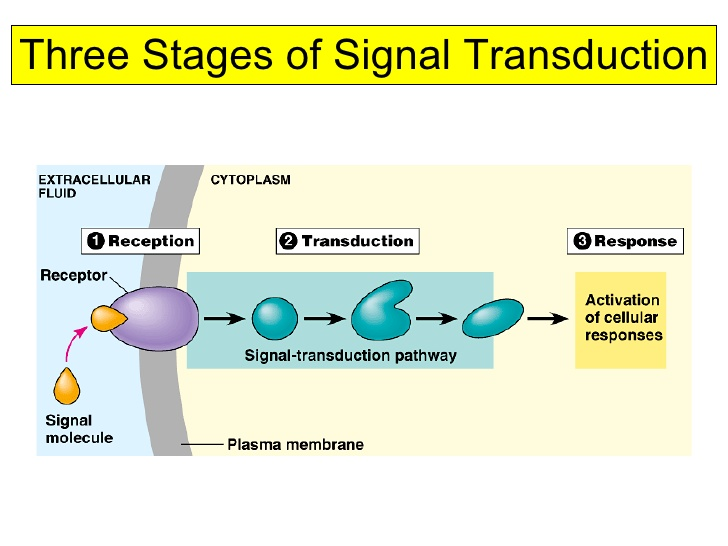
What is reception in signal transduction?
A ligand (signalling molecule) binds to a receptor on the cell surface or inside the cell
Receptors are usually proteins that are highly specific to their ligand (similar to a lock and key)
What is transduction in signal transduction?
The receptor changes shape or activity, triggering a cascade of intracellular activity
Involves second messengers (like cAMP or calcium ions) and protein kinases that phosphorylates other proteins
What is reception in signal transduction?
The cell responds by altering gene expression, enzyme activity, or cell behaviour (e.g. cell division, movement, secretion)
What is role of protein phosphorylation in signalling pathways?
Phosphorylation and Dephosphorylation of proteins is a widespread cellular mechanism for regulating protein activity.
Protein Kinases transfer phosphates from ATP to protein, a process called phosphorylation.
Protein Phosphorylation rapidly removes the phosphates from proteins, a process called dephosphorylation.
Steps in signalling pathway?
Signal Detection, Activation of a pathway, Signal Relay Amplication, Cellular Response
What is a signalling pathway?
Signal Detection
A ligand(signal molecule) binds to a receptor on the cell surface or inside the cell
This receptor is like a sensor that recognizes specific signals
Activation of the pathway
The receptor changes shape or activity, triggering a cascade of reactions
These reactions often involve second messengers (like cAMP or calcium ions) and protein kinases (enzymes that add phosphate groups to other proteins)
Signal Relay and Amplication
Each step requires more and more molecules, amplifying the signal
This ensures a small signal can produce a big response
Cellular Response
The final target might be a transcription factor (which turns genes on or off), an enzyme, or part of the cell's structure
Cell might divide, move, secrete something, or change metabolism.
What does the enzyme Guanyl Cyclase do?
Activated by the binding of nitric oxide- functions as the receptor
Leads to the relaxation of arteries by stimulating cGMP production
Catalyses the formation of cyclic GMP (cGMP) from guanosine tri-phosphate (GTP)
The cGMP causes the smooth muscle to relax, and blood flow through the blood vessel increases.
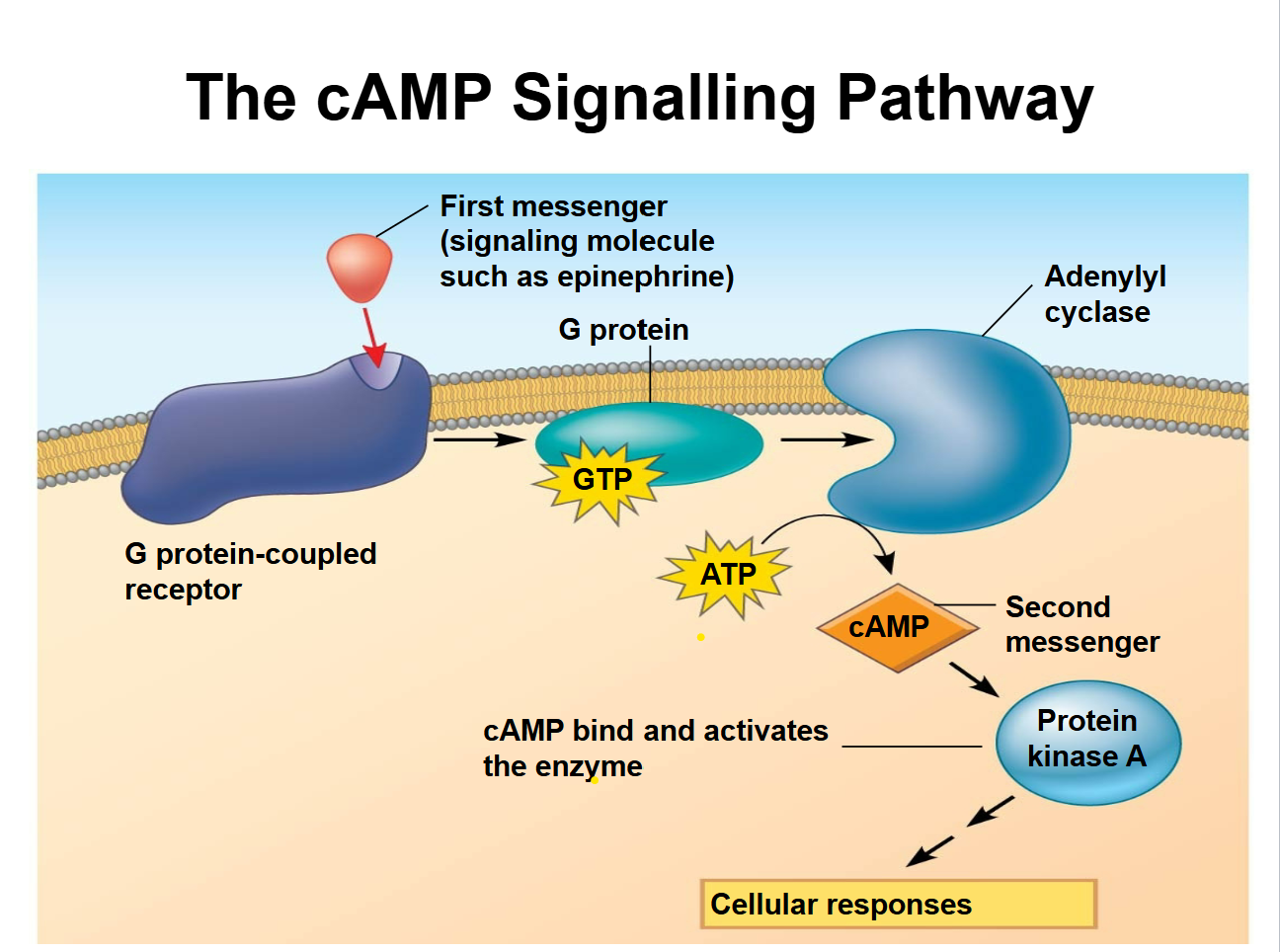
What does the enzyme adenylyl cyclase do? How is it activated in a signalling pathway?
Pathway is called cAMP-dependant pathway
converts ATP into cyclic AMP (cAMP), a second messenger
CAMP activates protein kinase, which phosphylates target proteins to regulate gene expression, metabolism and more
Activated by G Protein-Coupled receptors (GPCR) binding to the enzyme which stimulates it
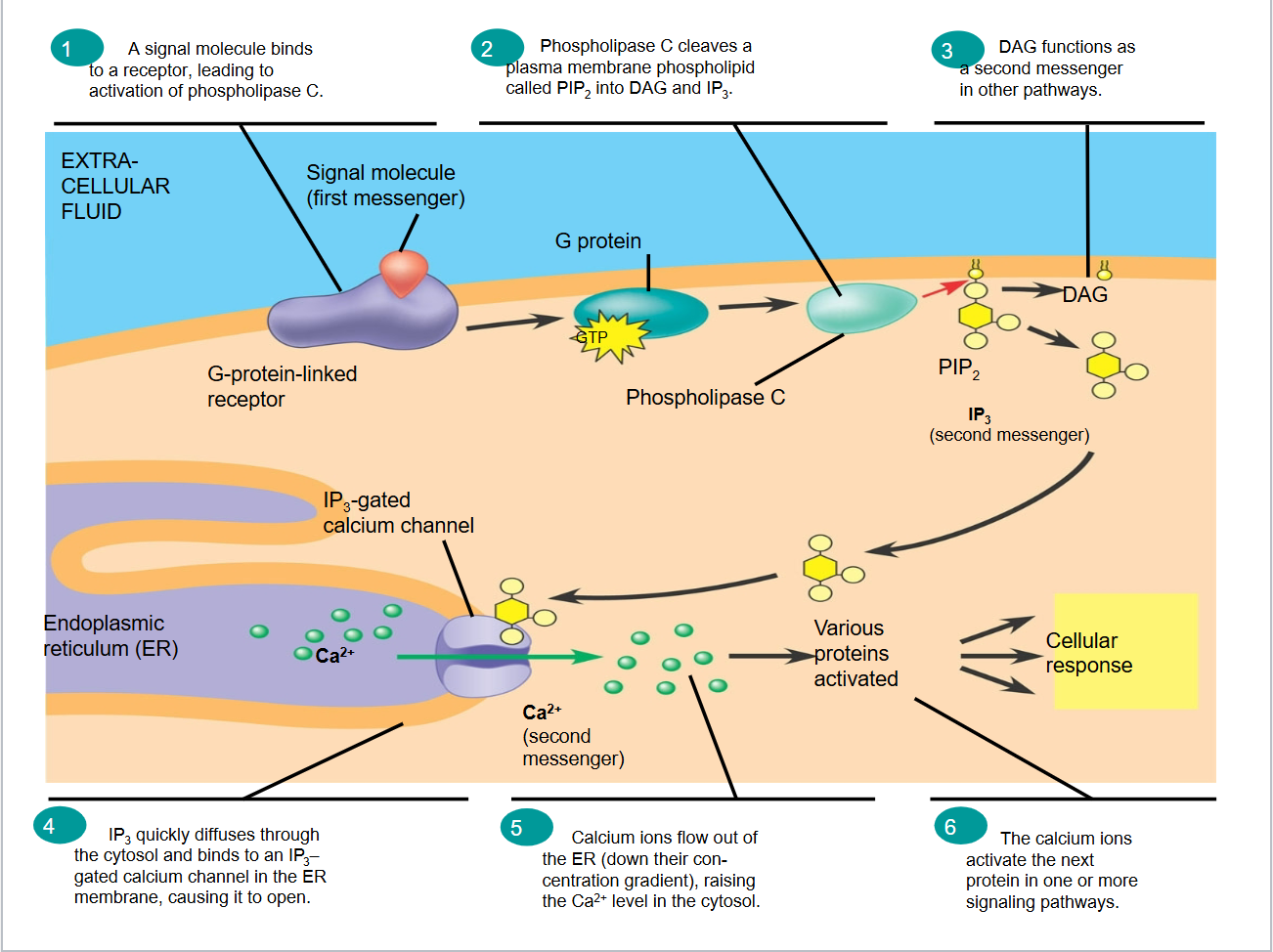
What is the enzyme phospholipase C do? How is it activated in a signalling pathway?
Enzyme that breaks down a membrane lipid called PIP2.
Cleavage produces 2 second messengers: DAG and IP3
IP3- diffuses through the cytosol and binds to IP3 gated calcium channel in ER membrane, causing it to open
How does cyclic GMP (cGMP) function as a messenger in signalling pathways?
Made from GTP by guanylyl cyclase.
Activates protein kinase G (PKG).
Regulates smooth muscle relaxation, vision (retina), and vasodilation.
Often triggered by nitric oxide (NO) or light in photoreceptor cells.
How does cyclic AMP (cAMP) function as a messenger in signalling pathways?
Produced from ATP by the enzyme adenylyl cyclase.
Activated by G protein-coupled receptors (GPCRs).
Activates protein kinase A (PKA), which phosphorylates target proteins.
Involved in processes like energy metabolism, gene expression, and hormone response.
How does Calcium (Ca2+) function as a messenger in signalling pathways?
Stored in the endoplasmic reticulum (ER) and released into the cytoplasm.
Release triggered by signals like IP₃ (inositol triphosphate).
Binds to proteins like calmodulin, activating enzymes and pathways.
Controls muscle contraction, neurotransmitter release, and cell growth.
What are Second Messengers?
Definition: Signal amplification means one signal molecule triggers a large cellular response.
Purpose: To make the cell respond strongly and efficiently to even a small amount of signal.
How it works:
One receptor activates many second messengers.
Each second messenger activates multiple enzymes or proteins.
This creates a cascade effect, multiplying the signal at each step.
Result: A big response from a tiny signal — fast and powerful!