HS133 Dental Anatomy
 Call Kai
 Learn
Learn Practice Test
 Spaced Repetition
 Match
Match Flashcards
 Knowt Play
1/42

There's no tags or description
Looks like no tags are added yet.
Name | Mastery | Learn | Test | Matching | Spaced | Call with Kai | Chat |
|---|
No analytics yet
Send a link to your students to track their progress
43 Terms
What is dentition? The natural teeth in a jaw.
- a person has 2 dentitions during a lifetime
What are the different types of dentitions?
1. Primary
2. Mixed
3. Permanent
Primary Dentition
aka baby teeth, milk teeth.
appropriate term deciduous teeth
20 in total
8 incisors, 4 canine, 8 molars
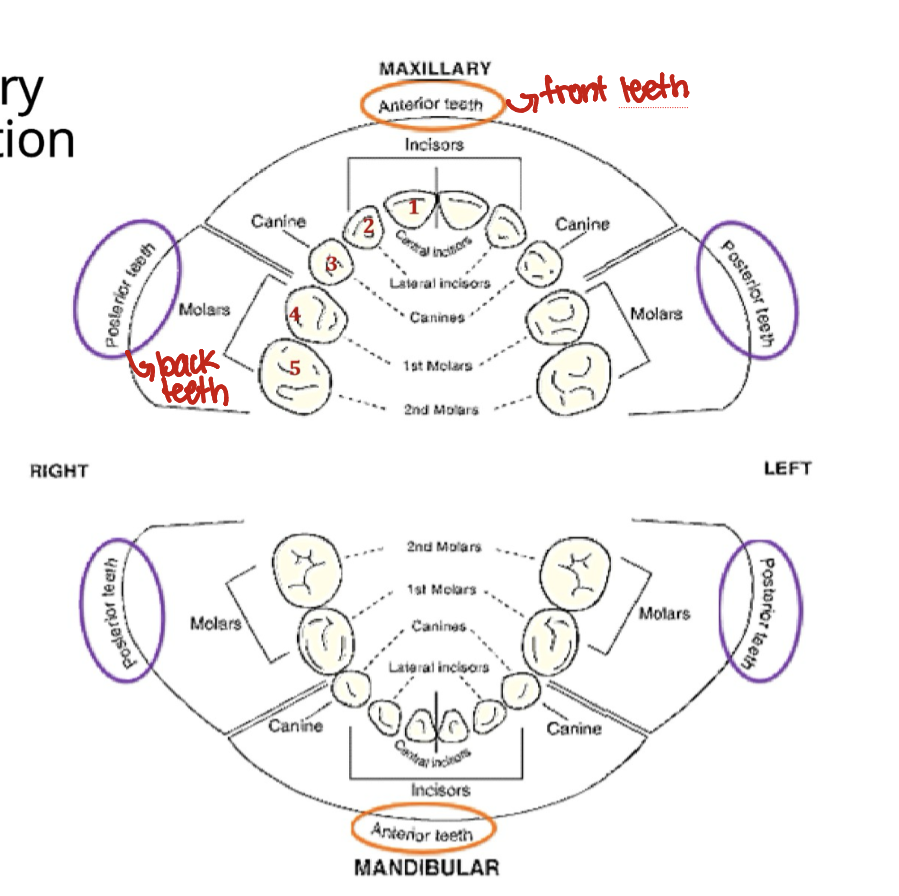
what type of dentition is this?
primary dentition
Permanent Dentition
aka secondary dentitions “adult teeth”
should have 32 teeth
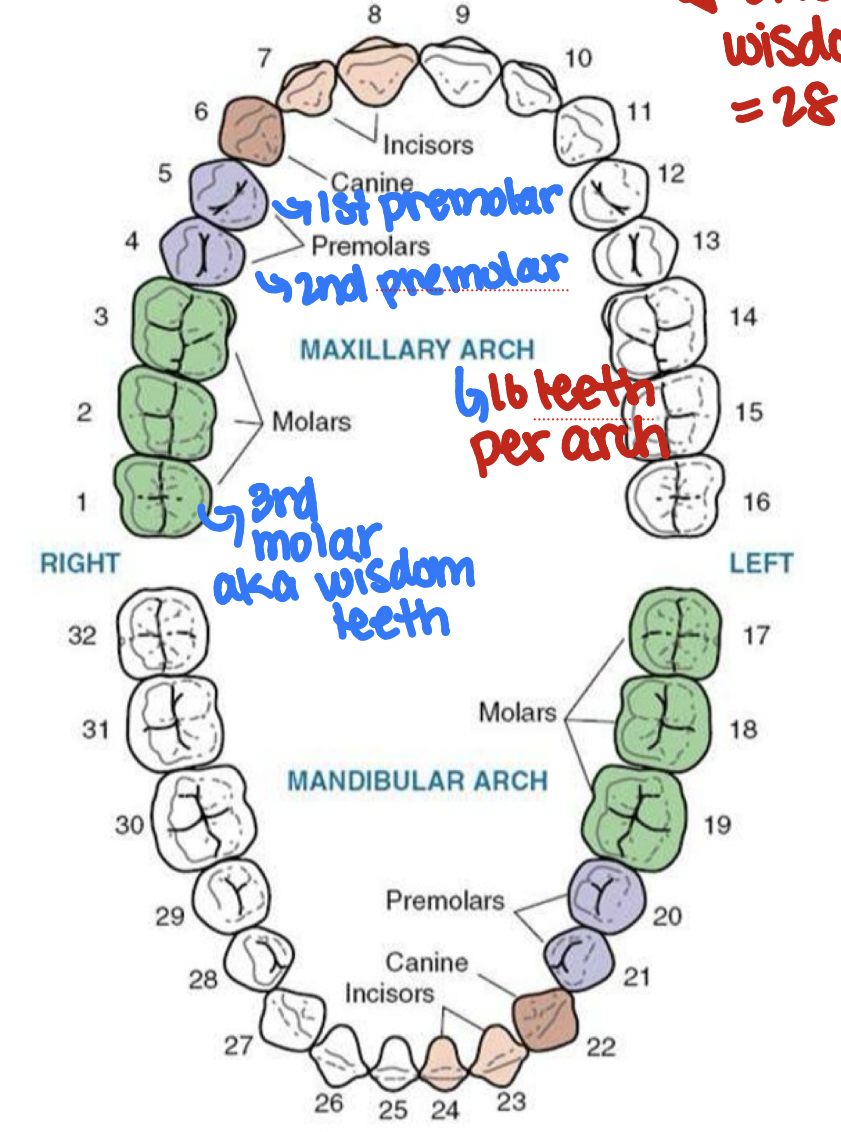
what is the break down of teeth in permanent dentition?
32 teeth
8 incisor
4 canine
8 premolars
12 molars
Mixen dentition
both primary and permeant teeth are present
is considered a mixed as soon as the first permanent teeth erupts
Approximately at what ages does mixed dentition period begin and end?
begin around age 6 when first premolar erupts, end around age 13 when last primary tooth exfoliates
what does exfoliate mean?
shedding or loosing of primary teeth
define succedaneous
permanent teeth that take place of the deciduous (primary) teeth
define non succedaneous
permanent teeth that do not replace deciduous teeth.
ex: permanent molars, do not replace any primary teeth.
only found in permanent dentition not found in primary.
Types of teeth
incisors
canine
premolars
molars
General functions of teeth
1. eating (cutting, holding and grinding)
2. Communication (speech, phonetics, whistling)
3. protection (hard physical barriers to protect oral structure)
4. aesthetics
What is the function of incisors?
To bite, shear and cut food, due to their triangular proximal form.
How many incisors do human have?
8 total.
-Four maxillary and four mandibular.
- central and lateral
What is the function of canines?
tearing, piercing, holding
- due to their tapered (spear head) shape and prominent cusp.
- longest teeth in the dentition
- best-anchored, most stable due to having the longest root
How many canines do human have?
4 Total
- 2 maxillary, 2 mandibular
Which teeth are only found in the permanent dentition?
Permanent molars.
- not found in primary dentitions
What is the function of premolars? holding, grinding and piercing
- assist molars in grinding food and canines in piercing and tearing.
how many premolars does a permanent dentition have?
8 total
- 4 maxillary, 4 mandibular (2 in each quadrant)
Which teeth have the largest and strongest crowns?
Molars.
What is the function of molars?
chew, grind and crushing
how many molars can a permanent dentition have?
up to 12
what is a alveolus?
cavity/socket in the alveolar process in which the root of the tooth is held
what is the alveolus process?
Part of the bone in the maxillae and audible that forms the socket for each tooth.
- the bone itself that supports and surround the tooth.
what is the difference between alveolus and alveolus process?
alveolus is located in the alveolus process
the alveolus is referring to the socket/cavity itself while the process refers to the bone making this socket
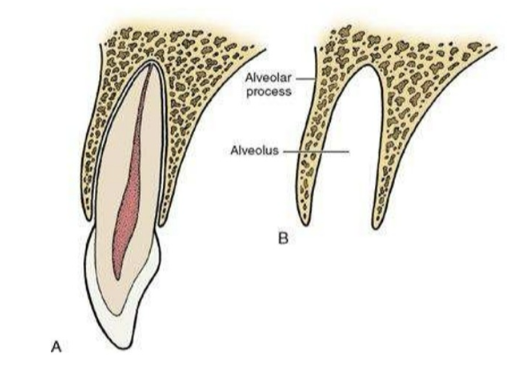
what is each alveolar process of the jaw also considered?
Dental arch
all teeth in the upper and/or lower jaw forming into a arch shape
what is the term for the upper arch?
Maxillary arch
what is the term for the lower arch?
Mandibular arch
What is the occlusal plane?
An horizontal imaginary curved plane separating the maxilla (upper) and mandible (lower).
occlusal plane= upper and lower half
What is the midsagittal plane?
An vertical imaginary plane dividing the skull into left and right sides.
midsagittal = left and right half
remember as midsagittal = down the midline
Quadrants
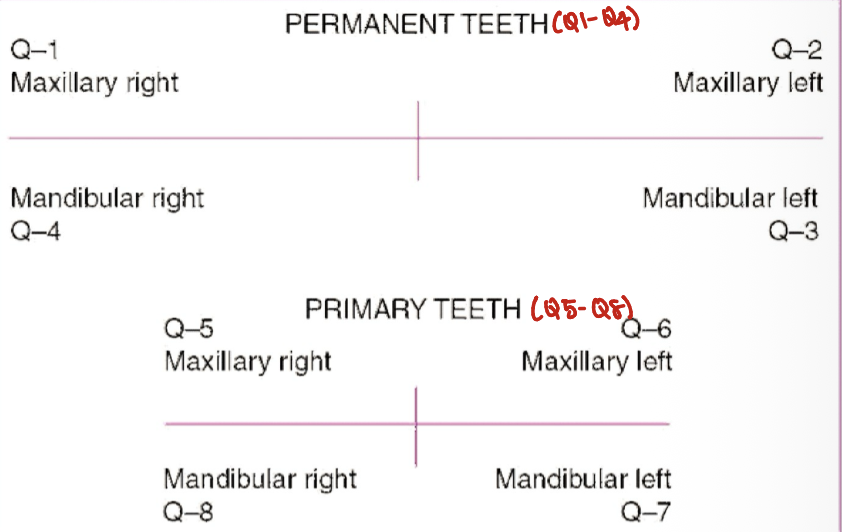
occlusal and midsagittal planes are used to divide the jaw, into 4 quadrants
how are the 4 quadrants referred?
Q1 (upper right)- Maxillary right
Q2 (upper Left)- Maxillary left
Q3 (lower left)- Mandibular left
Q4 (lower right)- Mandibular right
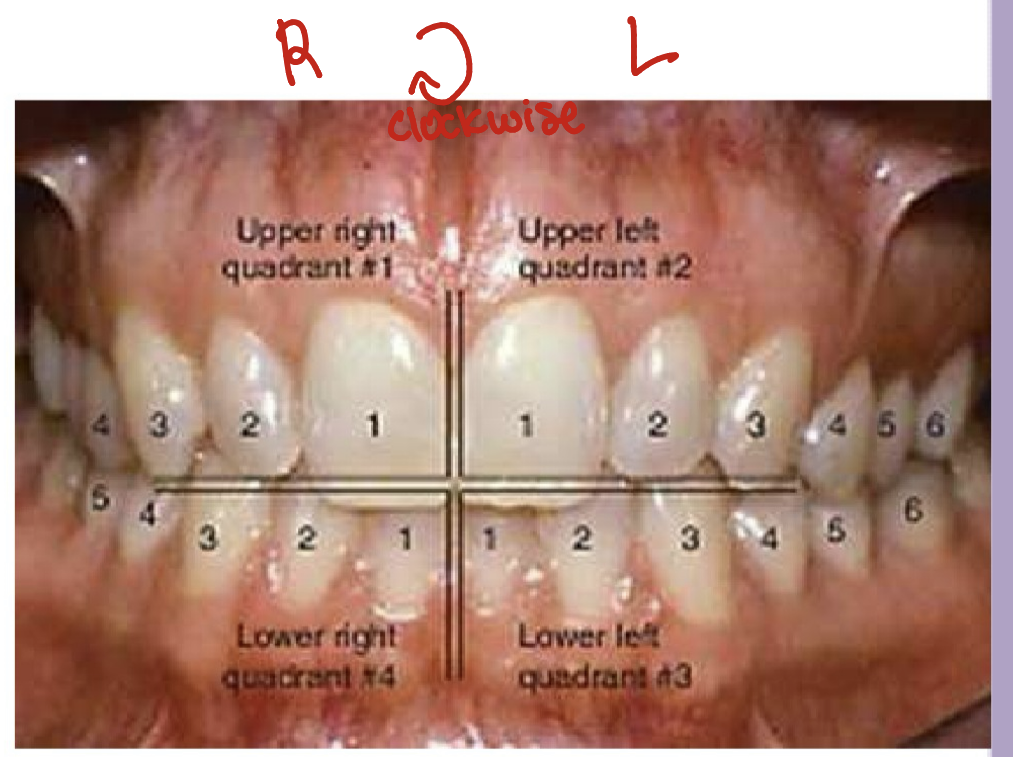
What is the quadrant system for primary teeth?
Q1=Q5, Q2=Q6, Q3=Q7, Q4=Q8 . uses Q5-8
D A Q T
Dentition: permanent or primary
Arch: maxillary or mandibular
Quadrant: Left or right
Tooth: central/ lateral incisor, canine, premolars, molars
Midline
Divides each arch into a left and right side
Anterior
front teeth
closest to the midline
included incisor and canines
Posterior
away form the midline
premolars and molars
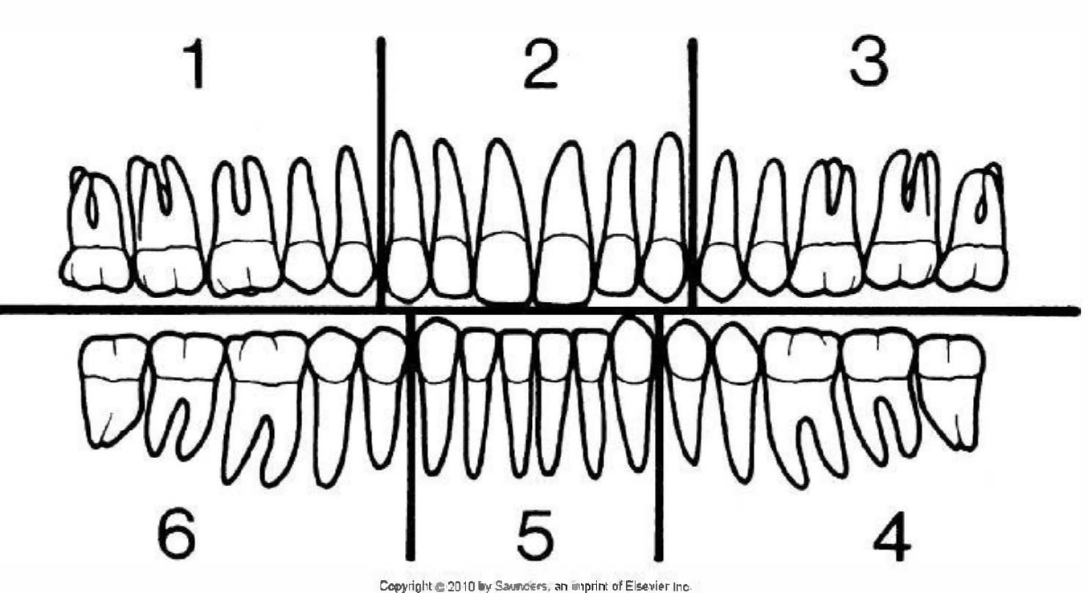
Sixtants
Divides in 6 segments
3 in each arch
how are the segments in sixtants divided
maxillary
Q1, Q2, Q3
mandibular
Q6, Q5, Q4
What are the three main tooth designation systems?
1. FDI (Federation Dentaire Internationale)
2. Universal System (US)
3. Palmer Notation Method
How are permanent teeth numbered in the Universal System?
Consecutively from 1 to 32 clockwise, starting with the upper right third molar.
What does the D-A-Q-T system stand for in tooth description?
Dentition, Arch, Quadrant, Tooth.
According to nomenclature rules, which terms always precede all other terms?
Mesial and distal, with mesial taking precedence.