Combined Cell/Molecular Bio & Heredity
 Call Kai
 Learn
Learn Practice Test
 Spaced Repetition
 Match
Match Flashcards
 Knowt Play
1/303

There's no tags or description
Looks like no tags are added yet.
Name | Mastery | Learn | Test | Matching | Spaced | Call with Kai | Chat |
|---|
No analytics yet
Send a link to your students to track their progress
304 Terms
Cell Theory
All living organisms consist of one or more cells.
RNA World Hypothesis
Self-replicating RNA molecules were life's precursors.
Central Dogma of Biology
Genetic information flows from DNA to RNA to protein.
Polymerase Chain Reaction (PCR)
Amplifies DNA sample through denaturation, annealing, elongation.
Denaturation
High heat separates double-stranded DNA during PCR.
Annealing
Cooling allows primers to attach to DNA strands.
Elongation
Polymerase synthesizes new DNA strands during PCR.
Centrifugation
Separates components of a liquid sample by spinning.

DNA Sequencing
Determines the sequence of base pairs in DNA/RNA.

Blotting Techniques
Identifies specific DNA, RNA, or protein fragments.
Southern Blotting
Technique for detecting specific DNA sequences.
Northern Blotting
Technique for detecting specific RNA sequences.
Western Blotting
Technique for detecting specific protein sequences.
Gel Electrophoresis
Separates DNA by size and charge using a gel.
Microarray Assays
Monitors expression of large gene groups in genomes.
Recombinant DNA
Contains DNA segments from multiple sources.
Restriction Enzymes
Cut DNA at specific sequences to create sticky ends.
DNA Ligase
Connects DNA fragments to form recombinant DNA.
Transformation
Introducing plasmid DNA into bacteria for cloning.
Gene Libraries
Collections of DNA pieces from a genome.
Dideoxy Chain Termination
DNA synthesis requires free OH group on 3' carbon.
Confocal Laser Scanning Microscope
Uses fluorescent tagging to observe specific cell parts.
Light Microscope
Uses visible light to view thin biological samples.
Scanning Electron Microscope
Views surfaces of 3D objects with high resolution.
Genome Size
Total number of nucleotides in an organism.
Gene Number
Total number of coding sequences in an organism.
Gene Density
Ratio of gene number to genome size.
Repetitive DNA
Non-coding DNA unrelated to organism function.
Unique DNA
Coding sequences specific to an organism.
Transposable Elements
DNA sequences that can change positions within the genome.
Alternative Splicing
Single gene produces multiple protein products.
Introns
Non-coding regions within genes, absent in prokaryotes.
Exons
Coding sequences that remain in mRNA after splicing.
Epigenetics
Study of heritable changes without altering DNA sequence.
DNA Methylation
Addition of methyl groups, silencing gene expression.
Histone Acetylation
Modification that increases gene expression accessibility.
Genomic Imprinting
Expression of genes depending on parental origin.

Temperature-Dependent Sex Determination
Sex determined by environmental temperature during development.
Prader-Willi Syndrome
Condition due to paternal gene deletion on chromosome 15.
Angelman Syndrome
Condition due to maternal gene deletion on chromosome 15.
Queen Bees
Genetically identical, but express different genes due to diet.
Eukaryotes
Organisms with complex cells containing a nucleus.
Prokaryotes
Simple organisms without a nucleus, fewer genes.
Non-coding RNA
RNA molecules that do not code for proteins.
Gene Complexity
Eukaryotes have more complex genomes than prokaryotes.
Junk DNA
Non-coding DNA with no known function.
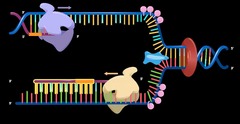
DNA Replication
Copying genetic information in cells.
Leading Strand
Synthesized continuously during DNA replication.
Lagging Strand
Synthesized discontinuously with Okazaki fragments.
Okazaki Fragments
Short nucleotide stretches formed on lagging strand.
DNA Polymerase III
Enzyme synthesizing new DNA in 5' to 3' direction.
Helicase
Unzips DNA double helix into single strands.
RNA Primer
Initial RNA segment for DNA synthesis initiation.
Primase
Enzyme creating RNA primer for DNA replication.
Ligase
Seals gaps between Okazaki fragments.
Topoisomerase
Relieves stress from unwinding DNA strands.
Telomere
DNA segment protecting chromosome ends from degradation.
Telomerase
Enzyme adding telomeres to chromosome ends.
mRNA
Messenger RNA for protein synthesis.
tRNA
Transfers amino acids to mRNA codons.
rRNA
Forms part of ribosomes for protein synthesis.
Transcription
Synthesizing RNA from a DNA template.
RNA Splicing
Removing introns and reconnecting exons in mRNA.
Exons
Protein-coding regions of the genome.
Introns
Non-coding regions in pre-mRNA.
Translation
Synthesis of proteins from mRNA sequence.

Point Mutation
Single nucleotide change causing substitution, insertion, or deletion.
Frameshift Mutation
Shifts reading frame of RNA transcript.
Silent Mutation
Codon change does not alter amino acid.
Missense Mutation
New codon encodes a different amino acid.
Nonsense Mutation
Codon change results in a premature stop codon.
Wild Type
mRNA sequence without any mutation.
Plasmids
Small, circular DNA molecules in bacteria.
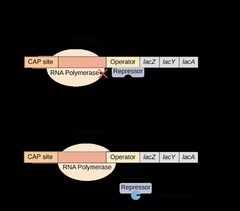
Lac Operon
Operon for lactose processing in prokaryotes.
Trp Operon
Operon for tryptophan synthesis in prokaryotes.

Operons
Gene clusters controlling transcription in prokaryotes.
Conjugation
DNA transfer via cell-to-cell contact in bacteria. Pilus (bridge) between bacteria is formed
Transformation
Uptake of free DNA from surroundings by a competent bacterium.
Transduction
DNA transfer via bacteriophage infection. EX: Virus that infects bacteria.

Genome
Complete genetic information of an organism.
Transcriptome
All RNA molecules produced by a cell.
Proteome
Complete set of expressed proteins in an organism.
Post-transcriptional processing
Adding 5' cap to 5' end and poly-A tail to 3' end of mRNA for stability
Initiation
1st step in transcription: RNA polymerase attaches to promoter region and unzips DNA into 2 strands
Elongation
2nd step in transcription: RNA polymerase synthesizes RNA nucleotides using one DNA strand as template
Termination
3rd step in transcription: RNA polymerase reaches a special sequence, detaches from DNA, and disassembles from complex
Locus
A gene's location within a genome
Gene
A basic unit or sequence of genetic material that encodes a trait
Homozygous
Carrying the same alleles on each homologous chromosome
Hemizygous
Having only one copy of a gene instead of two (e.g., sex chromosomes of males are XY)
Phenotype
The set of observable characteristics in an individual resulting from the expression of genotype (e.g., Genotype Aa can produce a brown eye phenotype while genotype aa can produce a blue eye phenotype)
Allele
A variant form of a gene
Wild type
Normal version of an allele
Mutant
An allele with an altered DNA sequence
Heterozygous
Carrying a copy of the recessive allele on one of the homologous chromosomes and a copy of the dominant allele on the other chromosome (e.g., Aa)
Homologous chromosomes
A pair of chromosomes (1 maternal, 1 paternal) that contain the same genes in the same locations
Genotype
The alleles an individual carries (e.g., Aa)
Mendel's Laws of Inheritance
Principles that describe how traits are inherited through generations
Law of Segregation
Pairs of alleles are separated when gametes are formed

Test Cross
A genetic cross between a homozygous recessive individual and an individual in question to determine the latter's genotype for a given trait