Lipid Metabolism, Dyslipidemia
 Call Kai
 Learn
Learn Practice Test
 Spaced Repetition
 Match
Match Flashcards
 Knowt Play
1/26

There's no tags or description
Looks like no tags are added yet.
Name | Mastery | Learn | Test | Matching | Spaced | Call with Kai | Chat |
|---|
No analytics yet
Send a link to your students to track their progress
27 Terms
Tg made of
3 FFA + Glycerol
Chylomicron special apolipoprotein
Apo48
VLDL, IDL, IDL special apolipoprotein
ApoB-100
HDL special apolipoprotein
ApoA-1
ApoA-1 function
Activate LCAT → Change FFA into cholesterol → Added to immature HDL → Mature HDL
Rank the lipoproteins by most Tg to lowest Tg
Chylomicron (most Tg) → VLDL → IDL → LDL → HDL (IDL, LDL, HDL is very small Tg content)
ApoB-100 function
Bind to LDL receptor to deliver cholesterol
ApoC-II function
Activate LPL → Extraction of Tg from VLDL to use as energy
ApoE function
Allows for liver uptake
Exogenous lipid metabolism
Tg broken down by pancreatic lipase in small intestine → Bile acid emulsify into micelle → Reassembled into chylomicron → Enter lymph → Systemic → ApoC-II activate LPL → FFA go to target → Chylo remnant go back to liver → Enter by ApoE → Break down into cholesterol → Made to bile acid
What are the targets of lipoproteins
Skeletal, smooth muscle and adipose tissue
Endogenous lipid metabolism
Liver pack CE and Tg into VLDL → Systemic → ApoC-11 activate LPL → VLDL remnant = IDL → Either go back to liver or become LDL
HDL pathway
Liver + small intestine make nascent HDL → Get CE → Becomes mature HDL
What is familial hypercholesterolemia
Auto dom mutation of LDLr or PCSK9 → Impaired LDL clearance → HIGH LDL
Clinical finding of familial hypercholesterolemia
Tandon xanthoma, early onset of ASCVD (<55 in men, <65 in women)
What is Familial Combined Hyperlipidemia
ApoB-100 overproduction → High VLDL, IDL and LDL
Complication of Familial Combined Hyperlipidemia
Premature ASCVD, insulin resistance, hypertension, NO XANTHOMA
What is Familial Hypertriglyceridemia
Auto recessive mutation of LPL or Apo-C-II → HIGH chylo and VLDL + LOW LDL
Clinical findings of Familial Hypertriglyceridemia
Acute pancreatitis, eruptive xanthoma, hepatosplenomegaly
What is Familial Dysbetalipoproteinemia
Autosomal recessive mutation of ApoE → Liver cannot clear chylomicron → IDL and chylomicron remnant high
Clinical finding of Familial Dysbetalipoproteinemia
Palmar and tuberoeruptive xanthoma, premature ASCVD
Complication of dyslipidemia
Pancreatitis, MASLD, signs = xanthoma, xanthelasma, corneal arcus, lipaemia retinalis
Pathogenesis of atherosclerosis
Endothelial injury → LDL trap in intima → Oxidization of LDL → Inflammation → MC attraction to site → PLT adhesion and GF release → MC engulf LDL → Foam cell formation → SMC migration and proliferation from PLT factors → ECM deposition and fibrous plaque formation
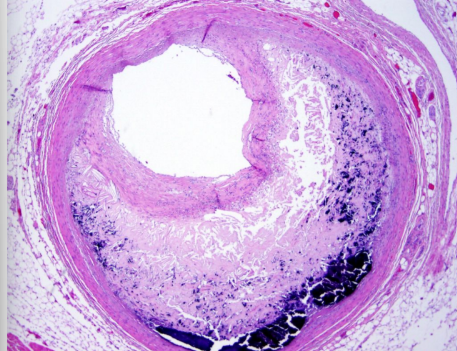
Describe what is being seen
Purple pink layer → Fibrosis
White area → Necrosis
Dark purple → Calcium deposit
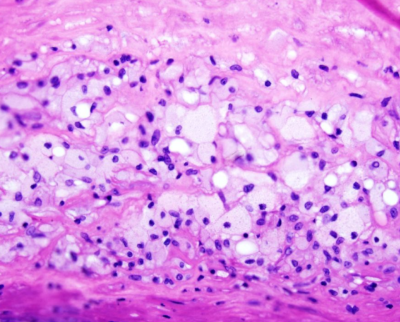
What cell is this
Foam cell
What happens if there is fracture of plaque fibrous cap
Exposed tissue factor → Red thrombus (fibrin rich)
What happens if there is superficial erosion of plaque
Expose collagen → White thrombus → Activate coagulation