Photon Interactions
 Call Kai
 Learn
Learn Practice Test
 Spaced Repetition
 Match
Match Flashcards
 Knowt Play
1/31

Earn XP
Description and Tags
Subgroup I: Radiation Physics and Detection
Name | Mastery | Learn | Test | Matching | Spaced | Call with Kai | Chat |
|---|
No analytics yet
Send a link to your students to track their progress
32 Terms
photon interactions with matter
photoelectric absorption
compton scatter
rayleigh scatter
pair production
What determines how a photon will interact with matter?
photon energy and absorber characteristics (electronic density, atomic number, and physical density)
photoelectric interactions
a photon interacts with an atom, usually an inner shell electron
all of the photon energy is transferred to the atom
the photon’s energy exceeds the binding energy of the electron in the atom’s shells
an orbital electron is ejected from the atom
During photoelectric interaction, the ejected electron is referred to as __
photoelectron
Energy of a photoelectron is equal to
the energy of the incident photon minus the binding energy of the ejected electron
photoelectrons tend to come from __ electron shells
K and L
If an inner shell vacancy is produced,
an electron will drop to fill the vacancy and release a characteristic x-ray or auger electron
absorption edges
there is a strong increase in the probability of photoelectric interaction at the absorption edge because the incident photon now exceeds the binding energy of the electron shell and the photon can now interact with more electrons
At lower energies in low atomic number materials (water), the probability of photoelectric absorption is __
>96%
At higher energies in low atomic number materials (water), the probability of photoelectric absorption is __
~0%
At lower energies in high atomic number materials (lead), the probability of photoelectric absorption is __
>99%
At higher energies in high atomic number materials (lead), the probability of photoelectric absorption is __
~50%
Compton scatter
a photon interacts with an atom, usually an outer shell electron
the photon is redirected with a decrease in energy
the photon becomes a scattered photon
during the process, an electron is also ejected from the atom
the energy of the photon is divided between the scattered photon and the ejected electron
In Compton scatter, the ejected electron is termed __
Compton electron
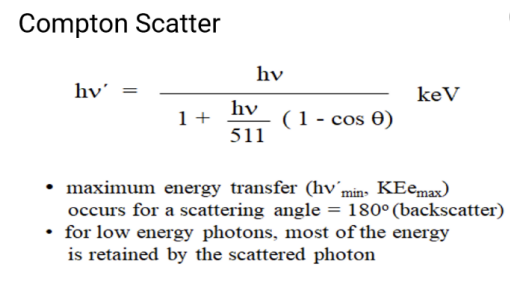
In Compton scattering, when does maximum energy to the photon occur?
at 180 degree scattering angle
In Compton scatter, a greater scattering angle will ___ energy to the incident photon and ___ energy to the electron.
decrease, increase
In Compton scatter, the higher the incident photon energy, ___ energy given to the electon.
the more
In Compton scatter, why can we ignore the binding energy of the ejected electron?
It’s quite small because it’s from an outer shell.
Compton scatter equation
hv’ = hv / ( 1 + (hv / 511) * (1 - cos θ)
Probability of Compton scatter is dependent on
electron density of the absorber
energy of the incident photon
Probability of Compton scatter is INdependent from
atomic number (Z) of the absorber
an increase in electron density results in ___ of Compton scatter
an increase
an increase in the energy of the incident photons results in ___ of Compton scatter
a decrease
Rayleigh scatter
a photon interacts with the ‘whole atom’
the electrons in the atom oscillate and emit a photon
energy of the emitted photon is equal to the incident photon energy
the emitted photon is on a different trajectory than the incident photon
ionization does NOT occur
If a Rayleigh scatter photon is detected, it will
degrade image quality
Rayleigh scatter is also known as
coherent scattering
The probability of Rayleigh scatter ___ as energy of the photon increases.
decreases
Is Rayleigh scatter significant to Nuclear Medicine?
no
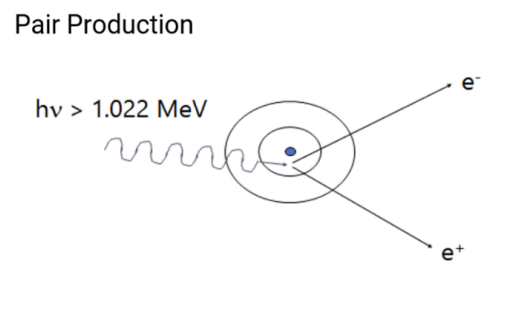
pair production
the energy of a photon is converted to mass in the form of an electron and a positron
the conversion takes place in the electric field of the atom
the rest mass of an electron (negatron and positron) is 0.511 keV
since electrons are created during this interaction, the incident photon must possess at least 1.022 MeV
Is pair production significant to Nuclear Medicine?
no
Is photoelectric absorption significant in Nuclear Medicine?
yes, it dominates as the first interaction in lead
Is Compton scatter significant to Nuclear Medicine?
yes, it dominates as the first interaction in tissue