Speech and Language Science - Voice Ch 5 and Ch 6
 Call Kai
 Learn
Learn Practice Test
 Spaced Repetition
 Match
Match Flashcards
 Knowt Play
1/48

Earn XP
Description and Tags
Ch 5 - Phonation 1 and Ch 6 - Phonation Measurement and Instrumentation
Name | Mastery | Learn | Test | Matching | Spaced | Call with Kai | Chat |
|---|
No analytics yet
Send a link to your students to track their progress
49 Terms
phonation
generation of sound by means of vocal fold vibration
Vf aka
vocal chords
voice in terms of energy is
conversion of aerodynamic energy from lower airway to acoustic energy as sound waves
AERODYN TO ACOUSTIC not the other way around
air flowing as single stream is reflected thru
air puffs, rapid vibration
larynx
list the 3 paired and 3 unpaired
how many caritlages vs bone
*insert anatomy notes
5 crtilages and 1 bone
larynx diagram, list structures

ligaments in larynx are made up of
collagenuous connective tissue fibers
connections between ligaments with other cartilages vs connections with VF or hyoid
intrinsic vs externsic
or external vs internal
the position of intrinsic ligaments of the larynx help describe..
cavities
what is the membrane of the inner cavity of the larynx
fibroelastic mucous membrane
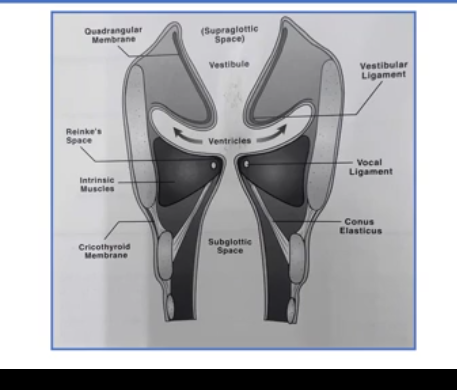
quadrangular membrane
arytenoid to inner thryoid to epiglottis
lower part of this thickens to form vestibular ligament
cricovocalis membrane (aka conus elasticus) attachment
posterior attaches the vocal process of the arytenoid
UPPER margin - true VF
LOWER margin - vestibular ligament (false VF)
review lateral larynx model
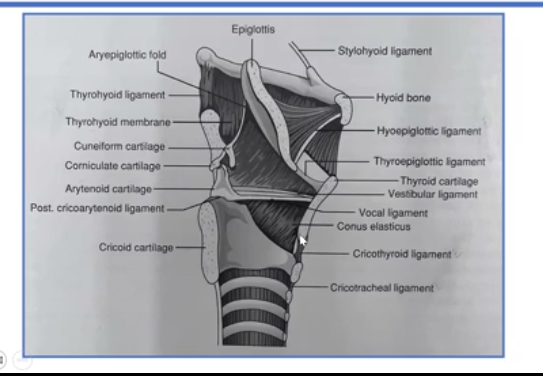
the supraglottic cavity is a
vestibule or an opening right above the VF
right above this vesituble are the FALSE VF
the mucous glands in the vesitbule is extremely important
larnyx func (4)
protection of lungs from foreign body
breathing
subglottal pressure for strenuous tasks
speaking
larynx muscles intrinsic
mostly innervated by recurreent laryngeal nerve and vagus nevre
abductor for larynx
posterior cricoid arytenoid
only one!
adductor for larynx
inter A
transverse and olique
lca
tensors/relaxer for larynx
musculariis - relax
vocalis - tensor
CT = pars rectus and
*****look at your anatomy notes
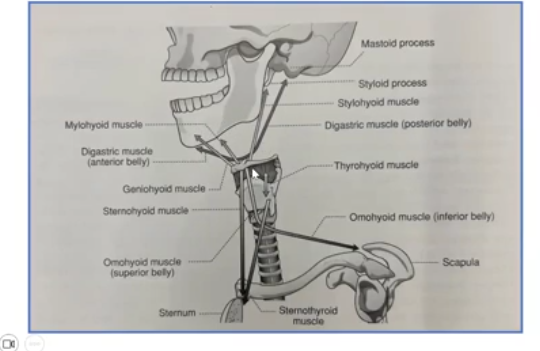
extrinisic muscles larynx
infrahyoid- below glottis
suprahyoid - above glottis
**look at the damn figure keisha
VF is paired or unpaired
paired
VF made up of of
thrioarytenoid muscle
thyroimuscularis and thyrdoicvocalis
how does VF open
anterior to posterior
quiet breathing opening
20mm and 8mm width
where is the medial edge of VF
innner edge
free margin, key to speech production
andteirod 3/5th of VF are what type of tissue
membranous
posterior 2/5ths of VF is made up of
cartilaginous
what are the 5 layers of VF
epidthelium
superior lamina propia
inferior lamina propia
g
ligament
increasingly stiff.
what is the body cover theory
two most important joinds
criciothyroid and cricoarytenoid
CT = contract leads to anteiror and downward (pars oblique posterior) and downward thryoid movment
THIS CAUSES LENGTH OF VF INCREASED. INCREASE TENSION, INCREASE PITCH.
ct joint what type of motion
rotary and liding (primary motion)
cricoarytenoid
rocking gliding sliding
breathing and voice production
influenced by pca, lca and TA vocalis
orecentral gyrus
(inferior)
vocal action !
SMAn
SLN external and internal (afferent) vs RLN?
s
myoelastic aerodynamic theory
elasticity of vf and role of aerodynamic forces
self ocilationne
venturi effect
acceleration of fluid in tube
bernoulli effect
for fluid under movment, the pressure exeted by a fluid on a surface decreases as velocicty of the fluid acorss the surface increases
describe in your own owrds the process of phonation
prephonation - VF approximate, they close. to begin vibration. rock gliding movement!!
lung pressure increases. lower border of VF open when pressure is greater than the VF resistance. opens the inferior margins FIRST then superior margins.
inverted triangle of VF opening is leads to bernoulli affect
end of phonation is caused by arytenoids
2 important componetns of VF vibration
viscosity and elsticity
veritcal phase difference vs outer phase
why? subglottal pressure, transglottic flow pressure, supraglottic pressure
VF needs to close completely in each cycle of vibration (t/f)
false
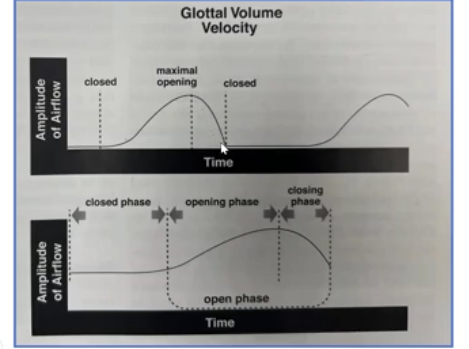
glottal volume velocity/trans-glottal airflow
volume of air flow thru the glottis as a function of time during phonation.
effeciency must be maintained
laryngeal airway or glottal resistance
resistance offered by the VF airflow (varies!)
glottal resistance = equation??
transglottal pressure / transglottal flow
cm of H20 (unit of measure)
butr for vowels transglottal pressure = lung pressure
how much subglottal pressure is required for phonation to begin? what is that term?
phonation threshold pressure
it varies on V resistance
threshold correlates with percieved effort
think of nodules on a VF . that would feel harder to begin phonation. more pressure!!!!!
phonation onset
refers to when the relationship betwn VF begin so phonation can start
variations can cause
gentle/soft
breathy- phonation air is escaping already
glottal attack/hard onset
what does vocal rise time refer to
onset to steady state amplitude in SPL
how long does it take for you to get to your regular state in tone
gives us info about phonation onset
stress vs strain
stress- force per unit area, causes change in volume/shape/lenfth of muscle
strain - length of change of VF tissue in firection of the force divided by the resting length (TA length) **there is a max level of strain
both chage voice characteristics

longest phase in cycle of typical of vocal fold vibration is
the closed phase