Techniques, Vital Signs, Height, Weight, & General Survey
 Call Kai
 Learn
Learn Practice Test
 Spaced Repetition
 Match
Match Flashcards
 Knowt Play
1/65

There's no tags or description
Looks like no tags are added yet.
Name | Mastery | Learn | Test | Matching | Spaced | Call with Kai | Chat |
|---|
No analytics yet
Send a link to your students to track their progress
66 Terms
Normal Temperature
Normal ~97.7 to 99.5 degrees Fahrenheit (F) or 36.5 to 37.5 degrees Celsius © (afebrile - no fever)
Hypothalamus job:
Regulatory center for temperature
When the body is too warm, vasodilation & sweating occur
When the body is too cool, epinephrine release leads to vasoconstriction, & shivering
What are the factors of temperature?
-Diurnal variation or circadian rhythm
Lower at night & early in the morning
Higher in the afternoon & evening
-Women have higher temperatures between ovulation & the onset of menses
-Labile (variable) temperatures in infants & children
-Exercise increases body temperature
-Older Adults: May have a normal temperature that is ~ 1-3 degrees F lower than younger adults
May experience environmental hypo/hyperthermia r/t altered temperature regulation
Environmental temperature may overwhelm the ability to adapt
What happens if a patient has a fever?
The set point in the hypothalamus increases
Heat production is > heat loss
Temperatures > 106 degrees F (41 degrees C) lead tο damage to vital organs (especially the brain) & death
How is oral temperature done?
Apply a probe cover
Place the thermometer under the tongue in the posterior sublingual pocket
It signals when done
Disinfect
How is temporal temperature done?
Apply a disposable probe cover
Slide the probe from the center of forehead sideways
You may continue by touching behind ear down to the indentation at the bottom of the ear
Facts: accurate and aseptic; skin should be dry
What is different from axillary temperature?
Less accurate but SAFE
Axillary temperature is ~1° F < oral
How is tympanic temperature done?
Apply a probe cover
Pull the pinna up & back
Aim the probe at the tympanic membrane
What are some errors when doing tympanic temperature?
not aim correctly
Excessive cerumen leads to a false low reading
False high readings may result if taken in the ear the patient was lying on
What are the facts of rectal temperature?
MOST accurate
ONLY use rectal thermometer with a RED probe
DO NOT switch probes or put on bed
Rectal temperature is ~1° F > oral
how is rectal temperature done?
Turn the patient to the left side, lubricate the tip of the probe cover, & ask the patient to take a deep breath
Insert the lubricated probe 2 to 3 cm (0.5 to 1 cm for children)
Aim towards the umbilicus
HOLD the patient AND rectal thermometer in place for patient safety
How to document temperature?
Record to nearest 0.1 degree Celsius (most common) or Fahrenheit per policy
Record the route taken (O, R, T, A or Ax)
Do NOT tell a provider that the patient has a fever
Let the NUMBER AND ROUTE speak for themselves
Pulse Rates
Normal rates vary with age
Adults 60-100 beats/minute
Bradycardia < 60 beats/minute
Tachycardia > 100 beats/minute
What are the factors affecting pulse rate?
Age; Infants pulses are faster
Pulse rates increase with exercise, fever, hemorrhage, & anxiety
Pulse rates are slower in athletes (normal) & when patients take some cardiac medications
What are the pulse sites?
Radial Pulse- Thumb side of the wrist
Apical Pulse- AUSCULTATE in the mitral (apical) area) in the 5th intercostal space at the midclavicular line instead of palpating there
How to take a pulse?
Count 30 or 60 seconds
60 seconds, if irregular
find the Rhythm (regular, irregular, or irregularly irregular in atrial fibrillation)
What do you do if unable to palpate?
Auscultate the apical pulse
Use a Doppler to hear the pulse rate
Dopplers with an external speaker are more aseptic than those that look like a stethoscope
what is the Pulse scale?
0 absent, 1+ weak, 2+ normal, 3+ bounding
what are the factors affecting the respiratory rate?
Respiratory rate increases with anxiety, exercise, blood loss, fever & infection
Respiratory rate decreases with a narcotic overdose
How to assess respirations?
Pretend you are still taking the pulse
- Count 30-60 seconds
60 seconds if abnormal
Normal Adult Range is 12-20 breaths/minute
Infants breathe fastest
Assess depth & rhythm (regular, irregular or a specific pattern)
how to document respirations?
# of breaths/minute
Rhythm
Regular, irregular or a specific pattern (covered with respiratory assessment)
Depth (normal, shallow, deep)
Characteristics (effortless vs. labored, quiet vs. noisy)
What is blood pressure?
the pressure on the arterial walls during systole AND diastole
What is hypertension?
Persistently elevated BP, NOT high anxiety
What are the stages of hypertension?
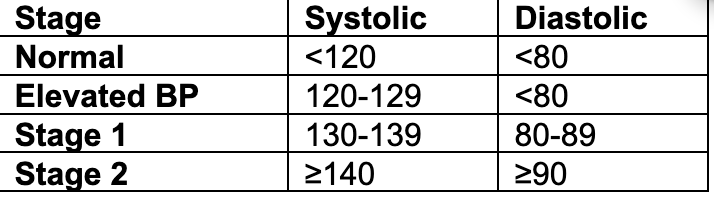
What is hypotension?
Low blood pressure (<90/60)
Low BP accompanied by dizziness and/or fainting (syncope)
What is orthostatic hypotension?
BP 20 systolic/10 diastolic mm Hg or more decrease in BP when changing position from lying, to sitting, or standing (need to check)
Dizziness & falls may result
Order/Prescription for orthostatic BPs means taking BP lying, then sitting, then standing
What are the factors affecting BP?
BP increases with increased cardiac output (young people don’t have high BP; more older), Arteriosclerosis, Age, Exercise, Anxiety, & Obesity
BP decreases with hemorrhage (faster bleed; more BP goes)
when using correct size cuff the width and length of the cup is?
width 40% of the arm circumference
80% to 100%
Where should arm cuff go?
Place the bladder of the cuff over the artery
Most cuffs have an arrow that is placed over the artery
The BP is taken over the brachial artery (pinkie side of the antecubital space)
Do not take a BP on the
Arm with an IV, if the other arm is available
-Arm with an AV fistula for dialysis
-Mastectomy arm
What is systolic by palpation?
FIRST pulse beat felt during deflation is the systolic BP
There is NO diastolic number
what is systolic with a doppler?
The FIRST Korotkoff sound heard during deflation is the systolic BP
There is NO diastolic number
Used when the patient has a Left Ventricular Assist Device (LVAD)
what are the facts of Radial/Forearm/Wrist BP?
Uses the radial artery
A radial artery BP is HIGHER than a brachial BP
Place the wrist at HEART LEVEL or the BP may be falsely elevated
What are the facts of thigh BP?
use as LAST resort
Uses the popliteal artery - highest BP
Systolic pressure may be up to 40 mm Hg higher than a brachial BP
how do you document BP?
Document MANUAL BPs in even numbers-Systolic/diastolic
Document Electronic BPs as displayed
Systolic/muffling/0 - if Korotkoff sounds do NOT disappear (once and while)
Record the site (brachial, radial) & source of BP (manual, electronic, doppler, palpation)
Pulse Pressure: Difference between the systolic & diastolic readings
What is pulse oximetry?
Measures the % of hemoglobin saturated with oxygen
Older pulse oximeters are NOT as accurate for patients with darker skin
Pulse oximeters accurate models for varying skin tones are available
Normal SpO2 96-100%
Sensors that are less likely to be affected by peripheral artery disease or hand movement
Ear
Forehead
Nose
What are indications for pulse Pulse Oximetry need to use constant?
Managing oxygen
Anesthesia or sedation
Heart or lung disease
Sleep apnea
Critical/Emergency care
Factors affecting accuracy on pulse oximetry?
Poor tissue perfusion r/t Hypotension (low BP) ; Hypothermia (low temp); Vasoconstriction
Finger movement
Poorly positioned sensor
Bright light: Shield the sensor from bright windows
Dark nail polish & acrylic nails - Remove
Abnormal hemoglobin
Low cardiac output
What are factors of false readings for pulse oximetry?
-Automatic BP cuff is on the same arm as the pulse oximetry sensor
-Darker skin tones (older pulse oximeters)
-ANEMIA
Each hemoglobin can carry 4 oxygen molecules
If each hemoglobin carries 4 oxygen molecules, the saturation will be 100%.
Carbon monoxide poisoning
Pulse oximeter can NOT tell whether oxygen or carbon monoxide is attached to hemoglobin
What is the documentation for pulse oximetry?
Result & unit of measurement (%)
Amount & type of O2 in use (Nasal cannula at 2 L/minute, 50% Venturi mask, etc.)
Do NOT document false readings
What to check in pit falls?
Pulse pressure variation- Normal: notch is older during inspiration than expiration, Abnormal: difference larger in hypovolemia, intrathoracic pressure swings, and obstructive lung disease
monitor cardiac output (check for signs of cardiac arrest, feel for peripheral central pulse indicator of pulseless).
what is the Order of taking vital signs?
Temperature, Pulse, Blood Pressure, & Pulse Oximetry
When is an electronic BP inappropriate?
Electronic BPs may need to be validated with a manual BP when the
Patient is hypotensive (< 90 systolic)
Heart rate is rapid
Rhythm is irregularly irregular (atrial fibrillation)
Patient is experiencing involuntary movements, tremors or is shivering
What is MEWS Score: Clinical Judgment?
Modified Early Warning Score indicates risk of ICU admission or death
Calculated by the Electronic Medical Record (EMR) using the Systolic BP, Heart Rate, Temperature, Respiratory Rate, Urine Output & Level of Consciousness
< 3 Patient is stable
3-4 Signs of respiratory failure
≥ 5 Critical condition
what is Clinical Judgment Model?
Assessment (History, patient assessment, equipment, labs, etc)
Analyze Data (recognize & analyze cues)
Refine & Prioritize Hypotheses
Generate Solutions
Take Action
Evaluate Outcomes (Better, worse, or the same)
Flat percussion sounds?
Heard over bones
Practice on the kneecap or forehead
Dull percussion sounds?
Normal over solid organs (liver, full bladder)
What is Tympany (Tympanic) percussion?
Heard over most of the abdomen d/t bowel tissue, fluid, & gas
what is Liver Percussion?
Start below the ribs in the right midclavicular line (MCL) & percuss upward
The sound changes from tympanic to dull over the liver
what is resonsant percussion?
Heard over spongy air filled lung tissues (NOT the ribs)
Hyperresonant
Heard over lungs that are more air filled (Emphysema)
Normal in children
what is Direct, Blunt or Fist Percussion?
To detect tenderness over the liver or kidneys
what are facts about palpation?
Be sure the hands are warm
Palpate painful areas LAST
Tense muscles may decrease the ability to palpate
what is Superficial Palpation?
To detect superficial tenderness & masses
Use light circular movements with the finger pads
what is deep palpation?
To detect deeper abnormal areas
One hand is placed on top of the other
The lower hand feels while the upper hand pushes down
If a mass is found, describe:
Location
Size
Shape
Consistency
Mobility
Tenderness
what is Temperature Palpation:
The back of the hand is more sensitive to temperature
Compare temperature bilaterally
what is Auscultation?
To listen to heart, lung & bowel sounds
Do NOT listen through a gown or clothing
what is the Diaphragm of a stethoscope?
Press firmly against the skin to listen to high-pitched sounds
what is the bell of a stethoscope?
Used to listen to low pitched cardiovascular sounds
what is body mass index based on?
height and weight
what is Body Roundness Index (BRI)?
Gender, age, height, weight, waist & hip size are used in the calculation
Assesses for body roundness associated with Diabetes & Cardiovascular Disease
% of body fat estimate
% of visceral (abdominal) fat estimate
The green area is a healthy BRI & the Black oval is the patient’s BRI
what is Normocephalic?
Head size is within a defined normal range
what is microcephalus?
small head
Small Head
Problems with brain development
Zika virus infection
what is hydrocephalus?
large head
excess cerebrospinal fluid
what are growth concerns?
Sudden decrease in the child’s percentile
Obesity
Change in the growth trend