Lesson4- 3.5a(Limiting Factors)

0.0(0)
Studied by 0 people
call kaiCall Kai
Locked
learnLearn
examPractice Test
spaced repetitionSpaced Repetition
heart puzzleMatch
flashcardsFlashcards
GameKnowt Play
Card Sorting

1/7

encourage image

There's no tags or description

Looks like no tags are added yet.

Last updated 3:15 PM on 9/10/26
Name
Mastery
Learn
Test
Matching
Spaced
Call with Kai
Chat

No analytics yet

Send a link to your students to track their progress

8 Terms

1
New cards
<p><strong>Limiting factors</strong></p><p>The ideal conditions for photosynthesis vary from one plant species to another, but the conditions below would be ideal for most plant species in temperate climates like the UK.</p><ol><li><p>High light …1? of a certain wavelength</p></li><li><p>Temperature around …2?</p></li><li><p>Carbon dioxide at 0.04%</p></li><li><p>Plentiful …3?</p></li></ol><p></p><p><strong>Limiting factors- Wavelength</strong></p><p>Light is needed to provide the energy for the light dependent reaction The higher the intensity of the light, the more …4? it provides.</p><ul><li><p>Light provides the energy to power the light-dependent stage of photosynthesis, to produce A…5? and reduced N…6? needed for the light-independent stage of photosynthesis.</p></li><li><p>Light causes the stomata to …7? to allow gaseous exchange to occur and also trans…8? (to deliver water to the leaves)</p></li></ul><p></p><p>Info: Only certain wavelengths of light are used for photosynthesis.</p><ol start="9"><li><p>What are the photosynthetic pigments?</p></li><li><p>what colour light do these pigments absorb in sunlight?</p><p></p><p><strong>Why is light important</strong></p></li></ol><p>•It’s needed for the photolysis of water which provides …11? And these …11? need light to become excited at both photosystems.</p><p>• Additionally light is required for photophosphorylation for chemiosmosis</p><p>• Light causes the stomata to …12? To allow for …13? to enter the leaf for the …14? Cycle.</p>

Limiting factors

The ideal conditions for photosynthesis vary from one plant species to another, but the conditions below would be ideal for most plant species in temperate climates like the UK.

  1. High light …1? of a certain wavelength

  2. Temperature around …2?

  3. Carbon dioxide at 0.04%

  4. Plentiful …3?


Limiting factors- Wavelength

Light is needed to provide the energy for the light dependent reaction The higher the intensity of the light, the more …4? it provides.

  • Light provides the energy to power the light-dependent stage of photosynthesis, to produce A…5? and reduced N…6? needed for the light-independent stage of photosynthesis.

  • Light causes the stomata to …7? to allow gaseous exchange to occur and also trans…8? (to deliver water to the leaves)


Info: Only certain wavelengths of light are used for photosynthesis.

  1. What are the photosynthetic pigments?

  2. what colour light do these pigments absorb in sunlight?


    Why is light important

•It’s needed for the photolysis of water which provides …11? And these …11? need light to become excited at both photosystems.

• Additionally light is required for photophosphorylation for chemiosmosis

• Light causes the stomata to …12? To allow for …13? to enter the leaf for the …14? Cycle.

  1. Intensity

  2. 25•C

  3. Water

  4. Energy

  5. Open

  6. Transpiration

  7. ATP

    1. NADP

    2. chlorophyll a, chlorophyll b and carotene

    3. Red and blue

    4. Electrons

    5. Open

    6. CO2

    7. Calvin


2
New cards
<p><strong>Limiting Factors- light intensity</strong></p><ol><li><p>Is the saturation point at point A or B in the image?</p><p>• At point B, something else is limiting the rate of …2? so therefore increasing light intensity makes …3? difference</p><ol start="4"><li><p>From which points on the graph is light the limiting factor?</p></li></ol></li></ol><ol start="5"><li><p>What is the relationship between light intensity and the rate of photosynthesis?</p></li></ol><p></p><p></p>

Limiting Factors- light intensity

  1. Is the saturation point at point A or B in the image?

    • At point B, something else is limiting the rate of …2? so therefore increasing light intensity makes …3? difference

    1. From which points on the graph is light the limiting factor?

  1. What is the relationship between light intensity and the rate of photosynthesis?


  1. B. 2. Photosynthesis. 3. No

    1. From A to B

    2. As light intensity increases, the rate of photosynthesis increases


3
New cards
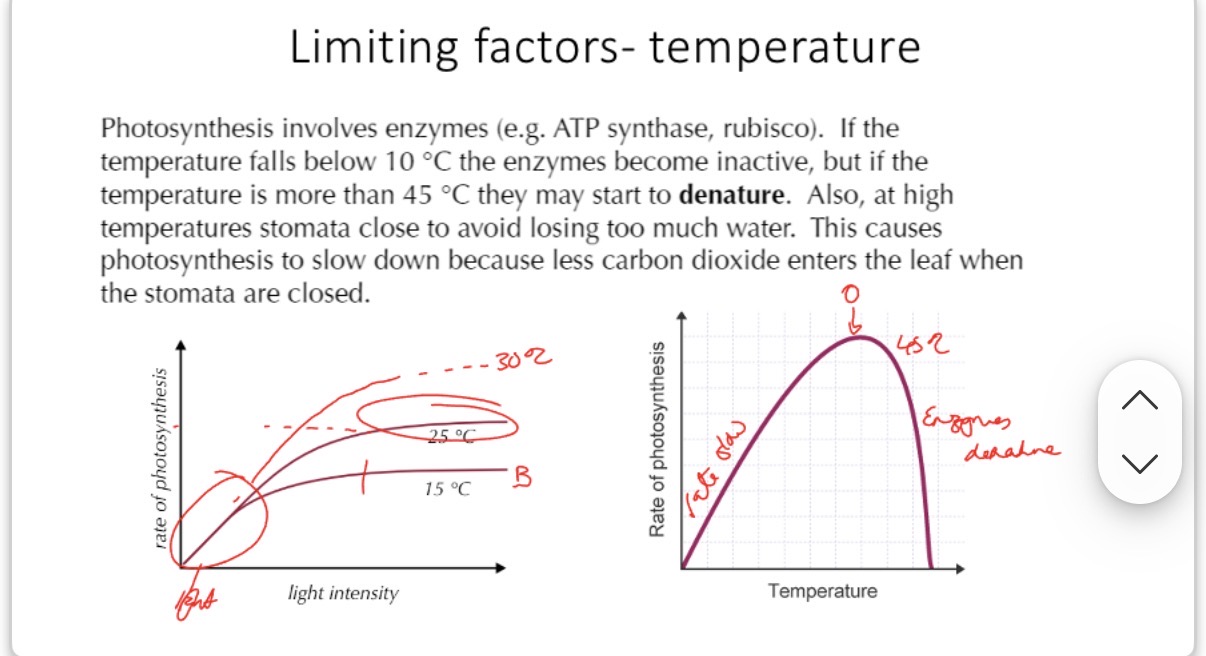
<p><strong>Limiting Factor - Temperature</strong></p><ol><li><p>At low temperature, the rate of reaction is …1? because there is lower ki…2?. Therefore there are less enzyme-substrate …3? formed.</p><p>info: 45•C is the optimum temperature photosynthesis .</p></li></ol><p></p><ol start="4"><li><p>What happens when the temperature exceeds the optimum for the rate of photosynthesis? (Refer to the tertiary structure in your answer)</p></li><li><p>At high temperature stomata start to close. Explain why?</p></li></ol><p></p><p>info: Photosynthesis involves enzymes (e.g. ATP synthase, rubisco). If the temperature falls below 10 °C the enzymes become …6?, but if the temperature is more than 45 °C they may start to …7?. Also, at high temperatures stomata …8? to avoid losing too much water. This causes photosynthesis to slow down because less …9? enters the leaf when the stomata are closed.</p><p></p>

Limiting Factor - Temperature

  1. At low temperature, the rate of reaction is …1? because there is lower ki…2?. Therefore there are less enzyme-substrate …3? formed.

    info: 45•C is the optimum temperature photosynthesis .


  1. What happens when the temperature exceeds the optimum for the rate of photosynthesis? (Refer to the tertiary structure in your answer)

  2. At high temperature stomata start to close. Explain why?


info: Photosynthesis involves enzymes (e.g. ATP synthase, rubisco). If the temperature falls below 10 °C the enzymes become …6?, but if the temperature is more than 45 °C they may start to …7?. Also, at high temperatures stomata …8? to avoid losing too much water. This causes photosynthesis to slow down because less …9? enters the leaf when the stomata are closed.


  1. Lower

  2. Kinetic energy

  3. Complexes

    1. •At too high temperature, the bonds in the tertiary structure of the enzyme are broken which changes the shape of the tertiary structure of the active site

    •Therefore the enzyme denatures and so less E-S complexes are formed

    •Therefore rate of photosynthesis decreases

  1. To prevent water loss

  2. Inactive

  3. Denature

  4. Close

  5. Carbon dioxide


<ol><li><p>Lower</p></li><li><p>Kinetic energy</p></li><li><p>Complexes</p><ol start="4"><li><p>•At too high temperature, the bonds in the tertiary structure of the enzyme are broken which changes the shape of the tertiary structure of the active site</p></li></ol><p>•Therefore the enzyme denatures and so less E-S complexes are formed</p><p>•Therefore rate of photosynthesis decreases</p></li></ol><ol start="5"><li><p>To prevent water loss</p></li><li><p>Inactive</p></li><li><p>Denature</p></li><li><p>Close</p></li><li><p>Carbon dioxide</p></li></ol><p></p>
4
New cards
<p>Graph info for temperature </p>

Graph info for temperature

5
New cards
<p><span>Carbon dioxide makes up …1? of the gases in the atmosphere.</span></p><p><span>Increasing this to …2? gives a higher rate of photosynthesis, but any higher and the …3? start to close.</span></p><p><span>Using the image but don’t look at its writing:</span></p><p><span>Both these graphs level off when light intensity is no longer the …4?. The graph at 0.4% carbon dioxide (CO2) levels off at a higher point than the one at 0.04%, so carbon dioxide concentration must have been a …5? factor at 0.04% carbon dioxide. The limiting factor here isn't temperature because it's the …6? for both graphs (25 °C).</span></p><ol start="6"><li><p><span>Read other side image</span></p></li></ol><p></p>

Carbon dioxide makes up …1? of the gases in the atmosphere.

Increasing this to …2? gives a higher rate of photosynthesis, but any higher and the …3? start to close.

Using the image but don’t look at its writing:

Both these graphs level off when light intensity is no longer the …4?. The graph at 0.4% carbon dioxide (CO2) levels off at a higher point than the one at 0.04%, so carbon dioxide concentration must have been a …5? factor at 0.04% carbon dioxide. The limiting factor here isn't temperature because it's the …6? for both graphs (25 °C).

  1. Read other side image


  1. [0.04%]

  2. 0.4%

  3. Stomata

  4. Limiting factor

  5. Limiting

  6. Same


<ol><li><p>[0.04%]</p></li><li><p>0.4%</p></li><li><p>Stomata</p></li><li><p>Limiting factor</p></li><li><p>Limiting</p></li><li><p>Same</p></li></ol><p></p>
6
New cards
<p><strong>Limiting Factors- Water</strong></p><p><span>Plants also need a constant supply of water — too little and photosynthesis has to stop. 1. Explain why?</span></p><p><span>→ but too much water and the soil becomes waterlogged, reducing the uptake of minerals such as …2?, which is needed to make chlorophyll …3?</span></p><ol start="4"><li><p>Fill in the blanks in the image?</p></li><li><p>State one way farmers can increase CO2 concentration in a greenhouse</p></li><li><p>How can farmers increase light intensity in a greenhouse when it’s night?</p></li><li><p>What systems can be used to keep optimum heat temperatures?</p></li><li><p>How can the heat/cold air provided by these systems be spread out evenly in a greenhouse?</p></li></ol><p></p>

Limiting Factors- Water

Plants also need a constant supply of water — too little and photosynthesis has to stop. 1. Explain why?

→ but too much water and the soil becomes waterlogged, reducing the uptake of minerals such as …2?, which is needed to make chlorophyll …3?

  1. Fill in the blanks in the image?

  2. State one way farmers can increase CO2 concentration in a greenhouse

  3. How can farmers increase light intensity in a greenhouse when it’s night?

  4. What systems can be used to keep optimum heat temperatures?

  5. How can the heat/cold air provided by these systems be spread out evenly in a greenhouse?


  1. Photosynthesis requires water and CO2 but with too little water, it can’t be carried out.

  2. Magnesium

  3. Chlorophyll A

    1. By combusting a small amount of propane in a CO2 generator.

  1. A lamp can provide light at night.

  2. Heating and cooling systems


<ol><li><p>Photosynthesis requires water and CO2 but with too little water, it can’t be carried out.</p></li><li><p>Magnesium</p></li><li><p>Chlorophyll A</p><ol start="5"><li><p>By combusting a small amount of propane in a CO2 generator.</p></li></ol></li></ol><ol start="6"><li><p>A lamp can provide light at night.</p></li><li><p>Heating and cooling systems</p></li><li><p></p></li></ol><p></p>
7
New cards
term image
knowt flashcard image
8
New cards
<p>Read the info on the graph. Then explain why this is the case.</p>

Read the info on the graph. Then explain why this is the case.

knowt flashcard image