Ortho 7 - Intro to Invisalign
 Call Kai
 Learn
Learn Practice Test
 Spaced Repetition
 Match
Match Flashcards
 Knowt Play
1/42

There's no tags or description
Looks like no tags are added yet.
Name | Mastery | Learn | Test | Matching | Spaced | Call with Kai | Chat |
|---|
No analytics yet
Send a link to your students to track their progress
43 Terms
Define the following:
- A SERIES OF CLEAR, CUSTOM MADE, REMOVABLE aligners created to move teeth into a desired position
Invisalign
Define the following:
- Combines orthodontics with 3D computer graphics to project tooth movement
Invisalign
What is different about new Invisalign aligners vs orthodontics in the olden days?
- Three dimensional (3D) geometric model instead of dental casts
- Computer aided appliance design
- Your prescription can be staged from beginning to end without taking impressions at various intervals
What are four benefits of using software for aligners?
- Computer-aided manipulation and calibrated accuracy
- Accurate and efficient staging of movements
- Detects interferences between teeth or collisions
- Quality and consistency checks
What are the five steps for the Invisalign treatment process and workflow?
1. Case submission
2. ClinCheck treatment plan
3. Start treatment
4. Monitor treatment
5. Fine tuning and retention
What are three required patient records for case submission?
- Patient photographs
- Panoramic radiograph
- PVS/VPS Impressions or Intraoral Scan
What are the four steps for the case submission process for aligners?
- Create a New Patient Record
- Complete the Prescription Form
- Print the Prescription form
- Package patient records for shipping
Define the following:
Provides set up technicians with an additional visual reference
Patient photographs
Define the following:
Foundation of aligner shape and fit
PVS/VPS Impressions
What are all of the following?
- iTero Element
- CEREC
- 3shape
- Carestream Dental
Intraoral scanners
What is the total timeline for Invisalign orders (submit case to receiving delievery)?
~25 business days
Scanning decreases timeline by about ~____ business days
10 business days
What are the four steps for the manufacturing process of Invisalign?
1. Mold Fabrication (Stereolithography)
2. Thermal Forming
3. Trimming with CNC
4. Polishing
ID feature of Invisalign:
-Three dimensional shapes added to tooth geometry to enhance the interaction between an aligner and the teeth
- Provide movement control or retention
Attachments
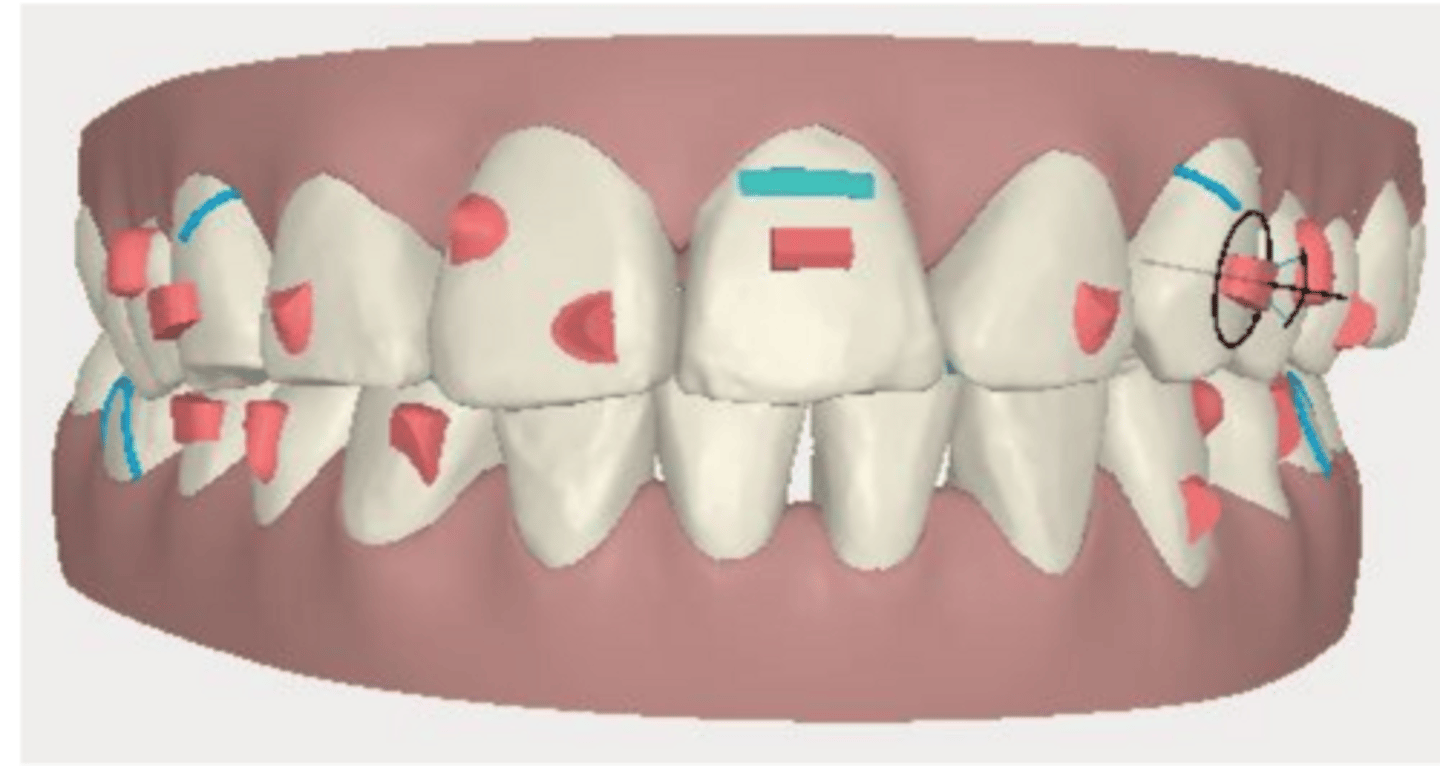
What do the red shapes represent in ClinCheck?
Attachments
(Forms in the ClinCheck software also indicate teeth requiring attachments)
What are aligners better at: pushing or pulling teeth?
Pushing teeth
What are traditional braces better at: pushing or pulling teeth?
Pulling teeth
Aligners maximize surface area to distribute force over larger area an to (increase/decrease) the interface of the object and force vector
Increase
Vector force is most efficient when it is directed __________ to the surface
Perpendicular
(Rather than at a acute angle - make the broader attachment perpendicular to the vector of force being applied/pushed onto the tooth)
T/F: Best to push an object from behind its center of resistance rather than next to it or in front of it. Results in better control of the objects directional movement (ie, shopping cart)
True
Maximize the attachment/aligner surface area interaction in relation to the ________ applied to the tooth
Vector of force
For _________ movements, use attachments that create a contrasting angle to the clinical crown (which typically tapers lingually)
Extrusive and torquing movements
For _______ movements, place the attachments on the mesial or distal so the force vector hits them as far behind the center of resistance as possible for better directional control
Sagittal movements
ID feature of aligner:
- Helps deliver lingual root movements for incisors
- Three dimensional shapes added to the aligner to enhance the interaction between an aligner and the teeth
Power ridge feature
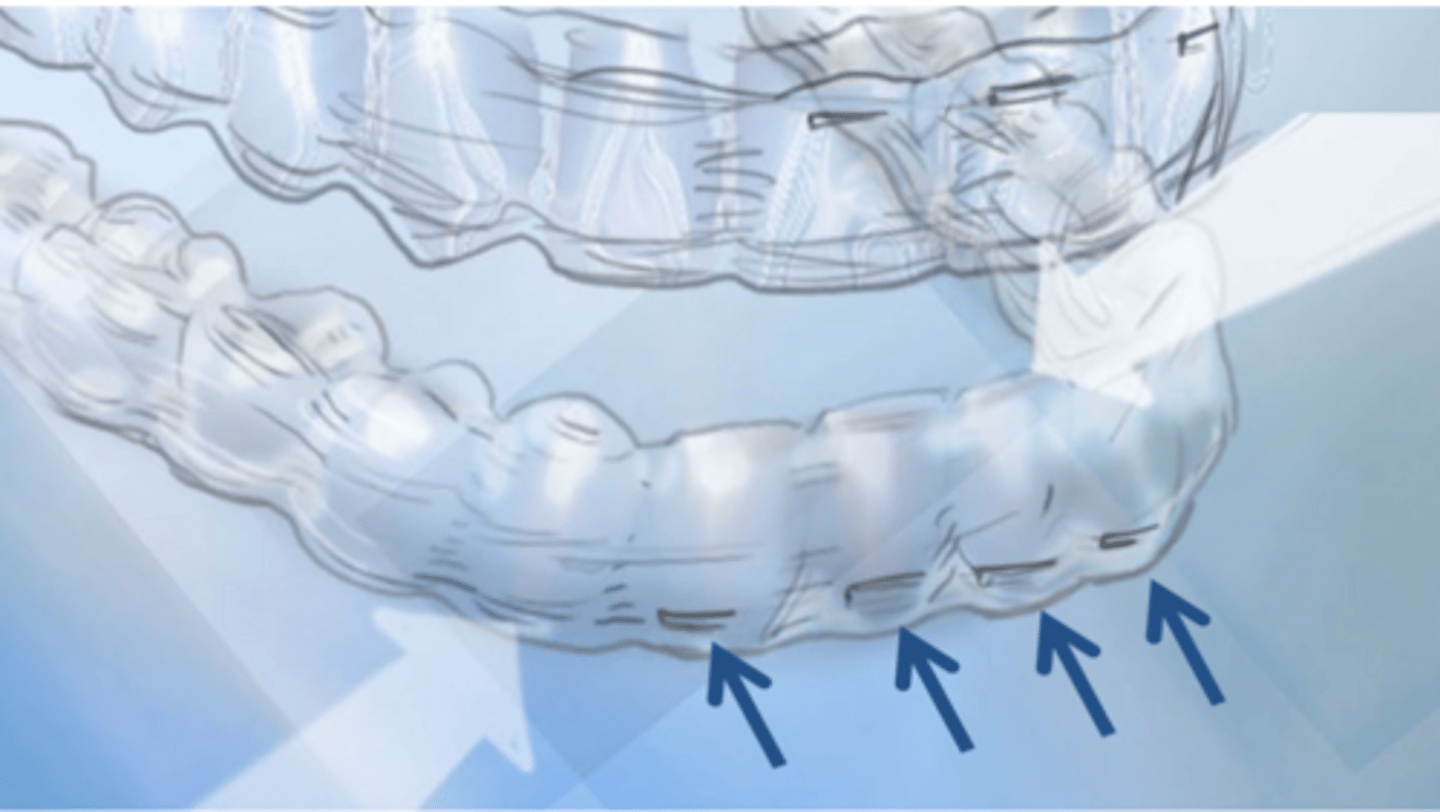
ID feature of aligner:
Power ridge feature
ID feature of aligner:
- Mesial and distal hooks provide direct anchorage for elastics
- Available for buccal placement on cuspids, bicuspids, and molars
Precision cuts: hooks
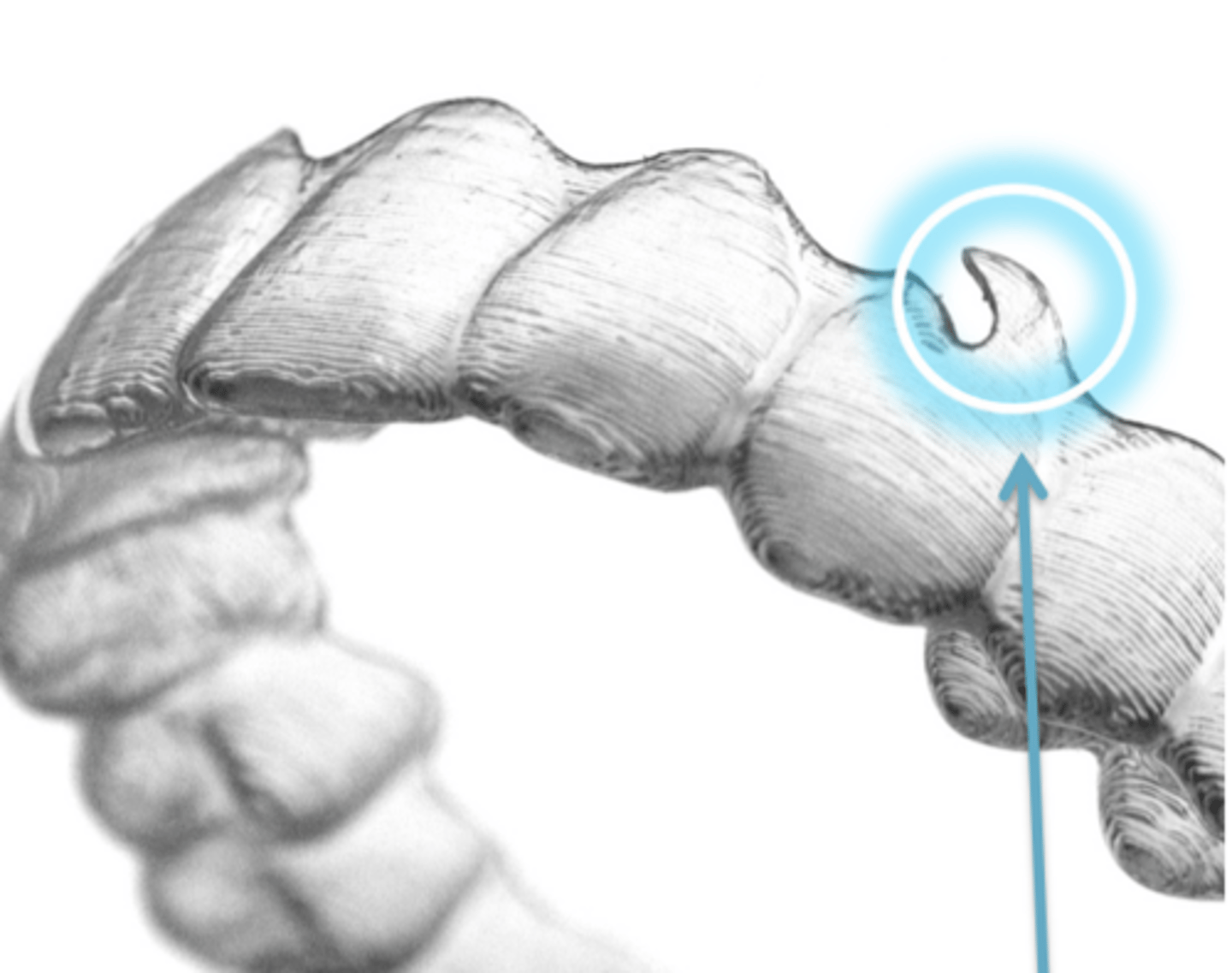
ID feature of aligner:
Precision cuts: hooks
ID feature of aligner:
- Accommodates buttons bonded to the tooth
- Available for buccal or lingual placement on cuspids, bicuspids, & molars
Precision cuts: button cutouts
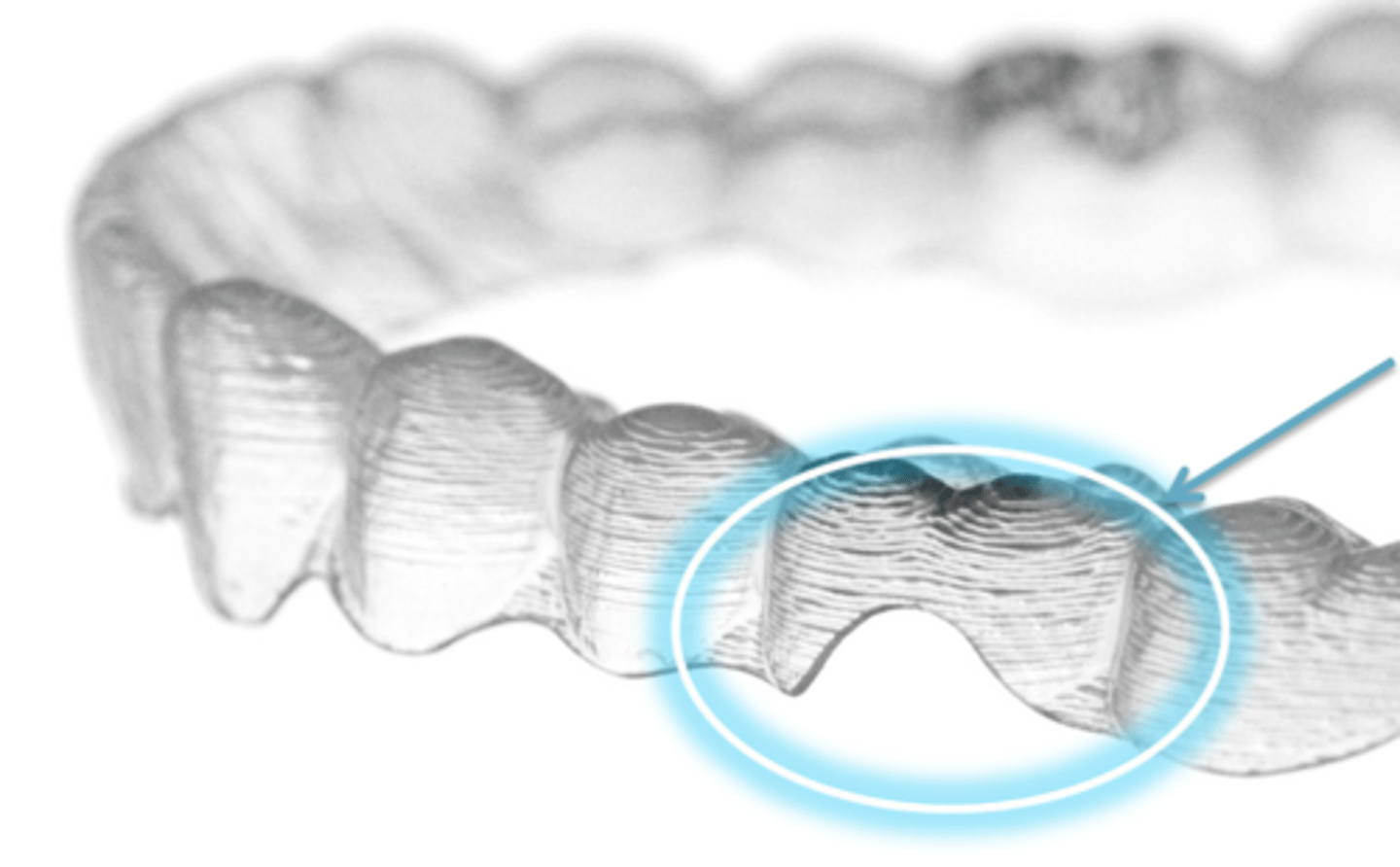
ID feature of aligner:
Precision cuts: button cutouts
ID feature of aligner:
- Plastic wedges on the lingual side of the aligners
- Help to prop the posterior bite open if the patient has excessive overbite to allow posterior teeth to erupt and support an improved overbite relationship
Precision bite ramps
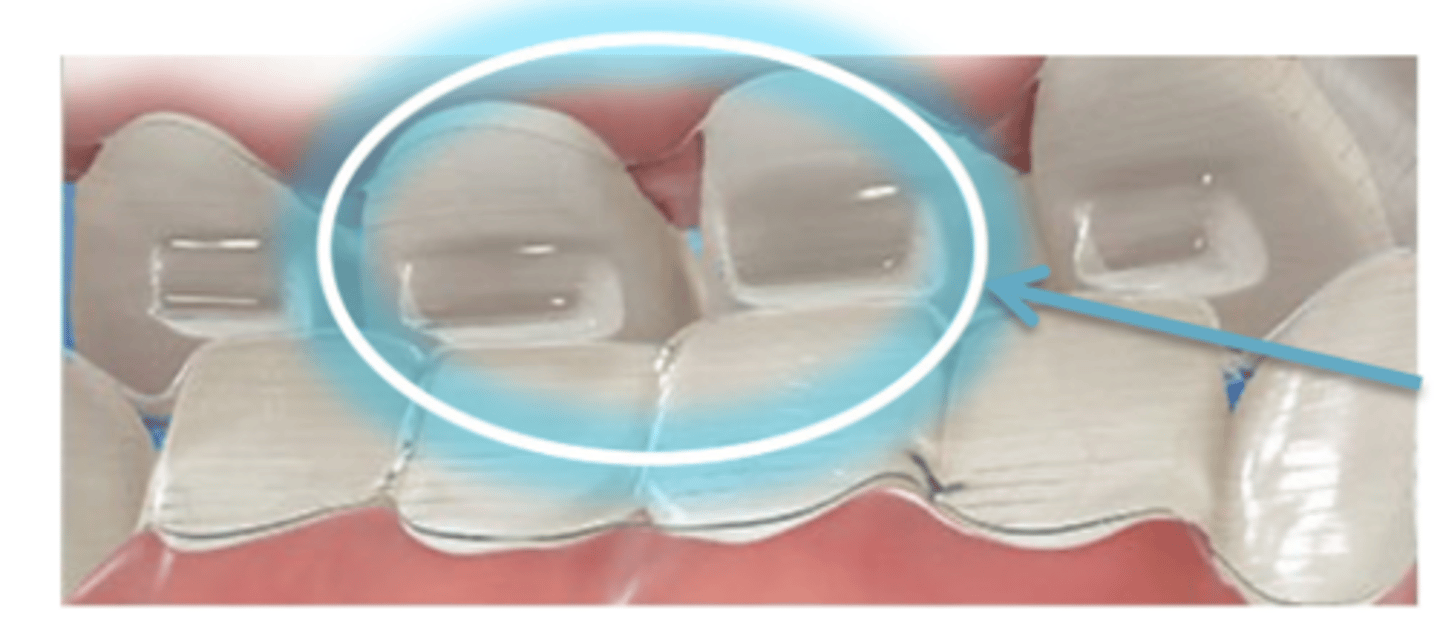
ID feature of aligner:
Precision bite ramps
ID feature of aligner:
- Process of removing a small amount of a tooth's enamel between two adjacent teeth.
- Commonly used to create space for the patient’s tooth alignment when teeth are crowded.
-Teeth cannot move past one another if the contacts are heavy
-Based on computerized measurements, staging, and tooth movements
- Specified by amount, and by the stage when it is required
Interproximal reduction (IPR)
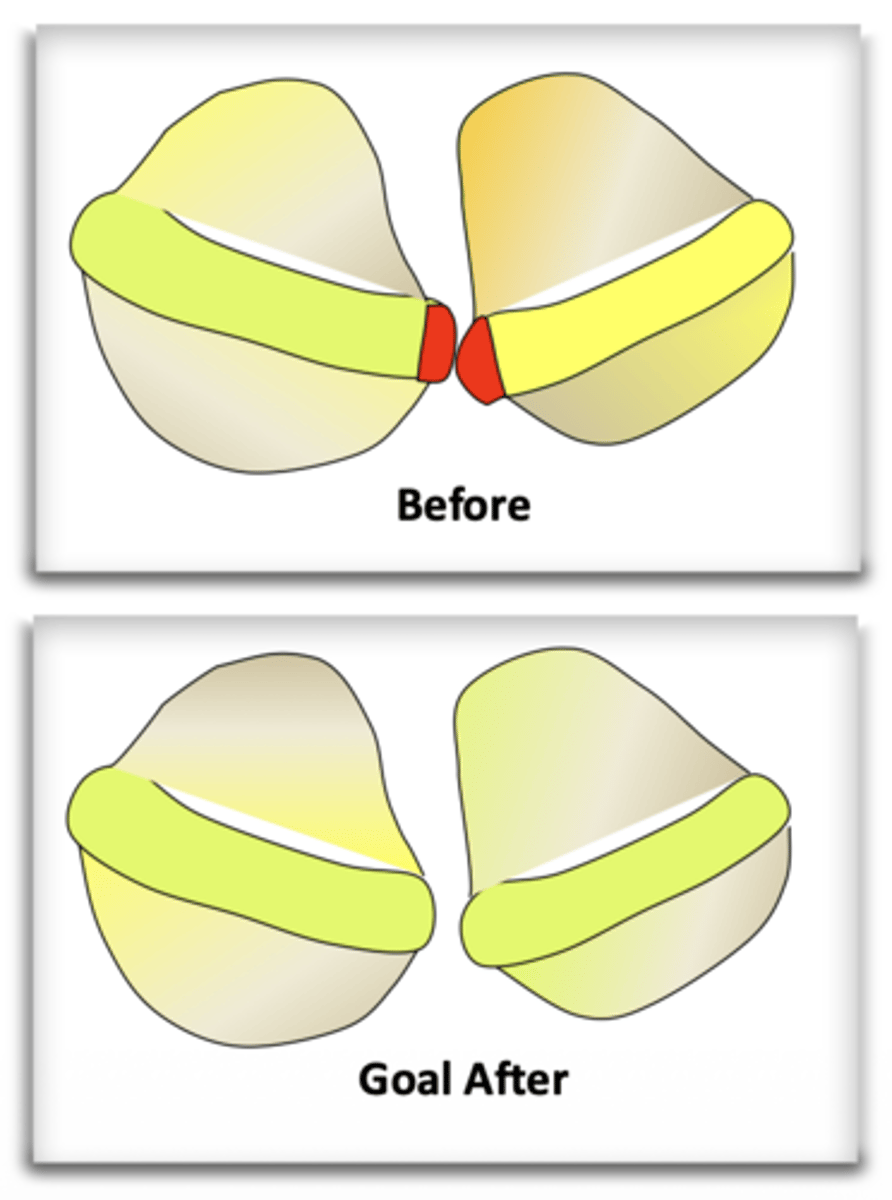
ID feature of aligner:
Interproximal reduction (IPR)
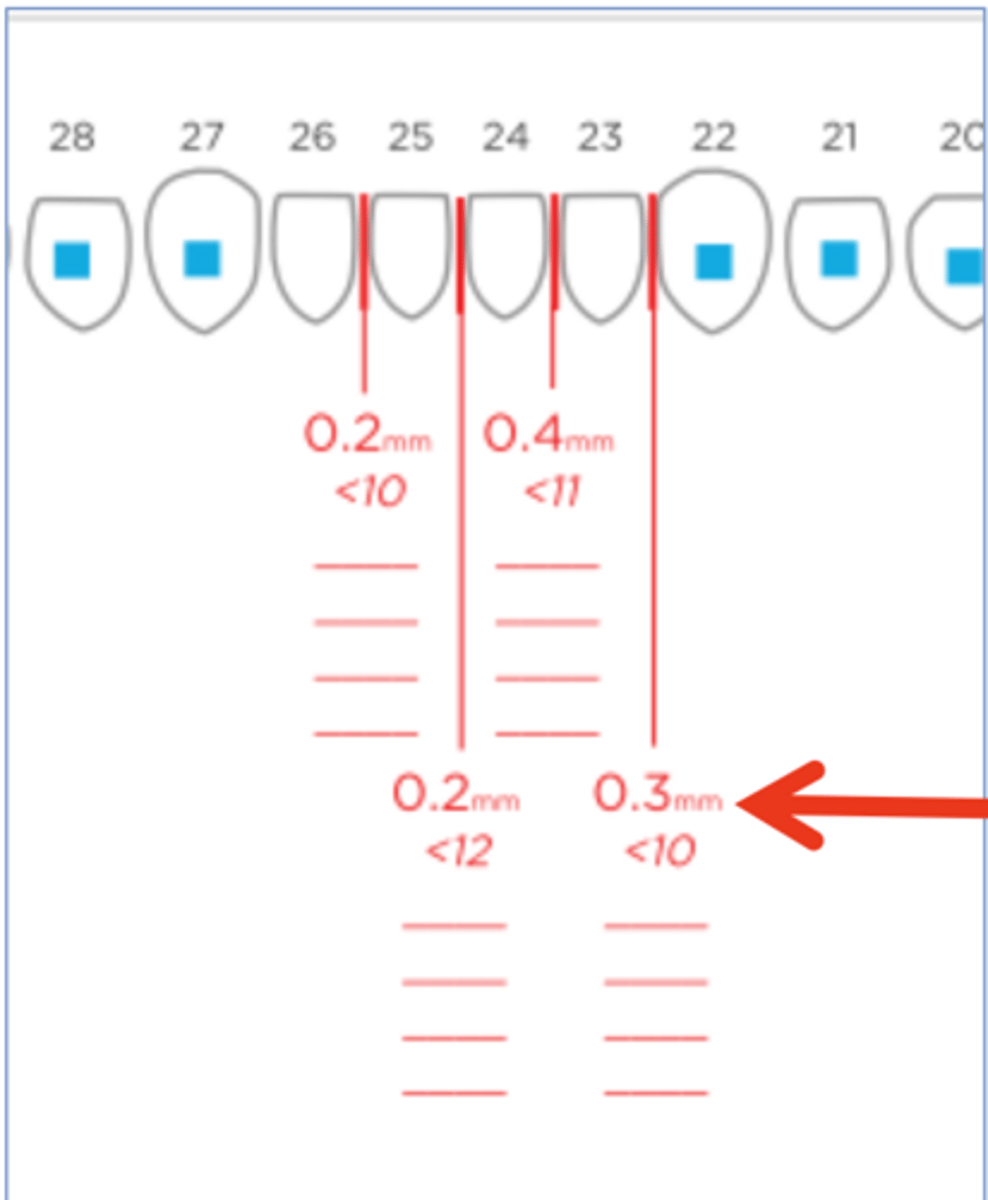
What does this interproximal reduction (IPR) instruction mean?
0.3mm IPR between tooth #23 and # 22 before Stage 10
____________ can also help in situations where there is a tooth size discrepancy between the top and bottom teeth. This balances the amount of tooth mass between the upper and lower teeth for them to fit properly in occlusion
Interproximal reduction (IPR)
Is your last aligner a retainer?
No - can order removable retainers directly from Align
All of the following are general properties of aligners and tooth movement EXCEPT:
A. Great at tipping teeth buccolingually, corrects flared out and tipped in teeth well
B. Great at intruding posterior teeth
C. Great at deepening overbites
D. Not so great at maintaining torque while retracting or protracting teeth
E. Great at opening deep overbites
E - NOT so great at opening deep bites
Is the following considered an easy or difficult case?
Class I deep OB / Class II div. II severe deep OB patients with minimal crowding or spacing
Difficult
T/F: ClinCheck always represents an accurate final outcome
False
(Can differ in reality - not all malocclusions are equal in achieving predictable results)
What is more likely...
A) Teeth tipping
B) Root of tooth moving
A) Teeth tipping
T/F: Aligners can easily intrude posterior teeth
True
(Posterior open bites develop easily if not accounted for. This is helpful in correcting anterior open bites)
T/F: Multiple movements can be employed at once with aligners which can decrease treatment time in certain situations
True
What is the ultimate risk factor of aligners?
Patient compliance (Trays must be worn >20hrs a day for treatment to work)