Lesson 4, 5, 6, 7
0.0(0)
Studied by 21 people Call Kai
 Learn
Learn Practice Test
 Spaced Repetition
 Match
Match Flashcards
 Knowt Play
Card Sorting
1/95

Earn XP
Description and Tags
Standards Organization for Data Communications, Transmission Modes, and Two wire vs Four Wire Circuits and Types of Synchronization
Last updated 8:55 AM on 3/5/23
Name | Mastery | Learn | Test | Matching | Spaced | Call with Kai | Chat |
|---|
No analytics yet
Send a link to your students to track their progress
96 Terms
1
New cards
Standards Organizations
An association of organizations, governments, manufacturers and users form the ____ and are responsible for developing, coordinating and maintaining the standards The purpose is that all data communications equipment manufacturers and users comply with these standards.
2
New cards
International Standard Organization (ISO)
the international organization for standardization on a wide range of subjects. It is comprised mainly of members from the standards committee of various governments throughout the world.
3
New cards
International Standard Organization (ISO)
It is even responsible for developing models which provide a high level of system compatibility, quality enhancement, improved productivity, and reduced costs. The ____ is also responsible for endorsing and coordinating the work of the other standards organizations.
4
New cards
International Telecommunications Union Telecommunication Sector (ITU-T)
is one of the four permanent parts of the International Telecommunications Union based in Geneva, Switzerland. It has developed three sets of specifications: the V series for modem interfacing and data transmission over telephone lines, the X series for data transmission over public digital networks, email, and directory services; the I and Q series for Integrated Services Digital Network (ISDN) and its extension Broadband ISDN.
5
New cards
International Telecommunications Union Telecommunication Sector (ITU-T)
Their membership consists of government authorities and representatives from many countries and it is the present standards organization for the United Nations.
6
New cards
Institute of Electrical and Electronics Engineers (IEEE)
____ is an international professional organization founded in United States and is compromised of electronics, computer and communications engineers. It is currently the world’s largest professional society with over 200,000 members.
7
New cards
Institute of Electrical and Electronics Engineers (IEEE)
It develops communication and information processing standards with the underlying goal of advancing theory, creativity, and product quality in any field related to electrical engineering.
8
New cards
American National Standards Institute (ANSI)
____ is the official standards agency for the United States and is the U.S. voting representative for the ISO. ____ is a completely private, nonprofit organization comprised of equipment manufacturers and users of data processing equipment and services. ____ membership is comprised of people form professional societies, industry associations, governmental and regulatory bodies, and consumer goods.
9
New cards
Electronics Industry Association (EIA
___ is a non profit U.S. trade association that establishes and recommends industrial standards ___ activities include standards development, increasing public awareness, and lobbying and it is responsible for developing the RS (recommended standard) series of standards for data and communications.
10
New cards
Telecommunications Industry Association (TIA)
is the leading trade association in the communications and information technology industry It facilitates business development opportunities through market development, trade promotion, trade shows, and standards development. It represents manufacturers of communications and information technology products and also facilitates the convergence of new communications networks.
11
New cards
Internet Architecture Board (IAB)
earlier known as Internet Activities Board is a committee created by ARPA (Advanced Research Projects Agency) so as to analyze the activities of ARPANET whose purpose is to accelerate the advancement of technologies useful for U.S military
12
New cards
Internet Architecture Board (IAB)
is a technical advisory group of the Internet Society and its responsibilities are;
I. Oversees the architecture protocols and procedures used by the Internet
II. Manages the processes used to create Internet Standards and also serves as an appeal board for complaints regarding improper execution of standardization process
III. Responsible for administration of the various Internet assigned numbers
IV. Acts as a representative for Internet Society interest in liaison relationships with other organizations. V. Acts as a source of advice and guidance to the board of trustees and officers of Internet Society concerning various aspects of internet and its technologies.
I. Oversees the architecture protocols and procedures used by the Internet
II. Manages the processes used to create Internet Standards and also serves as an appeal board for complaints regarding improper execution of standardization process
III. Responsible for administration of the various Internet assigned numbers
IV. Acts as a representative for Internet Society interest in liaison relationships with other organizations. V. Acts as a source of advice and guidance to the board of trustees and officers of Internet Society concerning various aspects of internet and its technologies.
13
New cards
Internet Engineering Task Force (IETF)
It is a large international community of network designers, operators, vendors and researchers concerned with the evolution of the Internet architecture and smooth operation of the Internet.
14
New cards
Internet Research Task Force (IRTF)
It promotes research of importance to the evolution of the future Internet by creating focused, long term and small research groups working on topics related to Internet protocols, applications, architecture and technology.
15
New cards
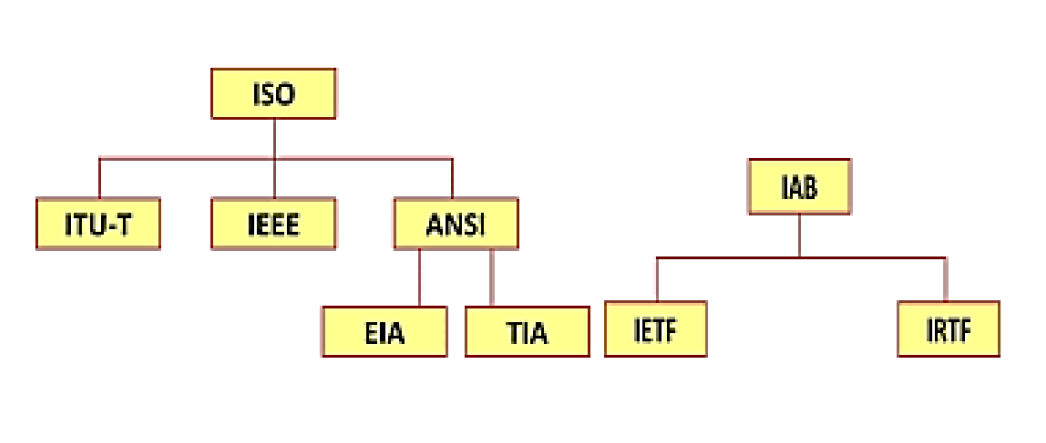
The primary standards organizations for data
communication are:
communication are:
16
New cards
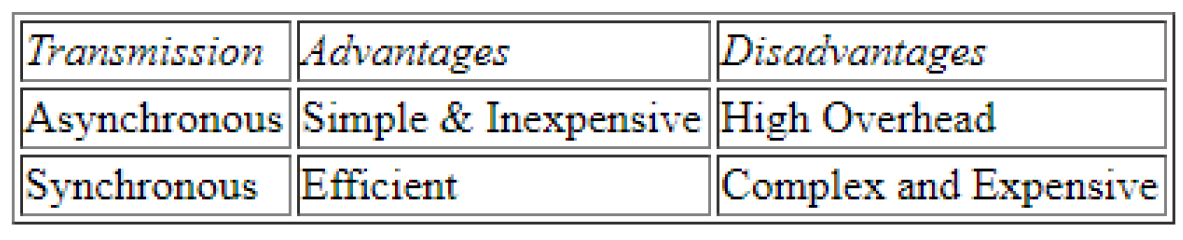
Transmission mode
It means transferring of data between two devices. It is also known as communication mode.
17
New cards
Buses and networks
are designed to allow communication to occur between individual devices that are interconnected.
18
New cards
Simple Mode
Half Duplex Mode
Full Duplex Mode
Half Duplex Mode
Full Duplex Mode
Three Types of Transmission Mode
19
New cards
Simplex Model
In _____, the communication is unidirectional, as on a one way street. Only one of the two devices on a link can transmit, the other can only receive. The ____ can use the entire capacity of the channel to send data in one direction.
20
New cards
Simplex Mode
What mode of transition: Keyboard and traditional monitors. The keyboard can only introduce input, the monitor can only give the output.
21
New cards
Half Duplex Mode
In _____, each station can both transmit and receive, but not at the same time. When one device is sending, the other can only receive, and vice versa. The ____ is used in cases where there is no need for communication in both direction at the same time. The entire capacity of the channel can be utilized for each direction.
22
New cards
Half Duplex Mode
What mode of transition: Walkie talkie in which message is sent one at a time and messages are sent in both the directions.
23
New cards
Full Duplex Mode
In ____ mode, both stations can transmit and receive simultaneously. The capacity of the channel, however, must be divided between the two directions.
24
New cards
Full Duplex Mode
In ____, signals going in one direction share the capacity of the link with signals going in other direction, this sharing can occur in two ways
\
1\. Either the link must contain two physically separate transmission paths, one for sending and the other for receiving.
\
2\. Or the capacity is divided between signals traveling in both directions. It is used when communication in both directions is required all the time.
\
1\. Either the link must contain two physically separate transmission paths, one for sending and the other for receiving.
\
2\. Or the capacity is divided between signals traveling in both directions. It is used when communication in both directions is required all the time.
25
New cards
Full Duplex Mode
What mode of transition: Telephone Network in which there is communication between two persons by a telephone line, through which both can talk and listen at the same time.
26
New cards
full/full duplex mode
transmission is possible in both directions at the same time but not between the same two stations. It is possible only on multipoint circuits. Postal system can be given as a person can be sending a letter to one address and receive a letter from another address at the same time.
27
New cards
full/full duplex mode
What mode of transition: station 1 transmitting to station 2, while receiving from station 3
28
New cards
Circuit
is the physical path that runs between two or more points. It terminates on a port (that is, a point of electrical or optical interface), and that port can be in a host computer (that is, a switching device used to establish connections), on a multiplexer, or in another device.
29
New cards
Two-Wire Circuits & Four-wire Circuits
Two Types of Circuits
30
New cards
Two Wire Circuits
A _____ circuit has two insulated electrical conductors. One wire is used for transmission of the information. The other wire acts as the return path to complete the electrical circuit. These are circuits are generally deployed in the analog local loop, which is the last mile between the subscriber and the subscriber's first point of access into the network.
31
New cards
Two Wire Circuits
A telephone conversation inherently requires transmission in both directions. When both directions are carried on the same pair of wires, it is called ____
32
New cards
local switching center
The telephones in our homes and offices are connected to a _____ (exchange) by means of two wire circuits.
33
New cards
Two wire operation.
When oppositely directed portions of a single telephone conversation occur over the same electrical transmission channel or path.
34
New cards
hybrid coil
A ____ accomplishes the conversion for both two wire and four wire.
35
New cards
Modern Line Card
it is strictly an analog/digital interface to a system that has a completely digital and integrated signal path internally.
36
New cards
4ESS
Using actual wires to circuit switch a telephone call became obsolete when the crossbar switch (a mechanical system) was replaced by ___ electronic switches in the 1970s by the Bell System in the US.
37
New cards
Two pair and four pair
refer to the number of wires in the internal cabling plan.
38
New cards
Two wire and four wire
have to do with the number of electrical conductors associated with a transmission line.
39
New cards
Four Wire
A ____ circuit has two pairs of conductors. That is, it has two sets of one way transmission paths: one path for each direction and a complementary path to complete the electrical circuit.
40
New cards
Four Wire Circuits
wire circuits are used where there is distance between the termination points which requires that the signal be strengthened periodically.
41
New cards
Four Wire Circuits
A type of circuit that connects the various switches that make up the public switched telephone network (PSTN).
42
New cards
Four Wire Circuits
circuits are also used with leased lines, where a customer may be connecting locations of its own that are separated by distance. Also, all digital circuits are provisioned on this basis.
43
New cards
Four Wire Circuits
is a two-way circuit using two paths so arranged that the respective signals are transmitted in one direction only by one path and in the other direction by the other path.
44
New cards
Four Wire Circuits
gets its name from the fact that is uses four conductors to create two complete electrical circuits, one for each direction. The two separate circuits (channels) allow full duplex operation with low crosstalk.
45
New cards
Four Wire Circuits
was historically used to transport and switch baseband audio signals in the phone company telephone exchange before the advent of digital modulation and the electronic switching system eliminated baseband audio from the telco plant except for the local loop.
46
New cards
a. physical four wire
b. logical four wire
b. logical four wire
There are two types of four wire circuits:
47
New cards
physical four wire
In ___ you can actually count four wires.
48
New cards
logical four wire
wire, physically there are only two wires, but you derive the four individual paths by splitting the frequency. Half of the frequency band carries the transmit signal, and the other half carries the receive signal.
49
New cards
attenuated signals.
signals that have been losing power as they have traveled across the network, which are called ____.
50
New cards
amplifiers and repeaters
tools to augment signals that have been losing power as they have traveled across the network, which are called ___.
51
New cards
amplifier
An ___ boosts an attenuated signal back up to its original power level so it can continue to make its way across the network.
52
New cards
First generation amplifiers
were unidirectional. They could only amplify a signal moving in one direction, so any time you needed to provision a circuit that was going to be crossing a distance, you had to literally provision two circuits one to amplify the information in the transmit direction and a second to amplify the information in the receive direction.
53
New cards
local loop
is a two wire circuit for one reason only: to save copper. Using half the number of copper wire conductors per circuit means that the infrastructure cost for wiring each circuit is halved. Although a lower quality circuit, it allows full duplex operation by using a telephone hybrid to keep near and far voice levels equivalent.
54
New cards
Synchronization
means that the receiver must be able to determine, when to expect a new transmission and when to send acknowledgements. In other words transmitter and receiver should have an agreement on the nature as well as timing of the signals.
55
New cards
Synchronization
in the context of .NET, is a process that involves coordinating the execution of multiple threads to ensure a desired outcome without corrupting the shared data and preventing any occurrence of deadlocks and race conditions.
56
New cards
Synchronization
also occurs between network nodes to ensure that data streams are received and transmitted correctly, and to prevent data collision. It usually uses a clock signal transmitted in sequence with a data stream to maintain proper signal timing.
57
New cards
To synchronize
is to coordinate or time events so they happen all at the same time.
58
New cards
Timing
refers to the method used by the data communication system so that the destination station recognizes the start of a data stream and reliably reads the information sent.
59
New cards
1. Asynchronous Transmission
2. Synchronous Transmission.
Two major timing schemes are used:
60
New cards
Asynchronous communications or transmission
sends data from the source to the destination without synchronizing the two clock systems. The source and destination clocks are free running and not locked to each other. Short characters of 7 to 8 bit data are sent one at a time framed by a start bit and 1 or 2 stop bits.
61
New cards
Asynchronous communications
is used for low data transfer rates usually 128 kbps or less and short bursts of data. Faster data rates and longer data lengths cause the data errors at the receiver.
62
New cards
Conventional representation
has asynchronous data flowing left to right and synchronous data flowing right to left.
63
New cards
Stop bits
The purpose of the ____ is to indicate the end of data. There could be 1 or 2 stop bits with 1 being the typical number of stop bits used today.
64
New cards
Asynchronous transmission
the characters are sent individually with a quiet period in between (quiet meaning 0 bit level). It requires the transmitting station and the receiving station to have individual internal free running clocks operating at the same frequency.
65
New cards
Free running
means that the clocks are not locked together.
\
\
66
New cards
Start bit
The receive station starts checking for data after the ____ is received (It is a wakeup call).
67
New cards
Synchronous transmission
it is a method of data communication that requires the source and destination to synchronize their clocks together.
68
New cards
1. Externally clocked synchronous transmission
2. Internally encoded synchronous transmission
There are two types of synchronous data transmission:
69
New cards
Asynchronous Transmission
there are 3 to 4 bits of overhead (start, stop, parity bits) sent with each character of data (7 to 8 bits). The start and stop bits were used to identify the beginning and end of transmission.
\
\
70
New cards
Synchronous transmission
blocks of data up to 64Kbytes in size can be sent without loss or corruption of data. A start field and end field indicate the beginning and end of transmission. Smaller overhead results in a more efficient delivery of data.
71
New cards
Externally clocked synchronous transmission
has separate lines from the data lines for synchronizing the clock. For example. in addition to the normal handshaking control lines, the V.35 physical layer standard has two pairs of wires used for synchronizing the source and destination clocks.
72
New cards
Transmit, Receive
The ____ Timing balanced pair is used to send out a timing clock to the destination, the _____ Timing balanced pair is a separate clock timing received from the destination.
73
New cards
99\.9%
how many percent does the time the transmit and receive data rates are the same.
74
New cards
Fields
Special sequence of bits called ___ are required at the beginning and end of the block of data to inform the destination that new data is arriving.
75
New cards
Start Field, End Fields
Synchronous Transmission sends blocks of characters at a time. Each block of data is preceded by a ____ which is used to tell the receiving station that a new packet of characters is arriving. The blocks of data also have ___ to indicate the end of the data block.
76
New cards
4 bytes
Synchronous transmission is more efficient than asynchronous (character transmission) as little as only ____ (2 Start Framing Bytes and 2 Stop Framing bytes) are required to transmit up to 8K bytes.
77
New cards
Overhead
Extra bytes, like the Start and Stop Frame, that are not part of the data are called ____. It consists of control information used to control the communication.
78
New cards

Efficiency
79
New cards
Generic Packet X
is used as an introduction to Synchronous Data Transmission.
80
New cards
Different frame types
(Ethernet, Token Ring, SDLC, HDLC, Frame Relay, ATM, Cell Relay, etc...)
81
New cards

Basic Frame Structure
82
New cards
Preamble
Starting Delimiter/Alert Burst/Start of Header. At the beginning of each frame (packet), there will be a sequence of bytes (8 bit words), called the _____
83
New cards
Preamble
It informs the receiving station that a new packet is arriving Synchronize the receive clock with the transmitted clock The ___ is a series of bytes with a specific bit pattern that is used only by the Preamble.
84
New cards
Names used by other protocols for the Preamble are:
Starting Delimiter, Alert Burst and Start of Header.
85
New cards
Address Field(s):
Source and/or Destination
Source and/or Destination
The ___ consists of a Source Address and/or a Destination Address. The Source and Destination Addresses are hexadecimal numbers that identify the sender Source and receiver Destination. The Network Addresses reside in either the Network Interface Card's firmware or can be either assigned during the initialization of the NIC. The purpose of the Source Address is to identify to the network who is sending data. The purpose of the Destination Address is to identify to the network who should be receiving the data. Under some protocols, there may not be both Source and Destination Addresses. Only one address may be present.
86
New cards
Control Field
The ____ is used to indicate the Type of Information being sent as Data. The Type of Information can be Control information used when establishing a connection (handshaking) or it can be Data such as file transfers between clients and servers. Its purpose is to identify what the purpose of the packet or frame is: Control or Data. It can also be used to indicate the size of the packet and Data.
87
New cards
Data/Message Field
The ____ or Message is the actual information that is being transmitted. The Control Field would indicate the Data Field size. The ___ is also called the Info field by some protocols.
88
New cards
Optional Pad The Data
The ____ is used to pad the data field when the protocol has a fixed Data Field size. If the Data Field size is fixed at 1200 bytes and only 300 bytes of information is available then the Pad will fill in the remaining 900 bytes with characters (e.g. 900 bytes of 00h). The protocol may also use the Pad to ensure a minimum Data field size.
89
New cards
CRC/ Frame Check Sequence
The ____ contains an error checking number that the Destination can use to verify that the packet is okay and error free.
90
New cards
End Frame Delimiter
is a series of bytes that have a specific bit pattern that identifies the end of the packet to the Destination. Not all protocols have these fields, protocols with fixed packet size may not need the field as the Destination may simply count the number of bytes it has received.
91
New cards
Comparison between asynchronous and synchronous data transmission:
92
New cards
1. Data synchronization
2. Process synchronization:
Types of Synchronization
93
New cards
Lock, mutex , and semaphores
Examples of process synchronization
94
New cards
Locks
are one synchronization technique. A___ is an abstraction that allows at most one thread to own it at a time. If a thread tries to acquire a lock currently owned by another thread, it blocks until the other thread releases the lock.
95
New cards
Semaphore
is typically an integer variable, it allows multiple program threads to access the finite instance of resources.
96
New cards
mutex
is an object. It allows multiple program threads to access a single shared resource but one at a time.