Microbiology 3050 Bacterial Endospores and Flagella
 Call Kai
 Learn
Learn Practice Test
 Spaced Repetition
 Match
Match Flashcards
 Knowt Play
1/85

There's no tags or description
Looks like no tags are added yet.
Name | Mastery | Learn | Test | Matching | Spaced | Call with Kai | Chat |
|---|
No analytics yet
Send a link to your students to track their progress
86 Terms
Bacterial endospores are complex, …
dormant survival structures formed by SOME bacteria, we will only discuss gram positive cells that produce endospores but gram negative cells can form them
What are the two bacteria that commonly form endospores?
Bacillus and Clostridium
Endospores can form in …
various places within the cell, species specific

Endospores are resistant to …
heat, radiation, chemicals, and desiccation (drying out)
When an endospore forms its goal is to …
survive not replicate
Endospores’ structures include …
Exosporium, spore coat, cortex, and core
The formation of an endospore gives gram positive cells an …
outer membrane, the germ cell wall which is surrounded by the exosporium, cortex an coat was the former cell wall before the formation of the endospore
An endospore is like when you give up for the day and …
wrap yourself in blanket and take on a burrito level of laziness on the couch, the cell wraps itself in many layers
The exosporium is …
the outermost, thin protein-and-glycoprotein layer found surrounding the spore coat in certain bacterial endospores
The cortex is …
a thick, specialized layer of peptidoglycan located beneath the spore coat that is essential for maintaining core dehydration and extreme heat resistance
The core is …
the vital, deeply dehydrated central center of a bacterial endospore that houses the cell's genetic material and machinery in complete dormancy
Endospores are so resistant because …
they have a low water content (water moved by calcium dipicolinate (Ca-DPA), less water means there is no smaller specific heat present in the cell, this means the contents inside the cell won’t boil and denature
Ca-DPA is an …
acid and it grabs onto water inside the central core and removes it, this dehydrates the core
SASPs also help make endospores resistant, it stands for …
small, acid-soluble, DNA-binding proteins, the core drops in pH and once it does these proteins find DNA and bind to it to protect it from denaturation
Lowering the pH of the core also slows …
metabolism
The exosporium and coat are …
additional layers that keep bad things out
We care about endospores because they are …
the most difficult bacteria to kill, they can survive going to space, and in cases of pathogenic bacteria like testis which makes endospores makes it harder for us to kill bacteria that are causing an infection or disease
In vegetative cells (normal replicating cells) their Microscopic appearance would be …
non-refractile, the endospore’s would be refractile
In vegetative cells, their calcium content would be …
low, but the endospores would be high
In vegetative cells, their Diplocolinic acid would be …
Absent, but in endospores it would be present
In vegetative cells, their Enzymatic activity would be …
High, but in endospores enzymatic activity would be low
In vegetative cells, their respiration rate would be …
High, but in endospores it would be low or absent
In vegetative cells, their Macromolecular sunthesis would be …
Present, but in endospores the macromolecular synthesis would be absent
In vegetative cells, their heat resistance, radiation resistance, and resistance to chemicals would be …
low, but for endospores all three would be high
In vegetative cells, Lysozyme would be …
sensitive/affective, while in endospores the cell would be resistant
Water content in vegetative cells is …
80-90% in endospores it would be 10-25%
Small acid-soluble spore proteins are …
absent in vegetative cells
sporulation is the …
process of producing an endospore, germination is the process of an endospore returning to a vegetative state
A vegetative cell begins sporulation when …
the cell senses distress which is anything that prevents it from dividing, like lack of nutrition
What is the first step to forming an endospore after some form of distress?
asymmetric cell division, when a cell begins replication but instead the cytoplasm doesn’t split and the copied material is pushed to one side of the cell (called the forespore, everything the cell will need once its germinated is in the forespore) and separated from the mother cell by the septum
Which step is the commitment (will you be my endospore) step?
Asymmetric cell division, once the cell completes asymmetric cell division it does not matter is the distress that initiated sporulation disappears, the cell will form a complete endospore regardless
The septum is …
an asymmetric (polar) membrane wall that divides the bacterial cell into two unequal compartments: a smaller forespore (the future spore) and a larger mother cell
After asymmetrical cell division, the mother cell …
engulfs the forespore, the septum becomes the internal membrane, the outer membrane was the mother cell’s cytoplasmic membrane
After the being engulfed, the …
coat and cortex form around the endospore which is still inside the mother cell (this is called late sporulation)
What happens after late sporulation?
Maturation: the spore dehydrates, Ca2+, SASPs, and dipicolinic acid are present
After maturation the mother cell …
lyses, resulting in a free endospore, it senses conditions outside and if they are better the cell will germinate
Activation of endospores prepares the spores for …
germination(everything rehydrates) and often results from treatments like heating
For germination to take place …
environmental nutrients is detected, the spore swells and the spore coat ruptures which equals the loss of resistance and increased metabolic activity
Flagella are …
thread-like appendages extending outward from the plasma membrane and cell wall
The functions of flagella are …
motility and swarming(cells move towards something, usually nutrients)
Flagella also help cells …
attach to surfaces and increase virulence(helps pathogen cause disease by moving to places that are hospitable within your body)
Research was done to see the affect of removing flagella and it resulted in …
pathogenic cells losing virulence
Bacterial flagellum spin like …
a propeller (think that the flagellum does the “Nene” and not “whip”")
When a cell has one flagellum its called …
monotrichous
When a cell has flagellum at the end of the cell its called …
polar flagellum
When a cell has one flagellum at each end of the cell its called …
amphitrichous
When a cell has a cluster flagella at one or both ends its called …
lophotrichous
When a cell has flagella spread all over the surface of the cell its called …
peritrichous (they look hairy)
Flagella have …
3 parts to them, the filament, hook, and basal body
The filament makes up …
most of the flagella, its made of one protein called flagellin

The hook adds …
spinning action and drag which leads to propulsion
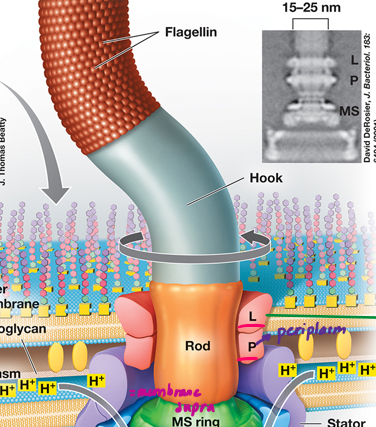
The basal body is …
embedded in the cell body and it includes the motor
The energy for rotation for flagella comes from the …
protein motive force (charges are separated across the plasma membrane which drives movement)
Charges move through the …
Mot (motility) protein which moves the C and MS ring of the motor

The flagellum motor includes the …
rotor (moves) = C ring and MS ring, and the stator (stays still) = Mot A and Mot B
The MS and C ring move and they are connected to …
the rod, hook, and filament, so it moves the entire flagellum

The rod, which connects the motor to the rest of the flagella, is connected/ held in place by …
the P ring (periplasm/peptidoglycan) and the L ring (lipopolysaccharide - for gram negative cells)
Gram - proteins require …
additional rings like rings P and L that are for support, they don’t spin!
The C ring gets its name because its located …
in the cytoplasm of the bacterial cell
The MS ring gets its name because its located in …
the membrane (MS = membrane supra)
Which part of the flagella is the first to form?
Starts from the outer membrane so the MS/C ring, then the motor (MOT) proteins, P ring, L ring, Early hook, Late hook, hook filament junction, and then finally filament synthesis
The Cap first appears in the …
late hook, the cap arranges flagellin to form the hollow tube, builds the tube from the tip
If the flagella is cut off, the Cap has been removed so to rebuild it …
the cell must send a new cap down to the end of what’s left of the tube
Flagella structure for gram positive cells
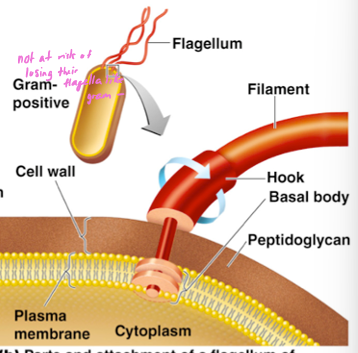
Flagella structure for gram negative cells

Flagellum rotate up to …
1100 rev/sec
Counterclockwise motion for flagellum generally results in …
a run, clockwise rotation disrupts a run by causing cell to stop and tumble
Using flagella is not exactly …
efficient but if a cell tumbles every so often it will eventually make its way towards nutrients
When running, peritrichous cells …
bundle up their flagella so that they run forward
Tumbling is simply …
reorientation, they do not chose what direction they move in (also called being stochastic - random)
Cells don’t constantly tumble or run because they have …
a limited amount of pmf, they can only run and tumble so many times before all the H+ protons enters their cyctoplasm
Spirochetes have multiple flagella that …
form axial fibril which winds around the cell (endoflagella, they hide inside the cell so that it doesn’t trigger an immune response inside the host)
Spirochetes endoflagella reside where?
in the periplasmic space inside outer sheath, they exhibit flexing and spinning movements (lyme disease comes from bacteria that do this)
Bacteria with flagella will use it to …
twitch(social) or glide(adventurous)
Flagella may involve slime to …
make it easier to move around
Twitching is …
a social movement because cells will do this together, like they are dancing = social, its a jerky intermittent , short movement
Type IV pili work like …
a cane, they will use it to drag themselves
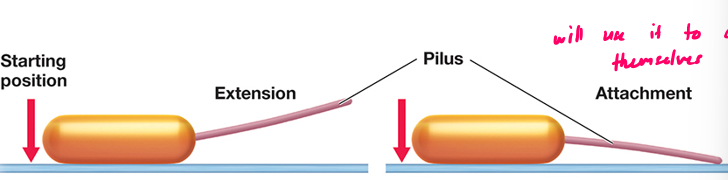
Gliding is …
done by singular cells, smooth movements, will use helical tracks, gliding motors, and extracellular adhesion proteins

Chemotaxis is …
movement toward a chemical attractant or away from a chemical repellant
concentrations of chemo-attractant and chemo-repellants are detected by …
chemo-receptors on surfaces of cells
Chemotaxis is a complex but rigid system where responses occur in less …
than 20 milliseconds, they can travel 2 to over 60 cell lengths/sec, insane for us to travel 60 lengths of our own height in less than 2 seconds
When bacteria are moving toward an attractant the cells runs are …
longer and tumbles are less frequent
When bacteria are moving toward a repellant their runs are …
shorter and tumbles are more frequent
Bacteria moving away from something involves …
similar but opposite responses
Chemotaxis is only done by …
bacteria with flagella