Chemosensory Systems: Taste and Smell Mechanisms
 Call Kai
 Learn
Learn Practice Test
 Spaced Repetition
 Match
Match Flashcards
 Knowt Play
1/63

There's no tags or description
Looks like no tags are added yet.
Name | Mastery | Learn | Test | Matching | Spaced | Call with Kai | Chat |
|---|
No analytics yet
Send a link to your students to track their progress
64 Terms
What are the two main chemosensory systems in humans?
Taste (gustation) and smell (olfaction)
How do taste and smell contribute to food selection?
Sweet and umami tastes are associated with nutritious food, while bitter tastes indicate potential toxins.
What is the role of chemosensory stimuli in reproduction for many species?
Chemosensory stimuli, such as pheromones, play an important role in reproduction.
What is the significance of the central pathways for smell?
Olfactory pathways project directly to the cortex, allowing for smell localization.
How do gustatory pathways differ from olfactory pathways?
Gustatory pathways pass through the thalamus before projecting to their relevant cortical area.
What ions are responsible for the transduction of saltiness and sourness in taste?
Saltiness is transduced by sodium ions, and sourness by hydrogen ions.
What is the transduction process for sweetness and bitterness in taste?
Sweetness and bitterness involve second messengers for transduction.
What is umami and what is it associated with?
Umami is a taste associated with glutamate and other nucleotides.
Which cranial nerves are involved in taste sensation?
The facial nerve (front of tongue), glossopharyngeal nerve (back of tongue), and vagus nerve (soft palate & mouth).
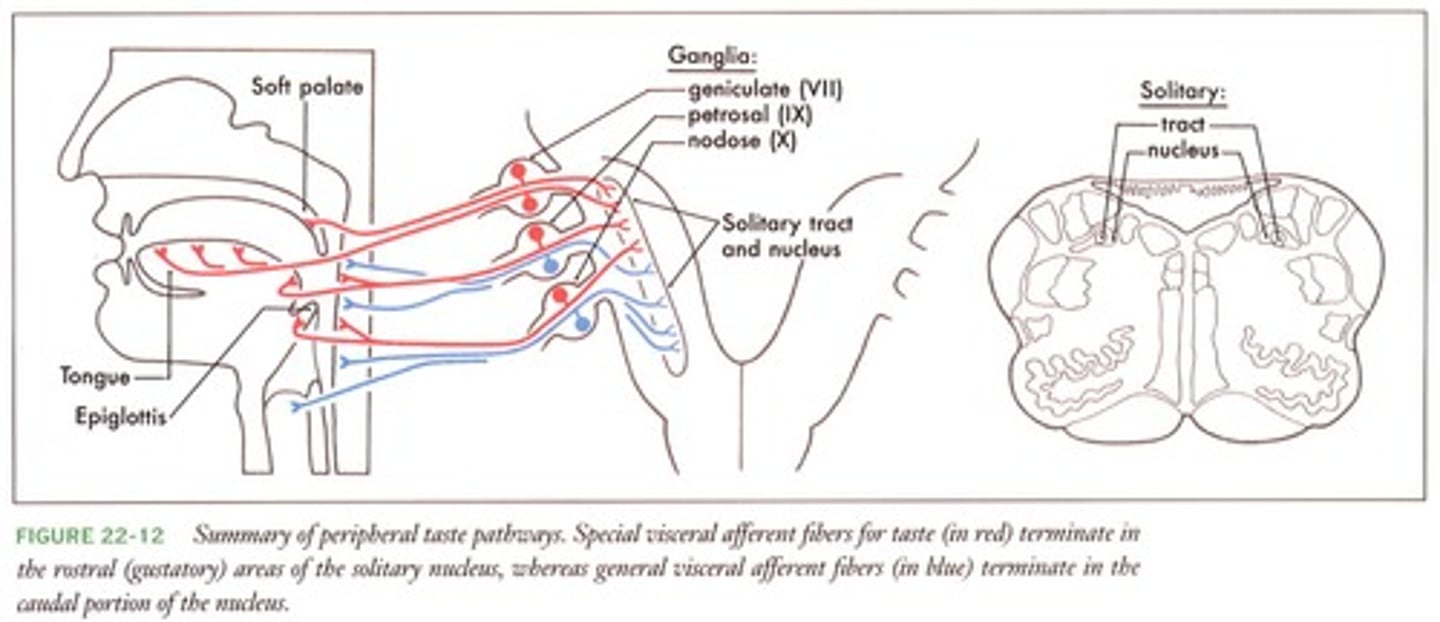
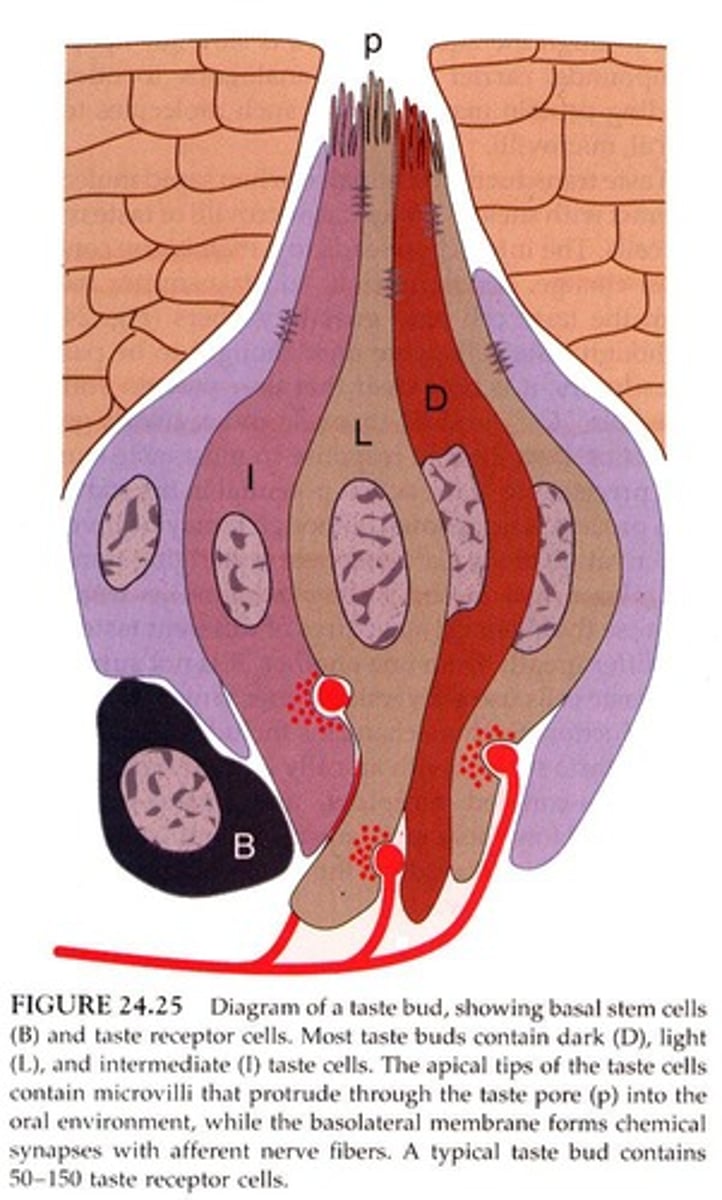
What types of cells are found in taste buds?
Taste buds contain different types of cells that express unique receptors for sweet, sour, bitter, salty, and umami tastants.
What is the concept of receptor specificity in chemosensory systems?
It refers to the ability of receptors to respond selectively to specific stimuli.
What is sensory adaptation in the context of chemosensory systems?
Sensory adaptation is the process by which sensory receptors become less sensitive to constant stimuli over time.
What does the concept of neural plasticity refer to?
Neural plasticity refers to the brain's ability to change and adapt in response to experience.
What is the importance of central projections and nuclei in sensory processing?
They are involved in the location and processing of sensory information in the brain.
What is the relationship between taste and smell in terms of sensory processing?
Taste and smell are closely linked, suggesting an overlap in central processing despite different receptors.
What is the role of local circuits in taste buds?
They include both excitation and inhibition, facilitating the transmission of taste information.
What are papillae and their role in taste?
Papillae are small rounded protuberances on the tongue that contain taste buds.
What is the role of bi-directional projections in olfactory pathways?
They contribute to the localization of smells.
How does the brain organize sensory information behaviorally?
The brain has a functional, behavior-driven organization that processes sensory information.
What is the concept of encoding transforms in sensory systems?
It refers to the process by which sensory information is transformed into neural signals.
What is the significance of gastrointestinal secretions in relation to taste and smell?
Taste and smell regulate gastrointestinal secretions, influencing digestion.
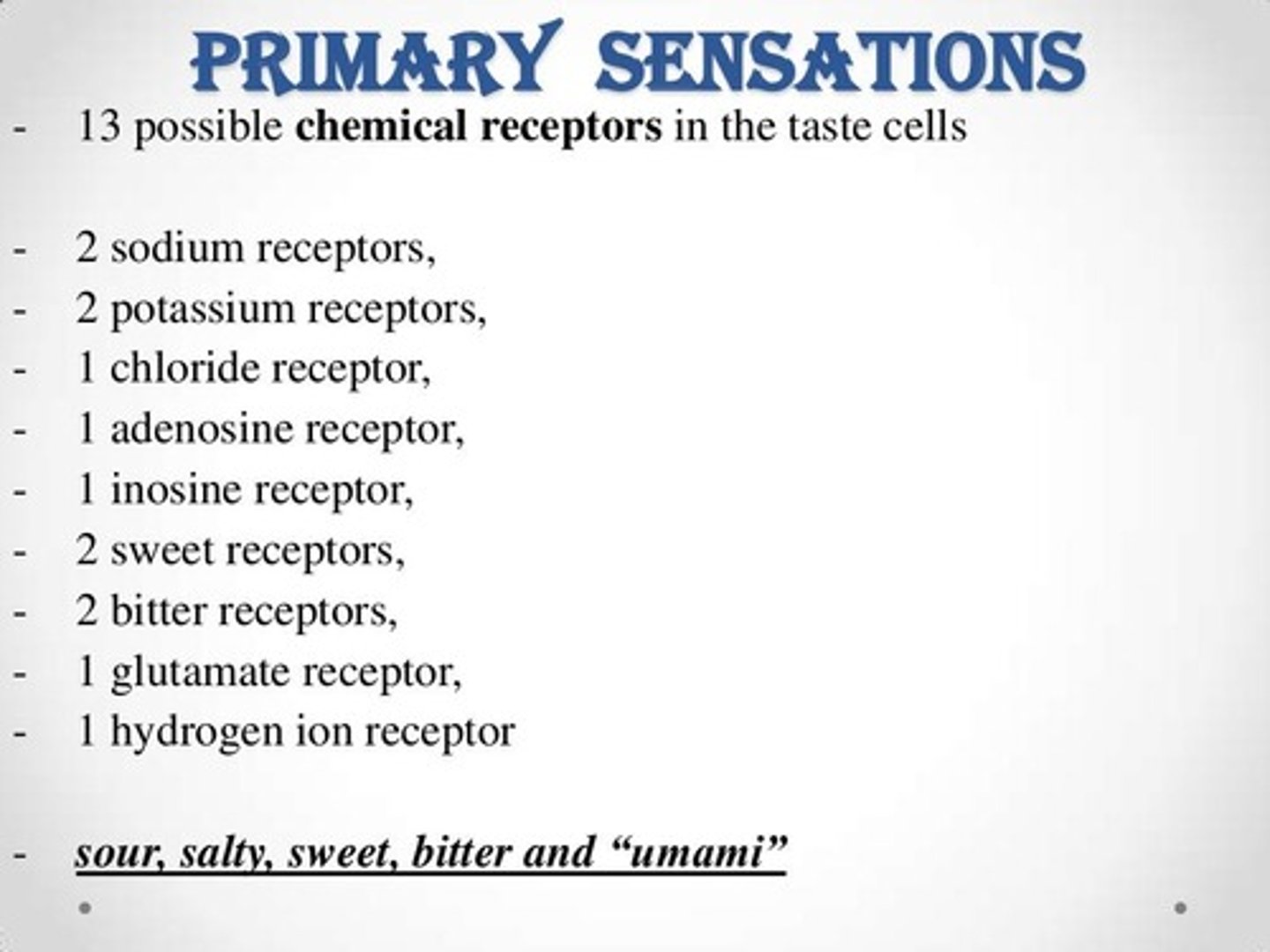
What are the five primary tastes detected by taste receptor cells?
Sweet, Bitter, Sour, Salt, Umami.
Which receptors are responsible for detecting sweet tastes?
T1R2/T1R3 (G-protein coupled receptors - GPCR).
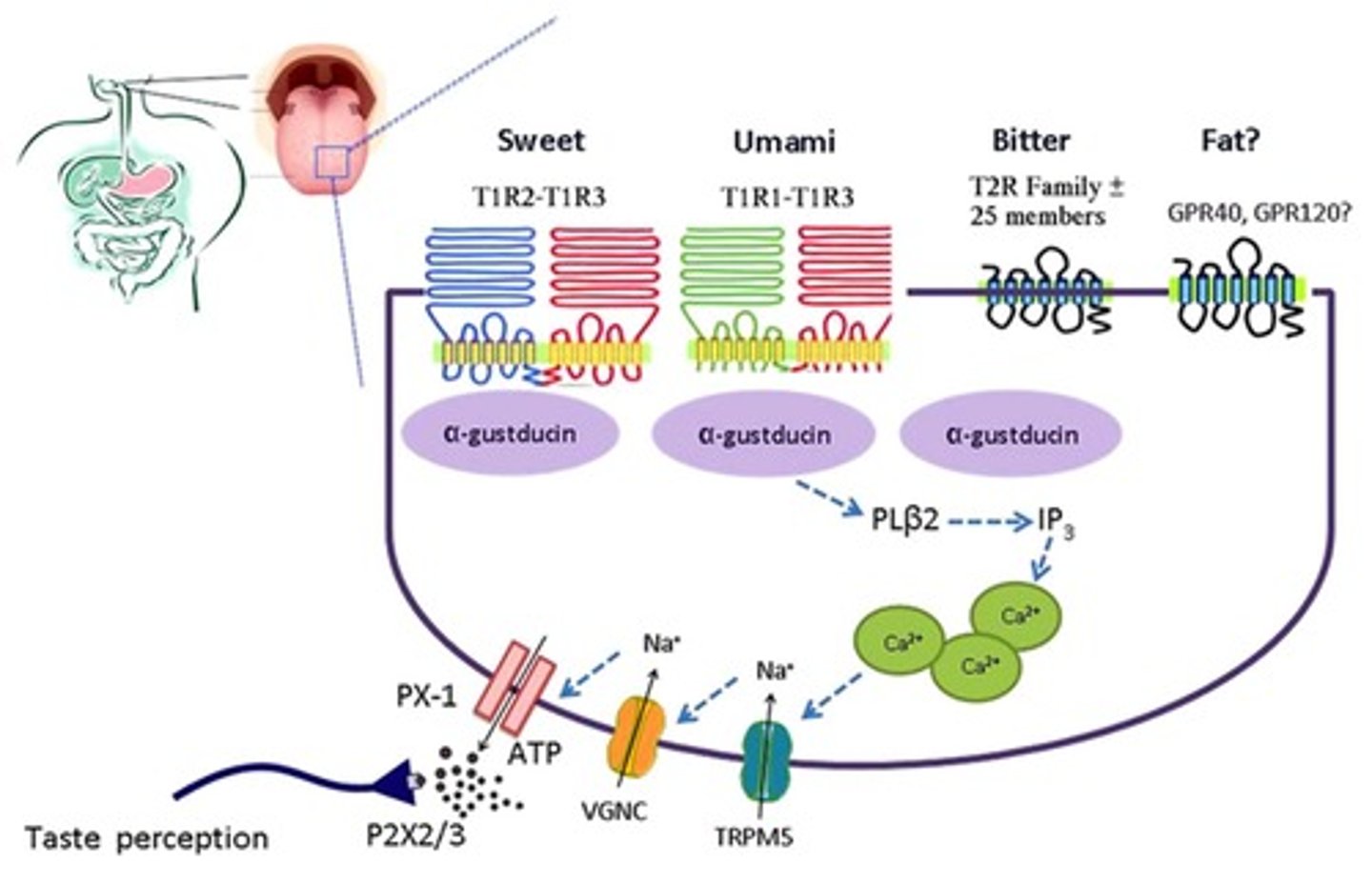
What type of receptors detect bitter tastes?
T2Rs (GPCR).
How is sour taste mediated?
By a broad range of receptors including GPCR and H+ ion channels.
What is the mechanism for salt taste detection?
Na+ entry via ion channels.
Which receptors are associated with umami taste?
Glutamate receptors; T1R1/T1R3 and mGluRs (GPCR).
What are the four major classes of taste cells based on?
Type 1 glial like cell- NT clearance
Type 2 receptor cell- taste transduction
Type 3 presynaptic cell- NT synthesis
Type 4- taste cells
characterized by ultrastructural features, patterns of gene expression, and functions.
What is the role of transducin in taste transduction?
Transducin releases Ca2+ from intracellular stores in response to bitter ligands.
How do sweet ligands activate taste cells?
Sweet ligands activate gustducin, which increases cAMP, closes K+ channels, and depolarizes the cell.
What triggers transmitter release in taste cells?
Increased intracellular Ca2+.
What is labeled-line coding in taste perception?
A coding logic where specific receptors correspond to specific taste qualities.
What is across-fiber pattern coding in taste?
A coding strategy that involves responses from multiple taste fibers to represent different tastes.
Where are olfactory receptors located?
Confined to about 5 cm2 of the olfactory mucosa deep within the nasal cavity.
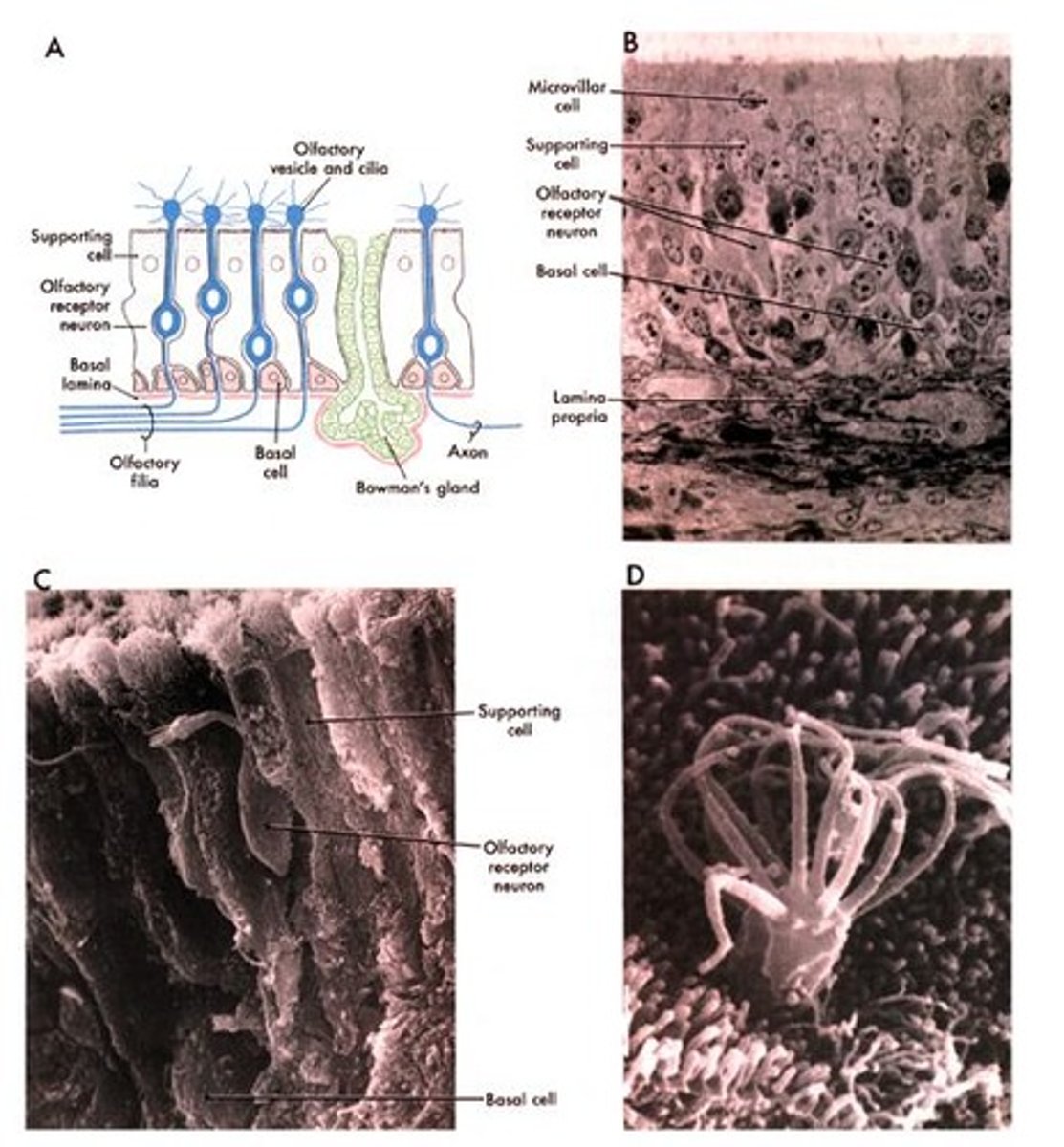
What is the role of cilia on olfactory receptor neurons?
They bind with odorants during the transduction process.
How many primary qualities of smell are there?
Seven primary qualities: peppermint, musk, floral, ethereal, pungent, putrid, and camphoreaceous.
What is the function of bipolar olfactory cells?
They are linked to the olfactory bulb via short axons.
What is the output pathway of the olfactory bulbs?
They project via the olfactory tracts to both ipsi- and contralateral olfactory regions of the cortex.
What is ACE2's role in relation to olfactory sensory neurons?
ACE2 is expressed in cells that provide metabolic and structural support to olfactory sensory neurons.
What are the three mechanisms of adaptation in olfaction?
1. Fewer receptor proteins on the cell surface; 2. cAMP receptor desensitization; 3. Other unspecified mechanisms.
What is the significance of the chemical structure of odorants?
It relates to human perceptual thresholds and qualities for common odors.
What is anosmia?
The inability to perceive odor, often tested based on common odors.
What are the three mechanisms of adaptation in sensory transduction?
1. Fewer receptor proteins on cell surface; 2. cAMP receptor desensitization; 3. Counteract by selective attention (higher cognitive function).
How does sniffing affect olfactory perception?
Sniffing directs air onto the olfactory mucosa, allowing odorants to be absorbed into the mucous layer over the receptors.
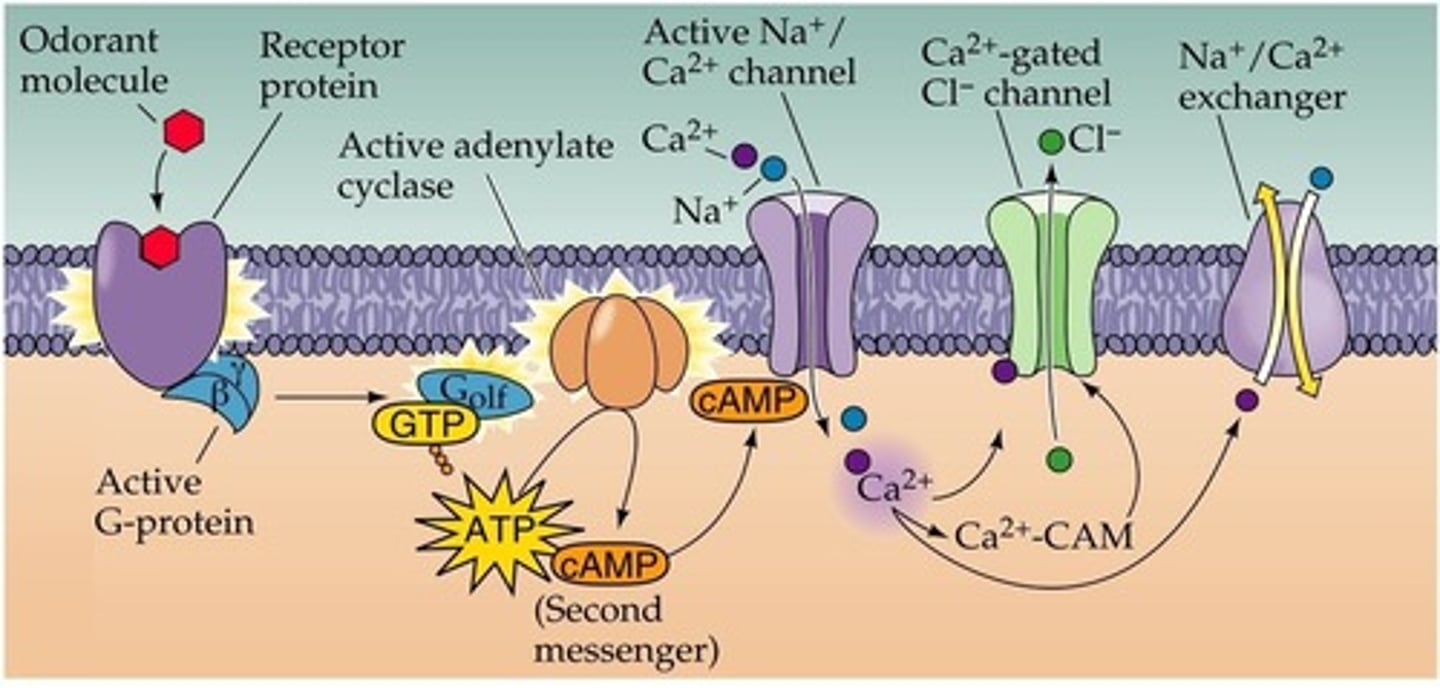
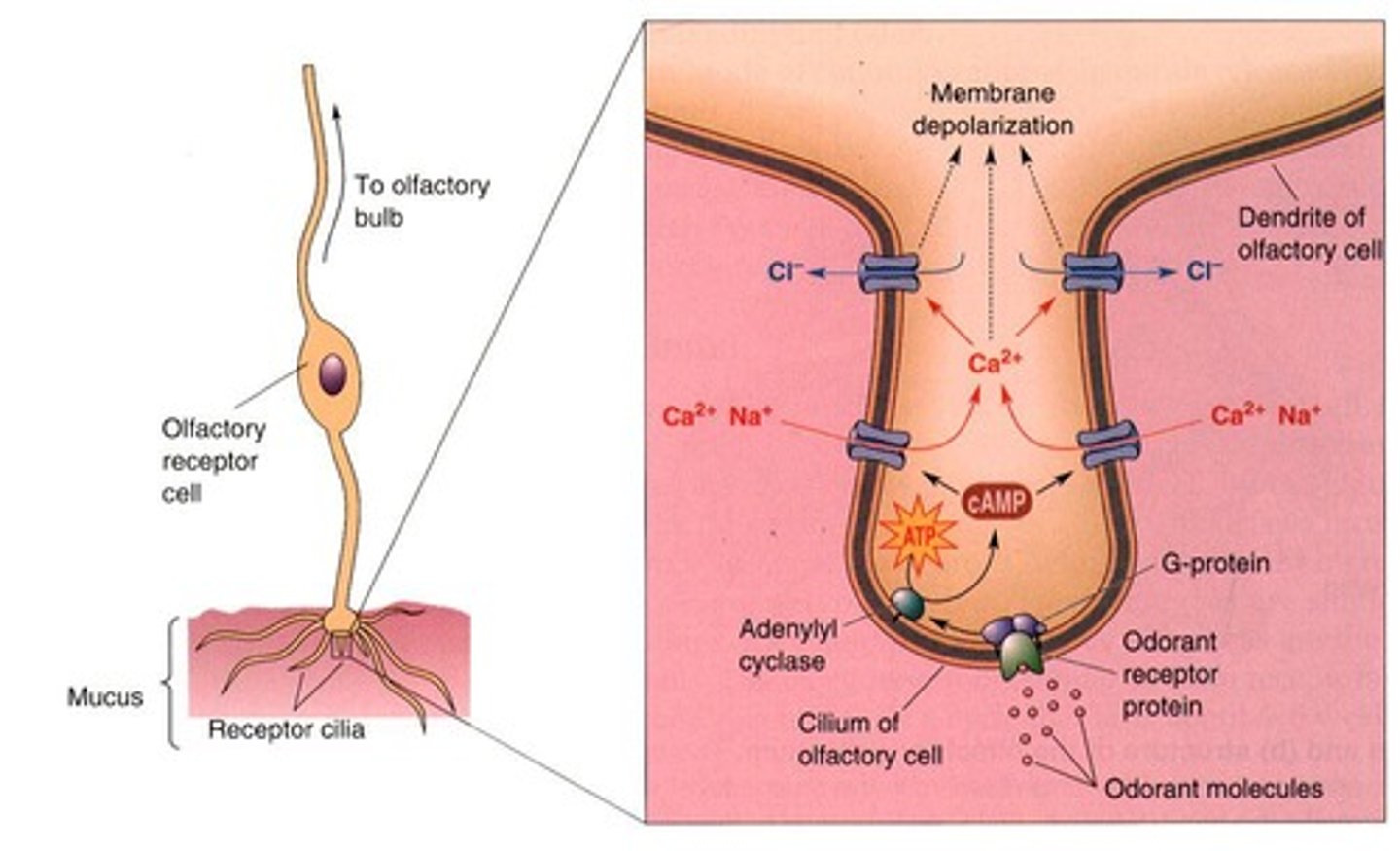
What initiates action potentials in olfactory receptor cells?
Binding of odorants to receptors on olfactory cilia activates a second messenger system, leading to depolarization of the receptive cell.
How many different odorant-binding proteins do mice and humans have?
Mice have about 1,000 different odorant-binding proteins, while humans have approximately 350.
What is the role of olfactory receptors in the olfactory epithelium?
Olfactory receptors are transmembrane proteins coupled to G proteins, located on the cilia of olfactory neurons.
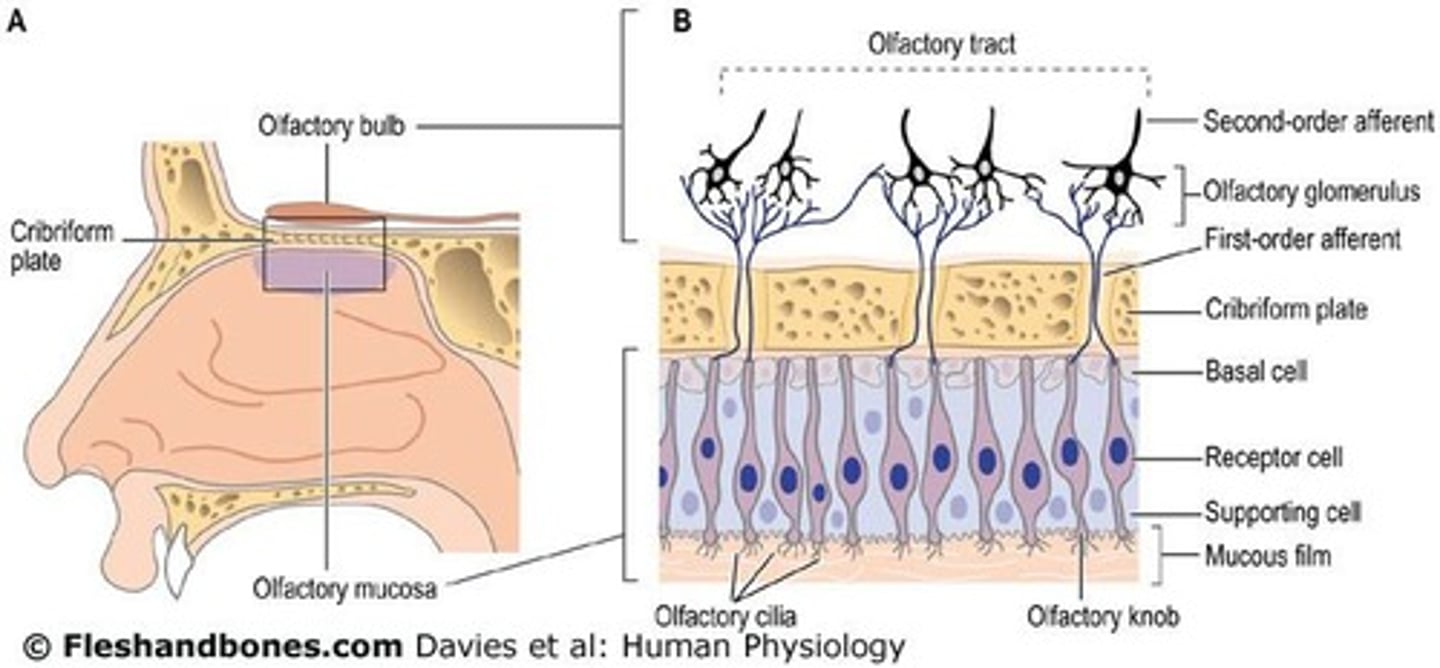
What is the significance of the laminar organization of the olfactory epithelium?
It allows for topographic projections to the olfactory bulb, facilitating organized processing of olfactory information.
What are the types of neurons found in the olfactory bulb?
Receptor neurons (blue), interneurons (red), projection neurons (green), and centrifugal fibers (black).
What are common causes of smell and taste problems?
Anosmia and ageusia can result from conditions like Alzheimer's, Parkinson's, radiation therapy, and COVID-19-related temporary loss of smell.
What is ageusia?
Ageusia is the loss of the sense of taste.
How can taste insensitivity affect health?
It can lead to nutritional deficiencies and/or increased salt intake.
What role do pheromone receptors play in behavior?
Pheromone receptors are involved in sex and social behavior.
What is the function of the olfactory bulb?
The olfactory bulb receives afferents from olfactory neurons and processes olfactory information.
What neurological symptoms are associated with COVID-19?
Temporary loss of smell (anosmia) is one of the earliest and main neurological symptoms.
How are olfactory receptors distributed in the olfactory epithelium?
Olfactory receptors are grouped according to their primary qualities, with non-overlapping distributions of three gene groups.
What is the relationship between olfaction and taste?
Smell and taste are interconnected, with convergence in sensory processing.
What is the response time of olfactory receptors compared to ionic receptors?
Olfactory receptors have a slower response than ionic receptors.
What is the significance of gene expression maps in olfactory research?
They provide insights into the distribution and function of different receptor binding proteins in the olfactory epithelium.
What is the impact of aging on olfactory function?
Aging can lead to a decline in olfactory sensitivity and function.
What types of medications can affect smell and taste?
Anti-fungals, anti-depressants, and medications for altitude sickness can impact olfactory and gustatory functions.
What is the role of the vomeronasal organ (VMO)?
The VMO is involved in detecting pheromones and influencing social and sexual behaviors.
How does the olfactory system contribute to the perception of flavor?
The olfactory system enhances the perception of flavor by integrating smell with taste.
What is the consequence of zinc or niacin deficiency on taste?
Deficiencies can lead to taste insensitivity.