Types of Chemical Bonds
 Call Kai
 Learn
Learn Practice Test
 Spaced Repetition
 Match
Match Flashcards
 Knowt Play
1/11

There's no tags or description
Looks like no tags are added yet.
Name | Mastery | Learn | Test | Matching | Spaced | Call with Kai | Chat |
|---|
No analytics yet
Send a link to your students to track their progress
12 Terms
Types of Chemical Bonds
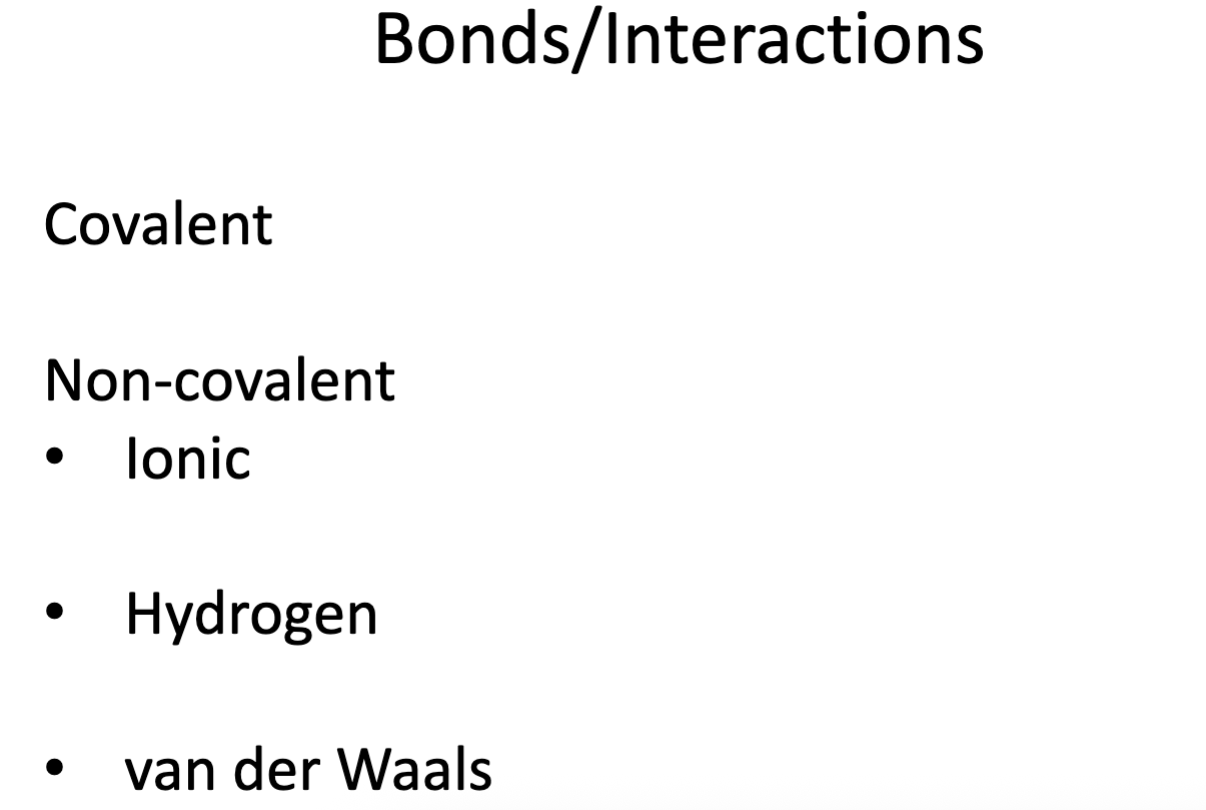
two main categories of chemical bonds or interactions, covalent and non-covalent.
Covalent bonds are strong bonds between atoms that share electrons.
Non-covalent bonds
weaker than covalent bonds
include ionic bonds, hydrogen bonds and van der Waals interactions.
Bond Strength Comparison, strength of a hydrogen bond
graph shows the comparison of the strength of different types of bonds, covalent bonds are the strongest.
Non-covalent bonds are weaker than covalent bonds, but very important for the interactions of molecules with other molecules.
Ionic interactions are the strongest of the three types of non-covalent bonds
van der Waals interactions are the weakest.
The strength of a hydrogen bond is about 20 kg per mole, which will serve as useful reference point for thinking about energy values in the future.

Structure of Adenine and Covalent Bonds
Here is the structure of Adenine, a nitrogenous base that is part of nucleotides, adenine is made up of carbon, nitrogen and hydrogen atoms. On this structure, the carbon atoms are represented by the intersection of two lines instead of the letter C and some of the hydrogen atoms are not shown.
Adenine contains both single and double bonds, which represent the number of electrons shared by two atoms.
atoms most commonly found in biomolecules
carbon, nitrogen, oxygen and hydrogen.
Valence of Common Atoms
Carbon is tetravalent, meaning it can form for covalent bonds with other atoms.
Nitrogen is trivalent forming three bonds,
oxygen is by bivalent forming two bonds, and
hydrogen is monovalent, forming only one covalent bond.
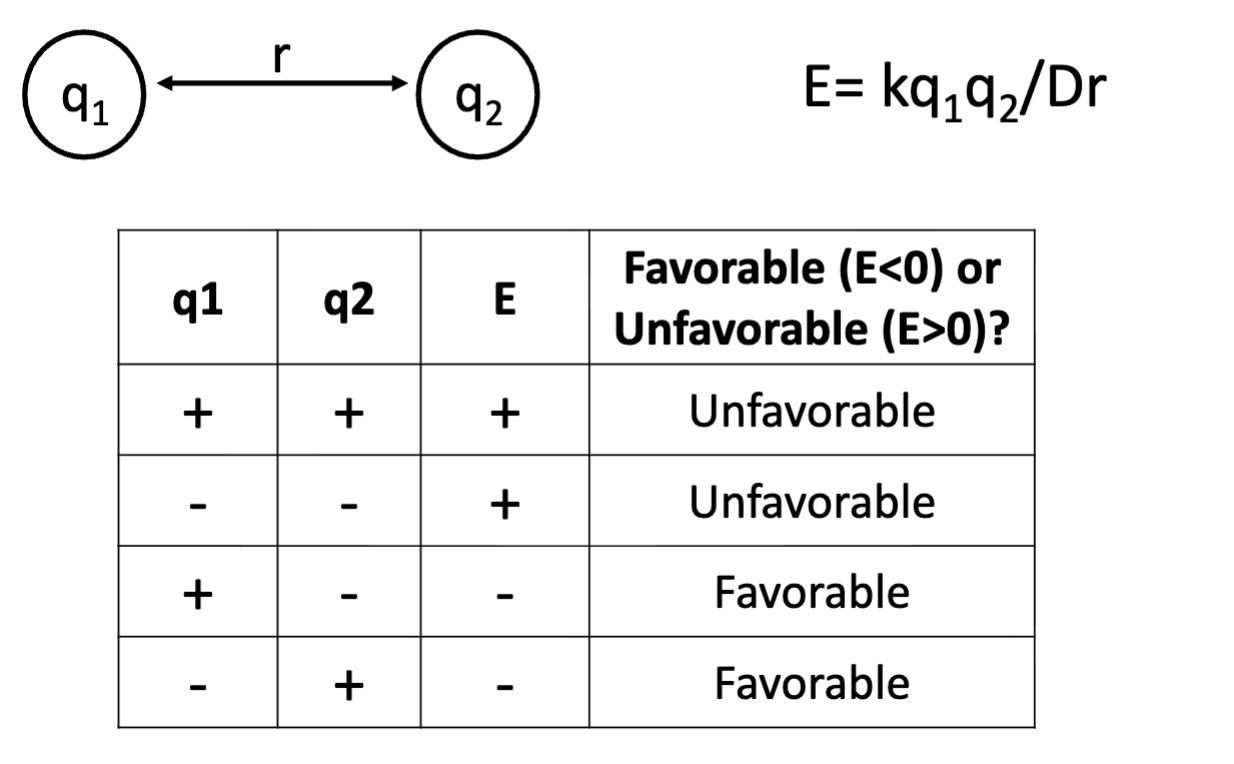
Ionic Bonds (Electrostatic Interactions) equation
An ionic bond is the interaction between two charges.
Consider the two charges here labeled q1 and q2.
The energy of an ionic interaction is dependent on the character of the two charges and the distance between the two charges indicated here by R. The energy of the interaction is also affected by the dielectric constant which is dependent on the properties of the solvent.
This equation shows the relationship between the energy of the interaction or E and the charges, the distance between charges, the dielectric constant and the proportionality constant k.
Let's consider different possible scenarios in a table format. If both charges are positive or both charges are negative, E Is positive, which is unfavorable. If one charge is negative and the other charges positive, E is negative, which is favorable. In other words, opposite charges experience an attractive force and like charges experience a repulsive force.
Electronegativity and Polar Bonds
Each atom has an electronegativity value which is a measure of the ability of the atom to attract electrons.
oxygen is the most electronegative and hydrogen is the least electronegative.
Bonds between two atoms with different electronegativity is results in the separation of charge.
oxygen is more electronegative than carbon, so will more strongly attract electrons and have a partial negative charge while the carbon atom will have a partial positive charge.
nitrogen is more electronegative than hydrogen, so will more strongly attract electrons and have a partial negative charge while the hydrogen atom will have a partial positive charge.
Bonds that exhibit separation of charge, like the bonds between carbon and oxygen and nitrogen, hydrogen shown here are called Polar bonds.
Bonds between atoms that have similar electronegativity is like carbon and hydrogen do not separate charge and are called non-polar or a polar bonds.

Hydrogen Bonds
Hydrogen bonds represented here by the green dotted line formed due to the interaction of a hydrogen atom with a partial positive charge and an atom with a partial negative charge like the oxygen represented here. Both the hydrogen and the other atom in a hydrogen bond have a polar-covalent bond with another atom.

Van der Waals Interactions
Van der Waals interactions depend on the distance between two atoms. The force's attractive when atoms are far away and repulsive when atoms are close to each other.
The Van der Waals contact distance represents the distance at which the Van der Waals interactions are most attractive.
The space filling representation of molecules like this one here are created by using a sphere to indicate the Van der Waals contact distance for each atom in the molecule.
Van der Waals interactions are very weak, but all atoms have Van der Waals interactions with all other atoms.
Van der Waals interactions between two molecules are numerous and therefore relevant for understanding how the molecules behave.

The Van der Waals contact distance
represents the distance at which the Van der Waals interactions are most attractive.
Summary of Chemical Bonds
In summary covalent bonds are created by the sharing of electrons between atoms.
Ionic bonds are favorable or unfavorable interactions between ions, which are positively or negatively charged.
Hydrogen bonds form between a hydrogen atom with a partial positive charge and another atom with a partial negative charge.
Van der Waals interactions are attractive or repulsive forces between all atoms that depend on the distance between the atom
Summary of Bonds/Interactions
