1 Disorders of Muscle
 Call Kai
 Learn
Learn Practice Test
 Spaced Repetition
 Match
Match Flashcards
 Knowt Play
1/42

There's no tags or description
Looks like no tags are added yet.
Name | Mastery | Learn | Test | Matching | Spaced | Call with Kai | Chat |
|---|
No analytics yet
Send a link to your students to track their progress
43 Terms
Neuromuscular disease
A patient is ataxic and has abnormal postural reactions and reflexes. This is most likely primarily *muscular or neuromuscular* disease.
Weakness:
stiff gait
lameness
trembling
exercise intolerance
ventral neck flexion
Patients with generalized muscle disease frequently present with what? Name some examples:
Acquired
Inherited
Name the two types of muscle disorders:
a. inflammatory (immune mediated and infectious)
d. traumatic
e. endocrine (esp. cushings)/metabolic
Select the muscle disorders which are often characterized as "acquired":
a. inflammatory (immune mediated and infectious)
b. muscular dystrophy
c. CNM of labrador retrievers
d. traumatic
e. endocrine (esp. cushings)/metabolic
b. muscular dystrophy
c. CNM of labrador retrievers (centronuclear myopathy)
Select the muscle disorders which are often characterized as "inherited":
a. inflammatory (immune mediated and infectious)
b. muscular dystrophy
c. CNM of labrador retrievers
d. traumatic
e. endocrine (esp. cushings)/metabolic
Acquired inflammatory myopathies (though I think dermatomyositis also has an inherited component)
Masticatory muscle myositis (MMM), extraocular myositis, dermatomyositis, protozoal myositis, fibrotic myopathy, and canine/feline idiopathic polymyositis are all examples of what?
Masticatory Muscle Myositis:
Temporalis atrophy
prominent zygomatic arch
masseter atrophy
trismus (dec. range of motion/resistance of mouth)
What is this? How do you know?
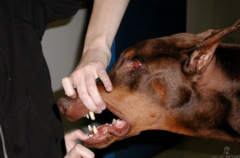
Masticatory Muscle Myositis (MMM)
What is a common immune-mediated disorder involving only the muscles of mastication in dogs?
Masticatory muscle myositis (MMM): ONLY muscles of mastication involved = focal
Polymyositis: atrophy may be prominent in temporalis and masseter muscles, but will ALSO have other signs like stiff stilted gait and mild to severe weakness
What is the difference between masticatory muscle myositis and polymyositis?
Masticatory Muscle Myositis (hint: 2M is a specific type of muscle fiber found predominantly in the masticatory muscles of dogs)
With this acquired inflammatory disease, IgG is directed against the unique myosin components of 2M muscle fibers, commonly in large breeds (GSD, doberman, retrievers)
Temporalis
Masseter
Pterygoid
Digastricus
Name the 4 muscles of mastication in dogs:
Masticatory muscle myositis
OTHER DIFFERENTIALS FOR A PAINFUL DOG:
retrobulbar abscess
dental disease
TMJ disease
A doberman comes in, O complains dog isn't eating. Dog presents with pain upon opening the mouth and painful palpation of masticatory muscles. Later, the same dog presents with marked atrophy and fibrosis of masticatory muscles with eyes sunk into the orbits. What are you thinking? Name some other differentials for this painful dog.
Trigeminal nerve disorder
Diffuse polymyositis or polyneuropathy
Systemic disease: hypothyroidism, HAC, cancer, cachexia
What if a doberman comes in with clinical signs of Masticatory muscle myositis but is NOT painful, what are differentials for this non painful dog?
1st choice: Circulating 2M autoantibodies prior to steroid treatment.
90% positive in acute cases
2nd choice: Immunohistochemistry on muscle biopsies of the masseter and temporalis mnuscles
NOT frontalis = wrong dx
How can you diagnose masticatory muscle myositis?
Masticatory muscle myositis
Thoughts?
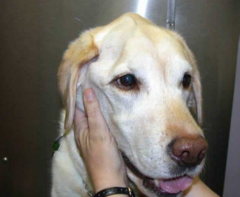
Glucocorticoids (immunosuppressive doses because MMM is an acquired inflammatory disease).
Note: glucocorticoids are a TYPE of corticosteroids
Commonly prednisone on tapering dose.
Add azathioprine or cyclosporine if unresponsive.
How do you treat masticatory muscle myositis?
Dogs
Bilateral
Masticatory muscle myositis ONLY AFFECTS *dogs or cats* and is bi/unilateral?
Will cause fractures and dislocation of the jaw, leading to unnecessary trauma
Forced tearing/stretching and opening of the fibrosed muscles under anesthesia USED TO BE recommended for masticatory muscle myositis treatment. Why is it not anymore?
Extraocular Myositis: bilateral exophthalmus and eyelid retraction in YOUNG
What is this?
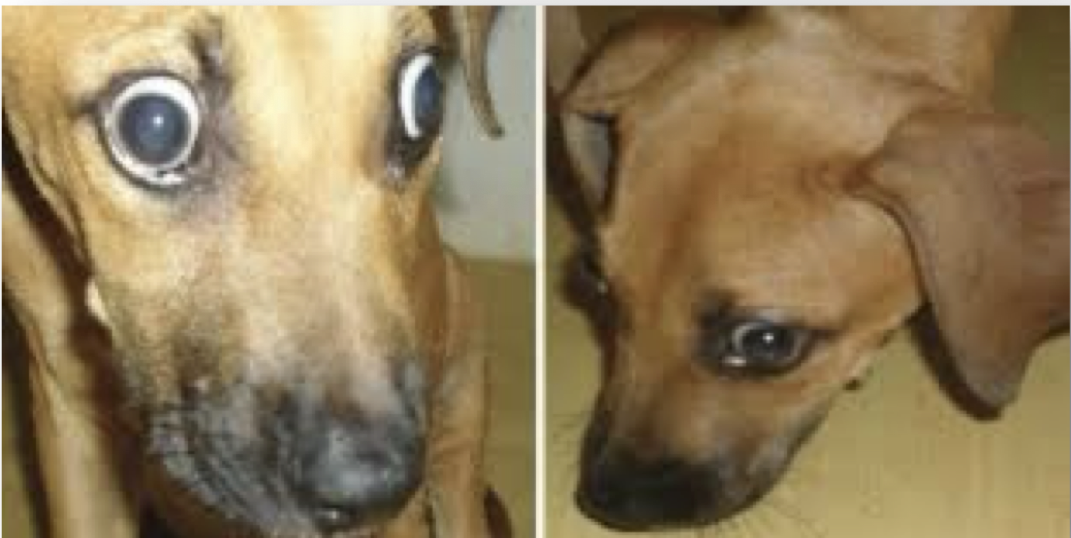
Canine Idiopathic Polymyositis
This is a diagnosis of EXCLUSION, where you must rule out everything else first when you have diffuse inflammation of skeletal muscle in dogs
TRUE: primary autoimmune OR secondary to systemic immune-mediated disease
TRUE OR FALSE: Canine idiopathic polymyositis can be caused by primary or secondary disease processes.
Canine idiopathic polymyositis
A dog presents with mild to severe weakness, stiff stilted gait that worsens with exercise, atrophy prominent in temporalis and masseter muscles, megaesophagus, and dysphagia. Top differential?
Elevated CK (2-100 fold) and AST is helpful, but MUSCLE BIOPSY IS DEFINITIVE DIAGNOSIS
How do you diagnose canine idiopathic polymyositis?
Boxer
Which dog breed is commonly affected with canine idiopathic polymyositis as a secondary to paraneoplastic lymphoma?
(remember: paraneoplastic is a syndrome not caused by the direct spread or compression of the tumor but are instead triggered by the body's immune system reacting to the lymphoma)
Treat or rule out underlying disease
Otherwise, prednisone
If megaesophagus = bailey chair (that dog high chair from lecture to help prevent regurg)
How can you treat canine idiopathic polymyositis?
CANINE idiopathic polymyositis
Which is more common: *feline or canine* idiopathic polymyositis?
Rule out other causes of common acquired diffuse weakness: *hypokalemia (K) and thiamine deficiency*
Feline idiopathic polymyositis is RARE. Because you know this, what is important to rule out?
DIFFUSE muscle weakness which is mild to severe and sometimes ventroflexion
What is the NUMBER ONE SYMPTOM of feline and canine idiopathic polymyositis?
Mild hypokalemia
70% of cats affected with idiopathic polymyositis suffer from what (I think meaning this is a concurrent problem?)
Predni*solo*ne (because remember prednisone is used in dogs but is not as bioavailable in cats)
If a cat actually IS affected by feline idiopathic polymyositis (because the potassium and thiamine is correct), how can you treat?
Cats: cervical ventroflexion
Hypokalemic myopathy MORE commonly affects what animal? How? (What clinical sign?)
Collies and Shelties
Which dog breeds are more commonly predisposed to dermatomyositis?
Dermatomyositis = do skin and muscle biopsy
A 3 month old collie comes in. O is complaining about skin lesions on the face. You find there is dermatitis but also vasculitis and polymoysitis with erythema, crusts, ulcers, and alopecia on the face and body. Thoughts?
Oral tetracyclines (broad spectrum antibiotics) and niacinamide (B3). Potentially glucocorticoids
How can you treat dermatomyositis?
Fibrotic Myopathy
This nonpainful disorder is characterized by the formation of a fibrous band within the muscle typically because of repetitive muscle injury. Commonly GSD
Gracilis and Semitendinosus muscles (she also had semimembranosus hilighted in class)
What muscles are most commonly affected by fibrotic myopathy?
Ultrasound
How can you diagnose fibrotic myopathy?
Acquired endocrine/metabolic myopathies (disease of muscle)
Glucocorticoid excess/deficiency (hyper/hypoadrenocorticism), hypothyroid dogs, hypokalemic CKD cats, postpartum hypocalcemia, and thiamine deficiency in cats are all examples of what?
Nutrition associated hypokalemic muscle weakness (post-partum)
Though it is more common in cats, dogs can also be present with cervical ventroflexion. What most likely causes it?
Inherited myopathies
Muscular dystrophy, centronuclear myopathy (CNM) of labrador retrievers, myotonia, and metabolic myopathies are all examples of what?
Golden retriever muscular dystrophy
What do you think is happening here because the puppy is so young?
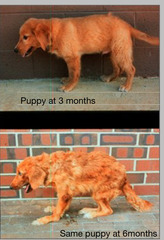
Muscular dystrophy
(note: Hypertrophic muscular dystrophy in cats is characterized by muscle weakness and an unusual increase in muscle size, particularly in the limbs and tongue, which is how it can make sense that with a dystrophic disease there is hypertrophy of the muscles)
This X linked disorder commonly affects siamese cats, with clinical signs like muscular hypertrophy, protruding tongue, and stiff gait appear at 6 months of age. *CK will be elevated*.
Hypokalemia
What is your top differential for a cat who is experiencing ventral neck flexion, weakness, and stiff gait?