The Case Laws
 Call Kai
 Learn
Learn Practice Test
 Spaced Repetition
 Match
Match Flashcards
 Knowt Play
1/17

Earn XP
Description and Tags
the 50 cases to remember
Name | Mastery | Learn | Test | Matching | Spaced | Call with Kai | Chat |
|---|
No analytics yet
Send a link to your students to track their progress
18 Terms
Donoghue v. Stevenson
Established a duty of care to the customer who not only purchases the product, but also consumers who use the product. ‘Who is my neighbor’ precedent. Tort theory of Product liability replacing contract theory.
Memory Aid: Drink with Snail

MacKay v. Starbucks Corporation
Established deemed occupier’s duty of care for portion of city sidewalk adjoining store, even though it did not occupy that portion of the sidewalk in question. Starbucks was held responsible for customer slip and fall on this abutting portion

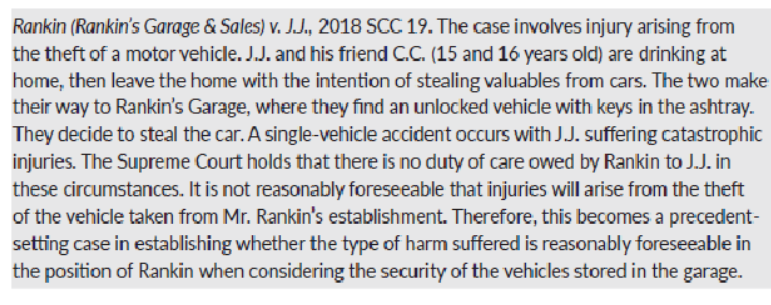
RANKIN V. JJ
JJ and CC, two underage boys, drink and leave home to steal valuables from cars but steal unlocked vehicle from Rankin’s Garage and have a catastrophic single vehicle accident. No duty of care owed by Rankin, as not reasonably foreseeable.
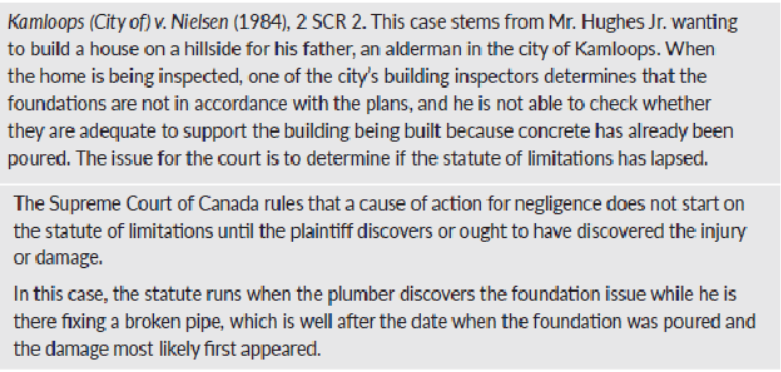
Kamloops (City of) v. Nielsen (1984)
Established that the limitation period starts when the plaintiff discovered or ought to have discovered the injury or damage and not when the work was performed. In this case the plumber fixing a pipe found the issue much later.
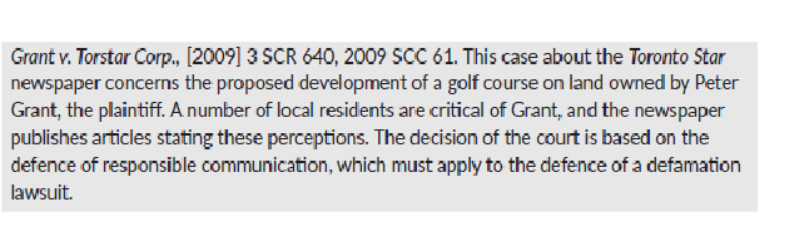
Grant v. Torstar Corp
Established the defence of responsible communication which applies to a public interest defamation lawsuit. Grant was building a golf course and local residents’ criticism was published which led to a libel judgement against Torstar who failed to verify the allegedly defamatory comments
Arland v. Taylor
Established the “reasonable person” standard used to measure whether someone’s behaviour was proper or negligent.
A reasonable person is considered to have:
Ordinary skills
Ordinary intelligence
Ordinary foresight
Prudent behaviour
The defendant's conduct is compared against this standard to determine whether it was negligent.
Memory aid:
“Taylor made to fit a myth”
Rylands v. Fletcher
Established the principle of strict liability.
An occupier may be liable when a dangerous thing brought onto their property escapes and causes damage, without the plaintiff having to prove negligence.
The PDF's FLED requirements are:
F = Changed its natural Form or use
L = Likely to do mischief if it escapes
E = Escape occurred
D = Resulted in Damage
Veinot v. Kerr-Addison Mines
Established the occupier's duty of care toward trespassers.
An occupier must treat a trespasser with common humanity and cannot deliberately set traps or conceal dangers.
Courts consider 6 factors when determining whether the duty was breached:
Gravity of probable injury
Likelihood of probable injury
Character of the intrusion
Nature of the premises
Occupier's knowledge of the trespasser's presence
Cost of preventing the harm
Right of Canada v. Saskatchewan Wheat Pool
Established the rules for proving a negligence claim based on a breach of statute.
The plaintiff must establish 4 things:
The statute was breached
The breach caused the damage
The statute was intended to prevent that type of damage
The claimant belongs to the group the statute was intended to protect
Polemis v. Furness, Withy & Co. Ltd. (1921)
Established an earlier approach to foreseeability/remoteness.
A wooden plank was dropped into a ship's hold. Although the ultimate destruction of the ship could not reasonably have been foreseen, the defendants were still held liable.
This approach was later overturned by the Wagon Mound case.
Overseas Tankship (U.K.) Ltd. v. Morts Dock & Engineering Co. Ltd. — The Wagon Mound
Overturned the approach in Polemis and established a new threshold for reasonable foreseeability.
The defendant must be able to reasonably foresee that their negligent act or failure to act is likely to cause damage.
In the case, sparks ignited floating cotton waste and caused the fire. The court found the resulting damage was not reasonably foreseeable, so Morts Dock was not held liable for that damage.
Key idea:
Damage must be reasonably foreseeable.
Memory aid:
Wagon Mound = foreseeable damage
1688782 Ontario Inc. v. Maple Leaf Foods Inc. (2020 SCC 35)
There is no general right in tort to protection against pure economic loss.
There are, however, narrow exceptions, such as certain professional liability situations.
Key idea:
Pure economic loss is treated more restrictively under tort law.
Example from the PDF:
Lost rental income caused by interruption of access to a building, where there is no physical injury to a person or property.
Bux v.
Slough Metals
Established that for the denial
defence to succeed, defendant
needs to prove one or more of
these
1. Didn’t commit act
2. Actions not negligent
3. Plaintiff suffered no injury
due to defendant’s actions
Waldick v.
Malcolm
Established the factors required
to succeed in a defense of
Volenti Non Fit Injuria (Voluntary
Assumption of Risk)
1. Knowledge of risk factors
2. Waive the rights to any legal
claim
Ryan v.
Youngs
Established the inevitable
accident defence as Youngs
never had a heart attack
before so was able to prove
cause and result of accident
were not under control of
defendant.
Telfer V. Wright
Six months prior, Mr. Wright had
the same dizzy symptoms - should
have taken precautions to avoid
causing an accident in future. Mr.
Wright is judged negligent and his
plea of inevitable accident was not
successful.
Cooper v. Hobart 2001
