lecture 26 - prokaryotic transcription
 Call Kai
 Learn
Learn Practice Test
 Spaced Repetition
 Match
Match Flashcards
 Knowt Play
1/24

There's no tags or description
Looks like no tags are added yet.
Name | Mastery | Learn | Test | Matching | Spaced | Call with Kai | Chat |
|---|
No analytics yet
Send a link to your students to track their progress
25 Terms
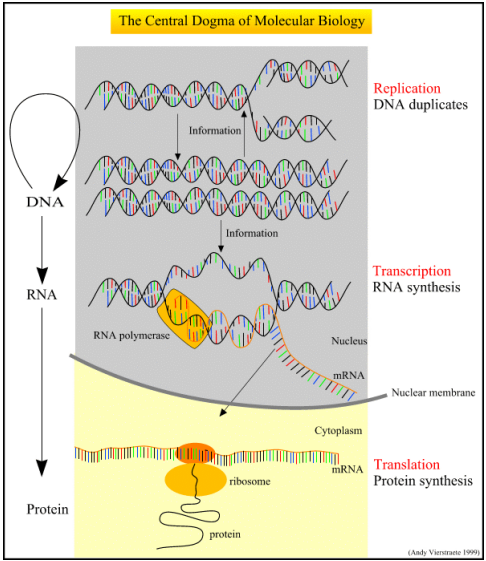
central dogma of molcular biology/pathway from DNA to protein
Gene Expression Levels
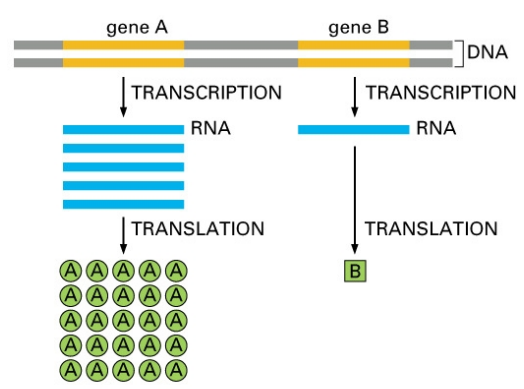
Different gene products (usually proteins) are required:
In different cells, At different levels, At different times
Cells regulate gene expression according to the needs of the moment
Mostly by controlling RNA production
Genes can be expressed with different efficiencies
Example (Gene A vs. Gene B):
Gene A is transcribed and translated much more efficiently than Gene B
Result: Protein A produced in much greater quantities than Protein B
chemical structure of RNA vs DNA
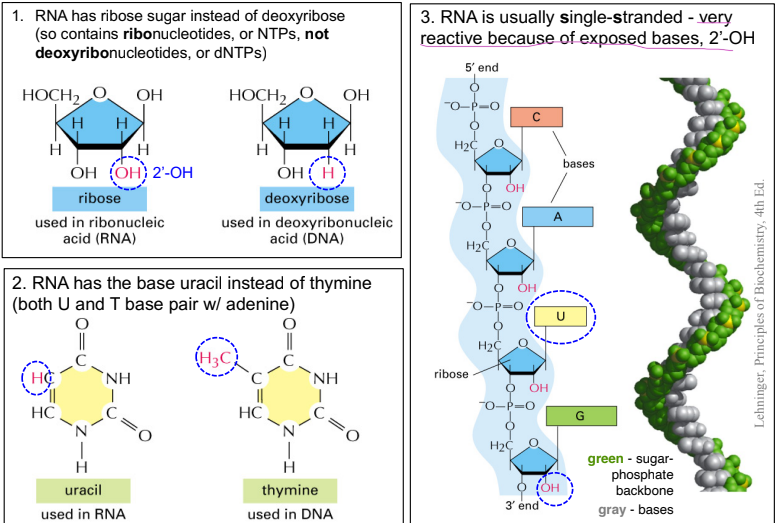
Why RNA Can Base Pair with DNA and Itself
free base pairing
RNA is most often single-stranded
But it must base pair (bp):
With DNA during transcription
With itself to fold into secondary structures
uracil vs. Thymine: Base Pairing
Uracil lacks the methyl group seen in thymine
This difference does not affect Watson-Crick base pairing with adenine
Uracil still pairs with adenine via the same hydrogen bonding pattern as thymine
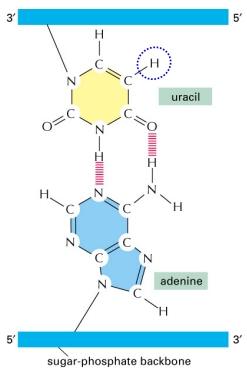
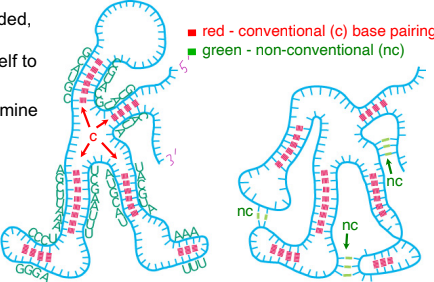
Conventional vs. Non-Conventional Base Pairing with RNA
Short complementary stretches of RNA can fold using:
Conventional (c) base pairing — Watson-Crick
Non-conventional (nc) base pairing — non-Watson-Crick
These pairings fold RNA into 3D structures
Structure is determined by nucleotide sequence
3D structures are more stable and can perform cellular functions
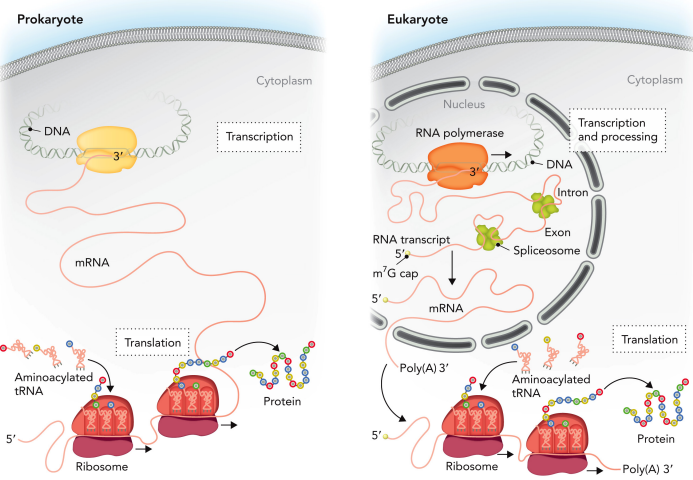
Comparison of eukaryotic and prokaryotic transcription
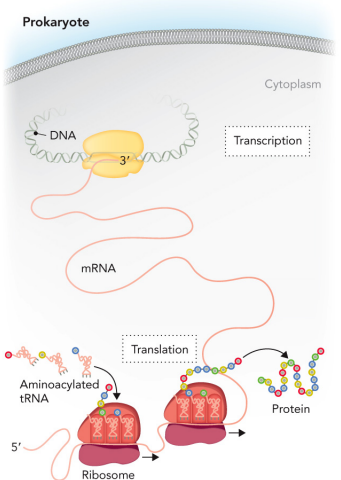
Prokaryotes: transcription and translation are coupled — no separation in space or time
Eukaryotes: transcription (+ processing) and translation are uncoupled — separated by the nuclear envelope
Overall strategies in regulating gene expression in prokaryotes
In bacteria, the concentration of a given mRNA dictates production of the protein it encodes. mRNA concentration depends on two factors:
the rate of mRNA synthesis
the rate of mRNA degradation
The three elements of gene control in prokaryotes are, in order of importance:
1. transcription initiation
2. RNA turnover (nuclease degradation)
3. transcription termination
RNA synthesis simple diagram & general info
The ssRNA “transcript” produced by transcription is complementary to the template strand, and shares the same nucleotide sequence as the coding strand, with the exception of having U in place of T. As with DNA synthesis, RNA synthesis occurs in the 5’→3’ direction.
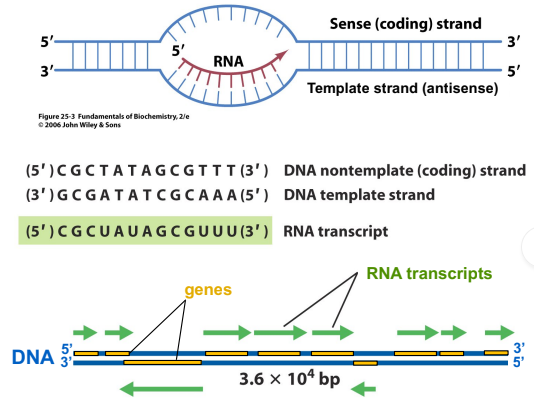
directions in RNA synthesis
+1 : 5’ postion of RNA being made
upstream : to the left from +1, negative
downstream : to the right from +1
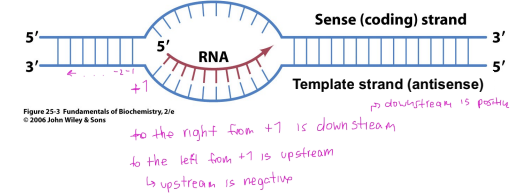
promoter sequence
RNA pol binds to promoter sequences to initate RNA synthesis
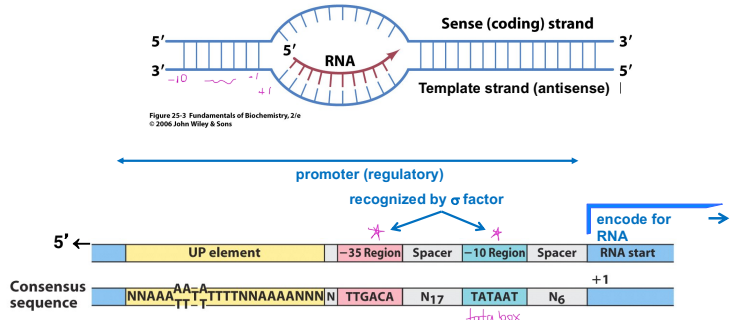
how does RNA polymerase know where to bind
Sigma Factors Guide RNA Polymerase to Bacterial Promoters
RNA polymerase holoenzyme–promoter complex
RNA polymerase holoenzyme = RNA core (α₂ββ'ω) + σ (sigma) subunit
σ subunit's role: recognizes the promoter to initiate transcription
σ factor binds directly at the:
−35 box (consensus: TTGACA)
−10 box (consensus: TATAAT)
Transcription begins at the +1 site (mRNA start), just downstream of the −10 box
RNA core + σ subunit = RNA polymerase holoenzyme, and σ subunit = promoter recognition (initiation)
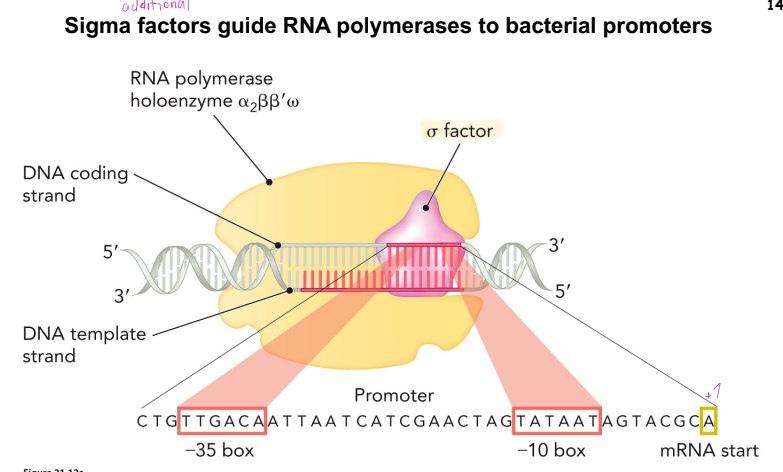
how to map protein binding sites on DNA
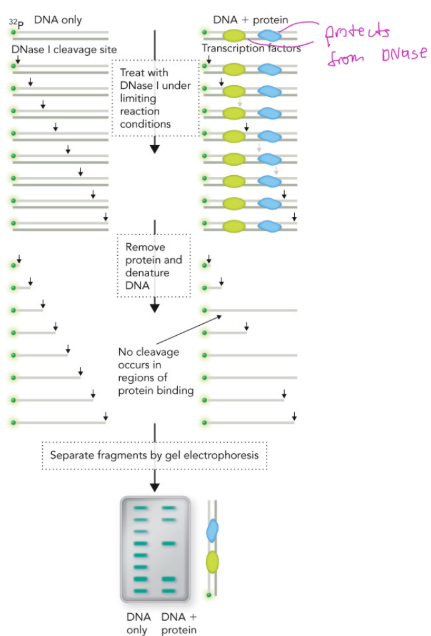
DNase I footprinting
how does DNase I footprinting work
DNase I = a type of endonuclease that cuts unprotected DNA
Method:
Two samples prepared:
DNA only (control)
DNA + protein (e.g., transcription factors bound)
Both treated with DNase I under limiting reaction conditions (partial digestion)
Protein bound to DNA "protects" that region from DNase I cleavage
Protein is then removed and DNA denatured
No cleavage occurs in regions of protein binding (the "footprint")
Fragments separated by gel electrophoresis
Result (gel):
DNA-only lane: cleavage products at every possible position → ladder of bands
DNA + protein lane: a gap ("footprint") appears where the protein blocked DNase I access — missing bands correspond to the protein-protected region
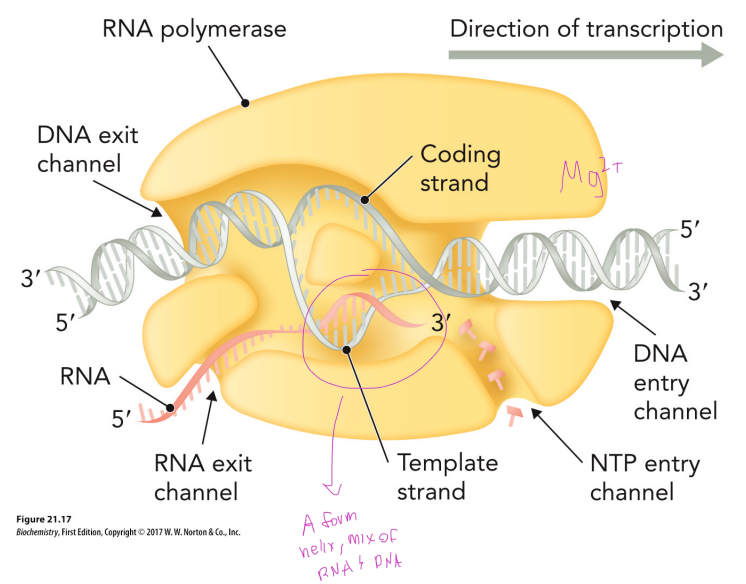
RNA Polymerase Structure: Channels and Strand Movement
DNA entry channel: where duplex DNA enters the enzyme
RNA polymerase unwinds DNA to expose the template strand
Template strand is read to synthesize RNA; the RNA-DNA hybrid formed here is an A-form helix (mix of RNA + DNA)
Coding strand: displaced, non-template strand (re-anneals with template downstream)
NTP entry channel: where incoming ribonucleotides enter to be added to the growing RNA
Mg²⁺: required as a cofactor for catalysis (same general role as in DNA polymerase)
RNA exit channel: where the newly synthesized RNA (5' end first) exits the enzyme
DNA exit channel: where the DNA duplex re-forms and exits after transcription
Overall direction of transcription: enzyme moves along DNA, synthesizing RNA 5'→3'
stages of transcription
initation
elongation
termination
Transcription Initiation
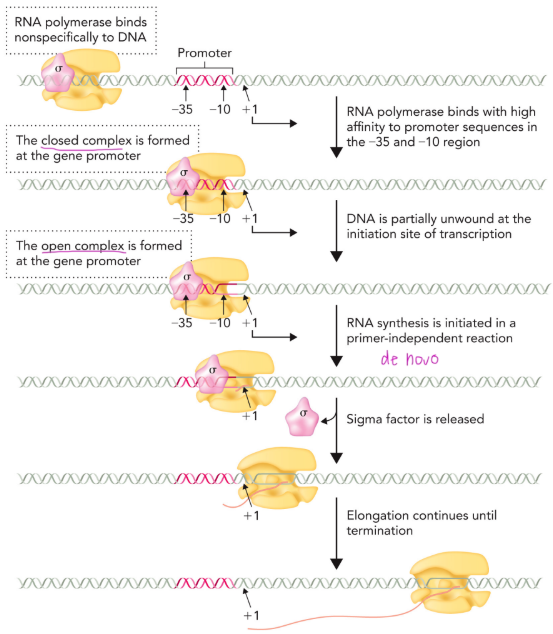
When is sigma factor released?
→ Sigma (σ) factor is bound to the RNA polymerase core enzyme (forming the holoenzyme) only during the initiation phase.
σ recognizes and binds the promoter (−35 and −10 boxes), positioning the holoenzyme to begin transcription
Once RNA polymerase has successfully begun synthesizing RNA and cleared the promoter (promoter clearance, early in elongation), σ is released
The core enzyme (without σ) then continues elongation alone, synthesizing the rest of the RNA transcript
σ can then be recycled and reused by a different core enzyme to initiate transcription elsewhere
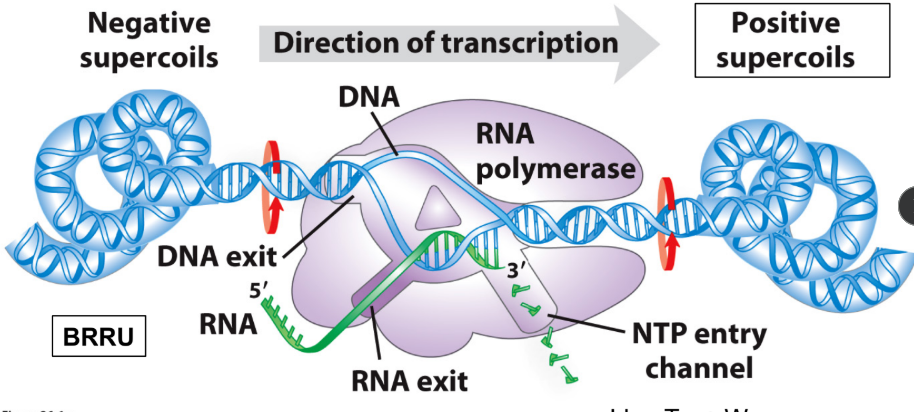
Supercoiling During Transcription
As RNA polymerase moves along DNA, it generates torsional stress:
Positive supercoils form ahead of the polymerase (direction of transcription)
Negative supercoils form behind the polymerase
This happens because RNA polymerase must locally unwind DNA to access the template strand, but the DNA ends are fixed/constrained, so the unwinding twist gets pushed into supercoiling elsewhere
types of transcription termination in prokaryotes
rho-dependent
rho-independent
Rho-Independent Termination (brief)
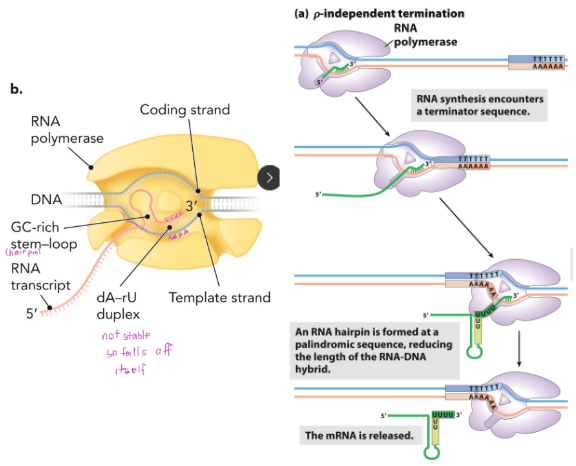
A GC-rich stem-loop (hairpin) forms in the RNA transcript
Causes RNA polymerase to pause
Followed by a weak dA-rU duplex (few H-bonds) → unstable → RNA transcript falls off on its own, no extra proteins needed
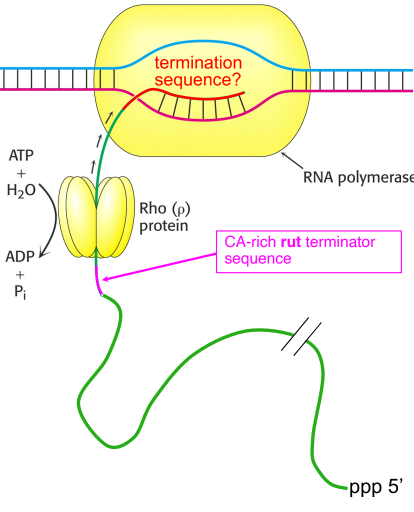
Rho-Dependent Termination (brief)
Rho helicase binds a C-rich sequence on the RNA transcript
Translocates along RNA (ATP-driven)
Catches RNA polymerase → destabilizes RNA-DNA hybrid → releases transcript
a mechanism in bacteria where the Rho protein stops the synthesis of RNA by catching up to RNA polymerase and unwinding the RNA-DNA bond. It requires three key items: the Rho utilization (rut) site, a pause site, and ATP energy. [1, 2]
How the Process Works
Binding to RNA: The ring-shaped hexameric Rho protein binds to a specific C-rich/G-poor sequence on the newly made RNA strand called the rut site (Rho utilization site). [1, 2]
Movement along RNA: Using energy from ATP hydrolysis, the Rho protein moves along the RNA strand in the 5' to 3' direction, following behind the RNA polymerase. [1, 2]
Catching the Polymerase: When the RNA polymerase temporarily stalls at a specific DNA sequence known as a pause site, the moving Rho protein catches up to it. [1]
Release of RNA: Once it reaches the stalled enzyme, Rho uses its helicase activity to break the hydrogen bonds in the RNA-DNA hybrid, releasing the RNA molecule and ending transcription.
![<ul><li><p>Rho helicase binds a <strong>C-rich sequence</strong> on the RNA transcript</p></li><li><p>Translocates along RNA (ATP-driven)</p></li><li><p>Catches RNA polymerase → destabilizes RNA-DNA hybrid → releases transcript</p></li></ul><p></p><p><mark data-color="#4c4646" style="background-color: rgb(76, 70, 70); color: inherit;">a mechanism</mark><mark data-color="#322a2a" style="background-color: rgb(50, 42, 42); color: inherit;"> in</mark><mark data-color="#2c2929" style="background-color: rgb(44, 41, 41); color: inherit;"> bacteria where the </mark><strong><mark data-color="#2c2929" style="background-color: rgb(44, 41, 41); color: inherit;">Rho protein</mark></strong><mark data-color="#2c2929" style="background-color: rgb(44, 41, 41); color: inherit;"> stops the synthesis of RNA by catching up to RNA polymerase and unwinding the RNA-DNA bond.</mark> It requires three key items: the <strong>Rho utilization (rut) site</strong>, a <strong>pause site</strong>, and <strong>ATP energy</strong>. [1, 2]</p><p>How the Process Works</p><ul><li><p><strong>Binding to RNA:</strong> The ring-shaped hexameric Rho protein binds to a specific C-rich/G-poor sequence on the newly made RNA strand called the rut site (Rho utilization site). [1, 2]</p></li><li><p><strong>Movement along RNA:</strong> Using energy from ATP hydrolysis, the Rho protein moves along the RNA strand in the 5' to 3' direction, following behind the RNA polymerase. [1, 2]</p></li><li><p><strong>Catching the Polymerase:</strong> When the RNA polymerase temporarily stalls at a specific DNA sequence known as a pause site, the moving Rho protein catches up to it. [1]</p></li><li><p><strong>Release of RNA:</strong> Once it reaches the stalled enzyme, Rho uses its helicase activity to break the hydrogen bonds in the RNA-DNA hybrid, releasing the RNA molecule and ending transcription.</p></li></ul><p></p>](https://assets.knowt.com/user-attachments/908f98d1-8fea-4daa-9055-585ad0854c7b.png)
Rho-Independent Termination: Detailed Mechanism
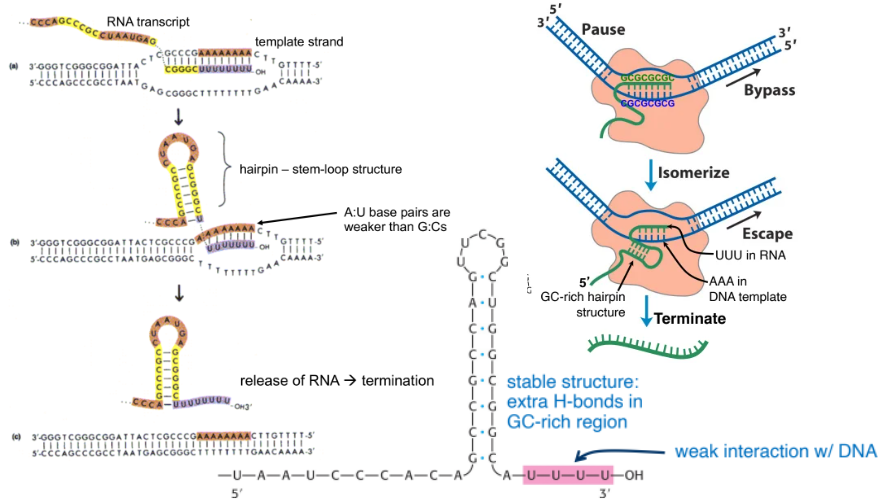
RNA polymerase pauses at a GC-rich sequence in the transcript (template is also GC-rich)
The GC-rich RNA sequence base-pairs with itself, forming a stable hairpin near the 3' end (this folding = isomerization)
The hairpin destabilizes the RNA:DNA hybrid
GC-rich sequence is followed by ≥3 A's in the template → transcribed into U's in the RNA
A-U pairing = only 2 H-bonds (vs. 3 for G-C) → weaker H-bonding in this region of the hybrid → further destabilization
Combined effect (hairpin + weak A-U pairing): induces RNA to dissociate → transcription terminates
Sequence of events: Pause → Isomerize (hairpin forms) → Escape (weak UUU:AAA hybrid) → Terminate
rho-dependent terminators
A terminator sequence at the end of the gene causes RNA polymerase to pause
Upstream (5') of this, the RNA has a 70–100 nt CA-rich sequence called rut (rho utilization site)
Rho (ρ) protein — a hexameric ATPase — binds RNA at the rut site
Rho migrates 5'→3' along the RNA, hydrolyzing ATP, until it reaches the paused transcription complex
Rho disrupts RNA-DNA base-pairing, releasing the RNA transcript
Mechanism not fully understood — Rho functions like a helicase (unwinds the RNA:DNA duplex)