Lecture 5 - Mission Operations
 Call Kai
 Learn
Learn Practice Test
 Spaced Repetition
 Match
Match Flashcards
 Knowt Play
1/63

There's no tags or description
Looks like no tags are added yet.
Name | Mastery | Learn | Test | Matching | Spaced | Call with Kai | Chat |
|---|
No analytics yet
Send a link to your students to track their progress
64 Terms
What does ESOC stand for and what is its primary function?
European Space Operations Centre, located in Darmstadt; ESA's centre for mission operations and ground systems engineering.
When was ESOC founded and how many ESA missions has it operated (2026 status)?
Founded in 1967; has operated 83 ESA missions total, 56 of them for their full mission duration.
What is ESOC's staffing and mission load in 2026?
~865 staff; 18 missions (28 satellites) in routine operations; >20 missions in preparation/assessment phase.
★ What extreme conditions must spacecraft components survive?
Launch
Zero gravity
Vacuum
★Why are spacecraft technologies described as effectively "first of its kind"?
lightweight,
compact,
stable, flexible,
extremely robust,
reliable,
long-lasting,
resistant to temperature/radiation/corrosion
this drives heavy design, analysis, review, and verification effort, making development expensive and time-consuming.
★How does telecommand/telemetry complexity compare across a toy car, F1 car, airliner, and spacecraft?
satellites are far more complex than any of these, yet extremely reliable.
★Name the four main entities in ESA's spacecraft operations loop and their roles.
Mission Operations Centre (MOC/ESOC) commands the spacecraft via ground stations;
Science Operations Centre (SOC) manages observation planning;
Science Data Centre (SDC) processes science data;
PIs/Science Community submit proposals and receive processed data.
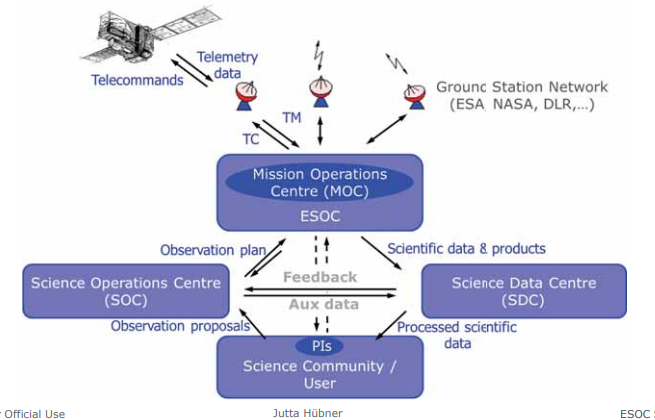
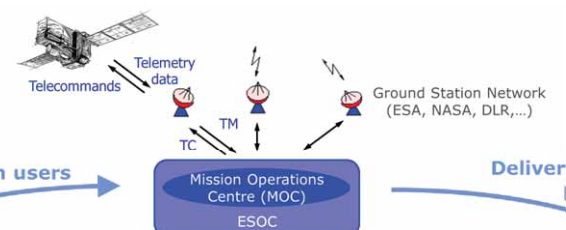
★What flows between the MOC and the spacecraft?
Telecommands (TC) uplinked to the spacecraft; telemetry (TM) downlinked from the spacecraft, relayed via the Ground Station Network.
★What are the four objectives of mission operations?
Ensure
Timely product delivery,
spacecraft safety,
Operations of spacecraft subsystems, payload, ground segment
maintenance of the required orbit and environment.
★What are the four pillars of a successful operations approach?
A well-designed and validated ground segment (reusing prior developments where possible);
Fully trained operations/support teams sized to mission phase;
Deep experience (>50 years at ESOC); and
Validated procedures for both nominal and contingency operations.
★What are the four core operating principles ESOC follows?
Failure avoidance rather than failure recovery;
first planning, then execution;
always apply procedures;
never a "trial-and-error" approach.
What does "sharing, reuse & standardisation" refer to in ground segment design?
The key strategy for reliability and cost savings — reusing existing ground segment systems/infrastructure across missions rather than building each one from scratch.
★Name the six main components inside the Mission Operations Centre (MOC).
SIM (Spacecraft Simulator),
MCS (Mission Control System),
ECC (ESTRACK Control Centre),
FDS (Flight Dynamics System),
MPS (Mission Planning System),
DDS (Data Disposition System).
★What functions does the Mission Control System (MCS) perform?
Interfacing with ground stations,
telemetry monitoring,
telecommanding,
mission planning/automation,
data distribution/archiving,
providing user interfaces.
What is ESTRACK?
ESA's global ground Tracking Station Network, made up of a Core ESA Network, a Cooperative Network, and an Augmented Network of stations worldwide.
★What is the difference between 15m and 35m ESTRACK terminals?
15m terminals (e.g. Kourou, Kiruna, Redu) support near-Earth missions;
35m terminals (e.g. New Norcia, Malargüe, Cebreros) form the Deep Space Network for interplanetary missions.
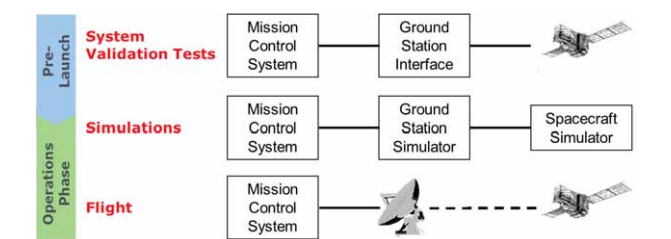
★Describe the three-stage validation/training sequence before flight operations.
(1) System Validation Tests — Mission Control System + Ground Station Interface + real spacecraft.
(2) Simulations — MCS + Ground Station Simulator + Spacecraft Simulator.
(3) Flight — MCS + real ground station + real spacecraft in orbit.
★Besides system validation, what other preparation is essential for operations readiness?
Continuous training of people: individual training plus dedicated simulation campaigns for the team, covering nominal and contingency scenarios for each critical mission phase.
★List the main "Team of Teams" groups supporting spacecraft operations.
Flight Control Team (core),
Flight Dynamics,
Space Debris Office,
Software Support,
Ground Operations,
Project Support/Representative,
Flight Operations Director, plus
Industry Support
Project Team.
What does the Ground Operations Engineer team handle?
Interfacing with and operating the ground stations.
What is the role of the Space Debris Office (SDO)?
Orbit screening and issuing conjunction (collision risk) warnings.
Name the three teams and their function in Mission Operations.
Ground Operations – Ground Stations
Flight Dynamics – Orbital dynamics and manoeuvre commanding
Software support – Mission Control Systems
Space Debris Office (SDO) – Orbit screening and Conjunction warnings
Simulator support – Simulations campaign
★What are the three main categories of Flight Control Team activities?
Mission planning & operations scheduling;
operations coordination & execution
Maintaining performance
★What is the difference between Mission Analysis and Flight Dynamics?
Mission Analysis supports pre-launch mission definition/design
launcher selection,
trajectory design,
attitude definition.
Flight Dynamics supports both pre-launch testing and post-launch operations
orbit determination/prediction/control/collision avoidance
attitude determination/monitoring/control/manoeuvre planning/calibration
★ Logic of a ground segment
A - Mission Study and Feasibility
B - Ground Segment Preliminary Design
C - Ground Segment Design
D - Ground Segment Production and Validation
E - Operation Execution (LEOP & Commisioning and Routine Operations)
F - Disposal
★ How does Phase E of the ESA project life cycle relate to mission operations?
Phase E is
the Operations Execution Phase,
covering everything from LEOP through Routine Operations, including critical operations
it directly follows
Phase D (Ground Segment Production & Validation) and precedes Phase F (Disposal).
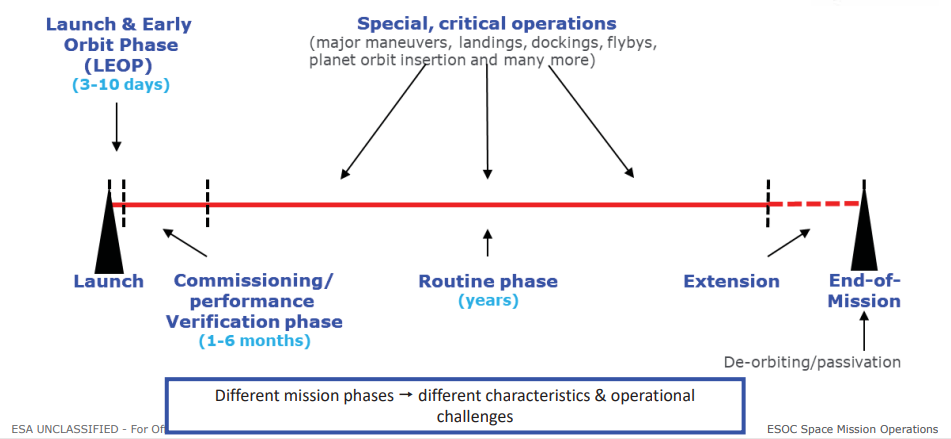
★ List the main mission phases in chronological order.
Launch → LEOP (Lauch and Early Orbit Phase) (3-10 days)
Commissioning/Performance Verification (1-6 months)
Routine phase (years, includes special/critical operations)
Extension
End-of-Mission (de-orbit/passivation)
Different mission phases → different characteristics & operational challenges
★ What activities and challenges characterize LEOP?
Activities:
Solar array/other deployment
Checkout of essential subsystems
achieving stable orbit
Challenges:
complex
short duration
★ What is the mission control approach during LEOP?
Maximize 24/7 ground contact - online control
use a large well-trained team,
fully simulate, validate, and plan operations before execution
★ What happens during in-flight commissioning, and what's the control approach what are the challenges?
Phase activities
Checking subsystem redundancy
Check operational modes
Approach
extended ground contact,
a mix of online/offline control
Challenges
Limited time
complex
★ What characterizes the routine phase, and how does its control approach differ from LEOP?
Challenges
Repetitive activities with rare critical operations,
emphasis on reliability/productivity;
Mission control approach
control approach is offline,
automated for routine tasks,
★ Can the routine phase still include critical operations, and how are they handled?
Yes — e.g. planet orbit insertion, comet rendezvous, spacecraft retrieval; handled similarly to LEOP (extended team, intense training, full validation), with the added complication of long signal travel times for interplanetary missions.
Mission phases and ops concept
End-of-Mission?
Retrieve it and return it to Earth
De-orbiting
LEO missions lower orbit for re-entry within 25 years (e.g. ERS2);
GEO missions move to a graveyard orbit above GEO;
Lagrange-point missions place the spacecraft on a safe trajectory
Passivate the spacecraft
deplete remaining chemical propellants on-board
de-activate spacecraft systems (e.g. switch-off transmitters)
What does "passivating" a spacecraft at end-of-mission mean?
Depleting any remaining chemical propellant on board and deactivating spacecraft systems (e.g. switching off transmitters), to prevent explosions or interference after disposal.
★ List the five typical mission types and their orbit ranges.
Low Earth Orbiters (250-800 km, polar for Earth observation);
Other Earth Orbiters (GEO ~36,000 km for telecom, or highly eccentric for astronomy);
Interplanetary/Deep Space missions (fly-by, orbiting, landing, sample return; escape to heliocentric orbit);
Lagrange point missions (L1/L2 for astronomy);
Manned missions (currently LEO/Moon)
★ What are the main operational challenges of LEO missions?
Short ground contact periods
large telemetry data volumes,
★ What control approach suits LEO missions, and why?
Primarily off-line control — ground contact is used to uplink time-tagged future operations and download products
High degree of on-board autonomy
Failure tolerance
★What are the main operational challenges of interplanetary missions?
Long cruise phases,
Long signal travel times,
Energy generation
Scarce knowledge of the target
Complex/variable navigation and attitude control operations
★What control approach suits interplanetary missions?
Primarily off-line control and on-board autonomy,
flexible team staffing,
training for critical activities,
incremental/adaptive operations concept.
★What is distinctive about the control approach and main challenges for manned missions?
Challenges
Human presence on-board: astronaut safety and health has priority
Ageing of on-board infrastructure, long service period
Large variations of on-board configurations due to payload exchanges and repair
Mission control characteristics
On-line “person in the loop” control (i.e. from space vehicle and/or ground)
★★ What is ROSETTA – Europe’s Comet Chaser?
Leaving the Earth
Very long cruise phase: 10 years
Long hibernation period driven by power budget: 2.5 years
Reaching the comet
Getting into orbit
Delivering the lander
Slow descent onto the comet
★★What was ROSETTA's total Δv gain from gravity-assist swing-bys, and how did that compare to onboard fuel capability?
Gravity assists (3 Earth + 1 Mars swing-by) provided a total Δv gain of 19.75 km/s, versus only ~2.2 km/s achievable from the 1700 kg of fuel carried on board — showing why gravity assists were essential for reaching the comet.
Why couldn't ROSETTA rely on solar power alone near the comet the way an LEO satellite might near Earth?
Its solar panels (16 m span on each side) only generated ~400 W at Jupiter's distance from the Sun — far weaker than near Earth, requiring careful power budgeting (hence the hibernation phase).
Describe the ROSETTA/Philae landing GO/NOGO decision sequence.
A staged series of go/no-go checkpoints counting down to separation: T0-13h (GONOGO1, last orbit determination), T0-8.5h (GONOGO2, spacecraft telemetry check), T0-7h (GONOGO3, Philae ready), T0-2h (GONOGO4, pre-delivery manoeuvre), T0-1h (GONOGO5, manoeuvre performance check), T0 (Philae separation), T0
What went wrong during Philae's landing on the comet?
Its harpoons and thrusters failed to fire on impact (~1 m/s), causing Philae to bounce for about 2 hours before settling roughly 1 km
What made navigating to and landing on comet Chury especially difficult?
Long signal travel times, orbit perturbations caused by outgassing (comet gas emissions), a nucleus darker than coal, and very limited prior knowledge of its irregular shape.
★What were the roles of Cassini and Huygens?
Cassini: NASA's Saturn orbiter (12 instruments).
Huygens: ESA's lander built to explore Saturn's moon Titan (6 instruments).
★ How long was the Cassini/Huygens cruise to Saturn, and how was Huygens maintained during it?
7 years (1997-2005), using gravity-assist flybys of Venus (x2), Earth, and Jupiter; Huygens stayed dormant, being switched on every 6 months for ~3h checks, with communication/power/temperature monitored by Cassini.
★What were the key timestamps of Huygens' descent onto Titan?
Released from Cassini 24.12.2004; descent began 14.01.2005 at 11:13; landed at 13:34; end of mission at 15:44 — a total descent of about 4.5 hours.
Describe Huygens' atmospheric entry and descent profile.
Entry at Mach 20 (~1500°C), pilot chute deployed near Mach 1.5, then main parachute, then a smaller stabiliser parachute for the final descent, landing at 5-6 m/s in ~-180°C conditions
★What is BepiColombo's biggest operational challenge, and why?
Thermal and power constraints: its solar arrays must stay below 190°C, which requires off-pointing more than 70° from the Sun — a direct trade-off between power generation and thermal safety.
★What is BepiColombo's cruise and orbit-insertion profile?
8.5-year transfer using electric propulsion and planetary swing-bys (arrival Nov 2026);
separation of 3 modules within 3 months, 7.5 years after launch;
Mercury orbit insertion via 15 manoeuvres, some as frequent as every 3 days.
★What is TGO's orbit and mission background?
ESA's second Mars orbiter, first mission of the ExoMars programme; launched March 2016; circular orbit at ~400 km altitude with a 2-hour period.
★What dual role does ESA's Trace Gas Orbiter (TGO) serve, and how did it support NASA?
TGO performs both science observation and data relay; it acted as a communications relay for NASA's Perseverance rover landing (Mars2020), relaying signals to Roscosmos/NASA within about 4 hours of touchdown across 3 relay passes — an example of ESA-NASA-Roscosmos international cooperation.
★★Why is INTEGRAL an unusual case in terms of on-board autonomy?
It has no on-board data storage or mission timeline — it must be commanded from the ground in real-time, with only very limited, simple survival-oriented on-board autonomy.
★How long has INTEGRAL operated versus its designed lifetime, and what is its ground contact pattern?
ESA Science Mission
Study most violent & exotic objects in the universe via multispectral observations by 4 instruments
Highly elliptical orbit
Highly eccentric, period: ~64h
Crosses Van Allen radiation belt
What is INTEGRAL's disposal plan?
Re-entry planned for February 2029; a disposal manoeuvre (3 burns, total Δv of 28.3 m/s) was already performed in 2015 to ensure a safe re-entry latitude and low casualty risk, in compliance with ESA's <10⁻⁴ casualty risk policy.
★★When do most spacecraft anomalies tend to occur, and why?
Either
early in the mission
Towards end-of-life
Why do anomalies often occur in "bursts"?
The first problem pushes the system into a less-well-tested state
requiring special operations,
and it can trigger further problems.
★Why is "contingency post-processing" considered key after an anomaly?
consider all aspects of the problem
and update the ops concept, procedures...
to adapt to the new situation
★Why can't extensive ground testing catch every possible failure?
an error due to memory size dimensioning
data sets only valid up to a certain year
effects of continuous operations rather than restart from clean state
★Why is in-flight software maintenance capability important?
Because on-board software is increasingly complex, and the ability to update or fix it in flight is essential for handling issues discovered only after launch.
★What are the main future trends in space mission control?
Increased ground automation (less human intervention in real-time tasks);
increased on-board autonomy (orbit/position determination, optical navigation);
"intelligent" telemetry (data compression);
modern space-ground communications (e.g. using space-based internet like Starlink);
digital twins for anomaly detection;
What is a "digital twin" in the context of spacecraft operations?
A detailed software model of the satellite used to detect deviations between expected and actual behaviour, helping catch anomalies early.