Chapter 14 - TECHNOLOGIES ARE AVAILABLE TO ASSIST IN REPRODUCTION
 Call Kai
 Learn
Learn Practice Test
 Spaced Repetition
 Match
Match Flashcards
 Knowt Play
1/18

There's no tags or description
Looks like no tags are added yet.
Name | Mastery | Learn | Test | Matching | Spaced | Call with Kai | Chat |
|---|
No analytics yet
Send a link to your students to track their progress
19 Terms
For sperm to be able to fertilise an egg, it must be:
• produced in sufficient quantities
• able to move in a forward direction
• able to penetrate the corona radiata and zona pellucida.
Infertility
Infertility is the inability to conceive despite frequent unprotected sex over the period of at least a year.
Other factors affecting male fertility
• Semen, and the sperm it contains, may flow into the bladder, rather than out the urethra.
• The male’s immune system may develop antibodies for their own sperm, altering them and
reducing their effectiveness.
• Blockages may occur in the male’s reproductive tract, especially in the vas deferens, which may
stop the sperm leaving the testes.
• Hormonal imbalances can affect sex drive and the production of sperm.
The information that can be gained from ultrasounds includes:
• confirming pregnancy
• estimating the stage of pregnancy
• determining the number of foetuses
• identifying abnormalities of the cervix or uterus
• monitoring the growth of the foetus
• determining the gender of the foetus
• evaluating the anatomy of the foetus
• genetic screening
• studying the placenta and amniotic fluid
• identifying birth defects
• determining the position of the foetus.
Amniocentesis
A technique in which a small amount of the amniotic fluid surrounding a foetus is removed and examined for indications of possible defects in the foetus
Artificial insemination
Introducing semen from a donor into the vagina using a syringe, to bring about fertilisation
Assisted reproductive technology (ART)
Methods developed to assist couples to have a child, including in vitro fertilisation and intrafallopian transfer
Chorionic villus sampling (CVS)
A technique in which foetal cells are removed from the chorion and examined for indications of possible defects in the foetus
Endometriosis
A condition where tissue similar to the lining of the uterus grows outside the uterus
Polycystic ovarian syndrome (PCOS)
A hormonal condition that causes changes to the menstrual cycle as well as cysts on the ovaries
Foetal blood may be sampled to:
• diagnose chromosomal abnormalities
• diagnose foetal anaemia
• check foetal oxygenation
• identify infections
• give medications.
The blood may be taken from:
• the umbilical cord via percutaneous
umbilical cord blood sampling (PUBS),
where a needle is inserted through the
abdominal wall and uterus into the
umbilical vein
• a foetal blood vessel, usually the liver or
heart, via a fetoscope.
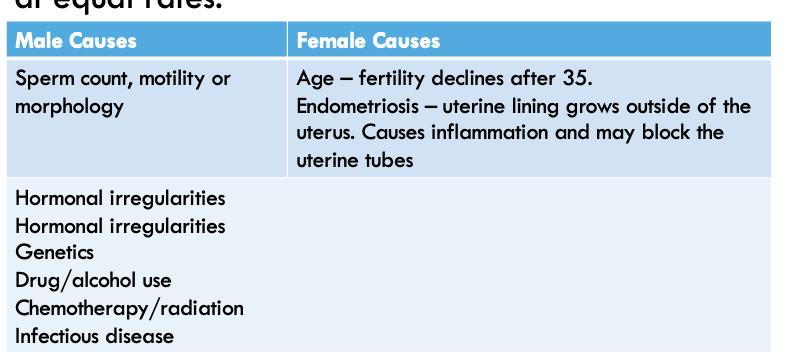
Male and females causes why for infertility
Microsurgery
Microsurgery
Passages are cleared of inflammation, scar tissue
Appropriate when:
§Sperm ducts or vas deferens are blocked in the male
§Uterine tubes blocked in the female.
Assisted reproductive technology (ART)
In-Vitro Fertilisation
§Uterine tubes blocked
§Male unable to ejaculate normally
§Cervical mucous hostile to sperm
Eggs harvested after hormonal stimulation.
Fertilisation oxccurs outside the body
Embryo implanted into the uterus
Assisted reproductive technologies
Gamete Intrafallopian Transfer (GIFT)
Eggs are harvested, immediately mixed with sperm and injected into the uterine tubes of the female.
Natural implantation takes place.
Appropriate when:
§Uterine tubes are clear
§High sperm count
Intracytoplasmic sperm injection (ICSI)
Intracytoplasmic sperm injection (ICSI)
Single sperm injected into single egg
Embryo implanted into the uterus
Appropriate when
§Low sperm count
§Poor quality sperm
§
Risk: may increase incidents of birth defects
Donor Egg/Embryo
Donor Egg/Embryo
Appropriate when female cannot use own eggs (e.g. cancer treatment, mitochondrial disease)
Embryo formed in vitro from donor egg and partner’s sperm
Embryo implanted into the uterus of the female.
Alternatively, donated embryo implanted into uterus of the female.
Surrogacy
Surrogacy
Appropriate when the female cannot carry a child (e.g. uterine cancer)
Either
Male partner provides semen and another woman bears the child
ART is used to provide an embryo using eggs and sperm from the couple and embryo is inserted into the surrogate.