AP Psych Unit 2 : Sensation/Perception Review
 Call Kai
 Learn
Learn Practice Test
 Spaced Repetition
 Match
Match Flashcards
1/105

There's no tags or description
Looks like no tags are added yet.
Name | Mastery | Learn | Test | Matching | Spaced | Call with Kai | Chat |
|---|
No analytics yet
Send a link to your students to track their progress
106 Terms
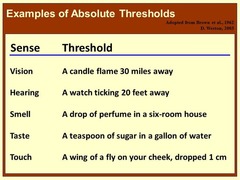
absolute threshold
The minimal amount of energy required to produce any sensation, 50 percent of the time.
binocular cues
visual messages/cues that require two eyes

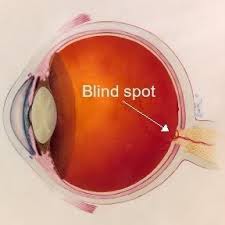
blind spot
Place on the retina out where the optic nerve leaves the eye, no receptors (rods/cones) are located here
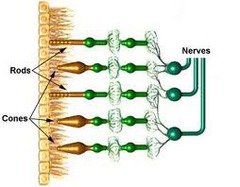
cones
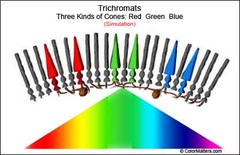
Visual receptor cells; located in retina; works best in bright light; responsible for viewing color; greatest density in the fovea.
difference threshold
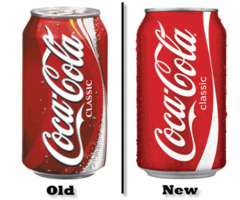
Just Noticeable Difference (JND); the smallest change in stimulation that you can detect 50% of the time; differs from one person to the other (and from moment to moment); tells us the flexibility of sensory systems - Basis of Weber's Law
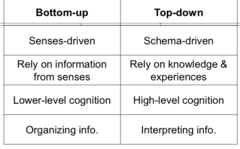
bottom-up processing
Starts with basic sensory information to construct a perception - not based on any experience.
top-down processing
Constructing perceptions based on our experiences and expectations
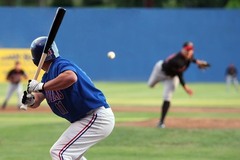
selective attention
The focusing of conscious awareness on a particular stimulus, like the cocktail effect (notice your name in a crowd)
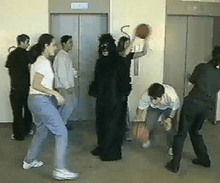
inattentional blindness
failing to see visible objects when our attention is directed elsewhere
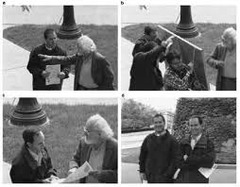
change blindness
failing to notice changes in the environment.
hue
color, or aspects of colors

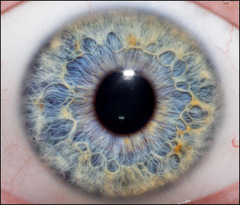
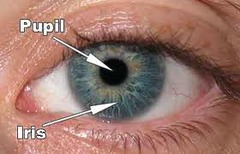
Iris
the color part of the eye; made of muscle that contracts/relaxes to control the size of the people allowing light to enter the eye
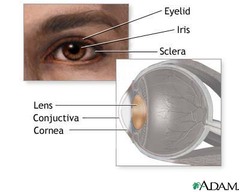
Lens
transparent part of the eye behind the iris; focuses light on the retina (accommodation); change shape to focus on objects
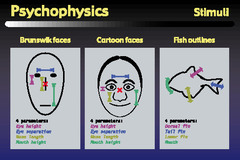
psychophysics
The study of relationships between the physical characteristics of stimuli, such as their intensity, and our psychological experience of them.
signal detection theory
States that circumstances, experiences, expectations affect our thresholds. Example- hearing the faint sound of the new born while sleeping but not noticing the loud thunder outside.

subliminal perception
Sensory information that is detected without our conscious knowledge

sensory adaptation
Diminished sensitivity as a consequence of constant stimulation.
habituation
decreasing responsiveness with repeated stimulation. As infants gain familiarity with repeated exposure to a visual stimulus, their interest wanes and they look away sooner
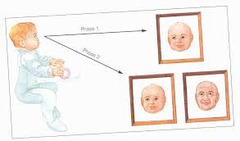
transduction
Conversion of one form of energy into another. In sensation, the transforming of stimulus energies into neural impulses.
opponent-process theory
created by Edward Hering; alternative theory used to explain after images; suggest that the retina contains three pairs color receptors or cones-yellow-blue, red-green, black-white; pairs work in opposition (thalamus)

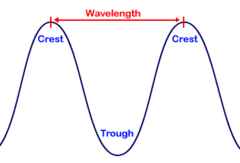
wavelength
The distance from the peak of one light or sound wave to the peak of the next. Determines the hue we see. longer waves/red, shorter waves/blue
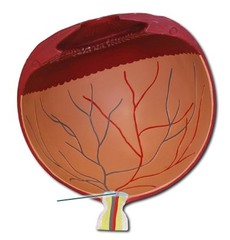
optic nerve
bundle of axons from ganglion cells that carries messages from the eye to the brain
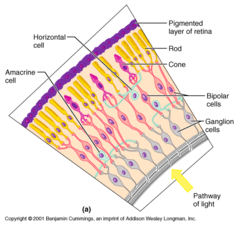
bipolar cells of retina
Bipolar cells compose an intermediate layer of connecting neurons in the retina.
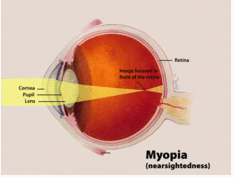
myopia
nearsightedness - unable to see things that are far away
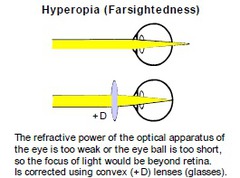
hyperopia
farsightedness - unable to see things that are up close
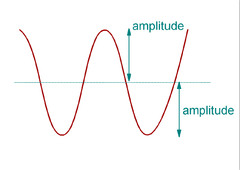
Intensity
The amount of energy in a light or sound wave, which we perceive as brightness or loudness, as determined by the wave's amplitude.
feature detectors
nerve cells in the brain that respond to specific features of the stimulus, such as shape, angle, or movement.

Gestalt grouping principles
We tend to group objects according to the following: proximity, similarity, closure, continuity and connectedness
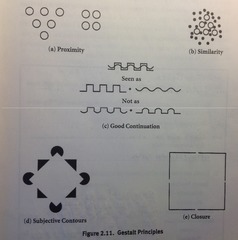
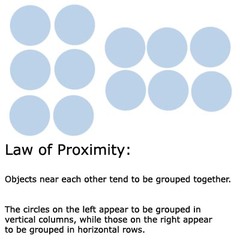
proximity
group nearby figures together
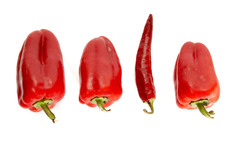
similarity
group similar figures together
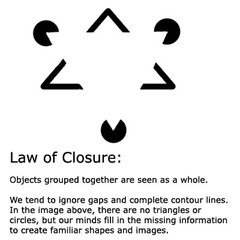
closure
we fill in gaps to create a complete, whole object
monocular cues
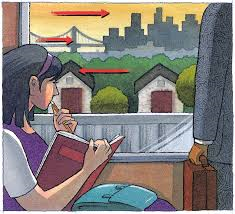
depth cues, such as interposition and linear perspective, available to either eye alone. Only need one eye to perceive it.
linear perspective
A monocular cue for perceiving depth; the more parallel lines converge, the greater their perceived distance.
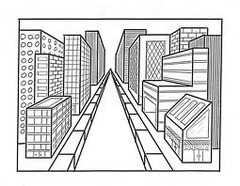
interposition cue
if one object partially blocks our view of another, we perceive it as closer

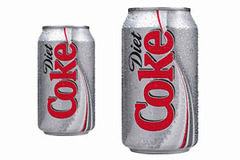
relative size
a monocular cue for perceiving depth; the smaller retinal image is farther away
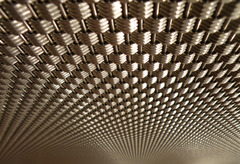
texture gradient (monocular cue)
a gradual change from a coarse, distinct texture to a fine, indistinct texture signals increasing distance. Objects far away appear smaller and more densely packed
relative clarity (monocular cue)
hazy object seen as more distant

light and shadow (monocular cue)
brighter objects are perceived as being closer than darker objects
perception
the mental process of sorting, identifying, and arranging raw sensory data into meaningful patterns

parallel processing
The processing of several aspects of a problem simultaneously; form, depth, color and motion
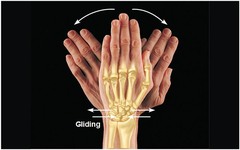
pupil
small opening in the center of the iris - the hole in the eye to allow light to enter.
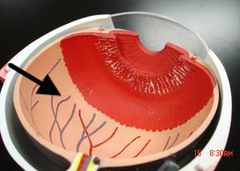
retina
the light-sensitive inner lining of the back of the eyeball; contains receptor cells (rods/cones) Allows you to see - it's the "brain" of the eye.
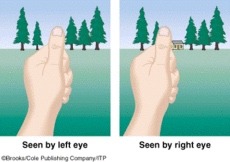
retinal disparity
binocular distance cue; based on the overlay of two retinal fields when both eyes focus on one object
rods
visual receptor cell; located in retina; respond to varying degrees of light and dark; responsible for night vision and peripheral vision
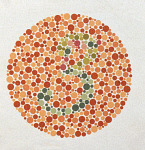
color blindness
Inability to distinguish some or all colors due to a damaged cone.
perceptual accommodation
in perception, the ability to adjust to an idea or mind set
sensation
the raw data of experience; sensory stimulation; example are eyes only register light energy and ears only register wave energy
synesthesia
describing one kind of sensation in terms of another ("a loud color", "a sweet sound")

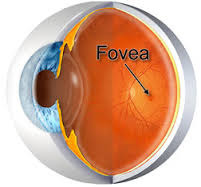
fovea
The central focal point in the retina, around which the eye's cones cluster.
size constancy
the perception of an object as the same size regardless of the distance from which it is viewed.
Weber's law
Ernst Weber; the principle that accounts for how one notices the difference threshold (JND) for any change must be proportional.
Sensory interaction
The principle that one sense may influence another, as when the smell of food influences its taste.

perceptual consistancy
perceiving objects as unchanging (having consistent shapes, size, lightness, and color) even as illumination and retinal images change.
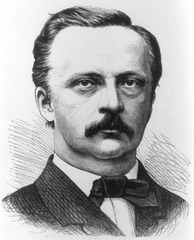
Herman von Helmholtz
Theorist who both aided in the development of the trichromatic theory of color perception and Place theory of pitch perception.
depth perception
Ability to see objects in three dimension although the image that strike the retina are two-dimensional; allows us to judge distance
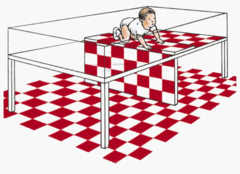
Visual cliff
Laboratory device for testing depth perception in infants and young animals. Study done by Eleanor Gibson
Phi Phenomenon
Illusion of movement created when two or more adjacent lights blink on and off in quick succession
Color constancy
Perceiving familiar objects as having consistent color, even if changing illumination alters the wave-lengths reflected by the object
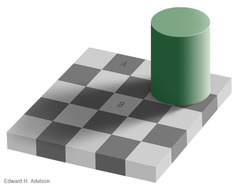
Perceptual adaptation
In vision, the ability to adjust to an artificially displaced or even inverted visual field
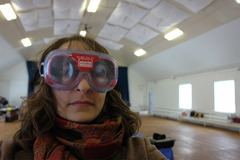
Perceptual set
A mental predisposition to perceive one thing and not another
Accommodation
Process by which the eye lens changes shape to focus near or far objects on the retina
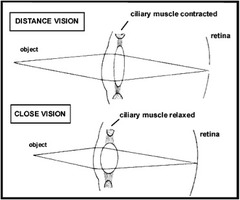
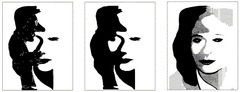
Figure Ground
The organization of the visual field into objects that stand out from their surroundings.

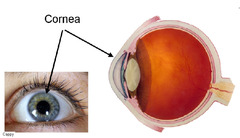
Cornea
the transparent outer covering of the eye
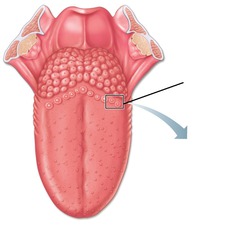
papillae
taste buds
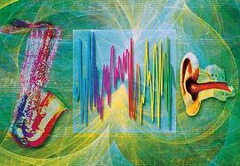
audition
the sense of hearing
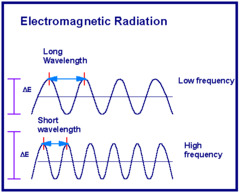
frequency
the number of complete wavelengths that pass a point in a given time - determines the pitch of a sound
relative motion
As we move, objects that are actually stable may appear to move
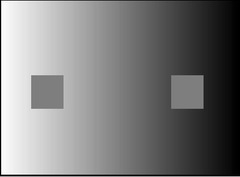
relative luminance (brightness)
the amount of light an object reflects relative to its surroundings
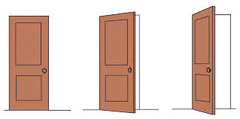
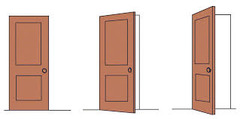
shape constancy
the tendency to interpret the shape of an object as being constant, even when its shape changes on the retina
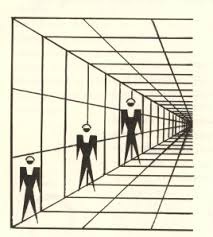
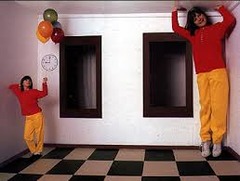
Ames room illusion
A perceptual misinterpretation involving a trapezium shaped room which appears rectangular when viewed through a peephole using only one eye and people appear small or large, depending on where they stand in the room.
perceptual adaptation
in vision, the ability to adjust to an artificially displaced or even inverted visual field
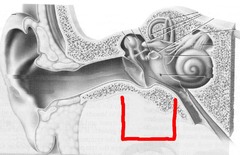
middle ear
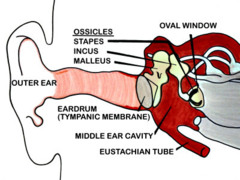
the chamber between the eardrum and cochlea containing three tiny bones (hammer, anvil, and stirrup) that concentrate the vibrations of the eardrum on the cochlea's oval window
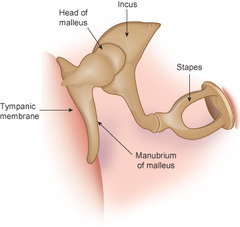
Ossicles
three tiny bones in the middle ear
(malleus, incus, stapes)
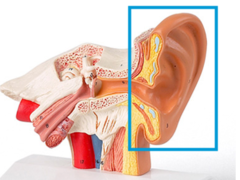
Pinna
the visible part of the ear
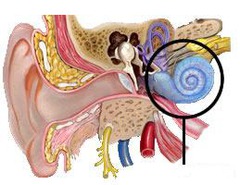
cochlea
a coiled, bony, fluid-filled tube in the inner ear through which sound waves trigger nerve impulses - where transduction takes place
oval window
membrane at the entrance to the cochlea through which the ossicles transmit vibrations
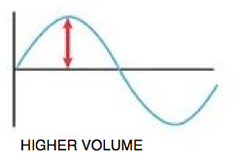
decibles
A unit used to measure the loudness of a sound.
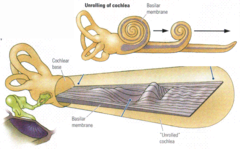
basilar membrane
A structure that runs the length of the cochlea in the inner ear and holds the auditory receptors, called hair cells.
auditory nerve
the nerve that carries impulses from the inner ear to the brain, resulting in the perception of sound
auditory cortex
the area of the temporal lobe responsible for processing sound information
sensorineural hearing loss
hearing loss caused by damage to the cochlea's receptor cells or to the auditory nerves; also called nerve deafness - Only corrected with a cochlear implant
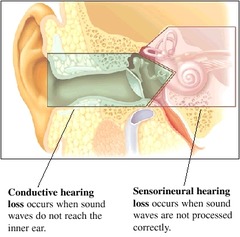
cochelar implant
a device for converting sounds into electrical signals and stimulating the auditory nerve through electrodes threaded into the cochlea
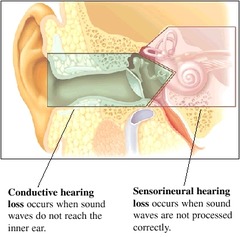
conduction hearing impairment
refers to problems with the mechanics of the outer or middle ear and means that sound vibrations cannot be passed from the eardrum to the cochlea - corrected with a hearing aid
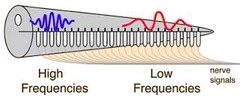
place theory
in hearing, the theory that links the pitch we hear with the place where the cochlea's membrane is stimulated
frequency theory
in hearing, the theory that the rate of nerve impulses traveling up the auditory nerve matches the frequency of a tone, thus enabling us to sense its pitch
volley principle for hearing
clusters of neurons take turns firing in a sequence of rhythmic volleys, and that pitch depends on the frequency of these volleys.
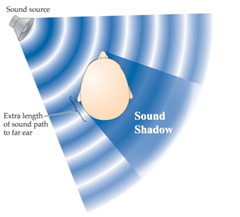
sound shadow effect
The amount of sound reflected also depends on the size of the object it encounters
tactile sense
sense of touch
phantom limb sensation
patients who have had a limb amputated may still experience sensations such as itching, pressure, tingling, or pain as if the limb were still there

touch sensations
pressure, warmth, cold, pain
Endorphins
natural, opiate-like neurotransmitters linked to pain control
pain
an unpleasant sensory experience associated with actual or potential tissue damage
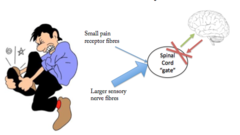
gate-control theory
the theory that the spinal cord contains a neurological "gate" that blocks pain signals or allows them to pass on to the brain. The "gate" is opened by the activity of pain signals traveling up small nerve fibers and is closed by activity in larger fibers or by information coming from the brain.
Placebos
Inactive substances, not real medications, that are used to test the effectiveness of drugs.
Gustation
sense of taste
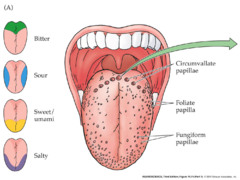
taste sensations
sweet, sour, salty, bitter, umami, oleogustus
sweet
energy source

salty
sodium essential to physiological processes

sour
potentially toxic acid - dangerous

bitter
potential poisons