CH 2: Investing and Financing Decisions and the Accounting System
 Call Kai
 Learn
Learn Practice Test
 Spaced Repetition
 Match
Match Flashcards
 Knowt Play
1/131

There's no tags or description
Looks like no tags are added yet.
Name | Mastery | Learn | Test | Matching | Spaced | Call with Kai | Chat |
|---|
No analytics yet
Send a link to your students to track their progress
132 Terms
What is the basic accounting equation?
Assets = Liabilities + Stockholders' Equity (A = L + SE) (Source: PDF slides)
Name 5 typical Asset accounts
Cash, Accounts Receivable, Inventory, Supplies, Equipment (also: Short-Term Investments, Notes Receivable, Prepaid Expenses, Long-Term Investments, Buildings, Land, Intangibles) (Source: PDF slides)
Name 5 typical Liability accounts
Accounts Payable, Notes Payable, Taxes Payable, Unearned Revenue, Bonds Payable (also: Accrued Expenses Payable) (Source: PDF slides)
Name the typical Stockholders' Equity accounts
Contributed Capital (Common Stock, Additional Paid-in Capital) and Retained Earnings (Source: PDF slides)
Accounts with "receivable" in the title are always what?
Assets — amounts owed by (receivable from) customers and others to the business (Source: PDF slides)
Accounts with "payable" in the title are always what?
Liabilities — amounts owed by the company to be paid to others in the future (Source: PDF slides)
Accounts with "unearned" in the title are always what?
Liabilities — amounts paid in the past to the company by others who expect future goods or services (Source: PDF slides)
What type of account is "Prepaid Expenses"?
Always an asset — amounts paid in advance by the company for future benefits (e.g., insurance, rent, advertising) (Source: PDF slides)
Why do we separate Common Stock from Additional Paid-in Capital (APIC)?
For historical legal reasons: par value (minimum initial share price) is recorded as Common Stock, and any excess is recorded as APIC (Source: PDF slides)
What are the 3 steps to record transactions during an accounting period?
1) Determine the impact on the accounting equation
2) Record the journal entry (in the general journal)
3) Track account balances in the general ledger (T-accounts) (Source: PDF slides)
What does "Debit" mean?
"Left" (sometimes abbreviated "DR") (Source: PDF slides)
What does "Credit" mean?
"Right" (sometimes abbreviated "CR") (Source: PDF slides)
In a journal entry, where are debited accounts/amounts placed?
Debited accounts on top, debited amounts on the left (Source: PDF slides)
In a journal entry, where are credited accounts/amounts placed?
Credited accounts on bottom (usually indented), credited amounts on the right (Source: PDF slides)
What is Rule #1 of journal entries?
A = L + SE (the accounting equation must always balance) (Source: PDF slides)
What is Rule #2 of journal entries?
Debits must always equal Credits (Source: PDF slides)
Does debiting an asset account increase or decrease it?
Increase (Debit = +A); crediting an asset account decreases it (-A) (Source: PDF slides)
Does debiting a liability account increase or decrease it?
Decrease (-L); crediting a liability account increases it (+L) (Source: PDF slides)
Does debiting an equity account increase or decrease it?
Decrease (-SE); crediting an equity account increases it (+SE) (Source: PDF slides)
True or False: Debits are "good" and Credits are "bad"
False — debits and credits are neither good nor bad; they simply mean left and right, with different effects depending on account type (Source: PDF slides)
Journal entry: Tippie Corp buys $1,000 of inventory with cash
Dr) Inventory (+A) 1,000 / Cr) Cash (-A) 1,000 (Source: PDF slides)
Journal entry: A customer pays Tippie Corp $500 to settle her account
Dr) Cash (+A) 500 / Cr) Accounts Receivable (-A) 500 (Source: PDF slides)
Journal entry: Kinnick Inc. borrows $10,000, signing a note payable
Dr) Cash (+A) 10,000 / Cr) Note Payable (+L) 10,000 (Source: PDF slides)
Journal entry: Kinnick issues $5,000 of Common Stock (par = $1,000)
Dr) Cash (+A) 5,000 / Cr) Common Stock (+SE) 1,000 / Cr) Additional Paid-in Capital (+SE) 4,000 (Source: PDF slides)
What is the General Journal?
A chronological list of transactions (Source: PDF slides)
What is the General Ledger (T-accounts)?
A record of the effects to and balances of each individual account (Source: PDF slides)
What does "posting" mean in accounting?
Transferring (posting) journal entry amounts from the General Journal to the General Ledger accounts (Source: PDF slides)
What is a Journal Entry used to summarize?
The effects of an individual transaction on two or more accounts (Source: PDF slides)
What is a T-account used to summarize?
The effects of a period's transactions on an individual account (Source: PDF slides)
What is a Trial Balance?
A listing of the ending balance in each account in the general ledger, used to check that debits equal credits (Source: PDF slides)

How are accounts ordered on a trial balance?
In financial statement order: assets, liabilities, stockholders' equity, revenues, then expenses (Source: PDF slides)
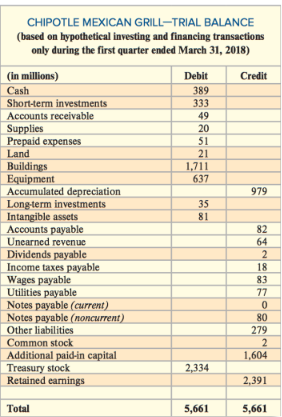
What is the purpose of the trial balance?
To make sure total debits equal total credits (Source: PDF slides)

List the steps of the Accounting Cycle "During the Period"
Analyze transactions, Record journal entries in the general journal, Post amounts to the general ledger (Source: PDF slides)
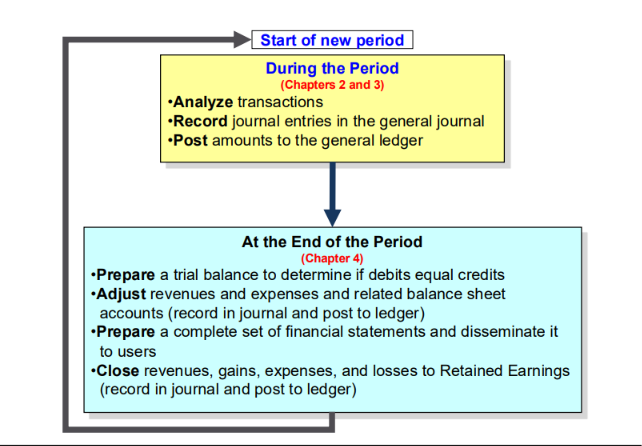
List the steps of the Accounting Cycle "At the End of the Period"
Prepare a trial balance, Adjust revenues/expenses and related accounts, Prepare financial statements, Close revenues/gains/expenses/losses to Retained Earnings (Source: PDF slides)
What are the three types of accounting information and their users?
Financial (Investors & Creditors, 10-K, U.S. GAAP, FASB, External audit), Managerial (Managers, internal reports, internal rules, C-Suite, Internal audit), Tax (Government, Tax Return, Tax Law, Congress, Tax audit) (Source: PDF slides)
Who sets U.S. GAAP?
FASB (Financial Accounting Standards Board) (Source: PDF slides)
Who sets international financial reporting standards?
The International Accounting Standards Board (IASB) (Source: PDF slides)
What is the purpose of financial reporting (per SFAC 8)?
To provide financial information about the reporting entity that is useful to existing and potential investors, lenders, and other creditors in making decisions about providing resources to the entity (Source: PDF slides)
What two fundamental qualities make information "decision useful"?
Relevance and Faithful Representation (Source: PDF slides)
What does "Relevance" mean in accounting information?
Information capable of making a difference in the decisions made by users (has predictive and confirmatory value) (Source: PDF slides)
What does "Faithful Representation" mean in accounting information?
Financial reports must faithfully represent the economic phenomena they purport to represent — being complete, neutral, and free from error (Source: PDF slides)
Name the four "enhancing" qualitative characteristics of accounting information
Comparability, Verifiability, Timeliness, Understandability (Source: PDF slides)
What is the fundamental constraint on providing accounting information?
Benefits must exceed Costs (Source: PDF slides)
List the four recognition and measurement assumptions
Separate Entity Assumption, Going Concern Assumption, Monetary Unit Assumption, Time Period Assumption (Source: PDF slides)
What is the Separate Entity Assumption?
Business transactions are separate from owners' transactions (Source: PDF slides)
What is the Going Concern Assumption?
The business will continue to operate into the foreseeable future (Source: PDF slides)
What is the Monetary Unit Assumption?
Information is reported using a national monetary unit (Source: PDF slides)
What is the Time Period Assumption?
The long life of a company can be reported in shorter periods (Source: PDF slides)
List the three recognition and measurement principles
Mixed-Attribute Measurement Model, Revenue and Expense Recognition, Full Disclosure (Source: PDF slides)
What is the Mixed-Attribute Measurement Model?
Most balance sheet elements are recorded at historical cost (though sometimes later adjusted) (Source: PDF slides)
What is the Full Disclosure principle?
Financial statements should include the information necessary for users to make informed decisions about the company (Source: PDF slides)
What are the two types of events that make up transactions?
External Events and Internal Events (Source: PDF slides)
What is an External Event (exchange transaction)?
An exchange of assets, goods, or services by one party for assets, services, or promises to pay from another party (something given, something received) — e.g., purchasing a machine from a supplier (Source: PDF slides)
What is an Internal Event?
An event that is not an exchange between parties but has a direct and measurable effect on the entity — e.g., using up supplies purchased previously (Source: PDF slides)
Is signing a contract a business transaction?
No — it only involves an exchange of promises, not an exchange of assets, goods, or services (Source: PDF slides)
which is NOT a business transaction?
A) A company buys goods on account.
B) A company sells land for cash.
C) A company fired 10 percent of the employees due to lackluster sales.
D) A company borrows money from the bank.
A company firing employees due to lackluster sales (no exchange of assets/goods/services occurs) (Source: PDF slides)
Which of the following IS a business transaction?
A) A company signs a contract for services to be provided during the first quarter of the next fiscal year.
B) A company pays its employees a year-end bonus.
C) A company hires a new marketing manager.
D) A company applies for a mortgage that will be used to purchase 8/27/2026 a new office building.
A company pays its employees a year-end bonus (cash, an asset, is exchanged) (Source: PDF slides)
What are the 3 criteria that define an Asset (SFAC 6)?
Probable future economic benefits; obtained or controlled by a particular entity; result of past transactions or events (Source: PDF slides)
What are the 3 criteria that define a Liability (SFAC 6)?
Probable future sacrifices of economic benefits; arising from present obligations to transfer assets or provide services in the future; resulting from past transactions or events (Source: PDF slides)
How is Stockholders' Equity defined (SFAC 6)?
The residual interest in the assets of the entity after subtracting liabilities (Source: PDF slides)
What are the two types of Stockholders' Equity?
Contributed Capital (financing provided by owners) and Retained Earnings (financing provided by business operations) (Source: PDF slides)
Is a $50,000 microassembly machine purchase an asset?
Yes — it provides probable future economic benefits, is controlled by the entity, and results from a past transaction (Source: PDF slides)
Is hiring 5 new office staff (future salaries) recorded as an asset?
No — future services of employees not yet performed do not meet the asset definition (no past transaction creating a controlled resource) (Source: PDF slides)
Is an internally developed brilliant business idea recorded as an asset?
No — internally developed intangible resources (not purchased) are typically not reported on the balance sheet (Source: PDF slides)
If a company sells its business idea to Google for $10 million, is that now recorded as an asset (for Google)?
Yes — once purchased in an exchange transaction, it becomes a recorded asset (e.g., an intangible asset) (Source: PDF slides)
Are unpaid wages for work already performed by employees a liability?
Yes — this is an accrued expense payable: a present obligation from a past event (work already performed) requiring a future economic sacrifice (payment) (Source: PDF slides)
Are some valuable resources like internally developed trademarks/patents reported on the balance sheet?
No — they are excluded because they were internally developed over time and not purchased (Source: PDF slides)
Are some obligations like equipment or building rental commitments reported on the balance sheet?
No — some such obligations (e.g., operating lease-type rental commitments) are not reported on the balance sheet (Source: PDF slides)
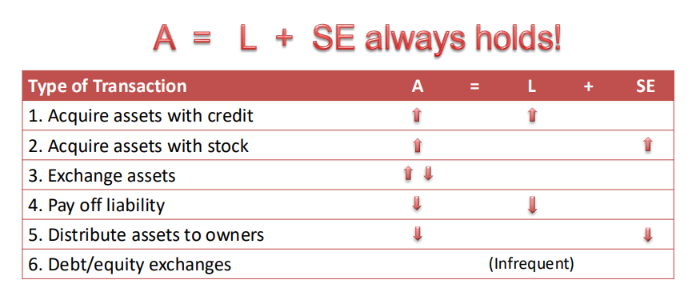
List the 6 general types of transactions affecting the accounting equation
1) Acquire assets with credit, 2) Acquire assets with stock, 3) Exchange assets, 4) Pay off liability, 5) Distribute assets to owners, 6) Debt/equity exchanges (Source: PDF slides)
Transaction type: Acquire assets with credit — effect on A, L, SE?
Assets increase, Liabilities increase (Source: PDF slides)
Transaction type: Acquire assets with stock — effect on A, L, SE?
Assets increase, Stockholders' Equity increases (Source: PDF slides)
Transaction type: Exchange assets — effect on A, L, SE?
One asset increases, another asset decreases (Assets only — no change to L or SE) (Source: PDF slides)
Transaction type: Pay off liability — effect on A, L, SE?
Assets decrease, Liabilities decrease (Source: PDF slides)
Transaction type: Distribute assets to owners — effect on A, L, SE?
Assets decrease, Stockholders' Equity decreases (Source: PDF slides)
Transaction type: Debt/equity exchanges — effect on A, L, SE?
Liabilities and Stockholders' Equity are affected (this type is infrequent) (Source: PDF slides)
Does A = L + SE always hold, no matter the transaction type?
Yes — this equality always holds after every transaction (Source: PDF slides)
Par Value (definition 1)
The nominal value per share of stock as specified in the corporate charter (Source: Screenshots/Textbook Glossary)
Par Value (definition 2)
Another name for bond principal, or the maturity amount of a bond (covered in Chapter 10) (Source: Screenshots/Textbook Glossary)
Retained Earnings (textbook definition)
Cumulative earnings of a company that are not distributed to the owners and are reinvested in the business (Source: Screenshots/Textbook Glossary)
Separate Entity Assumption (textbook definition)
Business transactions are separate from the transactions of owners (Source: Screenshots/Textbook Glossary)
Stockholders' Equity (Shareholders'/Owners' Equity) — textbook definition
The financing provided by the owners and the operations of the business (Source: Screenshots/Textbook Glossary)
T-Account (textbook definition)
A tool for summarizing transaction effects for each account, determining balances, and drawing inferences about a company's activities (Source: Screenshots/Textbook Glossary)
Transaction (definition 1, textbook)
An exchange between a business and one or more external parties to a business (Source: Screenshots/Textbook Glossary)
Transaction (definition 2, textbook)
A measurable internal event such as the use of assets in operations (Source: Screenshots/Textbook Glossary)
Transaction Analysis (textbook definition)
The process of studying a transaction to determine its economic effect on the business in terms of the accounting equation (Source: Screenshots/Textbook Glossary)
Trial Balance (textbook definition)
A list of all accounts with their balances to provide a check on the equality of the debits and credits (Source: Screenshots/Textbook Glossary)
Account (textbook definition)
A standardized format that organizations use to accumulate the dollar effect of transactions on each financial statement item (Source: Screenshots/Textbook Glossary)
Accounting Cycle (textbook definition)
The process used by entities to analyze and record transactions, adjust the records at the end of the period, prepare financial statements, and prepare the records for the next cycle (Source: Screenshots/Textbook Glossary)
Additional Paid-in Capital (textbook definition)
Also called Paid-in Capital or Contributed Capital in Excess of Par — the amount of contributed capital less the par value of the stock (Source: Screenshots/Textbook Glossary)
Assets (textbook definition)
Economic resources owned or controlled by a company; they have measurable value and are expected to benefit the company by producing cash inflows or reducing cash outflows in the future (Source: Screenshots/Textbook Glossary)
Common Stock (textbook definition)
The basic voting stock issued by a corporation (Source: Screenshots/Textbook Glossary)
Cost (Historical Cost) — textbook definition
The cash-equivalent value of an asset on the date of the transaction (Source: Screenshots/Textbook Glossary)
Credit (textbook definition)
The right side of an account (Source: Screenshots/Textbook Glossary)
Current Assets (textbook definition)
Assets that will be used or turned into cash within one year (Source: Screenshots/Textbook Glossary)
Current Liabilities (textbook definition)
Short-term obligations that will be paid or settled in the coming year in cash, goods, other current assets, or services (Source: Screenshots/Textbook Glossary)
Debit (textbook definition)
The left side of an account (Source: Screenshots/Textbook Glossary)
Going Concern Assumption (textbook definition)
Businesses are assumed to continue to operate into the foreseeable future (also called the continuity assumption) (Source: Screenshots/Textbook Glossary)
Journal Entry (textbook definition)
The accounting method for expressing the effects of a transaction on accounts in a debits-equal-credits format (Source: Screenshots/Textbook Glossary)
Liabilities (textbook definition)
Measurable obligations resulting from a past transaction; they are expected to be settled in the future by transferring assets or providing services (Source: Screenshots/Textbook Glossary)
Monetary Unit Assumption (textbook definition)
Accounting information should be measured and reported in the national monetary unit without any adjustments for changes in purchasing power (Source: Screenshots/Textbook Glossary)