FINAL Exam Theoretical Psych
 Call Kai
 Learn
Learn Practice Test
 Spaced Repetition
 Match
Match Flashcards
 Knowt Play
1/126

Earn XP
Description and Tags
Erm im cooked
Name | Mastery | Learn | Test | Matching | Spaced | Call with Kai |
|---|
No analytics yet
Send a link to your students to track their progress
127 Terms
Wilhelm Wundt
Father of scientific psychology
Wundt
Who said “mind is more than just association”
Wundt
had 188 doctoral students and wrote 50,000 pages
Lightner Witmer
Founded the field of clinical psychology and established the first psychological clinic in 1896
Mary Caulkins
First female president of APA
Lightner Witmer
student of Wundt
Helen Thompson
Performed first studies of mental differenes between men and women
William James
The father of American psychology. He is best known for his work "The Principles of Psychology”
Robert Woodworth
wrote columbia bible
Columbia bible
basically book about eveything psychology up until that point
Association
The mechanism that lets you go from one mental element to the next
Common Sense
The idea that the 5 senses produce sensory information and come together to form common sense
Aristotle
Who came up with the idea of commmon sense
Blank Slate
We are born without any mental content at all
John Locke
created blank slate
Sensoristic
all mental content is from the senses
Atomistic
sensoristic content comes together to build more complex contents
Associative (John Locke)
More complex contents are created by association
Law of coniguity
If two things happen at the same time, the presence of one reminds us of the other
Hebb’s Law
if two nerve cells are simultaneously stimualted for a period of time, the synapse binding them is strengthended
Connectionism
Modern form of associationism, needs computer models
Rumelhart & McClelland
Who is responsible for connectionism
Horizontal Faculties (domain-general) (Locke)
PIMIAM
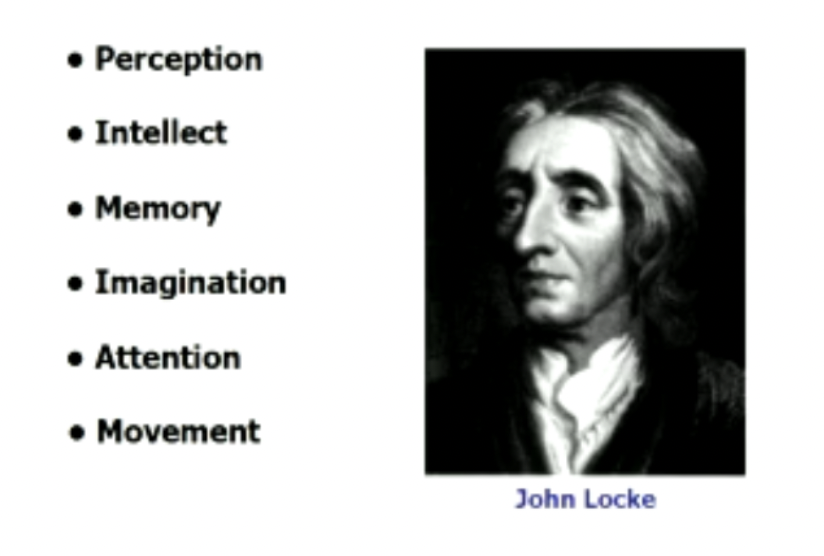
Phrenology (Gall) (pseudoscience)
functions are localized in the brain and bumps on skull reflect faculty. (Localization is correct but bumps are not)
Physiognomy (pseudoscience)
A face reflects character “criminal type”
Mesmerism (pseudoscience) (Mesmer)
Use of hypnosis and magnets
Mental Healing (pseudoscience) (Quimby)
Mental healing through correct and positive thinking
Spiritualism (pseudoscience)
If you die, your spirit and mind floats and people can talk to you through people who can talk to spirits
Wilhelm Wundt and William James
Psychology is the science of consciousness
Witmer
Founder of Clinical psychology
Witmer
Established first psychological clinic
Witmer
Used a team approach using a psychologist, medical doctor, and social worker to treat dyslexia
Chronoscope
Instrument that measures reaction time
Witmer
Published the "Psychological Clinic"
Hugo Munsterberg
Created forensic psychology
Forensic psychology
Measuring reliability of witnesses statements and helping in law
Hugo Munsterberg
Invented the use of psychology in industry
Id (originally Fechner's term)
Pleasure principle
Ego
Reality principle
Superego
Moral principle
Freud's iceberg
Ego and superego keep unconscious desires in check
Criticism of Freud's iceberg
Theory cannot be disproved which violates science rules
Freud
Whos technique was free association
Freud
Whos technique was dream analysis
Why did Freud use his techniques
To help make repressed matters conscious
John Watson
Who did the Little Albert study
Amygdala
Part of the brain associated with emotional memory
Hypothetico-deductive method
Mathematical formulas to make predictions
Clark Hull
Who invented the Hypothetico-deductive method
Hypothetico-deductive method formula
Action Readiness = Habit strength x Drive Strength
Edward Tolman
Tested cognitive maps with rats in mazes
Tolman
Said creating a mental map is quicker than response learning (always turn right)
Hippocampus
Part of the brain associated with locations
Basal ganglia
Part of the brain associated with responses
limitation of law of effect
Said that you don’t need to be rewarded or hungry to learn
Burrhus Skinner
He denied the existence of free will
addiction
What underlines operant conditioning
Behaviorism
he study of observable behaviors rather than internal mental states
John Watson
Founded behaviorism
John Watson
Experimented with how the "American dream" and blank slate affect people
Law of Effect
behaviors followed by satisfying consequences are more likely to be repeated, while behaviors followed by discomfort or unpleasant outcomes are less likely to recur
Houdini
Who invented the cat escape puzzle box
dopamine
Neurotransmitter that rewards you for getting something right
Operant Conditioning
behavior is modified by its consequences, utilizing reinforcement or punishment to increase or decrease the likelihood of a behavior recurring
Behaviorism
Psychology without the mind
Pavlov
Invented classical conditioning
Thorndike
Invented operant conditioning
attention
What highlights parts of consciousness
Wundt
Who studied consciousness vs attention
subliminal
What means there is a weak stimulus and no attention
pre-conscious
What has a strong stimulus but no attention
conscious
Strong stimulus and strong attention
subliminal priming
echnique that exposes individuals to stimuli (words, images) below the threshold of conscious awareness
subliminal attention
unconscious guidance of focus toward specific stimuli—like words or images
attention-dependent
Subliminal priming of reactions is
Parietal Damage
Attention only to half of your visual field
Spatial neglect
Impaired orienting of attention
Feature Binding
Searching for combinations of features (searching for luigi in marios)
Wundt
Who said attention highlights part of consciousness
Dehaene
Who said attention enables consciousness and some unconscious processes
Cartesian Theater
Says you look at a screen in your head
Pierre Flourens
Who experiemented with brains of pigeons and rabbits to prove Holism
Localization
The brain functions are results of specific areas of the brain do specific things
Holism
The brain regions all interact into an integrated whole to perform functions
Paul Broca
Who discovered damage to left inferior frontal cortex causes speech to production difficulties
Carl Wernicke
Created the association theory of language
Concept images
combinatinons of cognitive visualizations of objects, scenes, or concepts that are not currently present to the senses
nature vs nurture
Predisposition vs upbringing is also
Binet Test
identifies students who require special assistance in their education
Charles Spearman
discovered the g factor

