UE Overview & Osteology - JP Unit 2

0.0(0)
Studied by 0 people
call kaiCall Kai
Locked
learnLearn
examPractice Test
spaced repetitionSpaced Repetition
heart puzzleMatch
flashcardsFlashcards
GameKnowt Play
Card Sorting

1/31

flashcard set

Earn XP

Description and Tags

Musculoskeletal Unit 2 - Video 1

Last updated 10:13 PM on 8/28/26
Name
Mastery
Learn
Test
Matching
Spaced
Call with Kai
Chat

No analytics yet

Send a link to your students to track their progress

32 Terms

1
New cards

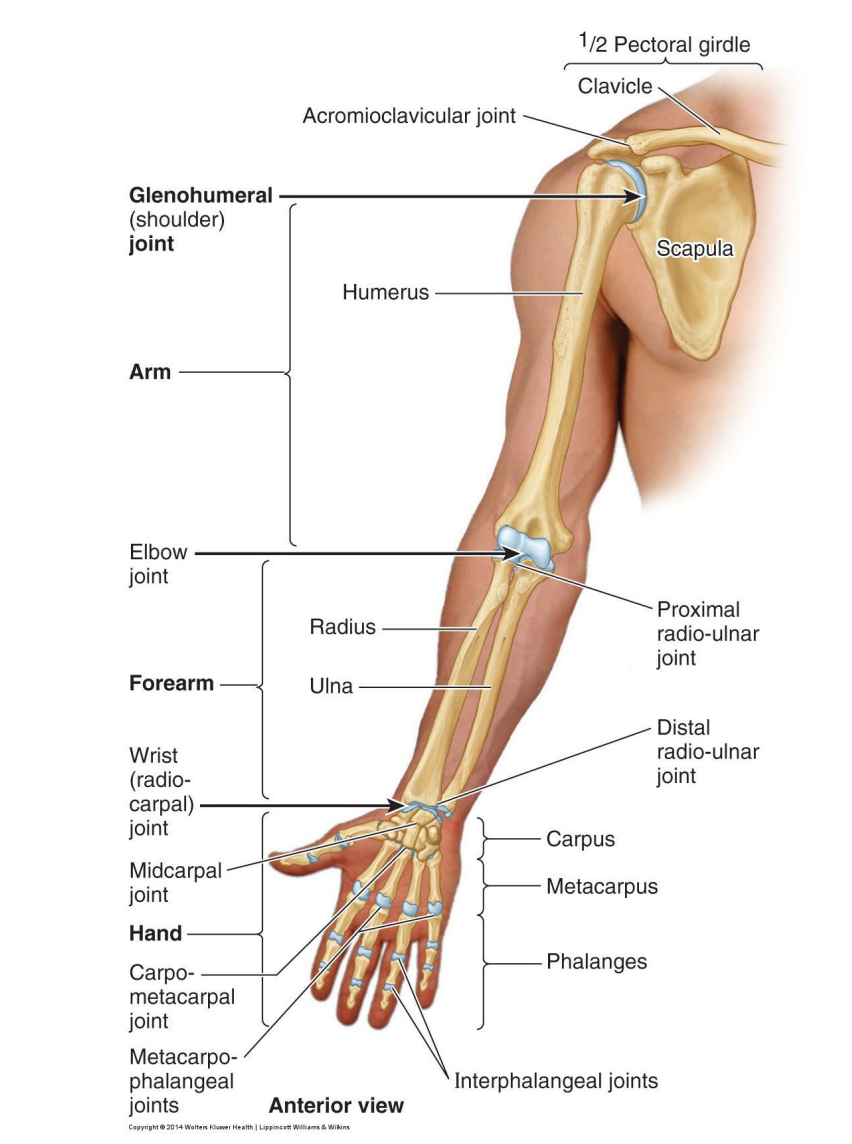
Arm vs Forearm on the Upper extremity

  • The Cubital (Elbow) is what makes this region split
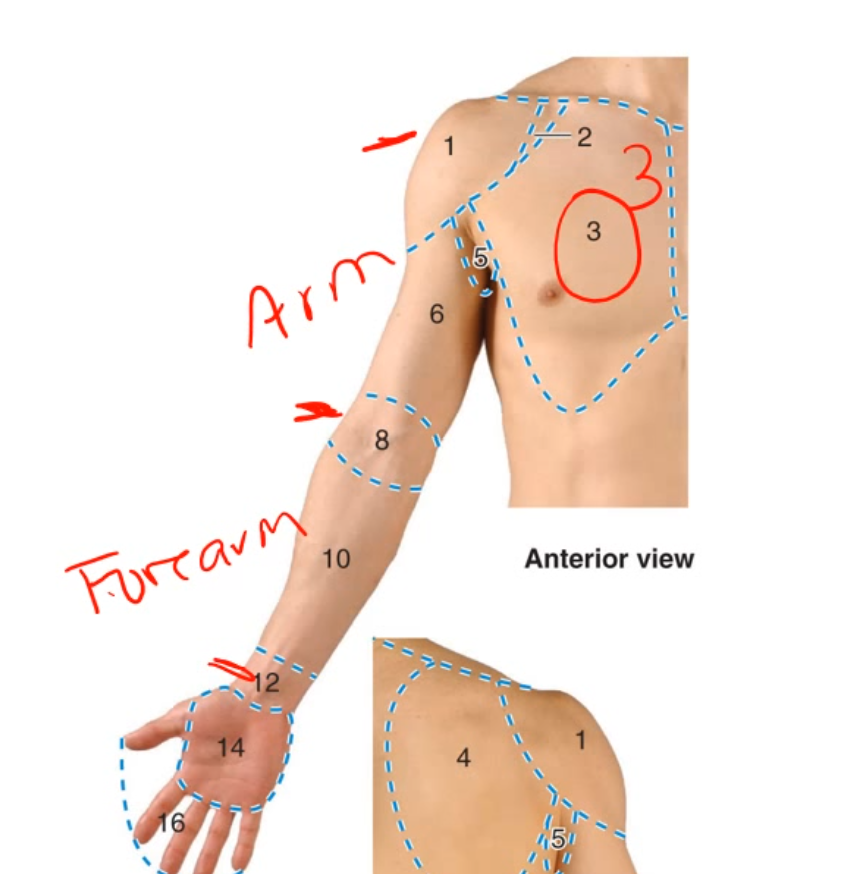

<ul><li><p>The Cubital (Elbow) is what makes this region split</p></li></ul><p></p>
2
New cards

Upper Extremities Overview Diagram

knowt flashcard image
3
New cards

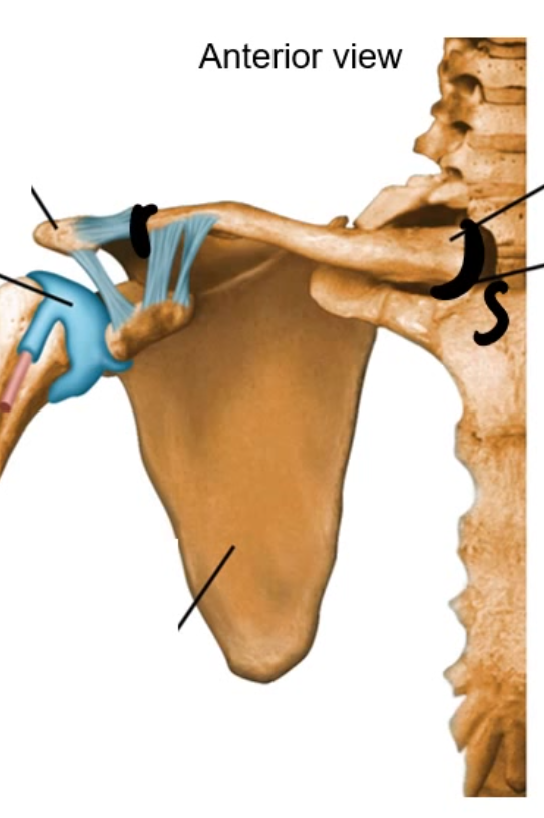
SHOULDER COMPLEX OSTEOLOGY (3) + (One boney Landmark)

1. Clavicle

2. Scapula

3. Humerus (proximal)


  • Sternum (Boney Landmark the upper extremity articulates to)
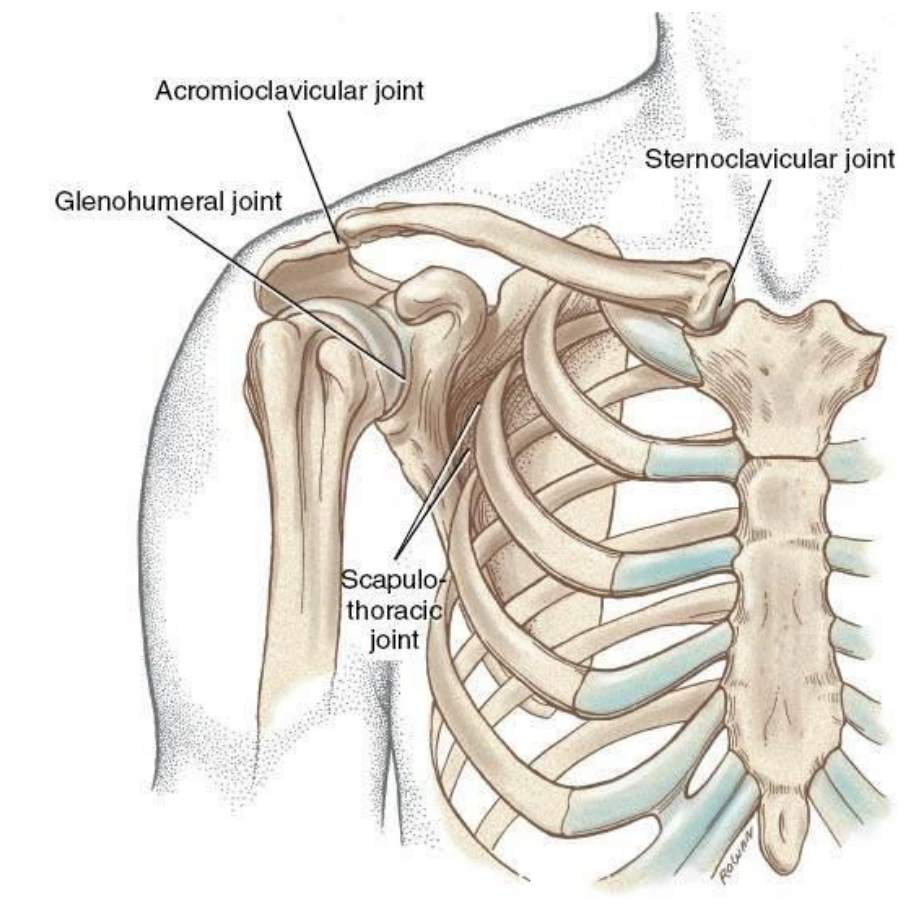

<p>1. Clavicle </p><p>2. Scapula </p><p>3. Humerus (proximal)</p><p></p><ul><li><p>Sternum (Boney Landmark the upper extremity articulates to)</p></li></ul><p></p>
4
New cards

Clavicle (Positioning) (3 Parts)

  • The “Collar Bone”


Flat, curved, superficial bone

  • Sternal end

  • Acromial end

  • Shaft


<ul><li><p>The “Collar Bone”</p></li></ul><p></p><p><span style="color: rgb(236, 244, 6);">Flat, curved, superficial bone </span></p><ul><li><p>Sternal end </p></li><li><p>Acromial end </p></li><li><p>Shaft</p></li></ul><p></p>
5
New cards

Clavicle (Function)

Function:

  • Moveable, “crane-like strut”

  • Bony boundary of cervico-axillary canal

  • Shock absorption

  • Muscle attachments


6
New cards

Scapula (Boarders & Angles ; 5)

Triangular, flat bone on posterolateral thorax

.

Borders

  1. Superior

  2. Axillary (to the armpit)

  3. Vertebral (to the vertebrae)

.

Angles (2) –

1) Superior

2) Inferior
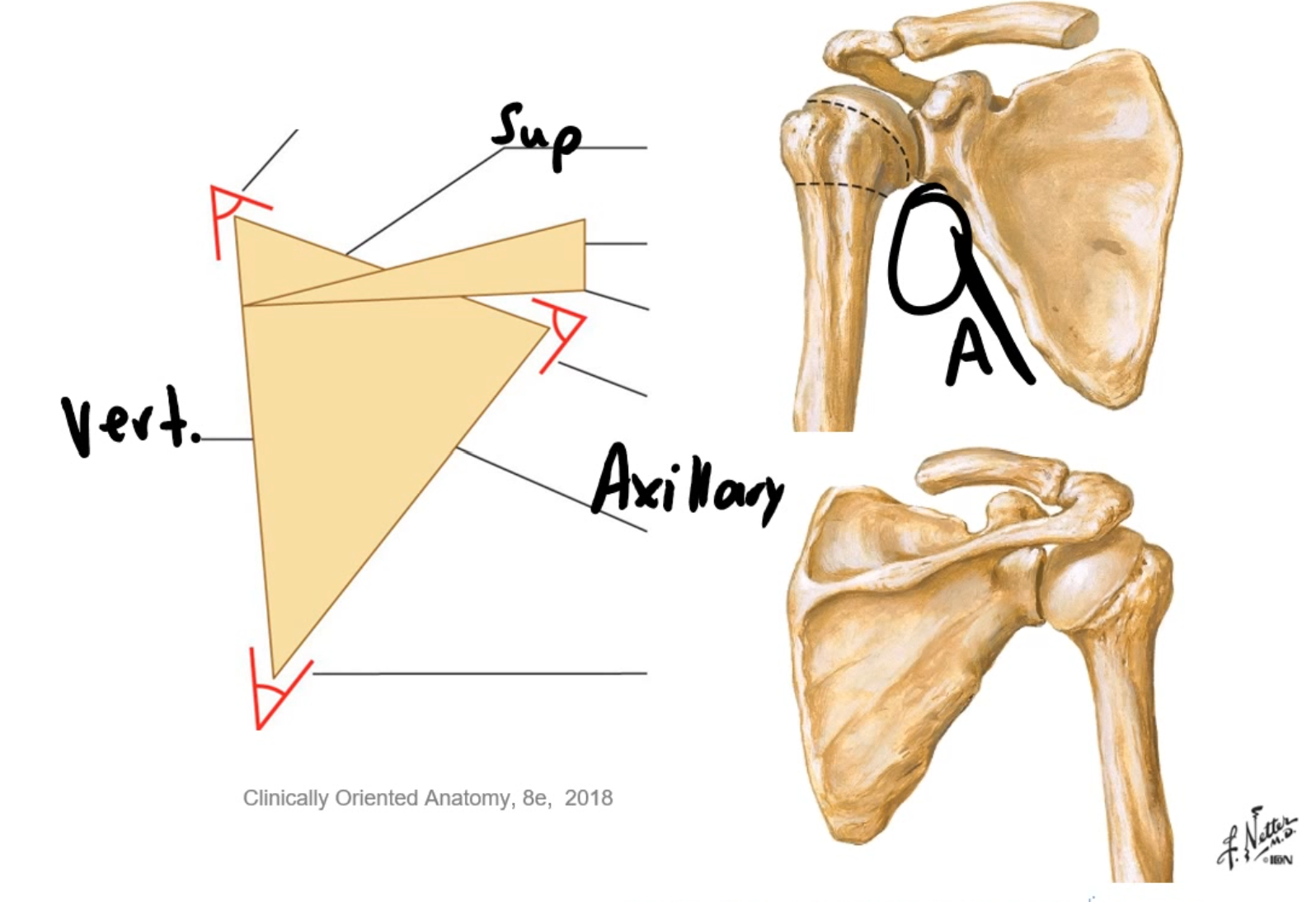
<p>Triangular, flat bone on posterolateral thorax</p><p>.</p><p>Borders </p><ol><li><p>Superior</p></li><li><p>Axillary (to the armpit)</p></li><li><p>Vertebral (to the vertebrae)</p></li></ol><p>.</p><p>Angles (2) –</p><p>1) Superior</p><p>2) Inferior</p>
7
New cards

How many Fossa & Processes are present in the scapula?

7

  • 4 Fossa

  • 3 Processes


8
New cards

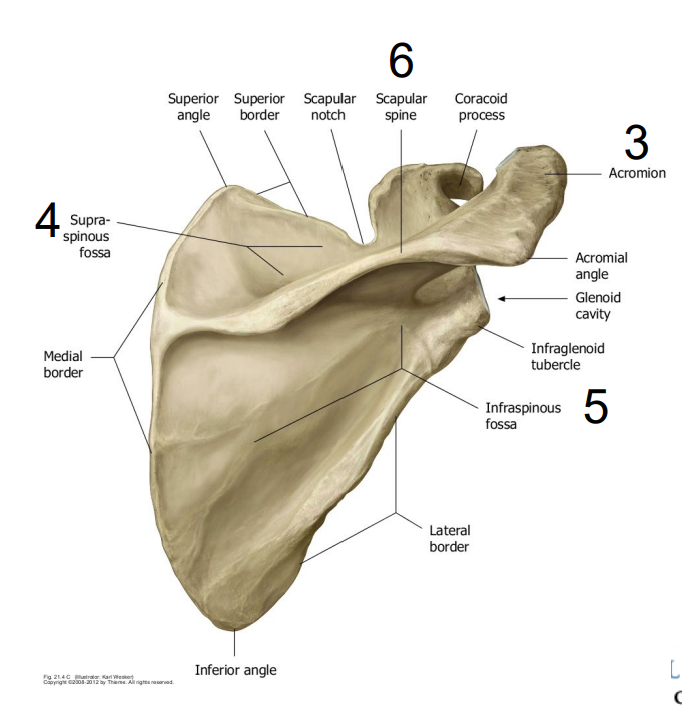
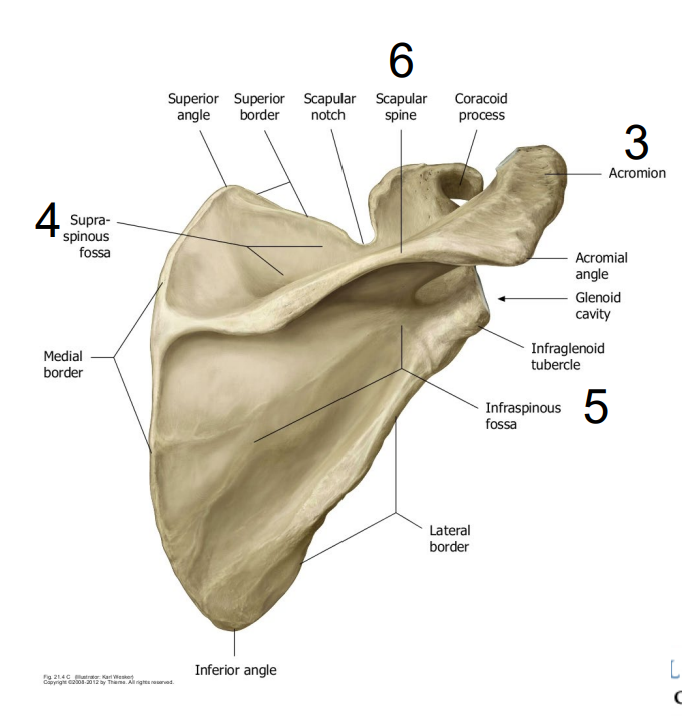
Name The Scapula Fossa(s) (4)

(1) Subscapular fossa

(4) Supraspinous fossa

(5) Infraspinous fossa

(7) Glenoid fossa

9
New cards

(1) Subscapular fossa

Only seen on the Anterior view

  • Where the subscapularis muscle sits (Muscle of the rotator cuff attachment)
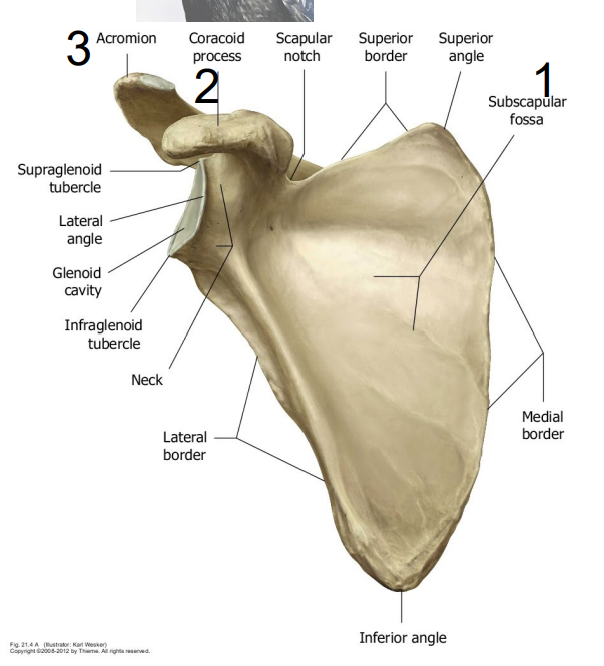

<p>Only seen on the <span style="color: rgb(248, 68, 68);"><strong>Anterior view</strong></span></p><ul><li><p>Where the <span style="color: yellow;">subscapularis muscle sits (Muscle of the rotator cuff attachment)</span></p></li></ul><p></p>
10
New cards

(4) Supraspinous fossa

  • Fossa above the spine


<ul><li><p>Fossa above the spine</p></li></ul><p></p>
11
New cards

(5) Infraspinous fossa

  • Fossa below the spine


<ul><li><p>Fossa below the spine</p></li></ul><p></p>
12
New cards

(7) Glenoid fossa

  • Part of the scapula that receives the head of the humorous

  • Forms glenohumeral joint (which is the primary ball-and-socket joint of the shoulder.)
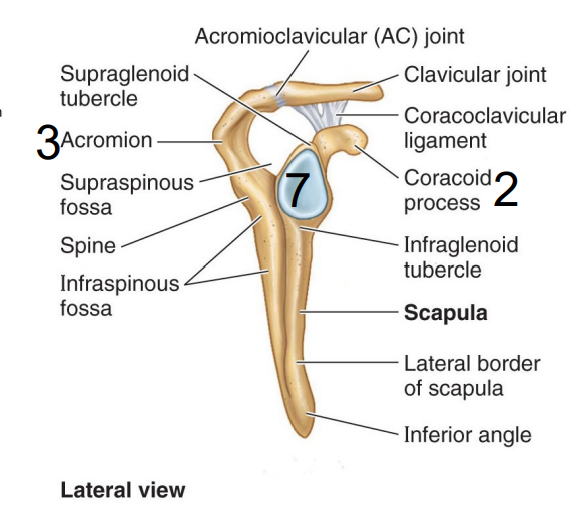

<ul><li><p>Part of the scapula that <span style="color: yellow;"><strong>receives the head of the humorous</strong></span></p></li><li><p>Forms <span style="color: rgb(57, 255, 66);"><strong><em>glenohumeral joint</em></strong></span> (which is the primary ball-and-socket joint of the shoulder.)</p></li></ul><p></p>
13
New cards

Name The Scapula Processes (3)

(2) Coracoid process

(3) Acromion process

(6) Spine of scapula

14
New cards

(2) Coracoid process

  • More inferior process then the Acromion process

  • Coracoid means “Crows Beak”


<ul><li><p>More inferior process then the Acromion process</p></li><li><p>Coracoid means “Crows Beak”</p></li></ul><p></p>
15
New cards

(3) Acromion process

  • The most superior process in this bone

  • Seen in all angles of the scapula

  • This is the a part of the scapula that articulates with the clavicle
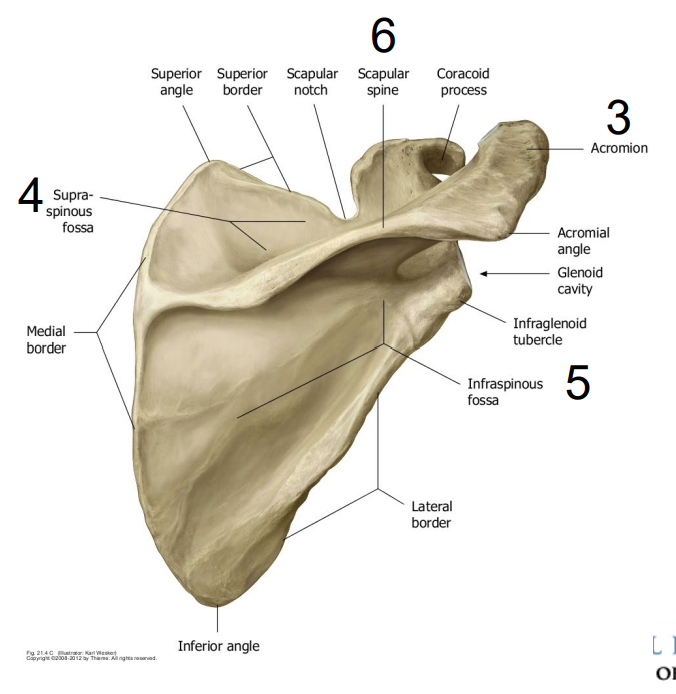

<ul><li><p>The most superior process in this bone</p></li><li><p>Seen in all angles of the scapula</p></li><li><p>This is the<span style="color: yellow;"><strong> a part of the scapula that articulates with the clavicle</strong></span></p></li></ul><p></p>
16
New cards

(6) Spine of scapula

  • a prominent, shelf-like ridge of bone that crosses the upper back surface of the scapula
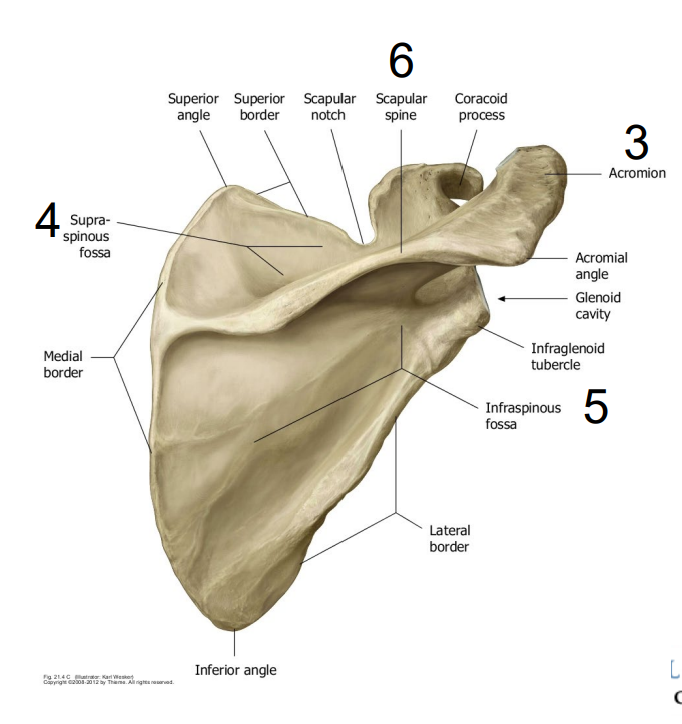

<ul><li><p>a prominent, shelf-like <span style="color: yellow;"><strong>ridge of bone that crosses the upper back surface of the scapula</strong></span></p></li></ul><p></p>
17
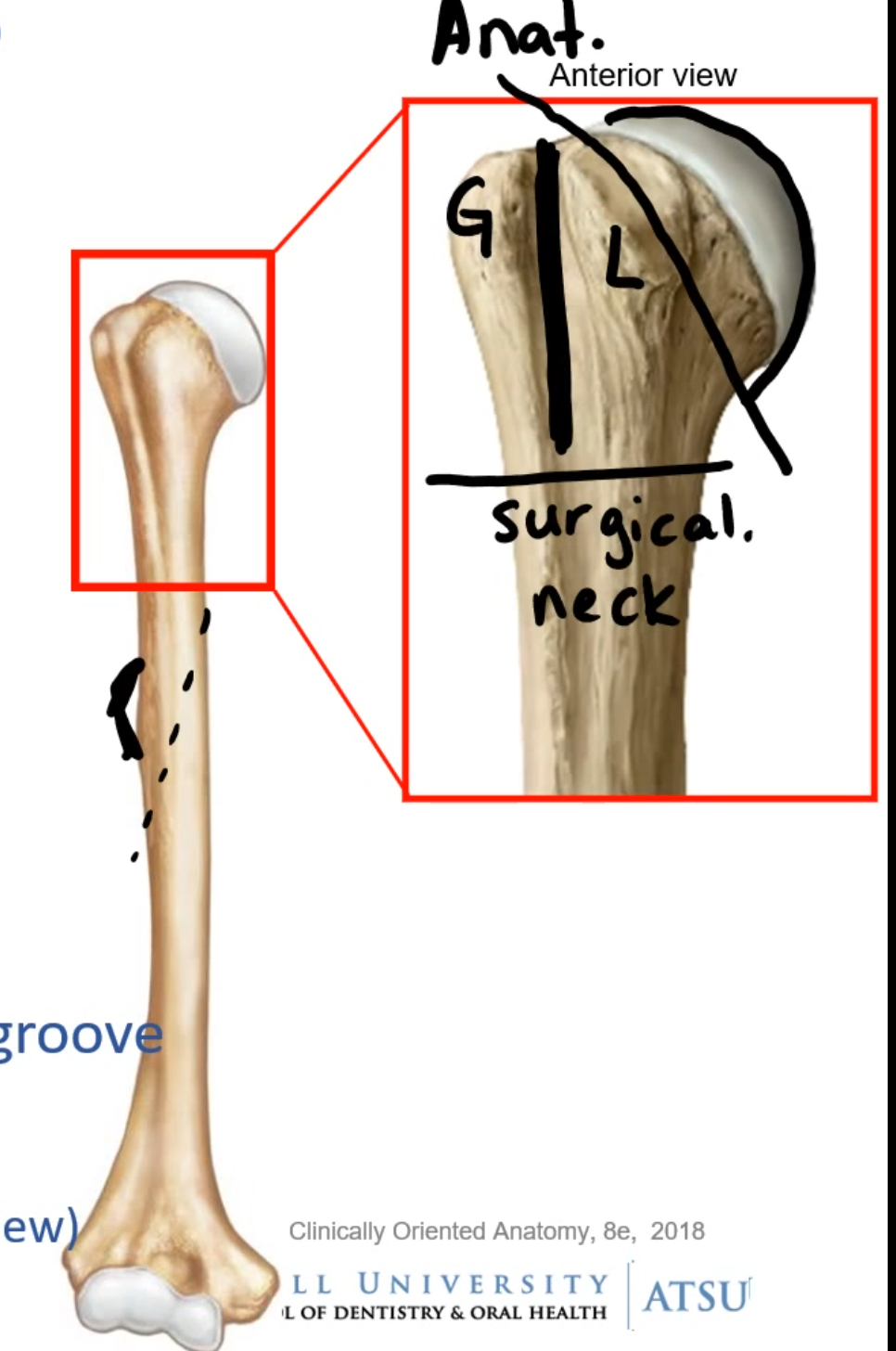
New cards

Proximal Humerus Landmarks (9)

Landmarks:

  • Humeral head

  • Neck

    • Anatomical

    • Surgical

  • Greater tubercle

  • Lesser tubercle

  • Intertubercular sulcus / Bicipital groove

  • Deltoid tuberosity

  • Radial/Spiral groove (posterior view)


<p>Landmarks: </p><ul><li><p>Humeral head </p></li><li><p>Neck </p><ul><li><p>Anatomical </p></li><li><p>Surgical </p></li></ul></li><li><p>Greater tubercle </p></li><li><p>Lesser tubercle </p></li><li><p>Intertubercular sulcus / Bicipital groove </p></li><li><p>Deltoid tuberosity </p></li><li><p>Radial/Spiral groove (posterior view)</p></li></ul><p></p>
18
New cards

Proximal Humerus Function

Ball of the ball & socket joint

  • ½ sphere = unstable joint


19
New cards

Bones of the elbow and forearm region (3)

1. Humerus (distal)

2. Ulna

3. Radius

20
New cards

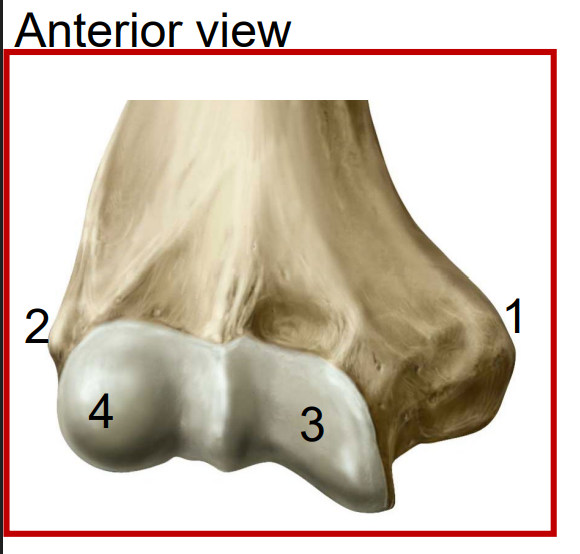
Distal Humerus Landmarks (5)

1. Medial epicondyle

2. Lateral epicondyle

3. Trochlea

4. Capitellum

5. Olecranon fossa
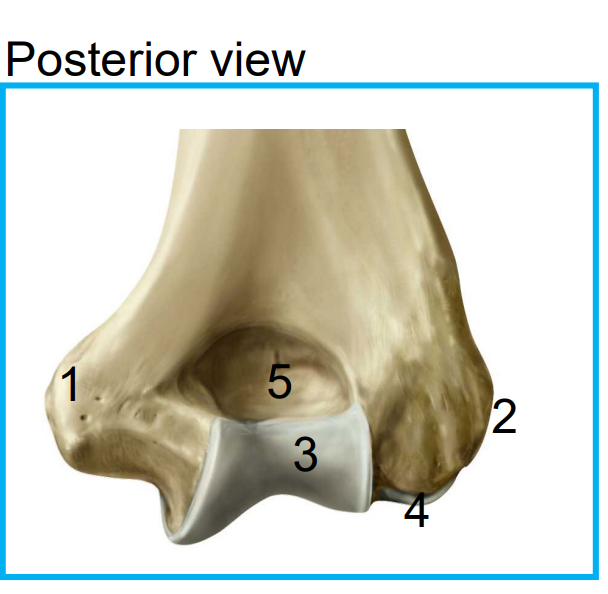
<p>1. Medial <span style="color: yellow;"><strong>epicondyle</strong></span></p><p>2. Lateral <span style="color: yellow;">epicondyle</span></p><p>3. <span style="color: rgb(60, 253, 105);">Trochlea</span></p><p>4. <span style="color: rgb(52, 212, 240);"><strong>Capitellum</strong></span></p><p>5. <span style="color: rgb(225, 160, 255);"><strong>Olecranon fossa</strong></span></p>
21
New cards

Medial epicondyle & Lateral epicondyle Function?

  • Muscles attach


22
New cards

Trochlea Function?

Articulate (connect) With the Ulna.

  • #3


<p>Articulate <span style="color: yellow;"><strong>(connect) With the Ulna</strong></span>.</p><ul><li><p>#3</p></li></ul><p></p>
23
New cards

Capitellum Function?

Articulate (connect) With the Radius

  • #4


<p>Articulate <span style="color: rgb(1, 246, 32);"><strong>(connect) With the Radius</strong></span></p><ul><li><p>#4</p></li></ul><p></p>
24
New cards

5. Olecranon fossa

  • Receives the Olecranon Process of the Ulnar bone
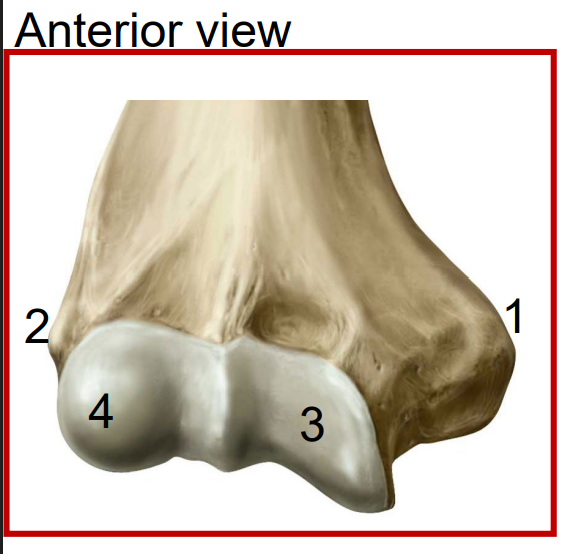

<ul><li><p>Receives the <span style="color: rgb(243, 70, 201);"><strong>Olecranon Process of the Ulna</strong></span>r bone</p></li></ul><p></p>
25
New cards

Proximal Radius (4 Parts)

1. Radial head

2. Radial neck

3. Radial shaft

4. Radial tuberosity
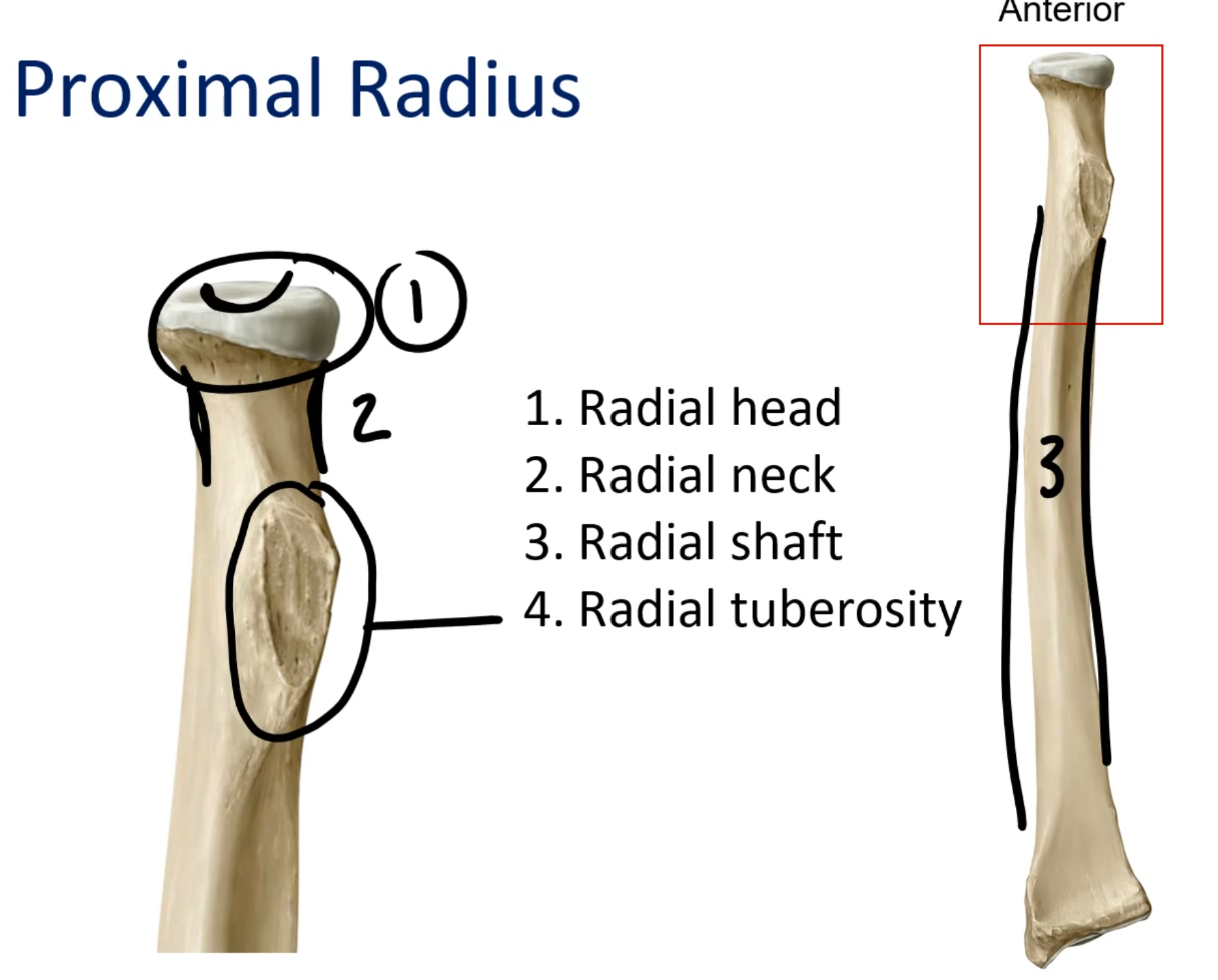
<p>1. Radial <span style="color: rgb(19, 248, 78);"><strong>head</strong></span></p><p>2. Radial <span style="color: rgb(235, 240, 25);"><strong>neck</strong></span></p><p>3. Radial <span style="color: rgb(9, 195, 250);"><strong>shaft</strong></span></p><p>4. Radial <span style="color: rgb(254, 133, 133);"><strong>tuberosity</strong></span></p>
26
New cards

Proximal Ulna (5 Parts)

1. Olecranon

2. Trochlear notch

3. Coronoid process '

4. Ulnar tuberosity

5. Ulnar shaft
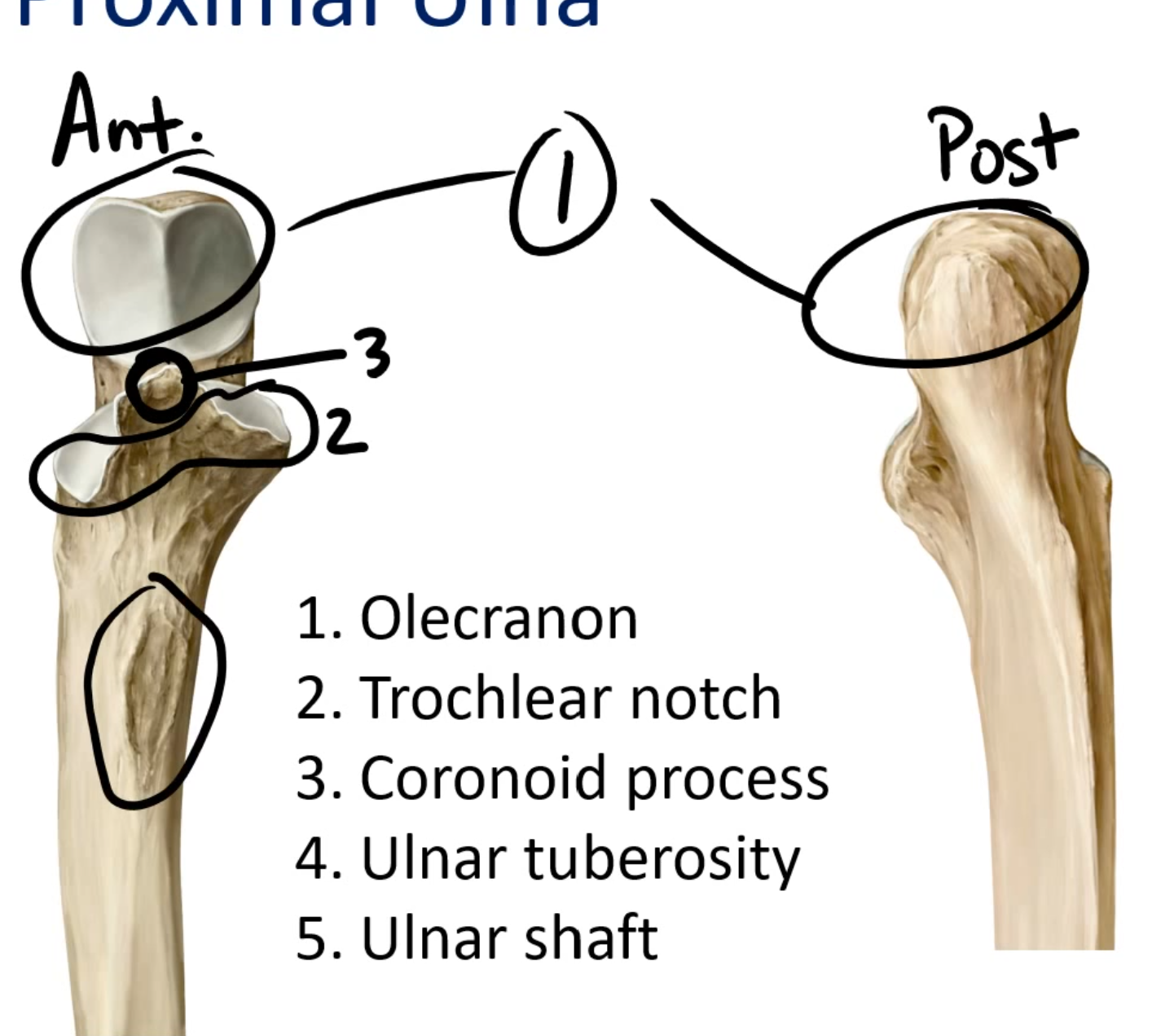
<p>1. Olecranon </p><p>2. Trochlear notch </p><p>3. Coronoid process '</p><p>4. Ulnar tuberosity </p><p>5. Ulnar shaft</p>
27
New cards

Bones of the wrist and hand region (5)

1. Ulna (distal)

2. Radius (distal)

3. Carpals (n=8)

4. Metacarpals (n=4)

5. Phalanges (n=14)
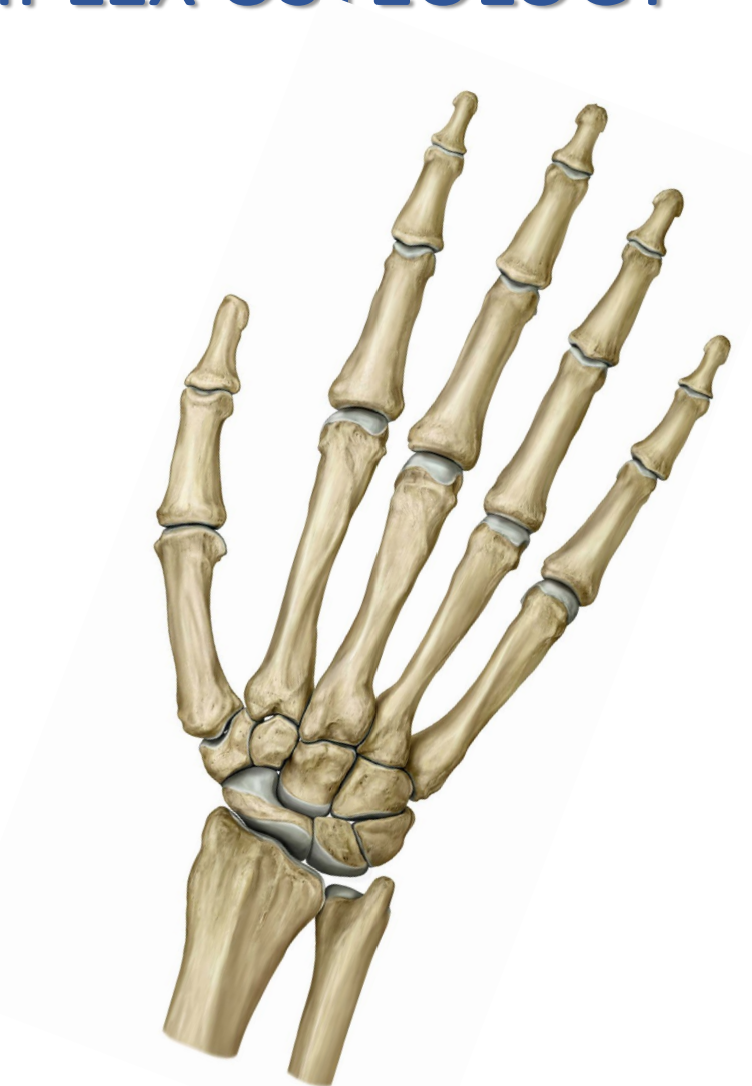
<p>1. Ulna (distal) </p><p>2. Radius (distal) </p><p>3. Carpals (n=8) </p><p>4. Metacarpals (n=4) </p><p>5. Phalanges (n=14)</p>
28
New cards

Carpal Bones 2 Sections

  1. Proximal

  2. Distal


29
New cards

Proximal Carpal Bones (4)

Mnmonic → So Long To Pinky


1. Scaphoid

2. Lunate

3. Triquetrum

4. Pisiform
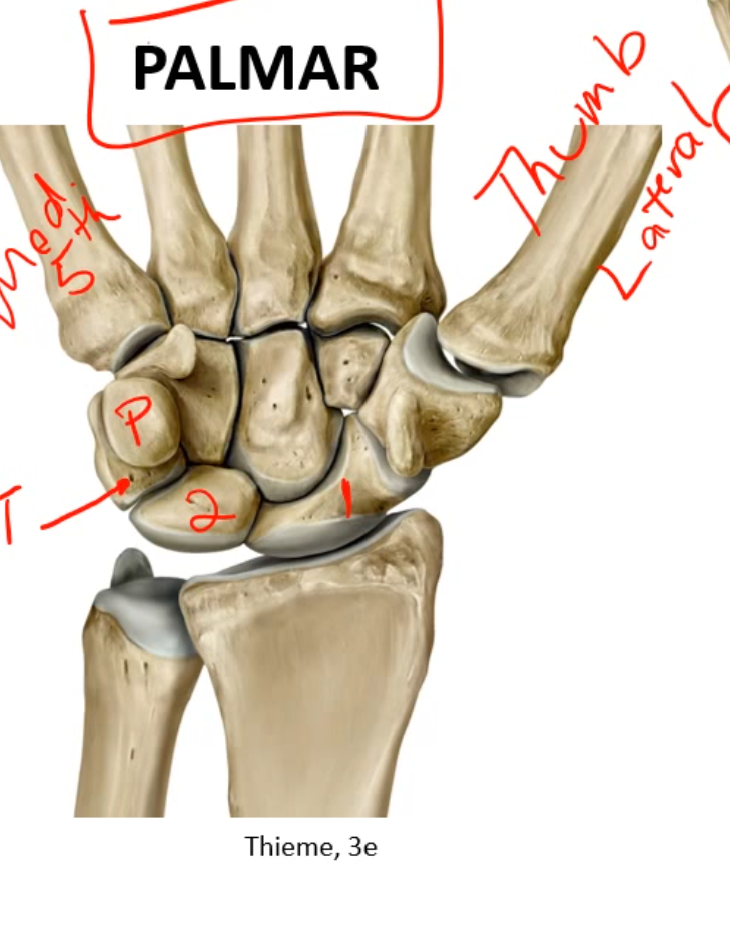
<p>Mnmonic → <span style="color: yellow;"><strong>S</strong></span>o <span style="color: yellow;"><strong>L</strong></span>ong <span style="color: yellow;"><strong>T</strong></span>o <span style="color: yellow;"><strong>P</strong></span>inky</p><p></p><p>1. <span style="color: yellow;"><strong>S</strong></span>caphoid </p><p>2. <span style="color: yellow;"><strong>L</strong></span>unate </p><p>3. <span style="color: yellow;"><strong>T</strong></span>riquetrum </p><p>4. <span style="color: yellow;"><strong>P</strong></span>isiform</p>
30
New cards

Distal Carpal Bones (4)

Mnmonic → Here Comes The Thumb


5. Trapezium

6. Trapezoid

7. Capitate

8. Hamate
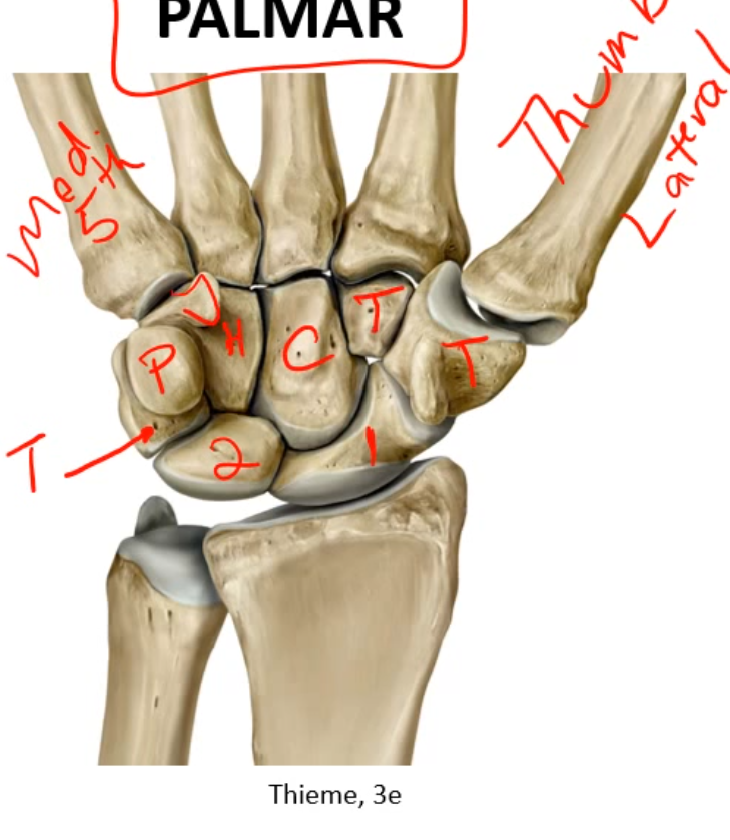
<p>Mnmonic → <span style="color: yellow;"><strong>H</strong></span>ere <span style="color: yellow;"><strong>C</strong></span>omes <span style="color: yellow;"><strong>T</strong></span>he <span style="color: yellow;"><strong>T</strong></span>humb </p><p></p><p>5. <span style="color: yellow;"><strong>T</strong></span>rapezium</p><p>6. <span style="color: yellow;"><strong>T</strong></span>rapezoid</p><p>7. <span style="color: yellow;"><strong>C</strong></span>apitate</p><p>8. <span style="color: yellow;"><strong>H</strong></span>amate</p>
31
New cards

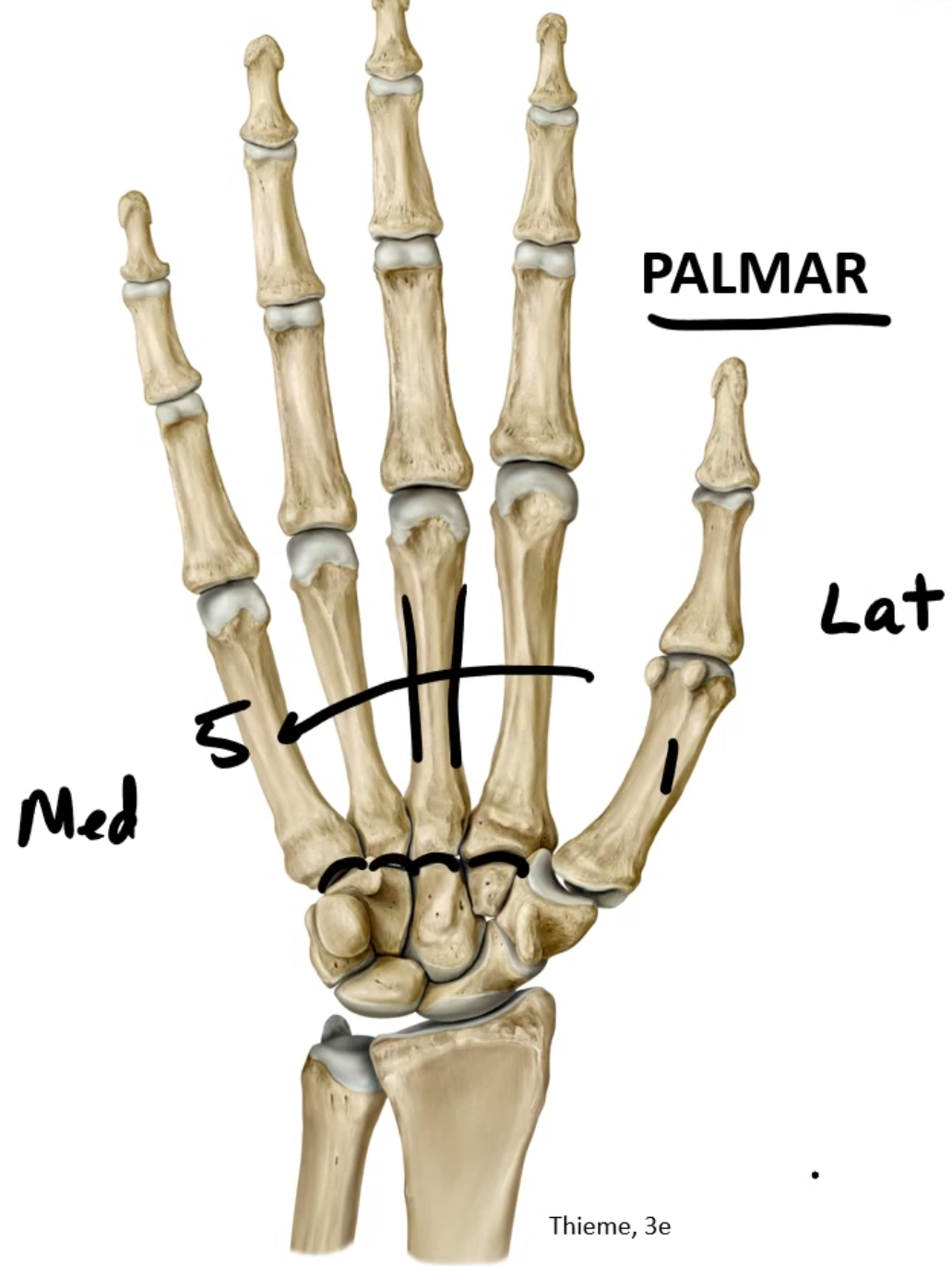
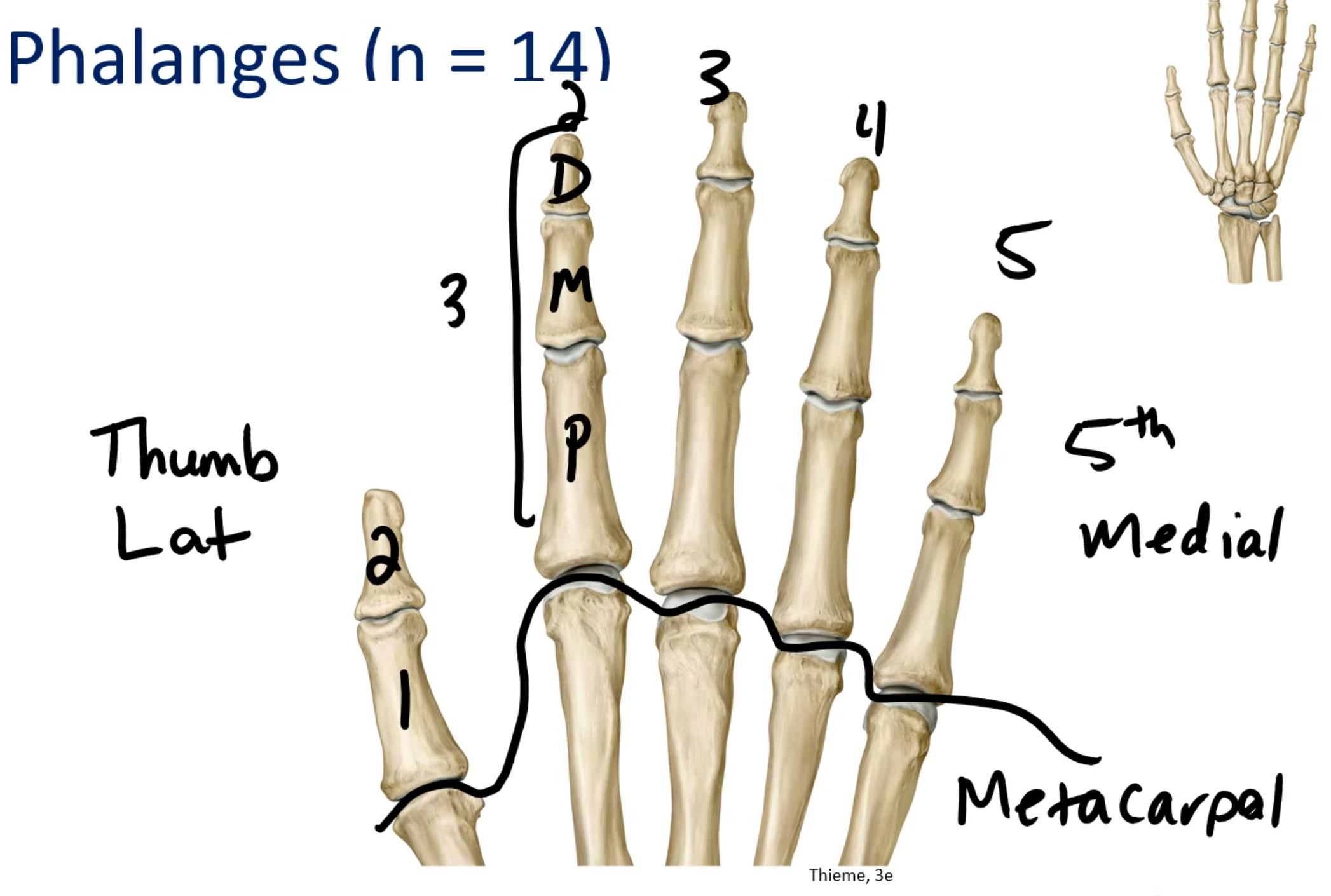
Metacarpals

  • There are 5

  • Thumb is 1 → Pinky is 5


<ul><li><p>There are 5</p></li><li><p>Thumb is 1 → Pinky is 5</p></li></ul><p></p>
32
New cards

Phalanges

  • There are 14

  • Thumb has 2

  • Every other finger has 3

    • 1 Distal

    • 1 Medial

    • 1 Proximal


<ul><li><p>There are 14</p></li><li><p>Thumb has 2</p></li><li><p>Every other finger has 3</p><ul><li><p>1 Distal</p></li><li><p>1 Medial</p></li><li><p>1 Proximal</p></li></ul></li></ul><p></p>