Oral Histology - Oral Mucosa
 Call Kai
 Learn
Learn Practice Test
 Spaced Repetition
 Match
Match Flashcards
 Knowt Play
1/157

There's no tags or description
Looks like no tags are added yet.
Name | Mastery | Learn | Test | Matching | Spaced | Call with Kai | Chat |
|---|
No analytics yet
Send a link to your students to track their progress
158 Terms
Mucous membrane
describes the moist lining of the GI tract, nasal passages, other body cavities that communicate with the exterior
In the oral cavity, the mucous membrane is often called the
oral mucous membrane or oral mucosa
At the ____, the oral mucosa is continuous with the skin
lips
At the _____, the oral mucosa is continuous with the mucosa lining the rest of the gut
pharynx
The oral mucosa is located anatomically between _____ and _____________ _______ and shows some properties of each
skin, gastrointestinal mucosa
The skin, oral mucosa, and intestinal lining consist of two separate tissue components:
covering epithelium and underlying connective tissue
Functions of the oral mucosa
- protection
- sensation
- secretion
- thermal regulation
protective functions of oral mucosa
- barrier for mechanical trauma and microbiological insults
- normal biting and chewing activities expose soft tissue to mechanical forces and surface abrasions
- there are a number of adaptations of the epithelium and CT to withstand insults
- epithelium of the oral mucosa is a major barrier to the toxic effect of microorganisms on tissues
- epithelial homeostasis
epithelial homeostasis
- cell production in the deeper layers will be balanced by loss of cells from the surface
- rate at which cells leave the surface represents a defense mechanism by rapidly clearing the substrate to which many microorganisms adhere
- this way they are unable to produce toxic effects or invade
mechanical forces include the actions of
- compression
- stretching
- shearing
surface abrasions may be described as
hard particles in the diet
sensation function of oral mucosa
- temperature (heat, cold)
- touch, pain
- taste buds
- thirst
- reflexes
reflexes include
- swallowing
- gagging
- retching
- salivating
secretion function of oral mucosa
- saliva produced by salivary glands contributes to the maintenance of a moist surface
- distant from the mucosa, secretions pass through long ducts
- minor salivary glands are associated with the oral mucosa
- sebaceous glands frequently present in the oral mucosa but secretions are mostly insignificant
thermal regulation function of oral mucosa
- practically no role
- no obvious specializations of blood vessels for controlling heat transfer
- important in animals via panting
Types of Oral Epithelium
- ortho-keratinization
- parakeratinization
- non-keratinization
ortho-keratinization
- shows narrow, darkly staining granular layer in gingiva
- gingiva, hard palate, some areas of dorsal tongue
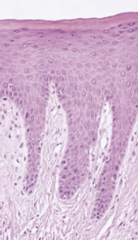
parakeratinization
- in gingiva, shows keratin squames that have retained pyknotic nuclei
- granular layer containing only a few scattered granules
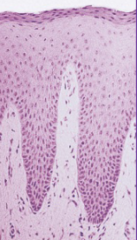
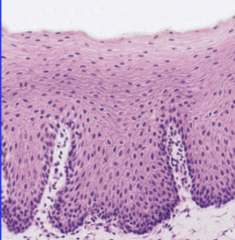
non-keratinization
- in buccal mucosa, shows no clear distinction between cell strata
- nuclei are apparent in the surface layers
- note thickness and epithelial ridge patterns, patterns of maturation
- no granular layer
keratinization of non-keratinized buccal epithelium may result from
irritation by tobacco use
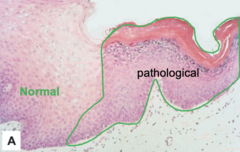
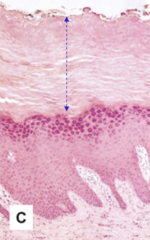
keratinization of normal hard palate
This image depicts
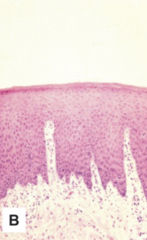
Hyperkaratosis in the hard palate may occur as a result of
irritation by smoking
basal cell layer of keratinized epithelium
- cuboidal or columnar cells containing bundles of tonofibrils and other cell organelles
- site of most cell divisions
prickle/spinosum cell layer of keratinized epithelium
- larger ovoid cells containing conspicuous tonofibril bundles
- membrane coating granules appear in upper part of this layer
granular cell layer of keratinized epithelium
- flattened cells containing conspicuous keratohyaline granules associated with tonofibrils
- membrane coating granules fuse with cell membrane in upper part
- internal membrane thickening occurs
keratinized cell layer of keratinized epithelium
- extremely flattened and dehydrated cells in which all organelles have been lost
- cell filled only with packed fibrillar material
- when pyknotic nuclei are retained
- parakeratinization occurs
basal cell layer of nonkeratinized epithelium
- cuboidal or columnar cells containing separate tonofilaments and other cell organelles
- site of most cell divisions
prickle/spinosum layer of nonkeratinized epithelium
- larger ovoid cells containing dispersed tonofilaments
- membrane coating granules appear in upper part of layer
- filaments become numerous
intermediate cell layer of nonkeratinized epithelium
slightly flattened cells containing many dispersed tonofilaments and glycogen
superficial cell layer of nonkeratinized epithelium
- slightly flattened cells with dispersed filaments and glycogen
- fewer organelles present, but nuclei persist
2 parts of the oral cavity
- outer vestibule
- oral cavity proper
outer vestibule is bounded by
lips and cheeks
oral cavity proper includes
superior zone: hard and soft palates
inferior border: floor of the mouth and base of the tongue
posteriorly the oral cavity proper is bounded by
pillars of the fauces and tonsils
the oral mucosa shows considerable __________ __________ in different regions of the oral cavity, but 3 main types can be identified according to their primary function: __________, ________, ___________ mucosa
structural variation, masticatory, lining, specialized
the larger part of the oral mucosa is represented with _______ mucosa, amounting to ___% of the total area
lining, 60
masticatory mucosa takes up around ___% of the oral mucosa
25
specialized mucosa occupies smaller areas, totaling around ___% of the oral mucosa
15
the oral mucosa varies considerably in ___________ and ________
firmness, texture
the lining mucosa of the lips and cheeks is
soft and pliable
the gingiva and hard palate are covered by a layer that is
firm and immobile
the differences in firmness and texture are clinically important for
- giving local injections of anesthetics
- taking biopsies of oral mucosa
fluid can be introduced easily into the ________ _______ mucosa
loose lining
injection into the __________ mucosa is difficult and painful
masticatory
the lining mucosa ______ when incised and may require suturing
gapes
masticatory mucosa (does/does not) gape
does not
the accumulation of fluid with inflammation is obvious and painful in
masticatory mucosa
in lining mucosa, fluid ___________ and ___________ may not be as painful
disperses, inflammation
lining mucosa (60%) covers
- floor of mouth
- ventral tongue
- alveolar mucosa
- cheeks
- lips
- soft palate
because the lining mucosa does not function in mastication, it has
minimal attrition
masticatory mucosa (25%) covers
- free, attached, interdental gingiva
- hard palate
masticatory mucosa is the ________ mucosa that comes in contact with food during ______________
primary, mastication
gingiva has ___% parakeratinized, ___% ortho-keratinized, and ___% nonkeratinized regions
75, 15, 10
specialized mucosa (15%) covers
- dorsal side of tongue
- mostly keratinized epithelial papillae
the oral mucosa can be distinguished from skin due to its
- moist surface
- absence of most appendages like hair follicles, sweat glands, and nails
there are __________ glands near the ______ salivary glands
sebaceous, minor
sebaceous glands are present in the ___________ of the lip and ________ _______ and occasionally in the alveolar mucosa, tonsillar pillar, and dorsum of the tongue
vermillion, buccal mucosa
sebaceous glands produce a _______ secretion called _______, the function of which is unclear
fatty, sebum
some claim that sebum may ___________ the surface of mucosa so it can slide easily against the teeth
lubricate
clinically, sebaceous glands appear as clusters of _____________ spots called _________ granules
pale-yellowish, Fordyce's
healthy gingiva show surface ________, small indentations on the mucosal surface
stippling
in some, a slight whitish ridge occurs along the buccal mucosa in the occlusal plane of the teeth, known as the ______ _______, a keratinized region that may represent the effect of abrasion from rough tooth restorations or cheek biting
linea alba
the two main tissue components of the oral mucosa are
stratified squamous oral epithelium and connective tissue layer called the lamina propria
there is a basal lamina on the interface between _______ and ________
epithelium, connective tissue
in many regions, a layer of ________ _______ or _________ connective tissue separates the oral mucosa from underlying bone or muscle
loose fatty, glandular
the composition of glandular connective tissue determines the flexibility of the attachment of ________ _______ to _________ ______
oral mucosa, underlying structures
The interface between epithelium and connective tissue is usually irregular and upward projections called the ___________ _________ _________ which interdigitate with _________ _______/____
connective tissue papillae, epithelial ridges/pegs
in regions like the gingiva or parts of the hard palate, oral mucosa is attached _______ to the periosteum of underlying bone with no intervening ________________
directly, mucoperiosteum
with no intervening submucosa present, it provides a
firm, inelastic attachment
minor salivary glands are situated in the _______ of the mucosa, while sebaceous glands lie in the ________ _______
submucosa, lamina propria
in several regions of the oral cavity, there are ________ of lymphoid tissue that consist of _______ formed by invaginations of the epithelium into the lamina propria. These areas are infiltrated extensively by lymphocytes and plasma cells and mount immunologic reactions
nodules, crypts
the largest accumulations of lymphoid tissue are found in the __________ part of the oral cavity where they form the Waldeyer's ring
posterior
the Waldeyer's ring consists of
- lingual tonsils
- palatine tonsils
- pharyngeal tonsils
small lymphoid nodules also may occur sometimes in the mucosa of the ________ _______, ______ surface of the tongue, and ________ of the mouth
soft palate, ventral, floor
The progenitor cells are situated in the ______ ______ in thin epithelia and in the ______ two to three cell layers in thicker epithelia
basal layer, lower
The larger portion of the progenitor compartment is composed of dividing cells, the function of which is to
increase the number of cells available for subsequent maturation
Turnover time for skin
52 to 75 days
Turnover time for gut
4 to 14 days
Turnover time for gingiva
41to 57 days
Turnover time in the cheek
25 days
Regional differences in the patterns of epithelial maturation appear to be associated with ________ ________ _______; for example, non-keratinized buccal epithelium turns over ______ than keratinized gingival epithelium
different turnover rates, faster
Various cytokines (such as epidermal growth factor, keratinocyte growth factor, interleukin-1, and transforming growth factors α and β) and Vit D are known to __________ ____________ and ___________ of oral mucosa, skin, and many other tissues
regulate proliferation, differentiation
Because cancer chemotherapeutic drugs block mitotic division, a significant number of patients taking them develop ______ ______ and thus experience pain and difficulty in eating, drinking, and maintaining oral hygiene
oral ulcers
Keratinized
inflexible, tough, resistant to abrasion, and tightly bound to the lamina propria
keratinization is also called
cornification
the basal layer (stratum basale) is made of ______/______ cells adjacent to the basal lamina
cuboidal/columnar
above the basal layer in keratinized cells, there are several rows of
larger elliptical or spherical cells known as the prickle cell layer or stratum spinosum
basal and prickle cell layers constitute ___ to ___ thickness of the epithelium
1/2-2/3
the stratum granulosum consists of
larger, flattened cells containing small basophilic granules
basophilic granules are also called
keratohyalin granules
squames (do/do not) contain nuclei
do not
the surface layer of flat squamous cells is called
stratum corneum
the stratum corneum is sometimes called
cornified layer, horny layer
orthokeratinization
pattern of maturation of cells
parakeratinization
variation of keratinization
n parakeratinized epithelium, the surface layer stains for keratin, but _________ ________ are retained in many or all of the squames
shrunken (or pyknotic) nuclei
parakeratinization (is/is not) a normal event in oral epithelium and (does/does not) imply disease
is, does not
in the epidermis, parakeratinization (may be/may not be) associated with diseases like psoriasis
may
clear cells represent a variety of cell types including
melanocytes, Langerhans cells, Merkel cells, inflammatory cells
clear cells make up __% of the cell population of the oral epithelium
10