PHARM 3082: LECTURE 1 PART 2
 Call Kai
 Learn
Learn Practice Test
 Spaced Repetition
 Match
Match Flashcards
 Knowt Play
1/80

There's no tags or description
Looks like no tags are added yet.
Name | Mastery | Learn | Test | Matching | Spaced | Call with Kai | Chat |
|---|
No analytics yet
Send a link to your students to track their progress
81 Terms
Pharmacodynamics?
Study of a drug’s mechanism of action + effects on cells.
4 basic drug actions?
Replace → stimulate → depress → interfere with foreign cells.
Types of drugs that interact with receptors?
Agonists + competitive antagonists + noncompetitive antagonists + partial agonists.
Agonist?
Binds + activates receptor -> response occurs.
Partial agonist?
Activates receptor, but gives a smaller response.
Competitive antagonist?
Competes for the same receptor; more agonist may overcome it.
Noncompetitive antagonist?
Blocks in a way that more agonist cannot fully overcome.
Pharmacokinetics?
Study of how medications travel through the body.
Potency vs efficacy?
Potency = dose needed (more potent = lower dose for same effect); efficacy = maximum effect.
ADME?
Absorption → Distribution → Metabolism/Biotransformation → Excretion.
Absorption?
Drug movement from entry into the body until it reaches circulating fluids/tissues.
Fastest route?
IV (already in bloodstream)

Route graph meaning? -
IV works fastest; IM is slower; oral is slowest of the three.
Bioavailability?
Amount of active drug that reaches the bloodstream.
Which route has 100% bioavailability?
IV.
Low bioavailability means what?
Less drug reaches blood -> a larger dose may be needed —> mininum effective concentration
First-pass effect?
Liver/GI metabolizes an oral drug before it reaches the body.
Large first-pass effect means?
Less active drug reaches circulation
Which route is most affected by first pass?
Oral
Routes that avoid first pass?
IV, IM, subcutaneous, sublingual, transdermal, and inhaled
Distribution?
Drug moves from blood to body tissues.
Which drug form can leave blood and act at receptors?
Free/unbound drug
What does protein-bound drug do?
Stays in blood and cannot act until released
Acidic drugs usually bind to?
Albumin
Low albumin causes what?
More free drug -> stronger effect/toxicity risk.
Blood-brain barrier purpose?
Blocks many drugs/chemicals from entering the brain
Placental barrier purpose?
Limits some drugs from reaching the fetus (does not block all drugs).
Metabolism/biotransformation?
Body changes a drug so it can be removed more easily
Main metabolism organ?
Liver
Phase I metabolism?
CYP450 changes the parent drug; often inactivates it or creates a metabolite
Phase II metabolism?
Adds a substance -> drug becomes more water soluble -> easier to excrete.
Two drugs use the same enzyme pathway—what can happen?
They compete -> metabolism slows -> drug levels may rise
Newborn metabolism concern?
Liver is immature -> drug may build up.
Older-adult metabolism concern?
Liver function may decrease -> drug may build up
Main excretion organ?
Kidneys.
Other routes of excretion?
Skin + saliva + lungs + bile + feces.
Which drugs are easily filtered?
Free, small, water-soluble drugs.
Kidney impairment causes what?
Slower excretion -> drug buildup -> toxicity
Why are infants and older adults at risk?
Kidney secretion is less effective -> drugs remain longer
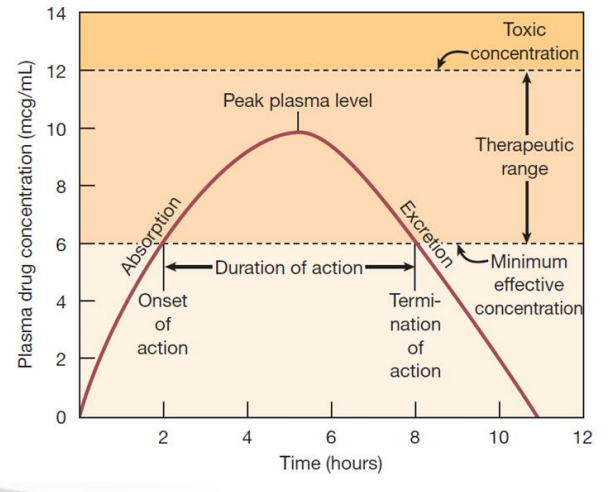
Minimum effective concentration (MEC)?
Lowest drug level that produces the wanted effect

Toxic concentration?
Level where serious harmful effects occur
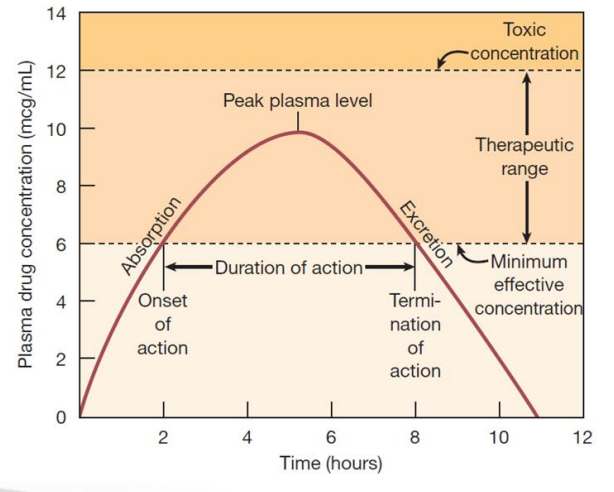
Therapeutic range?
Safe/effective level between MEC and toxic concentration

Below MEC means?
Too low -> drug may not work
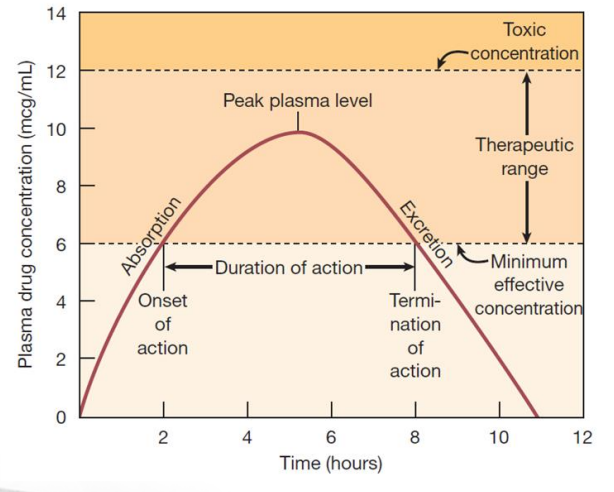
Trough level?
Lowest drug level; usually drawn right before next dose
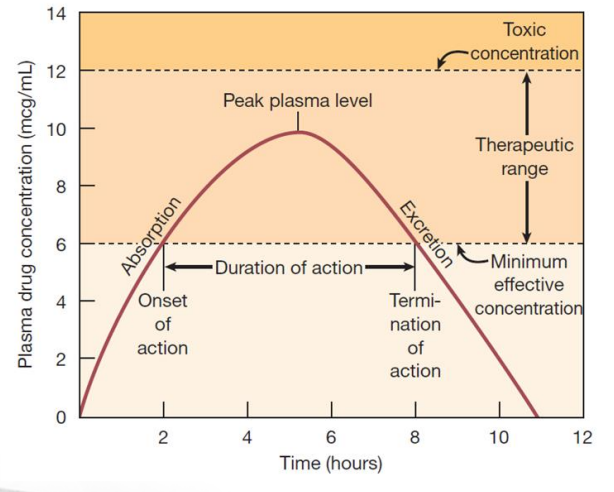
Peak level?
Highest drug level; drawn at a drug-specific time after a dose

Half-life?
Time needed for the drug level to drop by half.

Long half-life means?
Drug stays longer -> fewer doses -> more buildup risk.
Half-life pattern?
100% -> 50% -> 25% -> 12.5% -> 6.25%.
How much of a 100-mg drug remains after two half-lives?
100 mg → 50 mg → 25 mg.
100 mg after 1 half-life?
50 mg.
100 mg after 2 half-lives?
25 mg.
50 mg after 1 half-life?
25 mg.
50 mg after 2 half-lives?
12.5 mg.
Time to steady state?
About 5-7 half-lives (lecture).
Loading dose?
Larger first dose used to reach a therapeutic level quickly.
What medication history should the nurse collect?
Prescriptions + OTCs + vitamins/herbs + allergies.
Why check weight?
Many doses use mg/kg; wrong weight = wrong dose
What must the nurse evaluate after a drug?
Wanted effect + adverse effects + interactions + teaching
Important interaction types? -
Drug-drug, drug-food, drug-herb, and drug-lab
Medication rights from the slide?
Right patient, drug, storage, route, dose, preparation, time, documentation.
Order is unclear or incomplete—first action?
Hold the drug and clarify; never guess.
What must be on the order? ->
Patient's name (right patient)
Medication error occurs—FIRST action?
Assess and protect the patient
What comes after patient assessment in an error?
Notify -> treat/monitor -> document facts -> report per policy.
Why report errors and near misses?
Find system problems and prevent another error
Prescription ad gives an indication—what else must it include?
Contraindications, adverse effects, and precautions.
Are herbal products automatically safe?
No -> they can cause toxicity and drug interactions
Best supplement question to ask?
"What vitamins, herbs, teas, or remedies do you take?"
Medicare?
Federal public health program
Medicaid?
State/federal public health program
TRICARE?
Coverage for uniformed service members and eligible family members
Why is cost a medication-safety issue?
Patient may skip doses, split pills, or save medicine.
Can every tablet be split?
No; split only if approved. Never split extended-release or enteric-coated tablets.
Why not save leftover antibiotics?
Wrong/incomplete treatment -> infection may return + resistance increases.
Vitamin?
Organic nutrient needed for growth/health; usually obtained through diet.
Fat-soluble vitamins? -
A, D, E, K (A-DEK).
Water-soluble vitamins?
B vitamins + vitamin C.
Lecture question: Which is fat soluble—B12, D, B9, or B6?
Vitamin D.
Why can fat-soluble vitamins become toxic? -
Stored in fat/liver -> can build up
Mineral? -
Naturally occurring inorganic substance needed for health.
Examples of minerals?
Calcium, phosphorus, potassium, chromium, copper, fluoride.