Lecture 11 : GL An introduction to Time series forecasting
 Studied by 0 people
 Call Kai
 Learn
Learn Practice Test
 Spaced Repetition
 Match
Match Flashcards
 Knowt Play
1/43

There's no tags or description
Looks like no tags are added yet.
Name | Mastery | Learn | Test | Matching | Spaced |
|---|
No study sessions yet.
44 Terms
time series
= sequence of data points observed at successive, equally spaced points in time (fixed periodicicty : hourly, daily, monthly)
scalar on function regression
input : function / time series
output : numerical
is a type of statistical model used when you want to predict a single number (a scalar) using a predictor that is a curve or a shape (a function).
eg : time series of height prokected of a child, you map the data on an annual basis, and you want to predict the height at a certain age
time series classification
input : function/ time series
output : categorical
→ feature based : These methods transform the raw time series into a set of summary statistics or features. Once the time series is represented as a vector of numbers, any standard machine learning classifier (like Random Forest or XGBoost) can be used.
→ distance beased : These methods rely on a similarity measure (a distance function) to compare two raw time series. Instead of looking for specific properties like "slope" or "mean," they compare the actual shapes of the sequences.
categorical time series analysis
input : past values of same and or other time series
output : categorical element of time series
catgeorical in nature
binarizing continuous targets
time series components :
periodic patterns and autocorrelation
generalized linear models : multinomial/logistic regression
time series regression / forecasting
input : past values of same and or other time series
output : numerical lemeents of time series
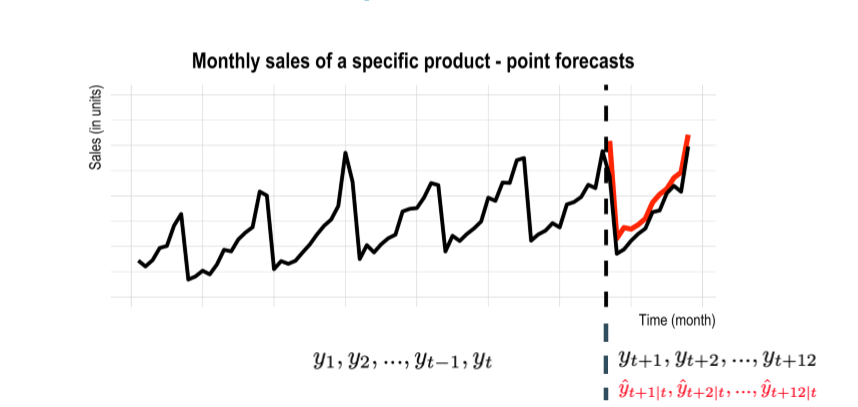
standard regression vs time series forecasting
standard regression Y = f(x) → time is not taken into account, it assumes that all observations are independent
TS forecasting : Predicts future values of a variable based on its own past values. It assumes observations are dependent on what happened before
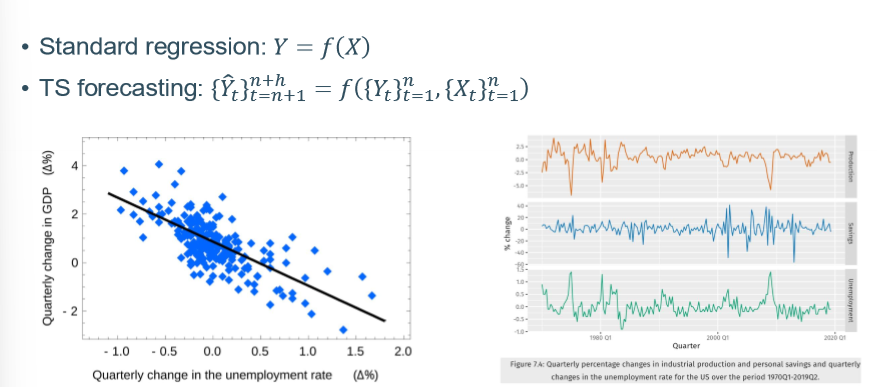
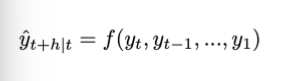
classical time series forecasting methods : univariate
= only used historical values of the time series itself to make forecasts
→ additive : yt = St + Tt + Rt
→ multiplicative : yt = St*Tt* Rt → equivalent to log(yt) = log(St) + log(Tt) + log (Rt)
(multiplicatibe : when variability is dependent on the level of the time series)
autocorrelation
measures the linear relationship between lagged values of a time series
ACF plots
autocorrelation function
TS forecasting : historical events : 1982 the first M(akridakis) competition
first true forecasting competition : multiple people could submet entries
1001 time series
TS forecasting : historical events : 1982 the first M(akridakis) competition : main findings
simple forecasting methods often produce more accurate forecasts than complex methods → shoft in focus from in-sample model fit to out-of sample forecasting performance (on unseen data)
cobining forecasts typically results in improved forecast accuracy : combine vs identify and fit single model that describes the data generating proces
univariate time series forecasting techniques : simple forecasting methods
mean method
naïve method : taking the last observed value as proxy
seasonal naïve method :

TS forecasting : historical events : 1998 the M3 competition
aim = updating frist M competition taking into account new methods
303 time series
focus of forecasting community → fine-tuning combination schemes and automated forecasting methods
TS forecasting : historical events : 1998 the M3 competition : main findings
opinions differ regarding evidence as to whether simple methods outperform complex ones
additional evidence of the benefit of combining multiple forecasts = ensembling
univariate time series forecasting technques : exponential smoothing
forecasts = weighted average of past observations, with the weights decaying exponentially as the observations get older
description of trend and seasonalily + how they enter the smoothing methode (in additive or multiplicative manner)
which exponential smoothing formulation to use
ad hoc → detailed inspection of time series
ETS :
→ state space model formation → statistical framework that underlies exponential smoothing methods
→ automatic model selection algorithm (based on minimizing AIC )→ ets()
ETS
state spare model formulation → statistical framework that underlies exponential smoothing methods
automatic model selection algorithm (based on minimizing AIC) → ets()
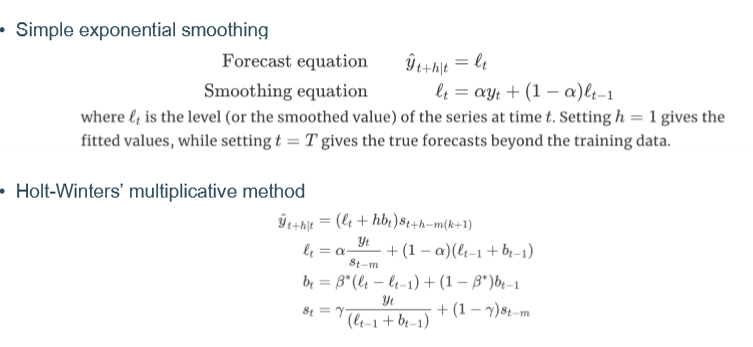
univariate time series forecasting technques : exponential smoothing : different exponential smoothing methods
simple exponential smoothing
holt winter’s multiplicative method
univariate time series forecasting technques :ARIMA
describes (seasonal) autocorrelations in the data
automatic model selection algorithm (based on minimizing AIC)
→ auto.arima()
which other univariate time series forecasting techniques exist ?
hierarchical time series forecasting
nnetar (neural entwork time series forecasts)
neural networks in M3 and NN3
only one NN submission in M3 → it did relatively poorly
NN3 ; Sven Crone organized a subsequent NN competition in 2006
111 of the monthly M3 series
over 60 algorithms were submitted, none outperformed original M3 contestants
consensus in forecasting community
NN and other data hungy ML methods are not well suited to univariate time series forecasting
evolutions in time series forecasting
combining simple forecasting methods
fine-tuning combination schemes and automated forecasting methods
big data era
demand sensing + machine learning (ML) methods
from local to gloal time series forecasting models
keeping up with the advances in ML → deep learning
from point to probabilistic forecasting
quantify forecast uncertainty
big data era = demand sensing (and other time series problems where external variables are available)
not only use prior demand data but alse use ‘a wide range of demand signals that reflect changing customer preferences as they unforl”
examples of demand sensing signals
promotional data
weather predictions

big data era : using external variablkes (xreg)
TSX (extend classical time forecasting, combining it with a xreg)
different flavors of auto.anima() or ets() + lm(residual-xreg)
useful if limited number of xreg, eg promotion dummy variablke
if xreg contains many variables (potentially due to unknown lag order)
→ need for variable selection eg hybrid stepwise aproach
→ we end up with p » n scenario rather quickly → limited hustorical data in proportion to potential leading indicators + unknown lag ordder
ML (bc you need to look further than the standard methods)
add TS fetaures to xreg (AR terms, trend, seasonal dummies)
big data example : problem discription and objective
tactical forecasting in supply chain management
supports planning for inventory, scheduling production, and raw material purchase,
forecasts up to 12 months ahead dor 4 different time series
large set of potentially relevant macro economic indicators
objective : improve tactical sales forecasting by using macro-economic leading indicators to replace judgemental (human) adjustments to incorporate macro-economic info
solution : LASSO to automatically select both the tupe of leading indicators, as well as the order of the lead dor each of the selected indicators + unconditional forecasting setup

M4 competition
forecast accuracy
forecast uncertainty → 95% PI
dataset was way larger (than M3)
from local to global time series forecasting models : local
= train one model for each time series
estimate model parameters independentely for each time series
limited availability of training data → only models with small number of free parameters can be estimated reliably
well known local methods : ETS and ARIMA
from local to global time series forecasting models : Global
= train one model jointly across time series
estimate model parameters jointly from all available time series
large training data set → DL model with mollions of parameters can be used
from local to global time series forecasting models : ML methods such as ANN and tree-based ensembles can be used both in global and local settings
local + ML : mixed results (univariate vs xreg)
global + ML : good results in M4 and M5 competitions
distinction local VS global is complementary to distinction between univariate vs multivariate
→ global metods do not imply a particular (in-)dependence structure between the time series vs explicitly modeled dependency structure between time series in multivariate methods
from point to probalistic forecasting : why quantify uncertainty
no need for forecasting in a world without uncertainty
forecast uncertainty frequently crucial to optimal decision making (eg safety stocks)
which are the sources of uncertainty in forecasting using time series models
random error term
parameter estimates
choice of model for the historical data
continuation of the historical data generating process into the future
which sources of uncertainty to model driven prediction intervals for time series such as ETS account for
only for random error term
M4 competition results
conclusion = hybrid is the way forewarde (vb pure ML)
local model-driven component - A model is only as good as its assumptions
model a limited set of patterns defined by the assumptions (eg trend or no trend)
parsimoniously parametrized and therefore nedd little data to be accurately fitted
global data-driven component - a model is only as good as the data it is fed
no strong structural assumptions
flexible (large number of parameters) at the cost of being data hungry
N-beats
doubly residual stacking -backcast, partial forecasts
sequential analysis of raw input time series
very deep network
when not to go global
strategic forecasting problem
high level aggregated
decision problems : long term capacity planning (investments), market entry
fit in domein knowledge
when to go global
decision problems : inventory management, capacity scheduling
enough data is available to learn complex patterns
too many time series and edge cases to design specific methods → ratio of forecasters/ time series « 1
why is deep learning architectures for time series forecasting an active field of research
flexibility
incorporating domein-specific ingedients such as forecast stability
customize loss functions
N-BEAT-S
direct probabilistic forecasting
parameters of probability distribution as outputs → loss = negative log-likelihood
N-N-BEATS
N-BEATS -S forecast updating and instability → cost and benefits
forecast updating
benefits : more accurate period-specific forecasts due to shorter forecast horizon
costs : induces instability which lead to revisions to supply plans
N-BEATS -S =
N-BEATS +
adding forecast instability component to loss functin to optimize forecasts from both
traditional forecast accuracy
forecast stability perspective
enter the M5 competition
= the first open data set that can be considered representative for real-world operational forecasting problems (meta-data, covariates, hierarchical structure, intermittency)
separate accuracy and uncertainty tracks
LightGBM and XGBoost in M5
hugely popular in M5
missing value treatment
speed
good default and trobust performance
easy to integrate covariates
M5 contestants did'n’t modify the core algorithms
characteristics of M5 winning method
22 Global LightGBM mmodel per store
equally weighted ensemble of recursive and non-recursive models
different models have dufferent yperparameters and input features
many decisions are based on expertise and feature selection procedures
→ heavy ensembling of tree-based learners
the future of time series forecasting
efficiency and stability of training and prediction
N-BEATS state of the art performance on M3 and M4 competition data sets
→ no time series specific eleents
→ ensembling (180 different N-BEATS networks)
model innovation vs brute force ensembling = adding more compute power
hybrid architectures
→ time series specific elements + global modeling approach
→ leveraging robustness and stability of local classical tie series methods
the future of time-series forecasting - pre-trained global deep learning models = transfer learning
train on source data set(s), deploy on new target data set(s) (after fine-tuning)
pre-trained models on heterogeneous datasets (eg pooled over multiple customers of software vendor)
use data-driven DL forecasting models even if only limited training data is available (few shot transfer learning)
future of time-series forecasting : zero short transfer learning
application of N-BEATS in zero shot learning setting
train on source data set
deploy on new target data set
no fine-tuning