Book 10A - Causes of inflation
 Call Kai
 Learn
Learn Practice Test
 Spaced Repetition
 Match
Match Flashcards
 Knowt Play
1/22

There's no tags or description
Looks like no tags are added yet.
Name | Mastery | Learn | Test | Matching | Spaced | Call with Kai | Chat |
|---|
No analytics yet
Send a link to your students to track their progress
23 Terms
Define inflation, GPL, inflation rate
Inflation (Def.): Inflation is a situation where there is a sustained increase in the general price level of an economy
NOTE: Inflation is NOT increase in prices of certain items only due to temporary increase in demand
GPL (Def.): average price of all G&S in the economy during a period of time
Inflation rate (Def.): Rate of change of GPL
State internal VS external value of money
GPL and the real value of money are inversely related
Internal value of money: domestic PP
External value of money: foreign exchange rate
Define and describe CPI
CPI (Def.): changes in the price of a fixed basket of G&S commonly purchased by the average household over time, with respect to a selected base year
Do NOT measure price changes of goods bought by firms, government, foreigners
Price of CPI basket in base year is 100
Define stagflation, deflation, disinflation
Stagflation (Def.): A situation of high unemployment and rapid inflation with negligible growth in national output or even contraction of the national output
Deflation (Def.): A sustained decrease in the general price level of an economy
Disinflation (Def.): A period where the inflation rate is still positive but declining over time
State and describe 4 degrees of inflation
1. Mild inflation
0% < IR < 3% per annum
Price increasing at modest rate -> price stability
Moderate inflation
IR 4-10% per annum
Prices increasing at moderate rate -> fairly stable prices
Galloping inflation
IR > 10% per annum
Prices increasing at high rate
PP of money is eroding -> people store wealth in physical assets
Hyperinflation
IR > 50% per month
Extremely large increases in prices
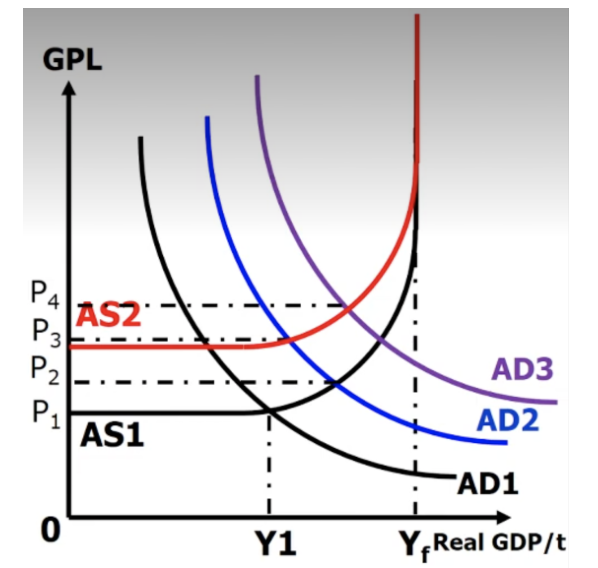
State demand pull inflation graphical anal (from firms increase production)
When firms increase output and operate closer to Yf, production becomes less efficient
Firms will be forced to use resources that are less and less suitable for their production
Increasingly larger amounts of labour and other inputs are required per additional unit of output produced -> UCOP increase
Firms will only produce extra output if it can be sold at higher prices
Rise in AD led to a rise in national output and GPL
When AD rises further and with the increased scarcity of resources, the GPL is further pulled upwards with limited increase in national output
Once Yf is reached, continued increases in AD will lead to increase in GPL only
Descirbe initial rate in AD wage push spiral
Due to the rising GPL and cost of living, trade unions (workers) bargain for higher wages to preserve workers' purchasing power
Higher wages leads to unit COP rising -> AS fall and GPL rise to P3
Furthermore, expectations of higher inflation in future, which would cause a fall in the internal value of money, would result in households increasing their consumption in the current time period -> AD rises from AD2 to AD3, pushing prices up from P3 to P4
This fuels further demand for increases in the wage and prices increase -> causing a wage-price spiral
Draw initial rate in AD wage push spiral GRAPH
What is demand-pull inflation caused by
Factors affecting rise in AD
Eval: SG context
Due to the prompt and effective government response to the Covid- 19 pandemic domestically, households and firms in Singapore have regained expectations of strong future economic performance by 2022
Country money supply
Money supply increase and excess money demand -> public will convert the excess money into physical assets by spending the excess money on G&S
Increase C and AD -> GPL increase as too much money chasing after too few G&S in the economy
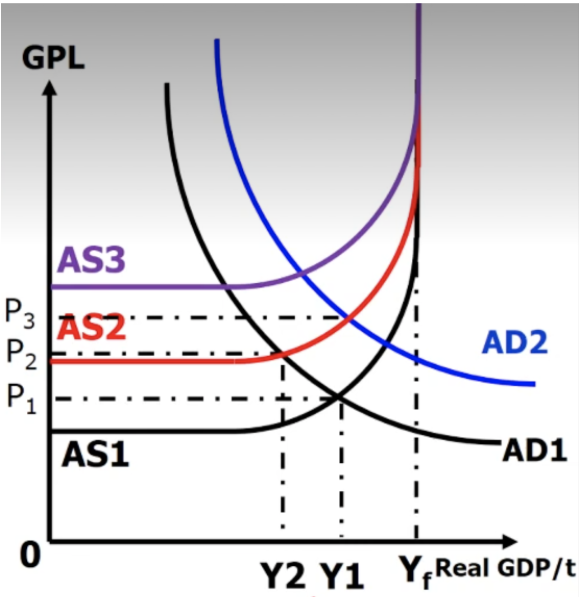
Describe sustained rise in GPL by cost-push inflation via govenrment policy
If fall in real GDP causes government to implement policies to boost AD, AD rises causing GPL to rise to P3
Due to the fall in real incomes which will decrease the purchasing power and standard of living of workers, trade unions might bargain for even higher wages without corresponding increases in labour productivity to preserve their PP -> UCOP rises even further -> exacerbating and causing a sustained rise in GPL to P4
Draw sustained rise in GPL by cost-push inflation via govenrment policy GRAPH
STATE what cost push inflation is caused by
Wage-push
Increase in price of imported inputs
Tax-push inflation
Ageing population
Explain how wage-push and increase in price of imported inputs causes cost push inflation
Wage-push
Aging population/government policies -> labour force declines
Trade unions push up wage rates independently of the demand for labour (labour strikes)
When wage rate rises faster than rise in labour productivity -> unit labour cost increase -> inflation
Increase in price of imported inputs
Caused by:
Cost of imported input increase (Imported inflation) caused by supply shocks
Depreciation of the foreign exchange rate
State SG eval ageing population
Tax-push inflation (indirect taxes)
Ageing population
Eval: SG context
By 2030, it would be almost 1 in 4 Singaporeans over 66
These citizens who are aged 65 and older are more likely to be retired from the labour force
Explain how advent of vaccines AND cause inflation
Advent of vaccines = tourism
People can travel -> increase in national income in economics of trading partners -> increase PP -> X increase
Driven by lower prices, rather than symptomatic of weakness in domestic economy = deflation NOT caused by fall in AD = no DD-side deflation
What is headline inflation
Headline inflation = GPL of everything increase
What is Debt amplified your indebtedness
Debt amplified your indebtedness = real value of debt increases -> real IR increase -> discourage borrowing by firms and consumers -> C and I falls -> AD falls -> multiplier effect -> -ove AG
Fall in I also causes PC to fall -> -ve PEG
Explain why SG GPL is expected to rise in 2021
Explain why SG GPL is expected to rise in 2021
1 cost-push + 1 demand-pull reason
SG: do NOT use C/I on its own (SG main driver is (X-M), only use to supplement)
Discuss whether deflation is always good for the economy
Discuss whether deflation is always good for the economy
R1: SOL increase
Cause of fall in GPL (oil price fall -> UCOP fall -> AS increase -> GPL fall) -> why SOL improve
R2: -ve EG
Explain why governments aim for low and stable inflation
Explain why governments aim for low and stable inflation
R1 + 2: why low and stable inflation good OR
R1 + 2: why high inflation BAD (lowkey easier)
NOTE: For I, pick either MB or MC change (not both) + no need nmSOL (assume nmSOL constant) (only give in CSQ if got evidence)
Extent of fall in SOL EVAL
Extent of fall in SOL
Depends on its duration and underlying cause
Japan: prolonged deflation would be considered malignant, as it likely led to entrenched expectations of falling prices -> hh delay C and firms to reduce I
This reinforced weakened AD, and led to a deflationary spiral -> negative income growth and increased the real debt burden -> worsening mSOL
SG: Deflation is ST and supply-driven -> hh and firms are less likely to defer their C and I -> limiting the negative impact on SOL
Extent of complementary policies EVAL
Complementary policies
SG: mild and anticipated inflation is accompanied by wage adjustments and government transfers, which can help hh maintain their real incomes -> smaller impact
Is DD or SS-side deflation more harmful OVERALL eval
DD-side deflation is typically more harmful as it reflects falling AD -> lower C and a potential deflationary spiral
SS-side deflation driven by productivity gains may support growth as output and incomes rise
In the case of inflation, inflation becomes more damaging when it is high and persistent -> erode real incomes significantly
Prolonged deflation can entrench expectations and weaken demand
Most damaging outcomes arise from DD-led and prolonged deflation