EXAM 1: Marketing of Agricultural Products
 Call Kai
 Learn
Learn Practice Test
 Spaced Repetition
 Match
Match Flashcards
 Knowt Play
1/77

There's no tags or description
Looks like no tags are added yet.
Name | Mastery | Learn | Test | Matching | Spaced | Call with Kai | Chat |
|---|
No analytics yet
Send a link to your students to track their progress
78 Terms
Macro view
a description of the total system for marketing food and fiber
Macro view focuses on the ____ and ____ questions.
who and what
Macro Marketing
the performance of all business activities involved in the forward flow of goods and services from producers to consumers
Marketing channels
the set of firms that move a commodity from the farm to the consumer
Flow of product and quality information
Input supplier, Production, Assembly, Processing, Wholesaling, Retailing, Consumption
Flow of payments and consumer preference information
Consumption, Retailing, Wholesaling, Processing, Assembly, Production, Input Supplier
Examples of value added
Chicken processed into chicken nuggets, eggs washed, sorted and placed into foam egg cartons, recipes provided on a soup can, services provided at the restaurant
What are the three approaches to the study of marketing agricultural products
Institutional Approach, Functional Approach, and Behavioral Approach
Institutional Approach
Emphasizes the key institutions and institutional players. The WHO of marketing. The middle men, assemblers, wholesalers, brokers, retailers, order buyers, information providers, etc.
Functional Approach
emphasizes the functions performed in marketing. This is a “what” approach, focusing on specialized activities within the marketing process.
Behavioral Approach
Emphasizes the interdependence and coordination of all participants and all the functions of the entire system. Combines institutional and functional approaches
Micro Marketing
the performance of business activities that direct the forwards flow of goods and services to consumers and accomplish the farmer’s or the firm’s objective
What does the micro view of marketing include?
packaging, storage, transportation, pricing, financing, and even product design
Marketing
Includes the identification of consumer demands and their translation into a set of decisions as to what to produce, how much to produce, what channels to use, and how to promote products
Merit of the micro definition of marketing
the emphasis on the active role required of the firm’s management
Micro procurement
the performance of business activities that direct the flow of agricultural commodities to a firm to satisfy its objectives
If one firm’s marketing program is another firm’s procurement program, why bother with the distinction?
The range of decision options open to a manger varies greatly with his or her freedom and ability to develop a procurement and marketing system
How to analyze managerial options
must distinguish between micro procurement and micro marketing options
Questions for marketing an appraisal
Is our agricultural marketing system unfair to farmers?
Does the marketing system operate efficiently?
Are consumers served properly?
Can sellers influence consumer demand?
In general, prices are determined by four forces. List and briefly explain the four forces.
The four forces that determine price are the opportunity cost of production, consumer value, negotiating power, and psychological and social considerations.
The opportunity cost of production
this means the price must cover the cost of production
Consumer value
This means the price must be set to match what consumers are willing to
pay
Negotiating power
If there are many competitors, consumers have more negotiating power,
and if there are few competitors, producers have more negotiating power.
Psychological and social considerations
The price must pass a social test
T/F: Most farmers and many agribusiness firms have no significant influence on market prices (they operate under a competitive model)
True
T/F: At any given moment, existing prices are determined by past and current decisions of all market participants.
True
T/F: The more perishable the commodity is, the more able sellers are to wait for a better price.
False
What is Market Clearing?
The process of the market price adjusting so that all buyers and sellers wishing to trade at that price can do so
T/F: A merit of the micro definition of marketing is the emphasis on the active role required of the firm’s management.
True
T/F: A merit of the macro definition of marketing is the emphasis on the active role required of the firm’s management.
False
What does an effective micro marketing strategy involve. Mention two points.
An effective micro marketing strategy mainly involves selling and buying but there are also other factors in between the two such as storage, packaging, transportation, and pricing. All of these steps go in to making sure the flow of goods is continuous.
Define micro view of marketing
Micro marketing is defined as the performance of business activities that direct the forward flow of goods and services to consumers and accomplish the farmer’s or the firms objective
T/F The Macro view of marketing is a description of the total system for marketing food and fiber.
True
What macro approach emphasizes the functions performed in marketing.
Functional Approach
What macro approach focuses on the interdependence and coordination of all participants and all the functions of the entire system.
Behavioral Systems Approach
What macro approach emphasizes the key institutions and institutional players
Institutional Approach
T/F The Institutional Approach of macro marketing is the “who” of marketing.
True
T/F The Functional Approach of macro marketing is the “who” of marketing.
False
T/F The Behavioral Approach of macro marketing is the “who” of marketing.
False
T/F The Institutional Approach of macro marketing is the “what” of marketing.
False
T/F The Functional Approach of macro marketing is the “what” of marketing.
True
T/F The Behavioral Approach of macro marketing is the “what” of marketing.
False
Macro view of marketing channels is the set of firms that move a commodity from the farm to the consumer.
False
Give an example of value addition in marketing
One example of value added to a product in marketing is when chicken is processed into chicken nuggets.
T/F Changes in quantity demanded represent a movement along the demand curve (own price change).
True
Changes in quantity demanded represent a shift in the demand curve (own price change)
False
List three (3) demand curve shifters.
Three demand curve shifters are income, price of substitutes, and consumer tastes and preferences.
List three (3) supply curve shifters.
Three supply curve shifters include price of related goods, price of inputs, and technology.
List three (3) characteristics of perfect competition
Three characteristics of perfect competition are many buyers and sellers, homogeneous products, and information on how to produce and use the goods is freely available.
Consumption originated from the retail grocery sector
Food at home
Consumption originates in the food service sector
Food away from home
The money spent on taking a farm product, processing it into a consumer product, and marketing
Marketing bill and Marketing margin
T/F Production is the creation of utility or value or hapiness
True
The activity of delivering food products at the time consumers desire them yields
Time utility
Selling the products so the consumer legally owns and can use it yields
Possession utility
The activity of delivering food to a convenient location for purchase yields
Place utility
The process of the market price adjusting so that all buyers and sellers wishing to trade at that price can do so
Market clearing
Pasta and pasta sauce are examples of
Complements
T/F: For an inferior good demand rises as income rises, and demand falls as income falls
False
T/F; Movement along the demand curve is a change in demand
False
T/F: A shift of the demand curve is a change in demand which are due to exogenous factors.
True
T/F: The vertical arm of the supply curve for perishable crops reflects the maximum total amount available for harvest
True
T/F: Storage is an alternative for perishable crops.
False
Supply
the quantity of a product or service that producers are willing and able to sell at different prices, holding other factors constant.
Supply curve
tells us how many more units will be produced as the price increases and how many fewer units will be produced as the price decreases.
Demand
the quantity of a good or service that consumers are willing and able to purchase at different prices, during a given period, holding other factors constant
Law of supply
more will be offered at higher prices than at lower prices, ceteris paribus. Supply curves slop upwards
Law of demand
Less will be desired at higher prices than at lower prices, ceteris paribus. Demand curves slope downwards, the downward sloping demand curve can be explained by the concept of diminishing marginal utility.
A perfectly competitive market
Prices arise from the interaction between buyers and sellers
Characteristics of perfect competition
many buyers and sellers, homogeneous products, one can become a buyer or seller with relative ease, information on how to produce and use the good is freely available
Market equilibrium is where
supply = demand
A price lower than the equilibrium price leads to excess ______.
demand
A price lower than the equilibrium price leads to excess ______.
Supply
Seasonal price pattern
a set of prices within a year that varies somewhat regularly as a result of the regular influence of the seasons on production, marketing and demand
Outlook information
data and projections about market demand, supply, and prices provided by private agencies
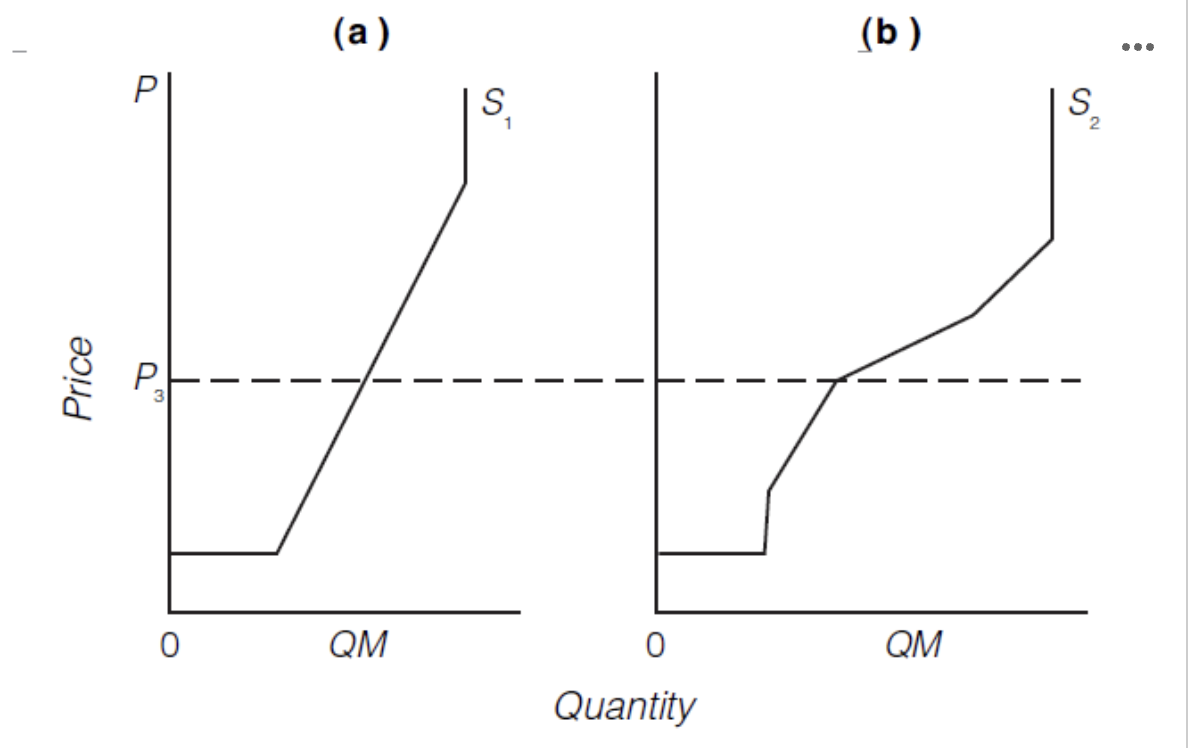
T/F: The supply curves in figure 1 are for a perishable crop
False
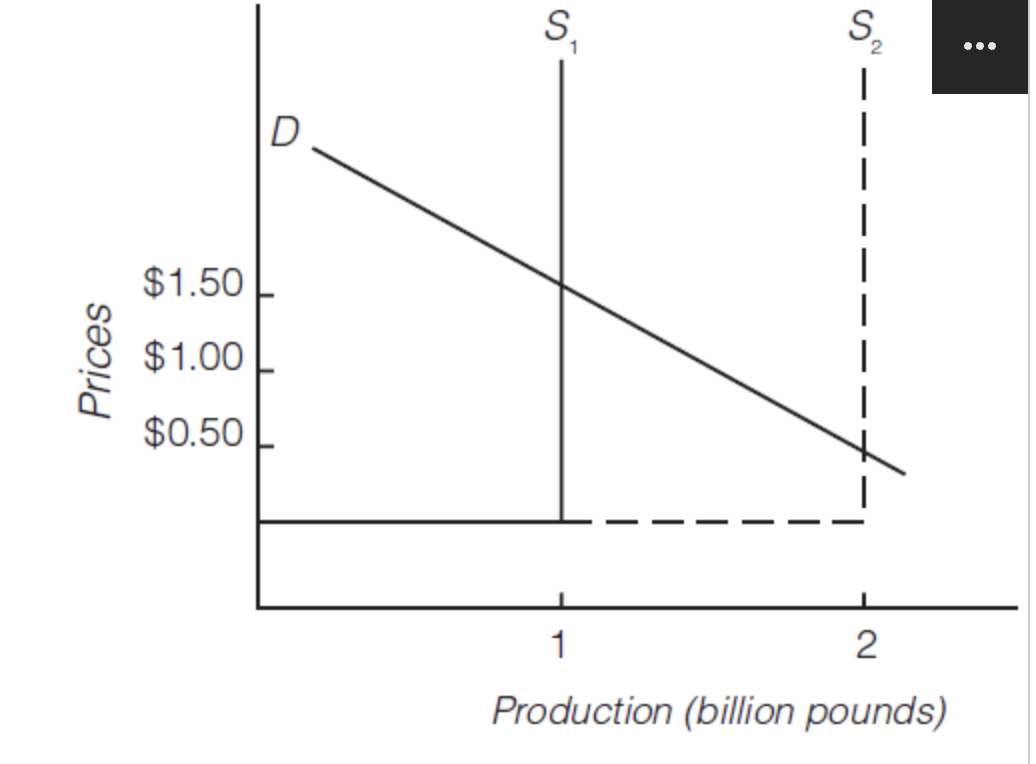
T/F: The supply curves in figure 2 are for nonperishable crops
False
What happens to the organic food market if consumer income rises, assuming it's a normal good?
There is an increase in demand