Psychology Ch. 14 Stress and Health
 Call Kai
 Learn
Learn Practice Test
 Spaced Repetition
 Match
Match Flashcards
 Knowt Play
1/50

There's no tags or description
Looks like no tags are added yet.
Name | Mastery | Learn | Test | Matching | Spaced | Call with Kai | Chat |
|---|
No analytics yet
Send a link to your students to track their progress
51 Terms
Stressors
Events, situations, or demands that are perceived as threatening or challenging and trigger a stress response.
E.g. Writing an exam, money problems, conflict with a friend, or moving to a new city can all be stressors.
Key idea: A stressor is the cause of stress.
Stress
A psychological and physiological response to stressor
E.g. A student feels anxious, tense, and physically alert before a major exam.
Key idea: Stress is the response to the stressor.
Life change units
A way of measuring stress by assigning numerical values to major life events based on how much adjustment they require. The higher your total
score, the more likely you are to have a stress-induced health breakdown
E.g. Events like divorce, moving, or starting university would each be assigned a certain number of life change units.
Key idea: More life change units = more stress load.
Holmes Rahe scale
A stress scale that measures the amount of stress in a person’s life by adding up life change units for major life events. There’s a scale for adults and teens.
E.g. If a person experienced moving, relationship problems, and academic pressure in the same year, their total score on the Holmes and Rahe scale would increase.
Key idea: It estimates stress by looking at major life changes.
College undergraduate stress scale
A stress scale designed specifically to measure stressors commonly experienced by university students.
E.g. It may include items such as failing a course, financial pressure, or relationship problems.
Key idea: Similar to Holmes and Rahe, but more specific to student life.
Chronic stressors
Stressful demands that continue over a long period of time rather than ending quickly.
E.g. Ongoing financial problems, chronic illness, or long-term family conflict.
Key idea: Chronic stressors are often more harmful than short-term stressors because they keep the body under stress for a long time.
Perceived control
A person’s belief about how much control they have over a stressful situation.
E.g. Two students have the same exam, but the one who feels prepared and in control may experience less stress than the one who feels helpless.
Two groups one group has a way to leave the room with tormenting sounds, the other group has no option to leave. In a year the two groups are now put into rooms where their able to leave. The group that didn’t get the option to leave before don’t bother leaving.
Key idea: More perceived control → usually less stress.
Fight or flight response (sympathetic nervous system)
The body’s immediate physiological reaction to a threat, preparing a person to either confront the danger or escape from it. Not good if the system is activated long.
E.g. If you almost get hit by a car, your heart races, breathing speeds up, and your body becomes more alert.
Key idea: This is the fast, short-term stress response.
HPA Axis (hypothalamus, pituitary gland, adrenal glands)
A major hormonal stress-response system in which the hypothalamus signals the pituitary gland, which then signals the adrenal glands to release stress hormones.
E.g. If a student is under prolonged academic stress, the HPA axis helps keep the body in a heightened state of readiness.
Key idea: This system is especially important for longer-lasting stress responses.
Cortisol
A stress hormone released by the adrenal glands as part of the HPA axis, helping the body respond to stress by increasing energy availability.
E.g. During exam season, prolonged stress may keep cortisol levels elevated.
Key idea: Cortisol is useful in short-term stress, but chronically high cortisol can be harmful.
Epinephrine/adrenaline
A hormone released during the fight-or-flight response that prepares the body for immediate action by increasing heart rate, blood pressure, and energy availability. Released from adrenal glands.
E.g. If a student suddenly realizes they forgot about an exam, their heart may start racing and their body becomes more alert because of adrenaline.
Key idea:
Adrenaline is part of the fast, immediate stress response.
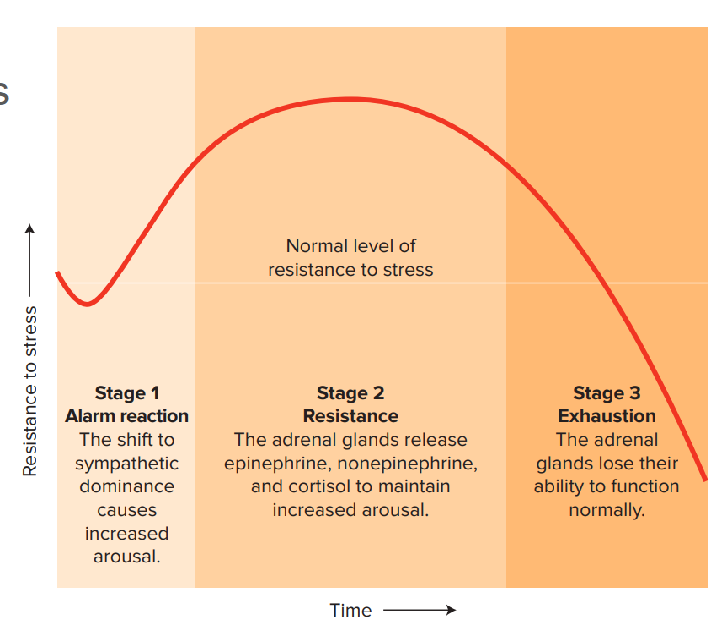
General adaptation syndrome (alarm reaction, resistance, exhaustion)
Hans Selye’s theory describing the body’s response to prolonged stress in three stages: alarm reaction, resistance, and exhaustion. Memorize the steps
1) Alarm reaction
The first stage of stress, when the body detects a stressor and activates the fight-or-flight response.
E.g. Right before a big exam, your heart races and your body becomes highly alert.
2) Resistance
The stage where the body continues trying to cope with the stressor after the initial shock has passed.
E.g. During a month of exams and assignments, your body stays activated and continues using energy to manage the stress.
3) Exhaustion
The stage where the body’s resources become depleted after prolonged stress, increasing the risk of illness and burnout.
E.g. After months of chronic stress, a student may become emotionally drained, physically exhausted, and more likely to get sick.
E.g. A student going through a very stressful semester may first feel a strong stress response, then try to cope for weeks, and eventually feel burned out and physically exhausted.
Telomeres
Protective caps at the ends of chromosomes that shorten as cells divide and as the body ages.
E.g. Chronic stress is associated with faster telomere shortening, which may contribute to aging and disease.
Key idea:
Shorter telomeres = more cellular aging.
Telomerase
An enzyme that helps rebuild or maintain telomeres, potentially slowing cellular aging.
E.g. Higher telomerase activity may help protect cells from some of the damage associated with chronic stress.
Stress and aging
Telomeres are caps at the ends of chromosomes (DNA). Telomerase rebuilds
them. But as you age, the telomeres start to wear down faster than
telomerase can rebuild them. Stress speeds this process up.
Immune system
Prolonged stress increases cortisol, epinephrine (adrenaline), but decreases
your immune system functioning (e.g. less lymphocytes/white blood cells).
Lymphocytes/white blood cells
The immune system competes with stress because cortisol production competes with white blood cell production. So with mores tress means more cortisol being produced and less white blood cells.
Cells of the immune system that help fight infections and other harmful invaders in the body.
Effect of social status on stress and health
Poverty is associated with daily stress, but also with status anxiety. So people with that will experience the effects of faster aging and weaker immune system. Lower status often means more chronic stress + less control, which harms health.
Type A personality
competitive, driven, hardworking, irritable. They get stuff done, but
they’re at greater risk of cardiovascular disease
E.g. A student who is extremely competitive, constantly rushed, and becomes angry when things don’t go perfectly may show Type A traits.
Key idea:
Type A is linked to higher stress, especially when hostility is involved.
Type B personality
relaxed, easy-going, laid-back. They can be lazy, but they’re at lower
risk of cardiovascular disease.
E.g. A student who works hard but stays calm, flexible, and not overly pressured by deadlines may show Type B traits.
Key idea:
Type B is generally associated with lower stress reactivity than Type A.
Primary appraisal
your cognitive evaluation of the situation (is it good or bad,
etc)
E.g. A student hears there is a surprise quiz and immediately thinks, “This is bad — I’m not ready.”
Key idea:
Primary appraisal = “Is this situation a threat, challenge, or not important?”
Secondary appraisal
do I have the ability to deal with this situation.
E.g. After hearing about the surprise quiz, the student thinks, “I studied a bit and I can probably handle this.”
Key idea:
Secondary appraisal = “Can I cope with this?”
Burnout
A state of physical, emotional, and mental exhaustion caused by prolonged stress, often involving feelings of hopelessness, detachment, and reduced performance.
Physical and mentally state of exhaustion. Unable to cope with things in your life.
E.g. After months of nonstop school pressure, a student feels drained, unmotivated, and unable to keep up with assignments.
Key idea:
Burnout is often the result of chronic, ongoing stress, especially when a person feels overwhelmed and unable to recover.
Repressive coping
A coping style in which people avoid, deny, or push away negative thoughts and emotions instead of directly dealing with them.
E.g. A student who is clearly overwhelmed insists they are “totally fine” and refuses to think about their stress.
Key idea:
The person may appear calm, but they may still be physiologically stressed underneath.
Rational coping (acceptance, exposure, understanding)
Acceptance
Exposure: Getting used to it.
Understanding: Finding a meaning. Reframing the stressor
Ex. Feeling of a good workout and you wake up with sore muscles. Even if its painful you think its a good workout. But if you randomly get the same sensation and you haven’t worked out then you would think going to the hospital.
Key idea:
Rational coping means working through the stressor instead of denying it.
Reframing
A coping strategy where a person changes the way they think about a stressful situation in order to make it feel less threatening or more manageable.
E.g. Instead of thinking “This exam will destroy my grade,” a student thinks, “This exam is important, but it’s also a chance to show what I know.”
Key idea:
Same situation, different interpretation.
Meditation
A mental practice that involves focusing attention on breathing and increasing awareness in a calm, controlled way to reduce stress and improve emotional regulation.
E.g. A student spends 10 minutes focusing on their breathing before studying to reduce anxiety.
Key idea:
Meditation helps lower stress by calming the mind and body.
Relaxation therapy
A set of techniques designed to reduce physical tension and stress, such as deep breathing, progressive muscle relaxation, or guided relaxation.
E.g. A person tenses and relaxes different muscle groups before bed to reduce stress and help them sleep.
Key idea:
Relaxation therapy targets the physical symptoms of stress.
Biofeedback
A technique in which people are given information about their physiological responses (such as heart rate or muscle tension) so they can learn to control them.
E.g. A person sees their heart rate on a screen and practices breathing techniques to lower it. Eventually won’t need to see their heart rate and can perform on their own.
Key idea:
Biofeedback teaches people to gain control over bodily stress responses.
Aerobic exercise
Physical activity that increases heart rate and breathing over a sustained period and can help reduce stress and improve mood. Good for depression and mental health.
E.g. Running, brisk walking, cycling, or swimming can help a student feel calmer during exam season.
Key idea:
Exercise reduces stress and can improve both physical and mental health.
Social support
The emotional, practical, or informational help people receive from others, which can reduce stress and improve health.
E.g. A student feels overwhelmed during exams, but support from family and friends helps them cope better.
Key idea:
Social support can buffer stress and make difficult situations feel more manageable.
Religiosity and health
The relationship between religious involvement and health outcomes, where being religious is often associated with lower stress and sometimes better physical and mental health.
Religious people live longer and happier. The effect of going to church every week is the same as not smoking.
E.g. Someone who regularly attends religious services may have a supportive community, coping resources, and a sense of meaning that helps them deal with stress.
Key idea:
Religiosity may help through social support, meaning, routine, and coping.
Intercessory prayer
Prayer offered by one person on behalf of another person, often for that person’s health or recovery.
E.g. Family members pray for a hospitalized relative to recover from illness.
Key idea:
This concept is usually studied to ask whether being prayed for has measurable effects on health.
Humour
being able to laugh at negative events to cope with stress and improve well-being.
Humour can reduce stress by changing emotional reactions and helping people cope.
Sickness response
A coordinated set of physical and behavioural changes that occur during illness, such as fatigue, reduced appetite, social withdrawal, and low energy.
E.g. When someone has the flu, they may feel exhausted, want to stay in bed, lose their appetite, and avoid social interaction.
Key idea:
The sickness response helps the body conserve energy and recover.
Pain
An unpleasant sensory and emotional experience associated with actual or potential tissue damage.
E.g. A person who sprains their ankle experiences both the physical sensation of pain and the emotional distress that comes with it.
Key idea:
Pain has both a physical/sensory part and an emotional part.
Primary somato-sensory area
A brain region involved in processing the physical/sensory aspects of pain, such as where the pain is located and how intense it is.
E.g. If you burn your hand, this area helps your brain recognize where the pain is and what it feels like physically.
Key idea:
Primary somatosensory area = the sensory side of pain.
Anterior cingulate cortex
A brain region involved in the emotional and unpleasant aspect of pain, such as how distressing or upsetting it feels.
E.g. Two people may have the same injury, but one finds it much more emotionally distressing because of how the pain is processed emotionally.
Key idea:
Anterior cingulate cortex = the suffering/distress side of pain.
Optimism
A general tendency to expect positive outcomes and believe that things will work out well.
E.g. A student facing a difficult exam thinks, “This is hard, but I can still do well if I prepare.”
Key idea:
Optimism is linked to better coping, lower stress, and sometimes better health.
Hardiness (commitment, control, challenge)
A personality style associated with resilience to stress, consisting of commitment, control, and challenge.
E.g. A student under pressure stays involved in their responsibilities, believes they can influence the outcome, and sees difficulties as challenges rather than disasters.
Commitment: Dedication to their tasks.
E.g. Continuing to attend class and study even during a stressful semester.
Control: They feel like their actions make a difference
E.g. Thinking, “If I manage my time well, I can improve my exam performance.”
Challenge: They view stressors as challenges/opportunities, they do not view them negatively.
E.g. Viewing a difficult class as a chance to improve rather than proof that you’re failing.
Problem-focussed coping
trying to get rid of the problem or solve the problem.
E.g. A student stressed about an exam makes a study schedule, asks the professor questions, and starts reviewing earlier.
Key idea:
Problem-focused coping = fix the problem itself.
Emotion-focussed coping
trying to reduce the negative emotions caused by the problem.
E.g. A student overwhelmed by exams meditates, talks to a friend, or goes for a walk to calm down.
Key idea:
Emotion-focused coping = manage the feelings caused by the problem.
Gender and coping
Men are more likely to use problem-focused coping, women are more likely to
used social support, and emotion-focused coping.
Important:
These are average tendencies, not fixed rules that apply to everyone.
People from individualistic cultures use more problem-focussed coping,
collectivistic cultures (at least Asian and Hispanic ones) use more of the other
two forms of coping.
Self-regulation
The ability to control one’s thoughts, emotions, and behaviours in order to achieve long-term goals.
E.g. A student wants to stay healthy, so they resist junk food, go to bed on time, and keep up with exercise even when they don’t feel like it.
Key idea:
Self-regulation helps people choose long-term health over short-term temptation.
Eating wisely
Making healthy food choices that support long-term physical health.
E.g. Choosing balanced meals, limiting excessive junk food, and paying attention to nutrition.
Key idea:
Good eating habits are a form of health-promoting behaviour.
Avoiding sexual risks
Engaging in behaviours that reduce the risk of sexually transmitted infections or unintended pregnancy.
E.g. Using protection, communicating with partners, and making informed decisions about sexual activity.
Key idea:
This is a form of preventive health behaviour.
Illusion of unique invulnerability
The mistaken belief that bad outcomes are less likely to happen to oneself than to other people.
E.g. A person thinks, “Other people might get an STI from risky sex, but it won’t happen to me.”
Key idea:
This belief can lead people to take unhealthy risks.
Not smoking
Avoiding or quitting cigarette use in order to reduce health risks such as cancer, heart disease, and respiratory illness.
E.g. A person chooses not to smoke because they know it harms long-term health.
Key idea:
Not smoking is one of the most important protective health behaviours.
Hedonic well-being
Well-being based on pleasure, happiness, and the experience of positive emotions with minimal negative emotions. Based on total amount of pleasure and minimal negative.
E.g. Feeling happy, relaxed, and satisfied with life.
Key idea:
Hedonic well-being = feeling good.
Eudaimonic well-being
Well-being based on meaning, purpose, personal growth, and living in a way that reflects one’s values.
E.g. A person may feel stressed while working toward an important goal, but still feel their life is meaningful and fulfilling.
Key idea:
Eudaimonic well-being = living well / living meaningfully.
12 findings from positive psychology
Positive psychology focusses on happiness and flourishing. Instead of studying the ways we go wrong, they study the ways we go right.
1. Having quality close relationships is a reliable predictor of happiness.
2. Physical exercise is a reliable predictor of happiness.
3. Getting enough sleep is a reliable predictor of happiness.
4. Money predicts happiness, but only up to a certain point. Results vary, but the
standard number given is 75,000 dollars. After that point, money has very
little effect on happiness (especially hedonic happiness).
5. A short commute is a better predictor of happiness than a big house.
6. Paying for experiences (e.g. something with friends) is better for happiness
than paying for new things.
7. Religious individuals are on average happier than non-religious individuals,
but religious societies are on average less happy than non-religious societies.
8. Having children increases eudaimonic happiness, but decreases hedonic
happiness. You are more satisfied overall with your life, but moment to
moment you think “this kid is driving me crazy”.
9. Pursuing goals is more enjoyable than achieving them.
10.Happiness has a genetic component (like almost everything in psychology).
11.Happiness is on a curve when it comes to age. It peaks in your 20s, goes
down in middle age, and goes back up in old age.
12.We tend to adjust to major life events, whether good (e.g. big promotion at
work) or bad (e.g. getting paralyzed). These events tend to leave no
permanent stamp on your happiness.