Ancient Rome: Early Foundations, Legends, Laws, and the Punic Wars
 Call Kai
 Learn
Learn Practice Test
 Spaced Repetition
 Match
Match Flashcards
 Knowt Play
 Podcast
1/28

Earn XP
Description and Tags
Vocabulary flashcards covering early Italian peoples, the founding legend of Rome, the Punic Wars between Rome and Carthage, and the representative selection of the Roman Twelve Tables.
Name | Mastery | Learn | Test | Matching | Spaced | Call with Kai | Chat |
|---|
No analytics yet
Send a link to your students to track their progress
29 Terms

Latins
One of the oldest groups in central Italy (settling from about 1000 BC) who lived in small farming villages and spoke Latin.

Etruscans
A rich and technically advanced civilization north of the Latins (from around 900 BC) known as skilled engineers and metalworkers who introduced the arch into Italian building and dominated Latium by around 800 BC.

Greeks (in Early Italy)
Settlers who established colonies along the coast of southern Italy and Sicily from around 800 BC, introducing art, architecture, alphabet-based writing, and ideas about government.


Systems of Roman Government
The three distinct chronological systems of government used by Rome: Kingdom, Republic, and Empire (which began from 27 BC onward).
Rhea Silvia
A princess of Alba Longa and daughter of rightful ruler King Numitor who was forced by her uncle Amulius to become a Vestal Virgin before giving birth to twin sons Romulus and Remus.
King Numitor
The rightful ruler of Alba Longa and father of Rhea Silvia, whose throne was seized by force by his brother Amulius.
Amulius
The uncle of Rhea Silvia who seized the throne of Alba Longa, forced Rhea Silvia into priestesshood, and ordered her twin babies Romulus and Remus to be drowned in the Tiber River.
Vestal Virgin
A priestess forbidden to marry or have children.
Mars
The Roman god of war who, according to legend, fell in love with Rhea Silvia and fathered Romulus and Remus.
Romulus and Remus
The twin sons of Rhea Silvia and Mars who were ordered to be drowned in the Tiber River by King Amulius but survived and were nursed by a she-wolf.
Capitoline Wolf
A sculpture illustrating the traditional legend of Romulus and Remus being nursed by a she-wolf after being ordered drowned in the Tiber River.
Carthage
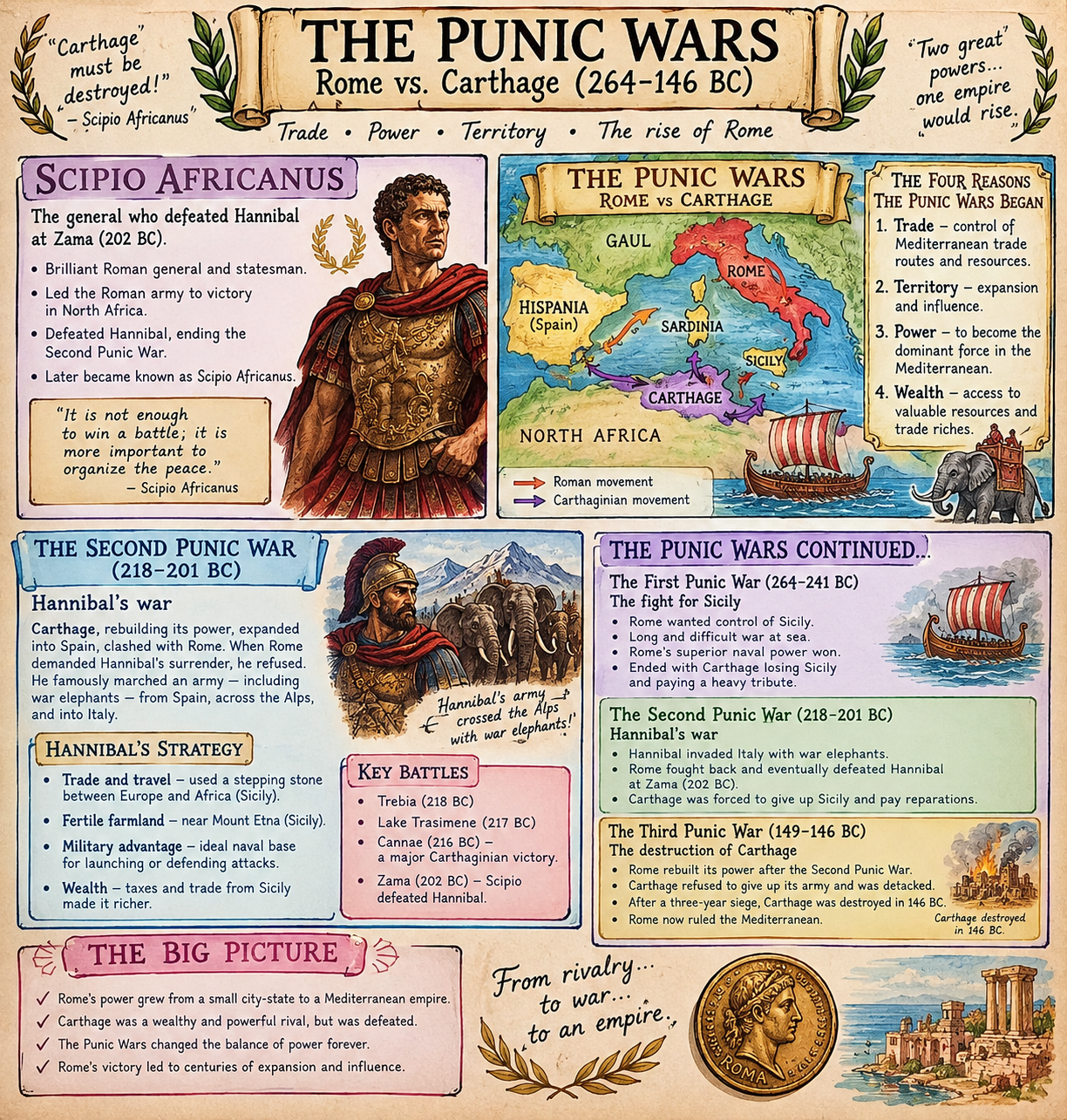
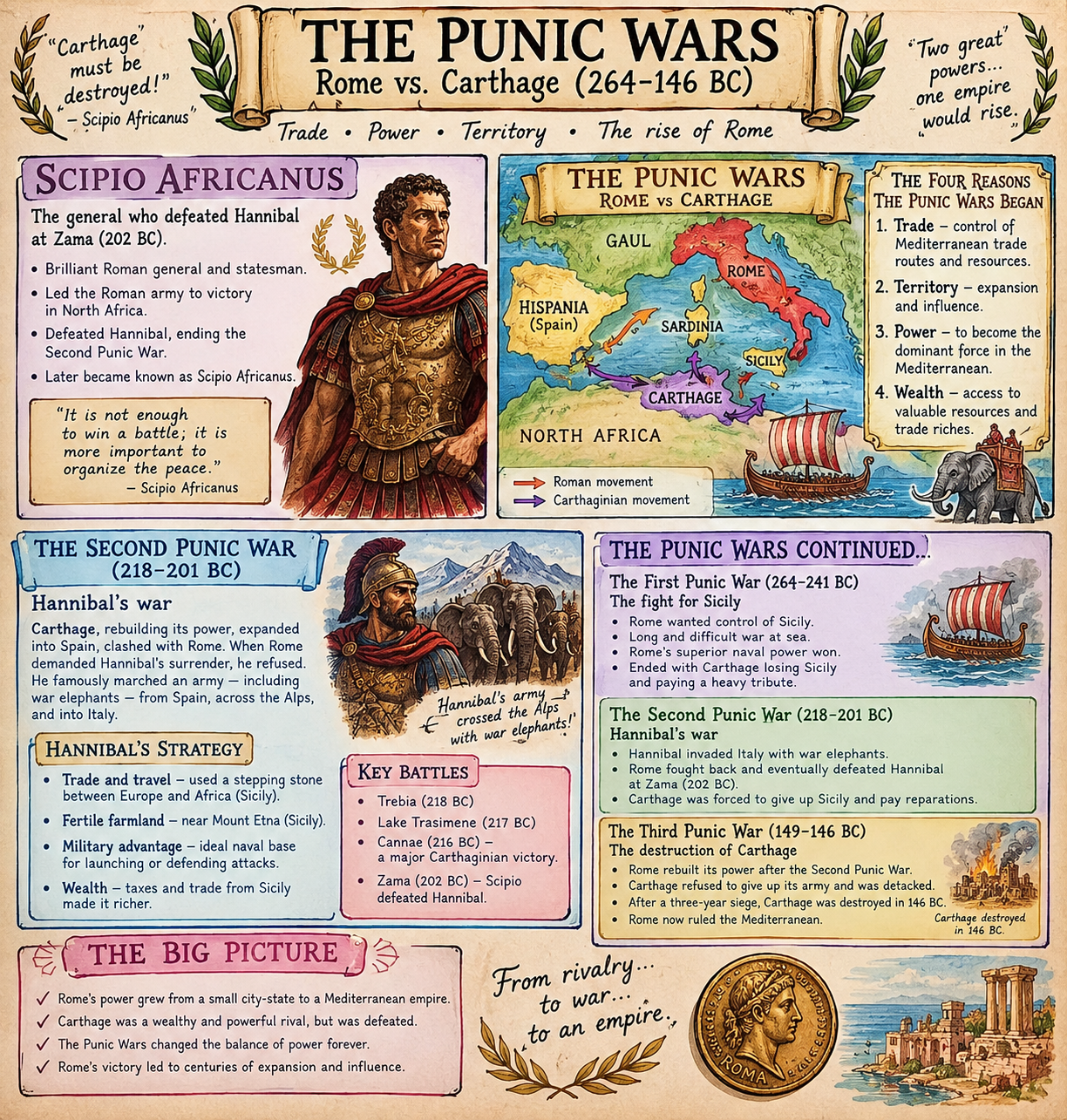
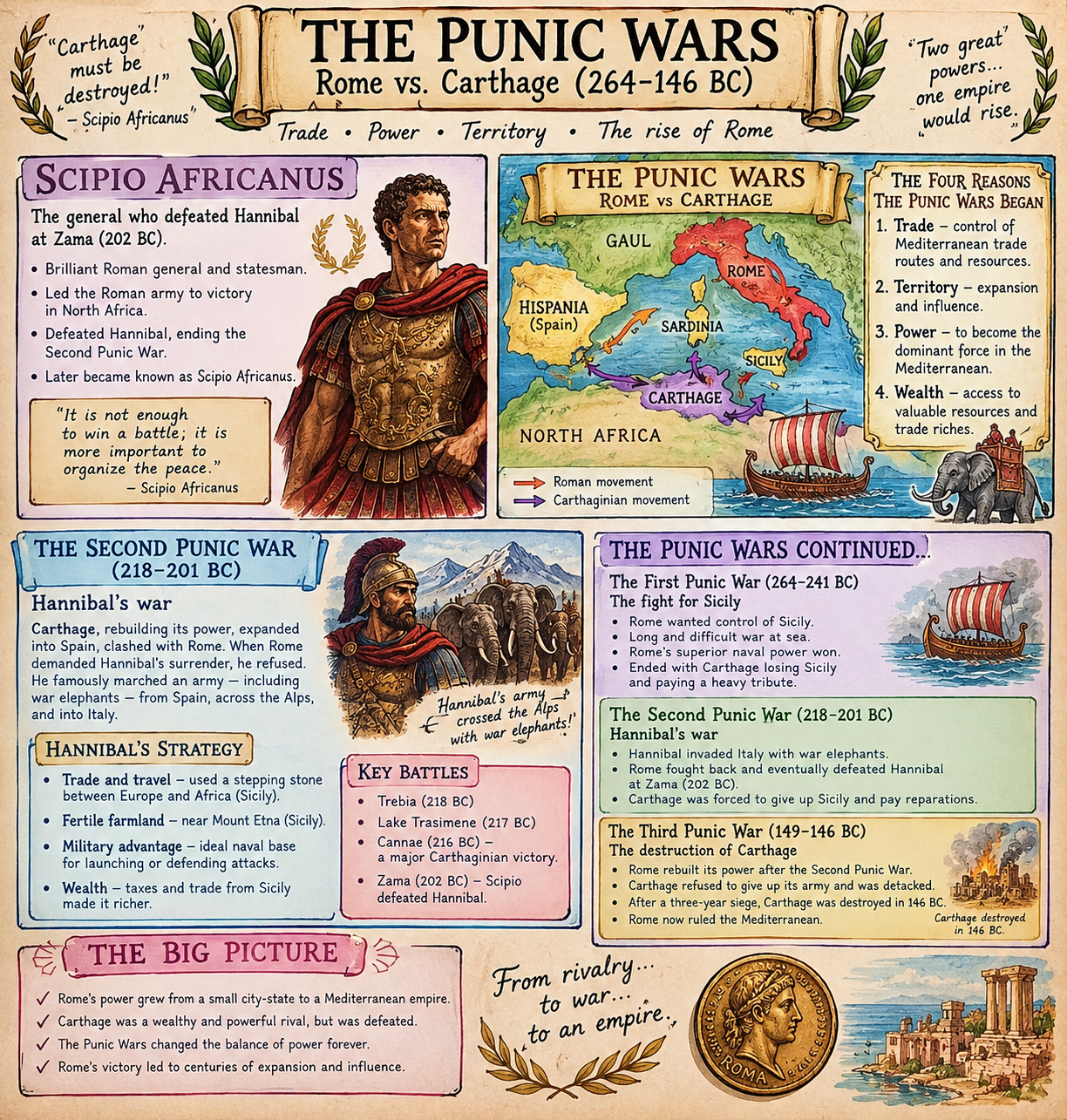
A wealthy trading city in North Africa (located in modern Tunisia) that fought against Rome for control of the western Mediterranean.
The Punic Wars
A series of three major wars fought between Rome and Carthage between 264 BC and 146 BC for control of the western Mediterranean.
First Punic War
The conflict fought from 264 to 241 BC between Rome and Carthage centered on gaining control of the island of Sicily.
Sicily (Punic Wars Significance)
A Mediterranean island contested for its trade route control, fertile farmland with volcanic soil near Mount Etna, ideal naval base positioning, and city tax wealth.
The Twelve Tables (c. 449 BCE)
A representative collection of early written Roman laws governing court procedures, family authority, property rights, public law, and punishments.
Judgment on Debt (Table III)
Section of Roman law granting 30 days for payment of confessed debt; creditors could chain debtors (chains no lighter than 15 pounds) for unpaid debts, leading to execution or sale into slavery across the Tiber after 60 days.
Patriarchal Powers (Table IV)
Section of Roman law granting fathers complete authority over children's lives, mandating the killing of deformed infants, freeing a son if sold into slavery 3 times by his father, and allowing husbands to divorce wives.
Inheritance & Guardianship (Table V)
Section of Roman law placing women (except Vestal Virgins) under permanent male guardianship due to 'frivolity of character' and passing estates without direct male heirs to the nearest male relative.
Ownership & Possession (Table VI)
Section of Roman law establishing that verbal promises are binding, 1 year of continuous cohabitation constitutes marriage, and 2 years of open land use grants ownership.
Laws of Injury (Table VIII)
Section of Roman law prohibiting nighttime city gatherings and specifying execution for harmful incantations, reciprocal injury for physical harm, and execution by falling from the Tarpeian Rock for false testimony.
Tarpeian Rock
A location from which individuals convicted of giving false testimony were thrown to their death under Table VIII of the Twelve Tables.
Public Law (Table IX)
Section of Roman law mandating that laws cannot be made secretly, personal privileges are forbidden, judges accepting bribes face execution, and no execution occurs without proven guilt.
Funeral Rites (Table X)
Section of Roman law banning burial or burning of bodies inside the city, limiting displays of wealth and excessive drinking, and forbidding corpses to be adorned with gold (excluding existing gold dental work).
Supplement: Marriage (Table XI)
Section of Roman law prohibiting intermarriage between plebeians and patricians and requiring soldiers to delay marriage until completing training.
Lex Talionis
A legal principle recognized in Table XII of the Roman Twelve Tables defined as reciprocal injury.
Wich hill?
Romulus wanted Palatine Hill and Remus wanted Aventine Hill. To settle it they looked for birds as a sign from the gods - called augury- Remus saw 6 and Romulus saw 12. Romulus killed his brother. Ruled Rome as 1st king.
Badges
They are proud of the she-wolf it is on all the badges for the last 90 or so years