Module 1 Revision
 Call Kai
 Learn
Learn Practice Test
 Spaced Repetition
 Match
Match Flashcards
 Knowt Play
1/45

There's no tags or description
Looks like no tags are added yet.
Name | Mastery | Learn | Test | Matching | Spaced | Call with Kai | Chat |
|---|
No analytics yet
Send a link to your students to track their progress
46 Terms

Primary motor cortex
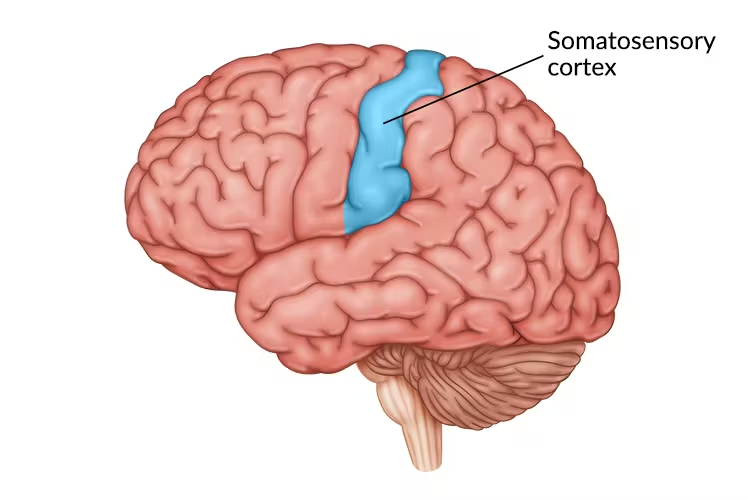
Somatosensory cortex
If ability to plan, personality and judgement affected, which lobe?
Frontal
Which lobe is associated to visual recognition?
Occipital
Which lobe is associated to speech?
Temporal
What structure inhibits unwanted excessive movements?
Basal ganglia
Which brain structure contributes significantly to directing attention
toward important sensory input?
Thalamus
Which structure is affected if a patient has bad gait or balance?
Cerebellum
Which structure plays the greatest role in refining movements through repetitive practice?
Cerebellum - repetitive practice question
A patient sustains a severe injury to the brainstem. Which function is most immediately life-threatening if disrupted?
Breathing regulation
What are primary (annulospiral) endings?
Afferent and detect change in muscle length and speed of muscle stretch
What are secondary (flower spray) endings?
Afferent and only detect change in muscle length
What are gamma motor neurons?
Efferent, and they affect muscle intrafusal fibres
What are alpha motor neurons?
Efferent and they affect the contractile behaviour of the extrafusal fibres
Monosynaptic v Polysynaptic v Acquired
Mono - 1 synapse in reflex arc between afferent and efferent neurons.
Poly - A sequence of synapses between afferent and efferent
Acquired - Result of learning and practice (cerebral cortex involved)

What is the sequence in the stretch reflex?
Stimulus - muscle stretched
Muscle spindles detect (primary detect length + rate of stretch, secondary detect mainly length)
Sensory afferent neuron carried to spinal cord ventral horn and synapses
Motor efferent neuron from ventral horn sent to muscle via alpha and gamma motor neurons
Contraction occurs at effector muscle
Type of disorder PD v HD?
PD - neurodegenerative movement disorder
HD - neurodegenerative genetic disorder
Cause - PD v HD
PD - damage to substantia nigra, resutling in dopamine deficiency
HD - Misfolding of huntingtin protein/gene abnormality affecting striatum
Movement characterisation PD v HD
PD - Hypokinetic
HD - Hyperkinetic
Key characteris HD v PD
PD - slow and stiff, TRAP (tremour, rigidity, akinesia/bradykinesia, postural problems)
HD - rapid chorea (jerky movements), impaired coordination, gait problems
Diagnosis PD v HD
PD - clinical assessment, response to dopaminergic therapy
HD - Genetic testing for HTT CAG repeat expansion
Treatment for PD
Levodopa/Carbidopa - dopamine agonists
MAO-B/ COM-T inhibitors
Deep brain stimulation
Treatment for HD?
Symptomatic treatment only
Tetrabenzine for chorea
Psychiatric medication
OT/ Speech therapy
The mechanism of action of tetrabenazine is best described as:
Inhibition of vesicular monoamine transporter (VMAT2)
What is the primary cause of MS?
Autoimmune disease causing demyelination
MS main site and age of onset?
Brain, spinal cord, nervous system, 20-40 years
MS main symptoms
Fatigue, muscle weakness, sensory disturbances, visual problems, balance impairment, spasticity
Disease progression of MS
Usually relapsing remitting initially, may progress over time
MS treatment approaches
Disease-modifying therapies: interferon-beta, glatiramer-beta
Corticosteroids for relapse symptoms
Symptom management
What is clinically isolated syndrome (CIS)?
First episode of MS symptoms, treatment would be disease-modifying therapy (interferon-beta)
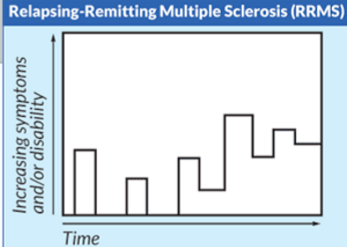
What is relapsing-remitting MS? (RRMS)
85% of patients have this, having ‘attacks’ or relapse, with periods of partial or complete recovery
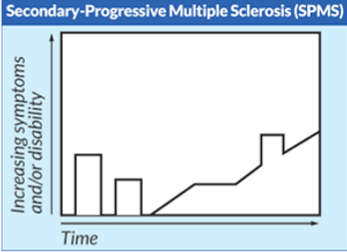
What is secondary progressive MS (SPMS)?
Starts as RRMS, can have active relapses, or just getting progressive worsening
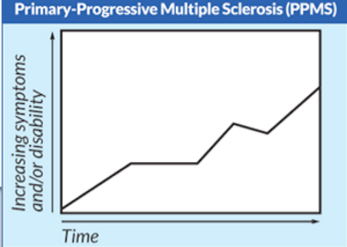
What is primary progressive MS (PPMS)?
Affects 15% of patients - worsening disability from onset of symptoms, without relapses or remissions
What is motor neuron disease (MND)?
A group of diseases in which the motor neurons degenerate and die
Most cases are sporadic, 5-10% genetically linked
MND age of onset
Typically adulthood
MND major symptoms
Progressive muscular weakness, muscle wasting (atrophy), speech and swallowing difficulties, respiratory failure
MND disease progression
Progressive and typically life-shortening
Treatment for MND
Riluzole may slow progression
Multidisciplinary care
What is muscular dystrophy (MD)?
Group of inherited genetic disorders causing degeneration of skeletal muscle fibres
MD age of onset?
Typically childhood
MD disease progression?
Progressive muscle degeneration through life
MD treatments
Corticosteroids
Physio and exercise programs
assistive devices
What is cerebral palsy (CP)?
Damage to the developing brain before, during, or shortly after birth resulting in permanent motor impairment
Major symptoms in CP
Abnormal muscle tone (spasticity), impaired movement, poor coordination, balance difficulties, delayed motor development, speech and feeding difficulties
Progression of CP?
Non-progressive, however functional limitations may change with growth
CP treatment approaches?
Multidisciplinary approach
Baclofen for spasticity
Botulinum toxin injections