Chapter 13 Econ
 Call Kai
 Learn
Learn Practice Test
 Spaced Repetition
 Match
Match Flashcards
 Knowt Play
1/52

There's no tags or description
Looks like no tags are added yet.
Name | Mastery | Learn | Test | Matching | Spaced | Call with Kai | Chat |
|---|
No analytics yet
Send a link to your students to track their progress
53 Terms
Demand-Side Policies (Demand Management)
Focus on changing aggregate demand, or shifting the aggregate demand curve in the AD-AS, to achieve several macroeconomic goals.
Two Types of Demand-Side Policies
- Monetary policy
- Fiscal policy
Supply-Side Policies
Focus on the production and supply side of the economy, specifically on factors aimed at shifting the long-run aggregate supply (LRAS) or Keynesian AS curves to the right, to increase potential output and achieve long-term economic growth.
Two Major Categories of Supply-Side Policies
- Market-based, which rely on the working of the market
- Interventionist, which rely on government intervention
Monetary Policy
Carried out by the central bank of each country.
Commercial Banks
Financial institutions whose main functions are to hold deposits for their customers, to make loans to their customers, to transfer funds by cheque electronically from one bank to another, and to buy government bonds.
Central Bank
Usually a government financial institution with several important responsibilities:
- Banker to the government and comemercial banks
- Regulator of commercial banks
- Conduct monetary policy
Inflation Targeting
The public announcement of medium-term numerical targets for inflation with an institutional commitment by monetary authority to achieve these targets.
Interest Rate (Rate of Interest)
The percentage of a loan charged by a lender for borrowing money, or the percentage paid by a bank to a saver for keeping money in an account.
Interest
The price paid for borrowing money or the return earned on lending and saving capital.
Money
Defined as anything that is acceptable as payment for goods and services; it includes currency (coins and paper money) and cheque (checking) accounts.
Supply of Money
The total amount of monetary assets (including physical cash, coins, and liquid bank deposits) available in an economy at a specific point in time.
The Money Market and Determination of the Rate of Interest Diagrams

Money Creation
The process by which the total money supply of an economy increases.
Minimum Reserve Requirement (Required Reserve Ratio)
The minimum percentage of customer deposits that commercial banks must hold in cash or at the central bank rather than lending out.
Monetary Multiplier
1 ÷ required reserve ratio
Open Market Operations
The buying and selling of government securities by a central bank to control the money supply and influence interest rates.
Minimum Lending Rate
The lowest interest rate a central bank charges commercial banks for borrowing emergency funds or reserves.
Quantitative Easing
An unconventional monetary policy where a central bank creates digital money to buy financial assets, such as government bonds, from commercial banks and other institutions.
Nominal Rate of Interest
The market rate that prevails at any moment in time.
Real Rate of Interest
The interest rate that has been corrected for inflation.
Real interest rate = Nominal interest rate - Rate of inflation
Effects of Expansionary Policy: Eliminating a Recessionary/Deflationary Gap
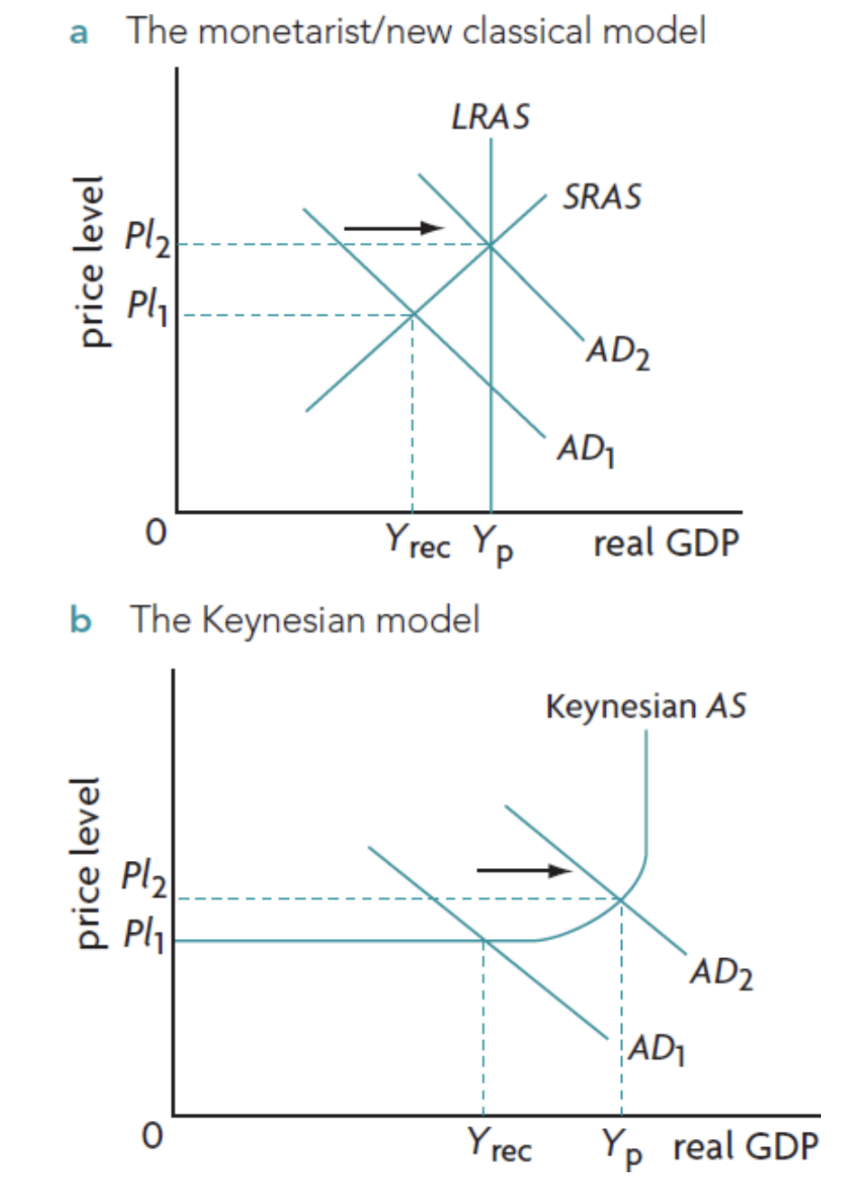
Expansionary Monetary Policy
Refers to an increase in the money supply by the central bank.
Contractionary Monetary Policy
Refers to a decrease in the money supply by the central bank.
Effects of Contractionary Policy: Eliminating an Inflationary Gap
Ratchet Effect
A process or economic cycle that moves easily in one direction but strongly resists going backwards.
Types of Government Expenditure
- Current expenditures
- Capital expenditures
- Transfer payments
Current Expenditures
Include the government’s spending on day-to-day items that are recurring and items that are used up or ‘consumed’ as a good or service is provided.
Capital Expenditures
Include public investments, or spending to produce physical capital, such as building roads, airports, harbours, school building, hospitals, etc.
Transfer Payments
Include payments by the government to vulnerable groups for the purposes of income redistribution (for example, unemployment benefits, child allowances, etc.).
Fiscal Policy
Refers to manipulations by the government of its own expenditures and taxes to influence the level of aggregate demand.
Expansionary Fiscal Policy
A government strategy to increase aggregate demand by raising spending, lowering taxes, or both.
Contractionary Fiscal Policy
A government strategy to increase aggregate demand by lowering spending, raising taxes, or both.
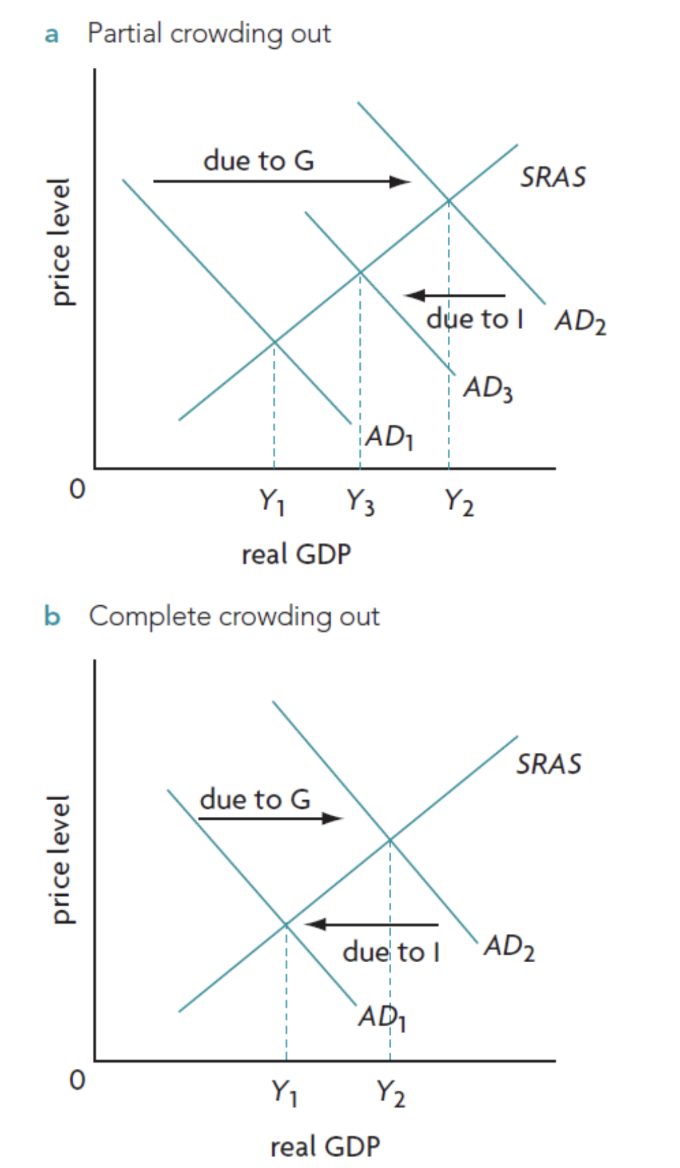
Crowding Out
An economic theory where increased government spending and borrowing reduce private sector spending and investment.
Crowding out of Private Investment (Diagram)
Automatic Stabilisers
Factors that automatically, without any action by government authorities, work toward stabilising the economy by reducing short-term fluctuations of the business cycle.
Keynesian Multiplier
Change in real GDP ÷ initial change in expenditure
Marginal Propensity to Consume
Defined as the fraction of additional income that households spend on consumption of domestically produced goods and services.
Marginal Propensity to Save
Defined as the fraction of additional income saved.
Marginal Propensity to Tax
Defined as the fraction of additional income taxed.
Marginal Propensity to Import
Defined as the fraction of additional income spent on imported goods and services.
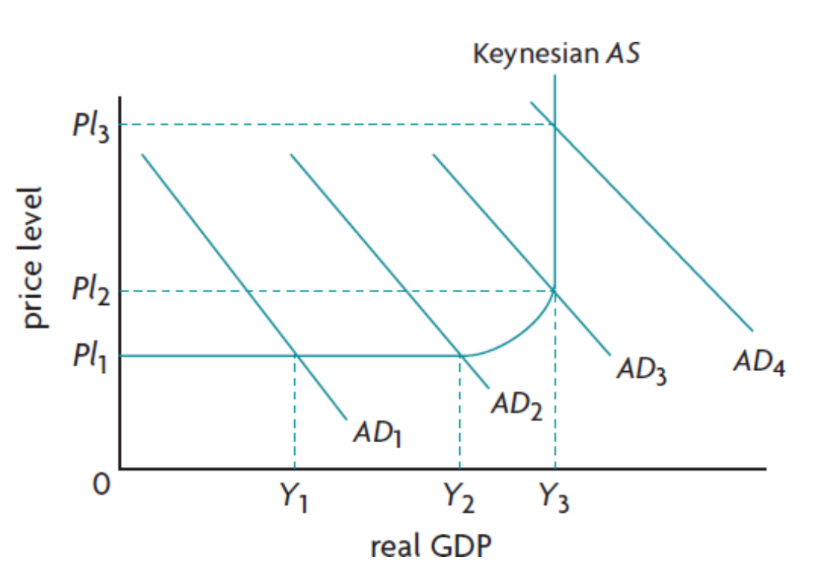
Aggregate Demand, Real GDP and the Multiplier in the Keynesian Model
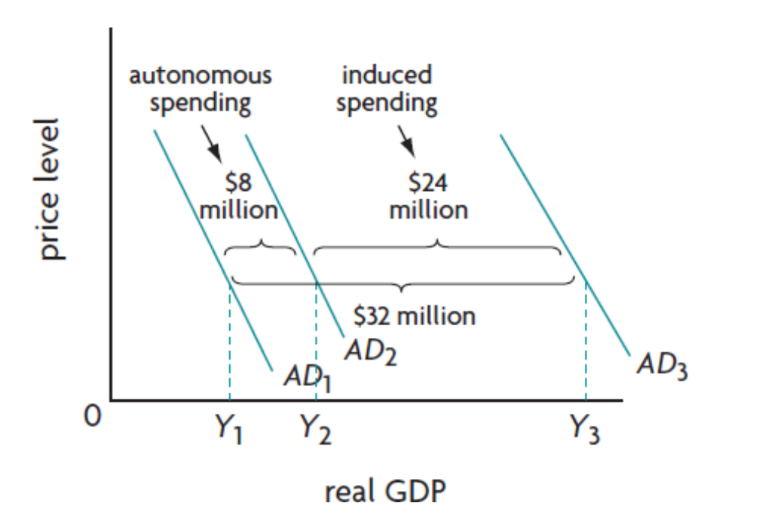
How the Effect of the Multiplier Changes Depending on the Price Level
Labour Market Flexibility
The speed and ease with which a workforce and its wages adapt to changes in the economy.
Market-Based Supply-Side Policies
Can be grouped under three headings:
1. Encouraging competition
2. Labour market reforms
3. Incentive-related policies
Privatisation
Involving a transfer of ownership of a firm from the public to the private sector, can increase efficiency due to improved management and operation of the privatised firm.
Deregulation
Involves elimination or reduction of government regulation of private sector activities, based on the argument that government regulation stifles competition and increases inefficiency
Labour Union
An association of workers in a particular profession, whose objective is to improve working conditions and defined rights of workers, representing its members in negotiation with employers.
Incentive-Related Policies
Involve cutting various types of taxes, which are expected to change the incentives faced by taxpayers, whether firms or consumers.
Capital Gains
Profits from financial investments (such as stocks and bonds) or from buying and selling real estate.
Interventionist Supply-Side Policies
Presuppose that the free market economy alone cannot achieve the desired results in terms of increasing potential output, and therefore government intervention is required.
Infrastructure
A type of physical capital, and therefore results from investments; it includes power, telecommunication, roads, dams, urban transport, ports airports, irrigation systems, etc.
Industrial Policies
Government policies designed to support the growth of the industrial sector of an economy. They include:
- Support for small and medium-sized enterprises or firms (SMEs)
- Support for ‘infant industries’