Pharmacodynamics - Dose-response curves
 Call Kai
 Learn
Learn Practice Test
 Spaced Repetition
 Match
Match Flashcards
 Knowt Play
1/7

There's no tags or description
Looks like no tags are added yet.
Name | Mastery | Learn | Test | Matching | Spaced | Call with Kai | Chat |
|---|
No analytics yet
Send a link to your students to track their progress
8 Terms
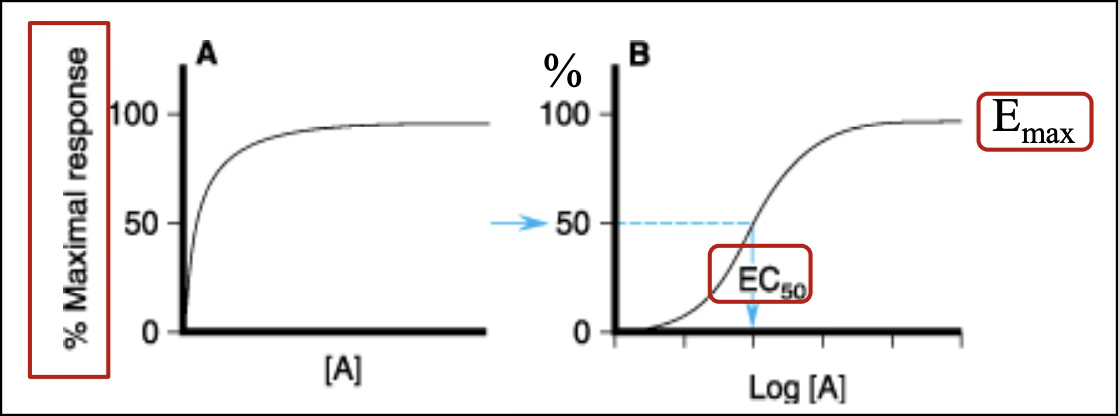
Efficacy?
The maximum effect a drug can produce, regardless of dose. Read at the plateau of the dose-response curve (Emax)
Potency?
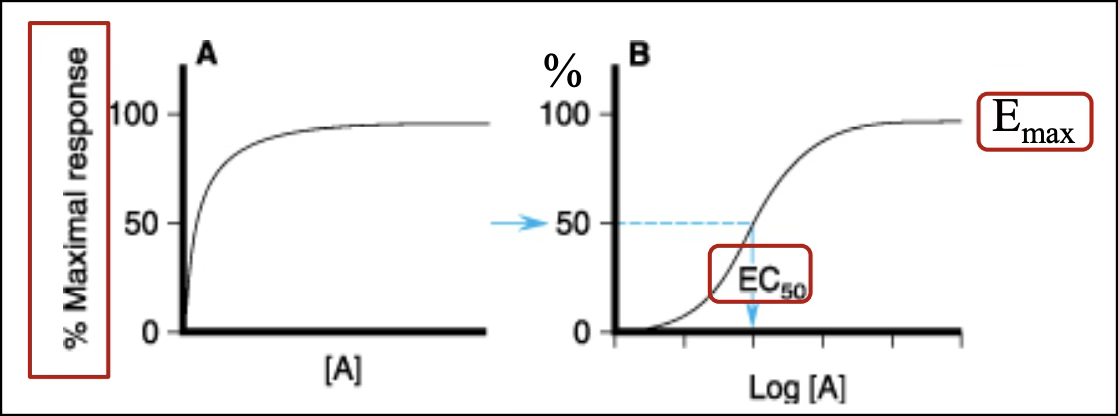
How much drug is needed to produce a given effect. Measured by EC50 (drug concentration that gives 50% of the maximum effect), where a lower EC50 = higher potency = curve further to the left.
Affinity?
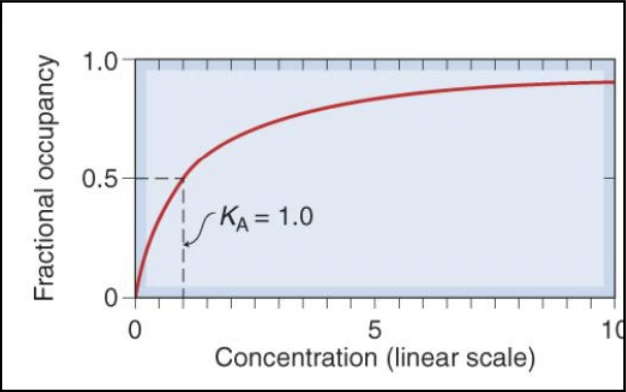
How tightly a drug binds to its receptor. Read through binding assays (% bound vs conc.), not dose-response curves.
Left-shifted curved = higher affinity
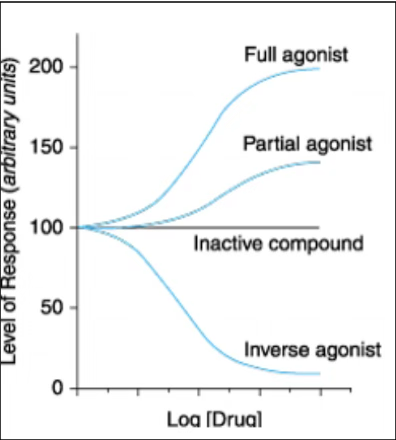
Agonist types
Full agonist: achieves Emax
Partial agonist: only produces sub-maximal response, even if all receptors are occupied
Inverse agonist: reduces receptor activity by inducing inactive conformation of receptor (only works on inherently active receptors, e.g., leaky channels)
What is the difference between an inverse agonist and an antagonist?
Inverse agonists inhibit the activity of receptors that are inherently active in the absence of a ligand, resulting in negative efficacy.
Baseline decreases
Antagonists have no effect on their own, only producing an effect is added together with agonist.
Baseline stays unaffected
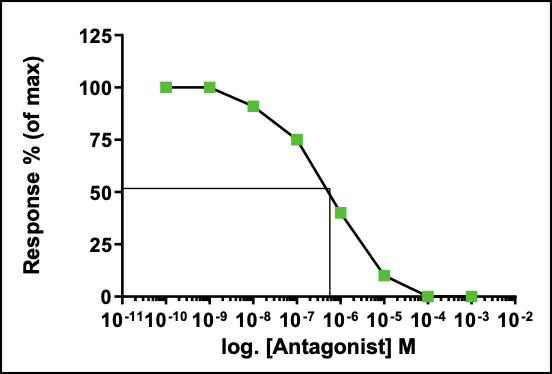
Antagonist?
Molecules that bind to receptors and blocks a/the receptor’s activation by agonists; does not induce a response on their own
0 efficacy as it doesn’t trigger a response
IC50 = antagonist concentration at which the receptor response is reduced by 50%
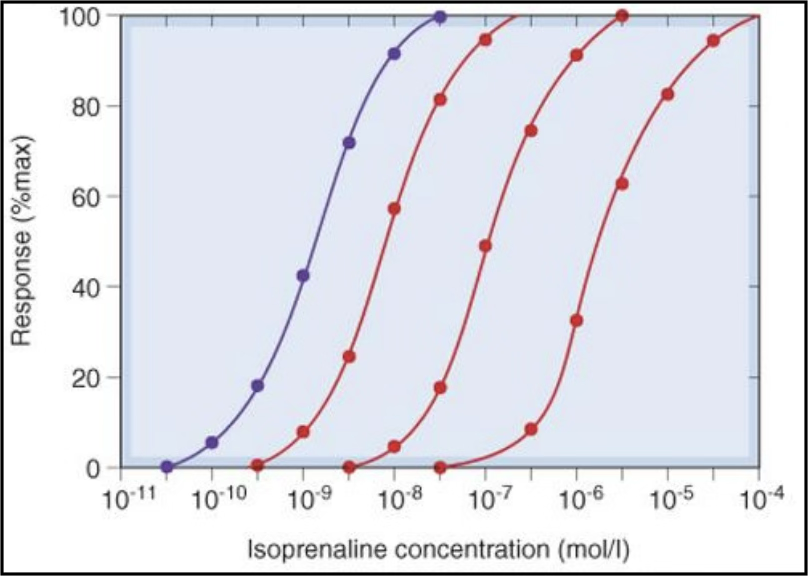
Competitive antagonist
Binds to the same site as agonist, competing with it
Shifts the curve to the right, in parallel
No change in Emax as it can still be reached by adding more agonist
Most drugs are competitive antagonists due to their reversible action
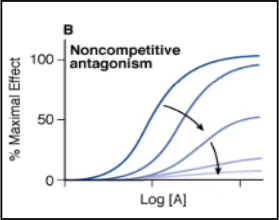
Non-competitive antagonists
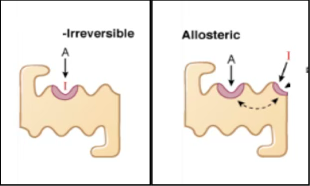
Binds either (i) irreversibly to receptor, or (ii) to allosteric site
Can therefore not be countered by adding more agonist
Curve flattens, reducing Emax