Modern Biology 1: Chapter 4-Cells
 Call Kai
 Learn
Learn Practice Test
 Spaced Repetition
 Match
Match Flashcards
 Knowt Play
1/106

There's no tags or description
Looks like no tags are added yet.
Name | Mastery | Learn | Test | Matching | Spaced | Call with Kai | Chat |
|---|
No analytics yet
Send a link to your students to track their progress
107 Terms
What are the two Microscope Types?
Light Microscopes, which use magnifying lenses with visible light
Resolve structures that are 200 nm apart
Electron microscopes, which use a beam of electrons
Resolve structures that are 0.2 nm apart
Cells were discovered in 1665 by ___________, and early studies were conducted by _____________ (1838) and ______________ (1839), together they proposed the Cell Theory
Robert Hooke
Mathias Schleiden
Theodor Schwann
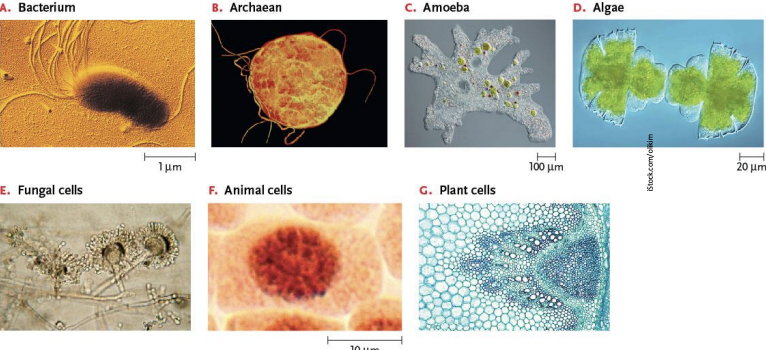
Example of Cells
All organisms are composed of one or move living cells, where cells are the smallest living units.

Units of Measure
Cell Size is limited by the surface area-to-volume ratio, because Surface area will determine the?
The amount of substance that can be exchanged between a cell and the outside environment
Doubling the diameter of a cell will insurance what of the cell? (Hint: Two different things)
Increase Surface Area by Four Times
Increase Volume by Eight Times
What’s another way cells can increase their surface area?
With extensions or folds

Surface Area Diagram
All Cells are bounded by the?
Plasma Membrane
The Plasma Membrane is a bilayer made of?
Phospholipids with embedded protein molecules
The Phospholipid Bilayer is what kind of barrier?
Hydrophobic Barrier
For the Phospholipid Layer, some substances can penetrate the cell membrane through?
Transport Protein Channels
What does the Selective Transport of Ions and Water-soluble molecules maintain?
The specialized internal environment required for cellular life
A central region of all cells contain?
DNA
The Cytoplasm is between what, and it contains what?
Plasma Membrane and Central Region
The Cytosol and Cytoskeleton
Cytosol is an aqueous solution containing?
Ions, various organic molecules, and organelles
The Cytoskeleton will do what? (Hint: Does 3 things)
Maintain cell shape
Plays a key role in cell division and Chromosome Segregation
Prokaryotes (domains Bacteria and Archaea) (Hint: Two things to note, being its nucleoid region, and one related to bacteria)
Contains a nucleoid region that has no boundary membrane
Many species of bacteria have few internal membranes
Eukaryotes (domain Eukarya) (Hint: Contains two things, one relating to it’s nucleus, and the Cytoplasms)
The True Nucleus is separated from the surrounding cytoplasm by membranes
Cytoplasms typically contain extensive membrane systems that form organelles
Prokaryotic Cell Structure
The Plasma Membrane of a Prokaryotic cell is typically surrounded by a?
Rigid external cell wall coated with polysaccharides called the Glycocalyx
When the Glycocalyx is loosely associated with the cells, it is a?, while when it is firmly attached, it is?
Slime layer when loosely
Capsule when firmly
What molecular system does the Plasma Membrane contain in the Prokaryotic Cell?
Molecular systems that metabolize food (or light) into ATP
What maintains the cell shape and function in cell division?
Prokaryotic cytoskeletons
Many bacteria and archaeans move using?
Flagella
How does the bacterial flagellum work?
It rotates in a socket and pushes cell through liquid medium
What does the Hairlike Pili do for the Prokaryotic cell?
Attach the cell to a surface or other cells
A special sex pilus joins bacteria during mating
What are the three shapes common among prokaryotes?
Spherical
Rodlike
Spiral
For most species, the DNA is a single circular molecule called the?
Prokaryotic Chromosome
Information from DNA is copied into _________ ___ molecules and carried to _________ in the cytoplasm, which assemble?
Messenger RNA
Ribosomes
Amino acids into proteins
The Eukaryotic Cell contains a?
True nucleus enclosed by membrane
The Eukaryotic cell is characterized by?
Compartmentalization by an endomembrane system, and the presence of membrane-bound organelles
Which cells are Eukaryotic Cells?
Plant Cells and Animal Cells
Whats an important structure for Eukaryotic Cells?
Their Cytoskeleton for support and structure
Differences in organelles between plant and animal cells (Hint: What do plant cells have?)
Chloroplasts
Vacuoles
Cell Wall

Cell Fractionation

Animal Cell Diagram

Plant Cell Diagram
The Eukaryotic Nucleus is the repository of genetic information, how many nucleus does a eukaryotic cell possess?
A single nucleus
The Nucleolus is the regions where? (Hint: Two things will occur)
Ribosomal RNA Synthesis takes place
Ribosomal Subunit formation, and exit through nuclear pores
What does the Nuclear Envelope consist of or have? (Hint: Their are 3 things)
2 phospholipid bilayers
A network of protein filaments called lamins reinforce envelope
Nuclear Pores, that control passage of molecules entering and exiting
In eukaryotes, the DNA is divided into?
Multiple linear chromosomes
The Liquid within the nucleus is called?
Nucleoplasm
The Nucleus will contain Chromatin, which is a?
A combination of DNA and proteins
In eukaryotes, each DNA molecule is linear - organized with its proteins into a specific?
Eukaryotic chromosome
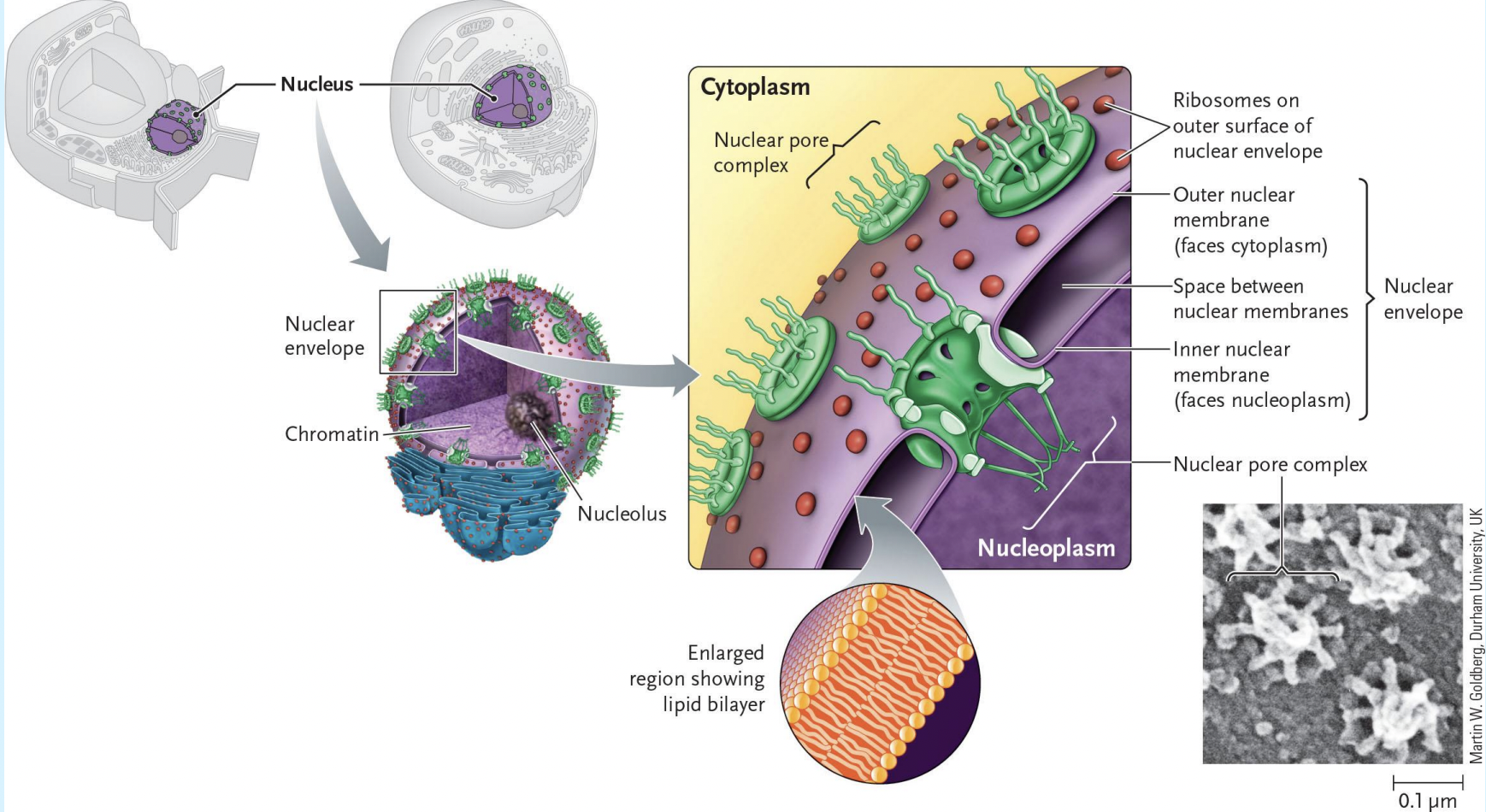
Nuclear Envelope Diagram
A eukaryotic Ribosome consists of a?, and are made of?
Large Subunit. and a Small Subunit
Ribosomal RNA and Proteins
Where are Ribosomal Subunits assembled in?
Nucleolus
Some ribosomes are freely suspended in the?, while others are attached to?
Freely suspended in Cytosol
Attached to membranes
Proteins made on free ribosomes have the ability to do many things note them?
Remain in the cytosol
Pass into the nucleus
Become parts of Mitochondria, Chloroplasts, Cytoskeleton, or other Cytoplasmic structures
Come back to slide 24 for photo from class
The Endomembrane System is a series of membranes throughout the cytoplasms that?
Divide the cell into compartments, where different cellular functions occur
The membranes may be connected directly or indirectly by Vesicles, which are?
Small membrane-bound sacs that transfer substances between parts of system
The Endomembrane System will include what structures?
Nuclear Envelope
Endoplasmic Reticulum
Golgi Complex
Lysosomes
Vesicles
Plasma Membrane
The Endoplasmic Reticulum is an extensive interconnected network of?
Membranous channels and Cisternae
Each Cisterna is formed by a?
Single membrane that surrounds an enclosed space called ER lumen
Rough ER has many?
Ribosomes on its our surface
Proteins made on those ribosomes attached to the ER will enter the? Where they will?
ER lumen, where they fold into their final forms
What will occur in the Lumen
Chemical Modifications, like addition of carbohydrates to produce glycoproteins
Once those proteins are made, they will be delivered to other regions of the cell, within the?
Small vesicle that pinch off from the ER
How does Smooth ER differ from Rough ER
Smooth has no ribosomes attached to their surfaces
Smooth ER will synthesize?, which become part of?
Synthesize Lipids which become part of cell membranes
In the Liver, Smooth ER will convert?
Drugs, and poisons to substances that can be tolerated or removed from body easier
The Golgi Apparatus is a collection of Golgi bodies made of?
Cis-Golgi Network, cis- face
Medial- face
Trans-golgi network, trans- face
Proteins made in the ER will enter on the?, delivered by what?
Enter on Cis-face
Delivered by transport vesicles that fuse with membrane
Those modified proteins will then exit from the?
Trans face in vesicles that bud off from mebrane
Golgi Apparatus Function
Collects, packages and distributes molecules (using vesicles) synthesized at one location in the cell and utilized at another location
Sugar production and addition to proteins and lipids to form glycoproteins and glycolipids
Final protein folding
Stores secreted material
Proteins to be secreted from the Golgi cell are transported to the plasma membrane in? Which release their contents to the?
Secretory Vesicles
Released to the exterior by exocytosis
After the vesicle releases the contents, the membrane of the vesicle will?
Fuse with plasma membrane, and become part of it
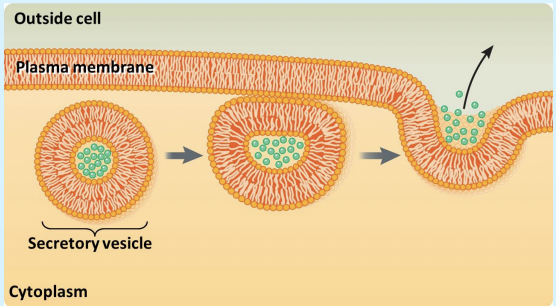
Exocytosis Diagram
Lyosomes are Membrane-Bound digestive vesicles that arise from?
Golge apparatus, trans-golgi network
Lyosomes are found in animals, but not in plants
Inside the Lyosomes, the Enzyme Catalyse the? Where these subunits are recycled in the?
Breakdown of macromolecules and these subunits are recycled in the cell
Lyosomes undergo Phagocytosis in which when cells engulf foreign matter or other cells from the outside the?
Lyosomes fuses with it to destroy and digest it
Lyosomes will also undergo Autophagy, in which they?
Digest worn-out or damaged organelles
pH within Lyosome is at what number?
Acidic - 5
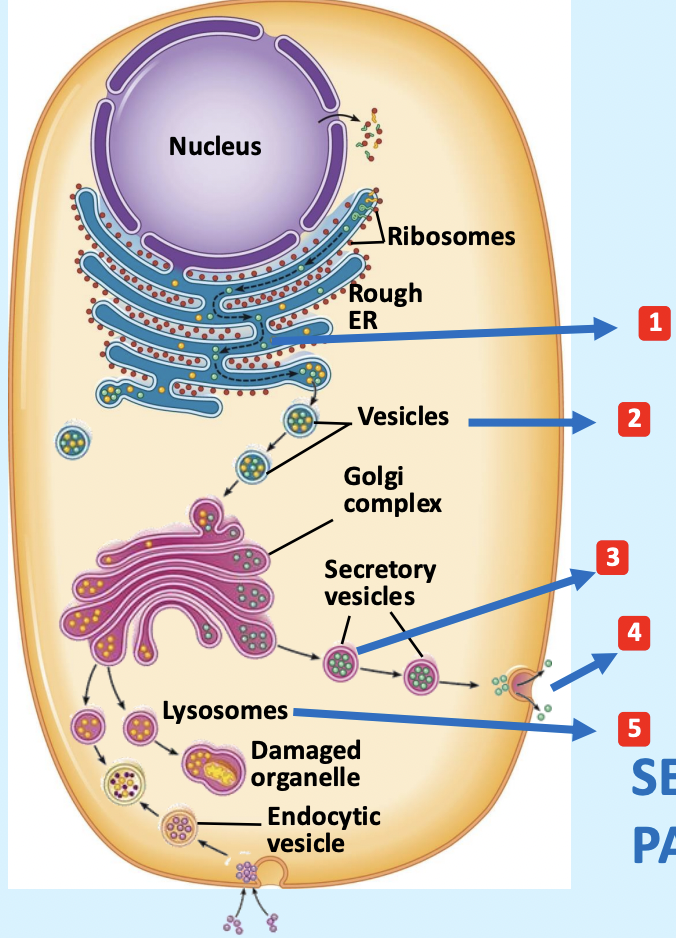
Secretory Pathway
What is Step 1 of Secretory Pathway?
(Rough ER Synthesis): Proteins made by ribosomes on the Rough ER enter the ER space where initial chemical modifications begin, and membrane lipids are manufactured.
What is Step 2?
(Transport to Golgi): Unfinished proteins and lipids are packed into transport vesicles that bud off from the ER membrane and travel down to the Golgi complex.
What is Step 3?
(Golgi Processing & Sorting): Modification is completed inside the Golgi complex, and the finished products are sorted into new vesicles (like secretory vesicles or lysosomes) that bud off from the Golgi.
What is Step 4?
(Exocytosis): Secretory vesicles carry the finished products to the plasma membrane, where they fuse and release their contents outside the cell (exocytosis)
What is Step 5?
(Lysosomes & Autophagy): Lysosomes bud off from the Golgi containing digestive enzymes to break down damaged organelles (autophagy) or digest material brought in from outside the cell via endocytic vesicles.

This is Vesicle Budding and Fusion
The 5-Step Process:
Selection & Binding: Coat and adapter proteins bind to specific cargo proteins. This acts like a sorting facility, ensuring only the right proteins get packed into this specific vesicle.
Budding: More coat proteins pile on, acting like a molecular drawstring that pinches the vesicle completely off from the shipping membrane.
Uncoating: Once the vesicle is floating freely in the cytosol, the outer coat proteins fall off ("uncoat"). Why? Because the vesicle needs a bare membrane to be able to fuse with its target later!
Fusion: The naked vesicle drifts to the receiving compartment, and specialized proteins help the two membranes melt and fuse together.
Delivery: The cargo trapped inside the vesicle is spilled out into the receiving compartment, and any proteins that were part of the vesicle's wall become a permanent part of the receiving compartment's membrane.
Peroxisomes are a Variety of?
Enzyme-bearing, membrane-enclosed vesicles
Peroxisomes contains enzymes invloved in?
The oxidation of fatty acids
After the oxidation, a Hydrogen Peroxide by-product is produced, but is rendered harmless by an enzyme called?
Catalase
Mitochondria are a cell with?
2 phospholipid bilayers - outer and inner membranes
The inner membrane is folded into partitions called?
Cristae
The innermost space of the Mitochondria is called the matrix, containing their own?
DNA, Ribosome, and other components
Mitochondria requires oxygen to perform a process called?
Cellular Respiration, where energy-rich food molecules are broken down to create ATP
(Occurs in the Cristae and Matrix)
Chloroplast contain enclosed internal compartments of? and are found in which organisms?
Stacked grana, containing thylakoids
-Found in photosynthetic organisms, aka Plants
The endosymbiotic theory proposes that mitochondria have originated from a mutualistic relationship between an?
Ingested prokaryotic cell and the Eukaryotic cell that ingested it
The Cytoskeleton is an interconnected system of?
Protein fibers and tubes that extends throughout the cytoplasm
The Cytoskeleton maintains a cell’s? (Hint: Their are 3)
Shape
Internal organization
Functions in movement
The Cytoskeleton of animal and plant cells contains? (Hint: Their are 3)
Microtubules
Intermediate filaments
Microfilaments

Cytoskeleton, Proteins to Filaments (polymers)
Microtubules are the largest of filaments, made of?
Alpha and Beta tubulin dimers
The walls of the Microtubule consists of?
13 protein filaments arranged side by side
The dimers are organized head-to-tail in each filament, giving the microtubule a polarity (+ and - ends)
Microtubules are dynamic structures, changing their lengths by?
The addition and removal of tubulin dimers - polymerization and depolymerization respectively