Module 2 need to know
 Call Kai
 Learn
Learn Practice Test
 Spaced Repetition
 Match
Match Flashcards
 Knowt Play
1/21

There's no tags or description
Looks like no tags are added yet.
Name | Mastery | Learn | Test | Matching | Spaced | Call with Kai | Chat |
|---|
No analytics yet
Send a link to your students to track their progress
22 Terms
Types of bonds
ionic
non-polar covalent bond
Polar covalent bond
Electronegativity across the periodic table
increases across a period, decreases down a group
Polarity of a bond
little polarity - similar electronegativity
polar bond - different electronegativity
ionic bond - very different electronegativity
electronegativity differnce values
<0.4 - Nonpolar covalent
0.4-1.6 - polar covalent
>2.0 - ionic
1.5-2.0 - Ionic if a metal involved, polar covalent if only non-metals are involved
Hydrophobic vs hydrophilic
Polar molecules mix well in polar solvents (hydrophilic) while nonpolar molecules do not mix well in polar solvents (hydrophobic) – likes dissolves likes
Stable electron configuation
metals lose ions, achieve configuration of previous noble gas
non-metals gain ions, achieve configuration of the next noble gas
steps for writing lewis structures
1. Calculate the sum of the valence electrons from all of the atoms.
2. Use a line to indicate each pair of bonding electrons (2 electrons in a bond).
3. Arrange the electrons so that each atom is surrounded by enough electrons to fill the valence orbitals of that atom
Rules for writing Lewis Structures
1. We must include all the valence electrons from all atoms. The total number of electrons available is the sum of all the valence electrons from all the atoms in the molecule.
2. Atoms that are bonded to each other share one or more pairs of electrons.
3. The electrons are arranged so that each atom is surrounded by enough electrons to fill the valence orbitals of that atom. This means two electrons for hydrogen and eight electrons for second-row non-metals.
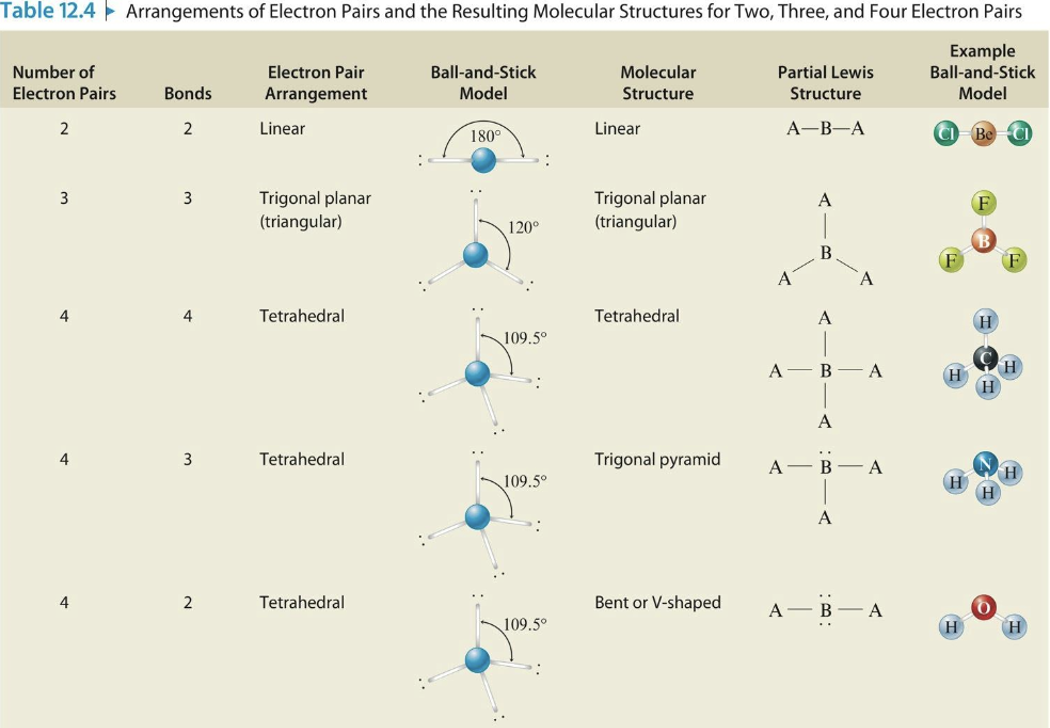
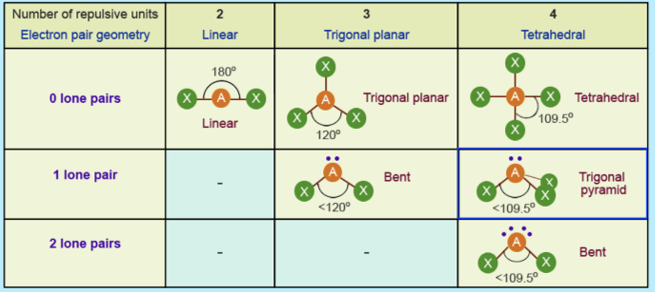
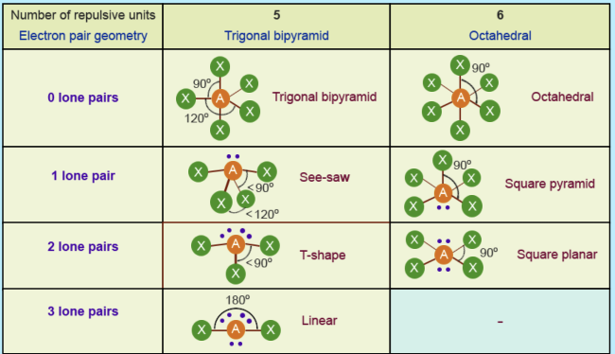
Steps for Predicting molecular structure with VSEPR:
1. Draw the Lewis structure for the molecule.
2. Count the electron pairs and arrange them in the way that minimizes repulsion
3. Determine the positions of the atoms from the way the electron pairs are shared.
4. Determine the name of the molecular structure from the positions of the atoms.
How to treat double and triple bonds in VSEPR model
the same as a single bond
configuration pt1
configuration pt2
configuration pt3
density
mass/volume
Changes of state are
physical changes, no chemical bonds are broken in the process
Intra vs Inter molecular forces
Intra - holds the atoms of a molecule together, stronger than
Inter - among molecules, cause them to aggregate
To determine the quantity of heat, Q to heat a sample from 1 temperature to a higher temperature, and a phase change is involved, you need to consider 2 quantities of heat energies
quantity of heat energy required to increase the temperature
quantity of heat energy required to bring about the phase change
Types of imtermolecular forces that occur between molecules
dipole-dipole attraction
hydrogen bonding
london dispersion forces
dipole-dipole attraction
Exists in molecules with dipole moment
Hydrogen bonding
very strong intermolecular attraction between molecules. Where hydrogen is bound to a highly electronegative atom, such as N, O or F
London dispersion forces
Weak and short lived. Occurs in all molecules, is the most signifigant intermolecular force for non-polar molecules and the noble gases
Vapour pressure
Amount of liquid first decreases then becomes constant
Condensation - process by which vapor molecules convert to a liquid
When no further change is visible the opposing processes balance each other – equilibrium
The pressure of the vapour present at equilibrium with its liquid is called the equilibrium vapour pressure or, more commonly, the vapour pressure of the liquid
Liquids with high vapour pressures (e.g. diethyl ether) are said to be volatile – they evaporate rapidly
Liquids in which the intermolecular forces are strong have relatively low vapour pressures, because such molecules need high energies to escape to the vapour phase