PSY388 Lecture 3: Emotional Disorders 2: Anxiety Disorders; Obsessive-Compulsive and Related Disorders
 Call Kai
 Learn
Learn Practice Test
 Spaced Repetition
 Match
Match Flashcards
 Knowt Play
1/34

There's no tags or description
Looks like no tags are added yet.
Name | Mastery | Learn | Test | Matching | Spaced | Call with Kai | Chat |
|---|
No analytics yet
Send a link to your students to track their progress
35 Terms
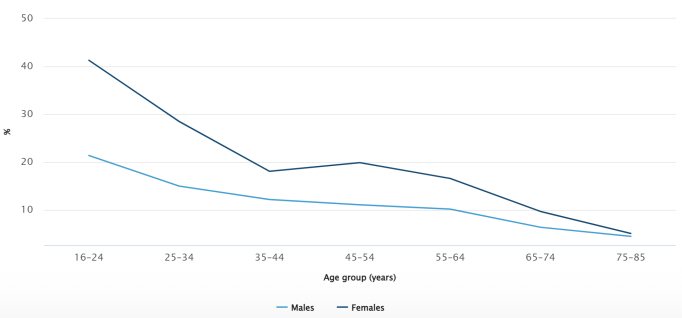
Any 12-month Anxiety disorder, by age and sex, 2020-21
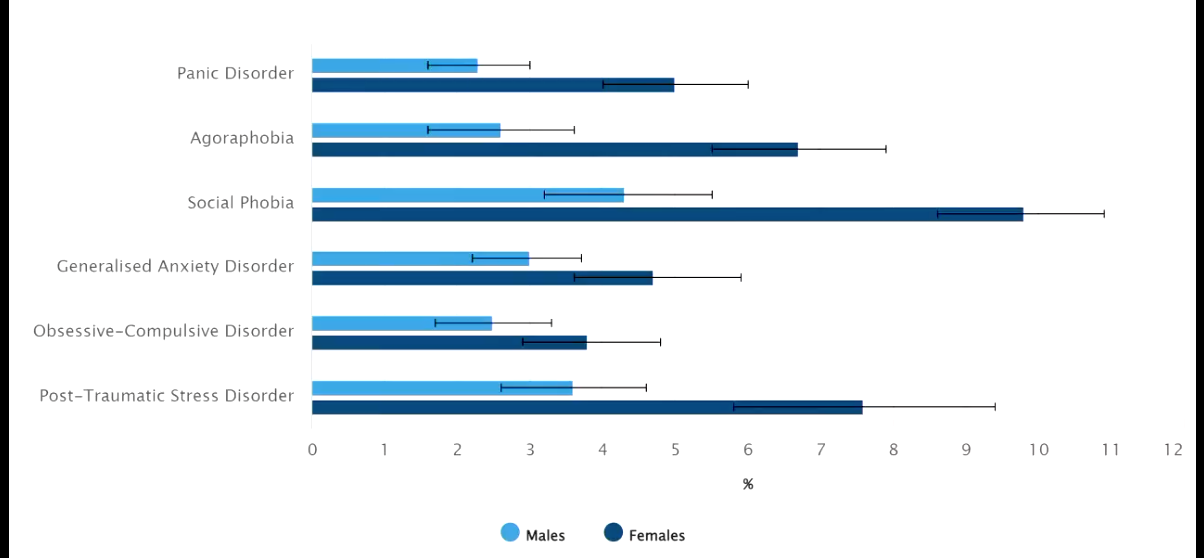
12-month Anxiety disorders, by type of disorder and sex, 2020-21
Anxiety Disorder
Panic Disorder (PD)
Agoraphobia (Ag)
Specific Phobia (SP)
Social Anxiety Disorder (SAD)
Generalised Anxiety Disorder (GAD)
More environment trigger to intense emotions + more pre-exisiting cognitive style to interpret as bad and avoid/control
Aetiology of Anxiety Disorders
Biology, Psychology, Environment, Social
Aetiology of Anxiety Disorders - Biology
Genetics/family history
Disruptions to fear brain networks
Heightened physiological sensitivity, more reactive, hypervigilant (HPA dysreg.)
Tendency to experience more fear/anxiety “negative affectivity
Aetiology of Anxiety Disorders - Psychology
Trait neuroticism
Modelling
Anxiety sensitivity, intolerance of uncertainty
Learned helplessness (e.g., “I have no control over whether bad things happen to me”)
Catastrophic thinking (e.g., “the world is a dangerous place”)
Aetiology of Anxiety Disorders - Environment
Stressful life events as a trigger OR predisposition (e.g., conditioning)
Aetiology of Anxiety Disorders - Social
Avoidance (negative Rft)
Overprotective parents
High “expressed emotion”
Excessive parental criticism
Equifinality
Is the principle that various causes can lead to the same outcome or disorder, particularly within the context of anxiety disorders, where multiple factors can contribute to an individual's experience of anxiety.
Multifinality
Is the principle that the same cause can lead to a variety of outcomes or disorders, particularly in the context of anxiety disorders, where an individual may respond differently to similar experiences.
Differential Diagnosis - Panic Disorder
Fear of having panic attacks
Differential Diagnosis - Agoraphobia
Fear of no escape/no help
Differential Diagnosis - Specific Phobia
Fear of harm from object/situation
Differential Diagnosis - Social anxiety disorder
Fear of negative evaluation
Differential Diagnosis - Generalised Anxiety Disorder
Fear of the unknown future (e.g. worry)
Moderate-to-large assoc btwn experiential avoidance and:
anxiety/depressive sx
MDD, GAD, SAD, PD, Ag, SP, OCD, PTSD
diagnostic co-occurrence did not moderate assoc, supporting transdiagnostic role
Emotion-Driven Behaviours
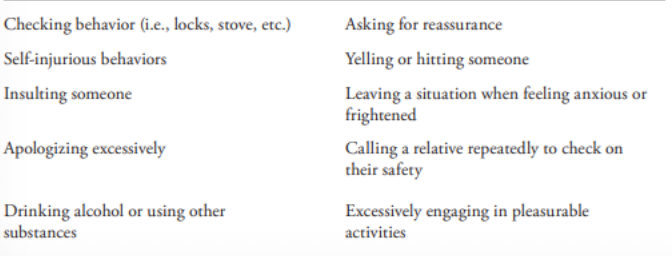
Behaviours driven by strong emotions that are designed to reduce the intensity of that emotion
Overt Avoidance
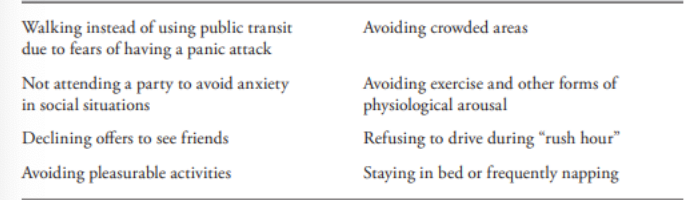
Outright avoidance of situations, people, etc. that bring up strong emotions
Subtle Behavioural Avoidance
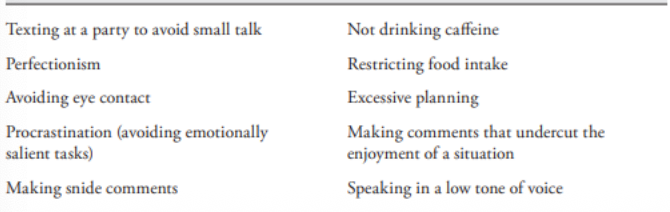
Behaviours that prevent fully experiencing an emotion when outright avoidance isn’t an option
Cognitive Avoidance
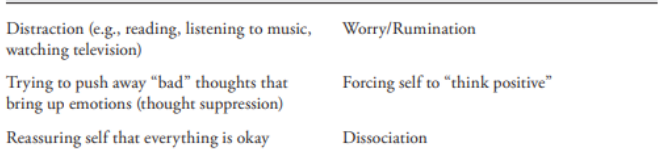
Cognitive strategies that are used to avoid thinking about something that is distressing
Safety Signals
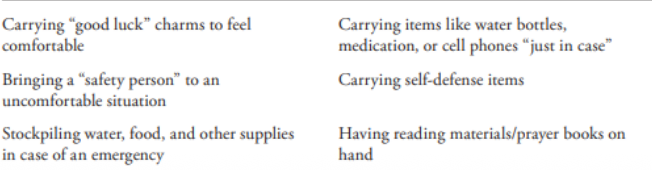
Items that are used to feel more comfortable and/or keep an emotion from becoming overwhelming
Cognitive behavioural therapy (CBT) - Anxiety disorders
Cognitive Therapy for Interpret as bad
Psychoeducation
Reappraisal
Increases Flexibility
Behaviour Therapy for avoid or control
Exposure
Activation
Lowers avoidance
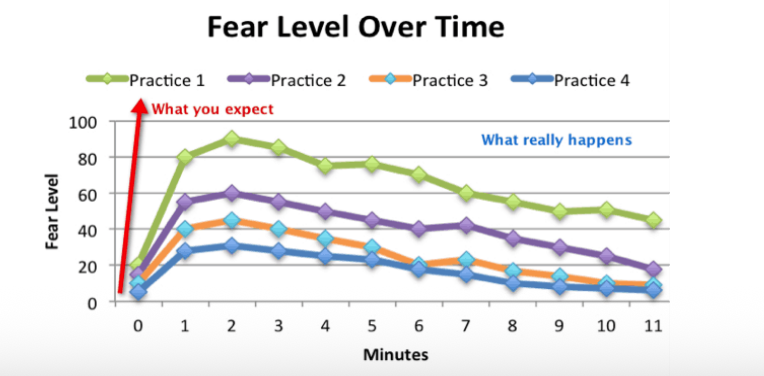
Other treatment for anxiety disorders
Yoga (Hatha)
Exercise/Physical activity
Obsessive Compulsive & Related Disorders
Obsessive-Compulsive Disorder (OCD)
Body Dysmorphic Disorder (BDD)
Hoarding Disorder
Excoriation (skin-picking) Disorder
Trichotillomania (hair-pulling disorder)
OCD
Obsessions and/or Compulsions
Time-consuming (more than 1hr/day) or distress/impairment
Obsessions
1. Recurrent, persistent, unwanted, intrusive thoughts, images, impulses
2. Attempts to ignore, suppress, neutralise (i.e., compulsions)
E.g., i. Doubts (e.g., locks, appliances) ii. Contamination/germs iii. Harming self/others iv. Horrific/violent thoughts/images/urges v. Unwanted sexual/religious/moral thoughts/images/urges vi. Nonsensical thoughts/images/urges
Compulsions
Driven to perform repetitive behaviours or mental acts
2. Aimed at reducing anxiety/distress (associated with obsessions) or preventing something from happening
E.g., i. Checking (e.g., locks, appliances) ii. Washing (e.g., self, house) iii. Counting iv. Internal repetition (e.g., words, phrases, prayers) v. Adhering to rules/behaviours (e.g., ordering/symmetry, routine, rituals)
Aetiology of OCD - Biology
Genetics/family history
Neuropsychological Model: failure of inhibitory pathways in the brain to stop “behavioural macros” in response to internal or external stimuli
Aetiology of OCD - Psychology
Cognitive Model: obsessional thoughts interpreted as danger signals (i.e., threat)
Intolerance of uncertainty → compulsions
Compulsions reinforced by maladaptive beliefs that performing them will reduce/prevent threat (“magical thinking”)
Aetiology of OCD - Environment
None
Aetiology of OCD - Social
High expressed emotion → signal threat, trigger need for control
Intolerance of uncertainty in youth with obsessive-compulsive disorder and generalized anxiety disorder: A transdiagnostic construct with implications for phenomenology and treatment
OCD and GAD are distinct disorders with significant phenomenological overlap.
Intolerance of Uncertainty (IU) may account for some overlap between disorders.
Neural circuitry underlying IU can be measured and may be altered in OCD and GAD.
Focusing on IU may improve diagnostic conceptualization and treatment.
Future research should examine whether focus on IU improves treatment outcomes.
Unwanted mental intrusions (non clinical)
Less frequent
Less unacceptable/distressing
Little association
Less resistance to the intrusion
Some perceived control
Considered meaningless, irrelevant to the self
Brief intrusions that fail to dominate conscious awareness
Less concern with thought control
Less emphasis on neutralising distress
Less interference in daily living
Clinical obsessions
More frequent
More unacceptable/distressing
Significant feelings of guilt
Strong resistance to the intrusion
Diminished perceived control over the obsession
Considered highly meaningful, threatening, important core values of the self (ego-dystonic)
Time-consuming intrusions that dominate conscious awareness
Heightened concern with thought control
Strong focus on neutralising distress associated with the obsession significant interference in daily living
OCD Treatment
Exposure therapy