Chemistry :- Reactivity series
 Call Kai
 Learn
Learn Practice Test
 Spaced Repetition
 Match
Match Flashcards
 Knowt Play
1/104

There's no tags or description
Looks like no tags are added yet.
Name | Mastery | Learn | Test | Matching | Spaced | Call with Kai | Chat |
|---|
No analytics yet
Send a link to your students to track their progress
105 Terms
How does pottasium react with cold water?
Reacts violently
How does sodium react with cold water?
Reacts quickly
How does Lithium react with cold water?
Reacts less strongly
How does calcium react with cold water?
Reacts less strongly
How does magnesium react with cold water?
reaction is very slow
How does zinc react with cold water?
Reacts very slowly
How does iron react with cold water?
very slow, slow rusting
Reaction of calcium with cold water
Ca (s) + 2H2O (l) ⟶ Ca(OH)2 (aq) + H2(g)
calcium + water ⟶ calcium hydroxide + hydrogen
Reaction of pottasium with cold water
2K (s) + 2H2O (l) -> 2KOH (aq) + H2 (g)
potassium + water → potassium hydroxide + hydrogen
Reaction of sodium with cold water
2Na (s) + 2H2O (l) -> 2NaOH (aq) + H2 (g)
sodium + water → sodium hydroxide + hydrogen
Reaction of lithium with cold water
2Li (s) + 2H2O (l) -> 2LiOH (aq) + H2 (g)
lithium + water → lithium hydroxide + hydrogen
Reaction of magneisum with cold water.
Mg (s) + 2H2O (l) -> Mg(OH)2 (aq) + H2 (g)
Magnesium + water → magnesium hydroxide + hydrogen
Reaction of zinc with cold water
Mg (s) + 2H2O (l) -> Mg(OH)2 (aq) + H2 (g)
Zinc + water → zinc hydroxide + hydrogen
Reaction of iron with cold water
Fe (s) + 2H2O (l) -> Fe(OH)2 (aq) + H2 (g)
Iron + water → iron hydroxide + hydrogen
Only metals _____ ________ in the reactivity series will react with dilute acids
above hydrogen
The more reactive a metal is the more _________ the reaction with dilute acid.
vigorous
Metals that are placed high on the reactivity series such as potassium and sodium are very dangerous and react ___________ with acids
explosively
When acids react with metals they form a ____ and _________ ___.
salt and hydrogen gas
The general equation for metals reacting with dilute acid is :-
metal + acid —→ salt + hydrogen
Reaction of magnesium with sulfuric acid
Mg (s) + H2SO4 (aq) → MgSO4 (aq) + H2 (g) |
Reaction of magnesium with hydrochloric acid
Mg (s) + 2HCl (aq) → MgCl2 (aq) + H2 (g)
Reaction of zinc with sulfuric acid
Zn (s) + H2SO4 (aq) → ZnSO4 (aq) + H2 (g)
Reaction of zinc with hydrochloric acid
Zn (s) + 2HCl (aq) → ZnCl2 (aq) + H2 (g)
Reaction of iron with Sulfuric acid
Fe (s) + H2SO4 (aq) → FeSO4 (aq) + H2 (g)
Reaction of iron with hydrochloric acid
Fe (s) + 2HCl (aq) → FeCl2 (aq) + H2 (g)
The reactivity of metals _________ going down the reactivity series.
decrease
A more reactive metal will ________ a less reactive metal from its compounds
displace
What is a metal displacement reaction?
A reaction where a more reactive metal displaces a less reactive metal from its compound.
How does metal reactivity change down the reactivity series?
It decreases going down the reactivity series.
What must be true for displacement to happen?
The solid metal must be more reactive than the metal in the compound.
What are the two main types of metal displacement reactions in the notes?
Reacting a metal with a metal oxide by heating
Reacting a metal with an aqueous solution of a metal compound
What happens when zinc is heated with copper(II) oxide?
Zinc displaces copper to form zinc oxide and copper.
What is the equation for zinc and copper(II) oxide?
Zn + CuO → ZnO + Cu
Which substance is the reducing agent in the zinc and copper(II) oxide reaction?
A: Zinc
What happens when magnesium is added to copper(II) sulfate solution?
Magnesium displaces copper to form magnesium sulfate and copper.
What is the equation for magnesium and copper(II) sulfate?
Mg + CuSO4 → MgSO4 + Cu
What happens to the colour of copper(II) sulfate solution when magnesium is added?
The blue colour fades as colourless magnesium sulfate forms.
What forms on the magnesium in the magnesium and copper(II) sulfate reaction?
Copper coats the magnesium and may fall to the bottom as a solid.
What are the products when iron(III) oxide reacts with aluminium?
Iron and aluminium oxide
What is the equation for the thermite reaction?
What happens when sodium oxide is mixed with magnesium?
No reaction because sodium is more reactive than magnesium.
What happens when silver oxide reacts with copper?
Silver and copper(II) oxide are formed.
What is the equation for silver oxide and copper?
Ag2O + Cu → 2Ag + CuO
What happens when zinc oxide reacts with calcium?
Zinc and calcium oxide are formed.
What is the equation for zinc oxide and calcium?
ZnO + Ca → Zn + CaO
What happens when lead(II) oxide reacts with silver?
No reaction because lead is more reactive than silver.
What happens when an iron nail is placed in copper(II) chloride?
Copper and iron(II) chloride are formed
What is the equation for iron and copper(II) chloride?
Fe + CuCl2 → FeCl2+ Cu
What happens when magnesium reacts with iron(II) sulfate?
Magnesium sulfate and iron are formed
What is the equation for magnesium and iron(II) sulfate?
Mg + FeSO4 → MgSO4+ Fe
What happens when zinc is added to sodium chloride?
No reaction because sodium is more reactive than zinc.
What happens when lead reacts with silver nitrate?
Lead(II) nitrate and silver are formed.
What is the equation for lead and silver nitrate?
Pb + AgNO3 ——→ Pb(NO3)2 + Ag
What happens when copper is added to calcium chloride?
No reaction because calcium is more reactive than copper.
What happens when iron reacts with copper(II) sulfate?
Iron(II) sulfate and copper are formed.
What is the equation for iron and copper(II) sulfate?
Fe + CuSO4 → FeSO4 + Cu}
Describe what you would observe when magnesium is added to copper(II) sulfate solution.
When magnesium is added to copper(II) sulfate solution, a displacement reaction occurs because magnesium is more reactive than copper. The magnesium displaces the copper from the solution, forming magnesium sulfate and copper. The blue colour of the copper(II) sulfate solution fades because the copper(II) ions are removed. A reddish-brown solid of copper is produced, which may coat the magnesium or fall to the bottom of the beaker. The equation is Mg + CuSO4 → MgSO4 + Cu.
Describe what happens when iron is added to copper(II) sulfate solution. [4]
Iron is more reactive than copper, so it displaces copper from copper(II) sulfate solution. The blue solution turns green as iron(II) sulfate forms. Copper metal is produced as a reddish-brown solid. The equation is Fe + CuSO4 → FeSO4 + Cu}
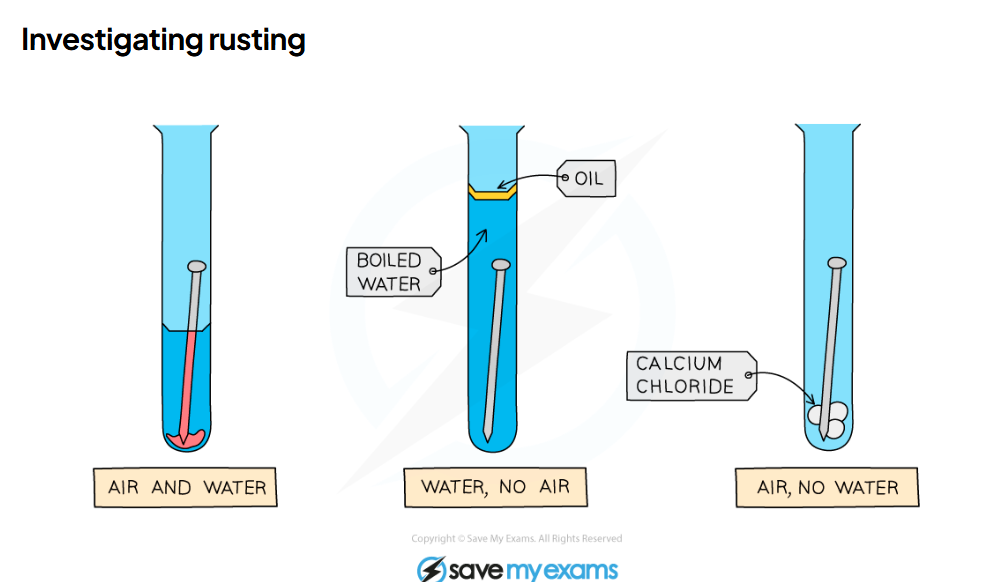
_______ and ______ must be present for rust to occur
oxygen, water
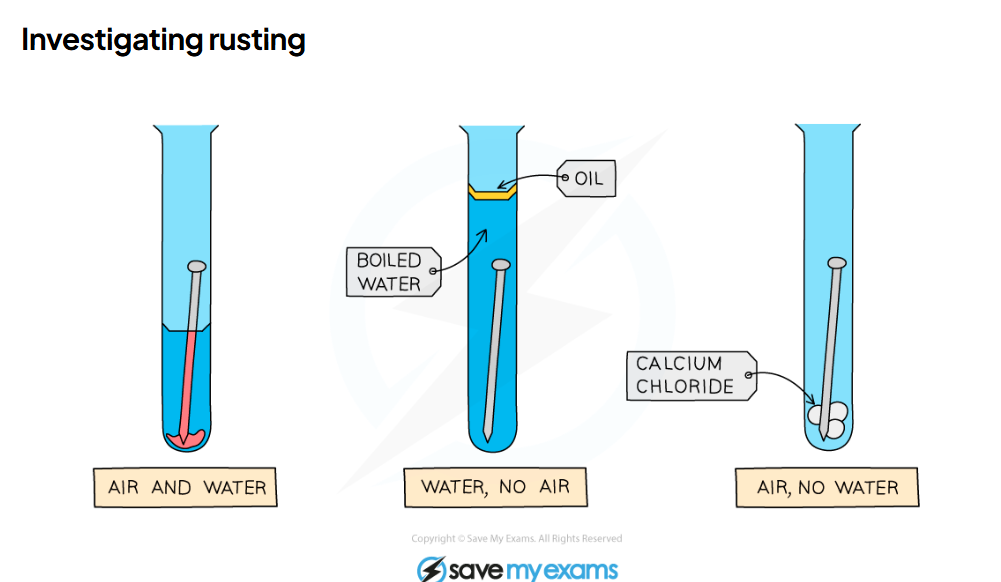
In the rusting experiment, what is the purpose of the test tube containing air and water?
It acts as the control showing that rusting happens when both oxygen and water are present.
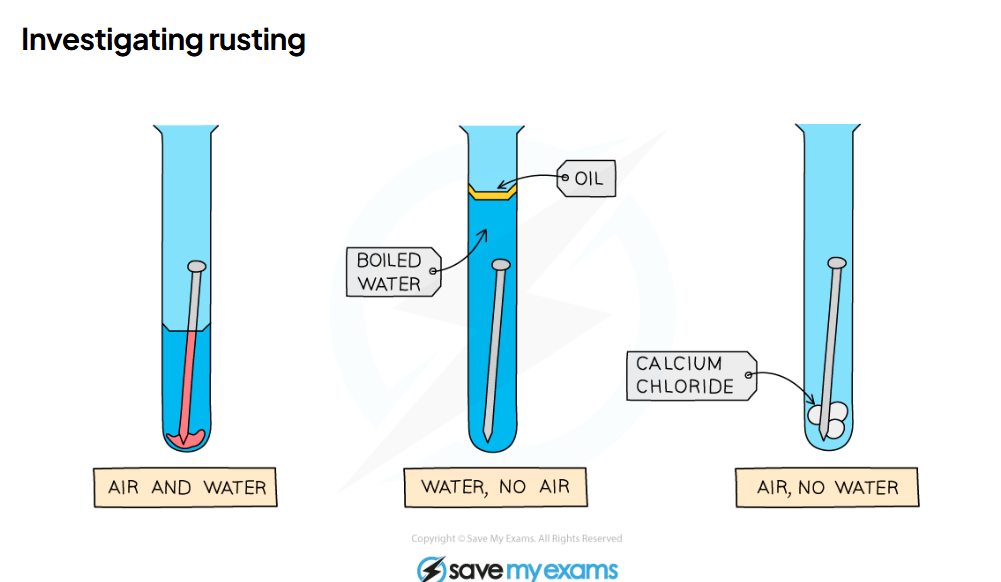
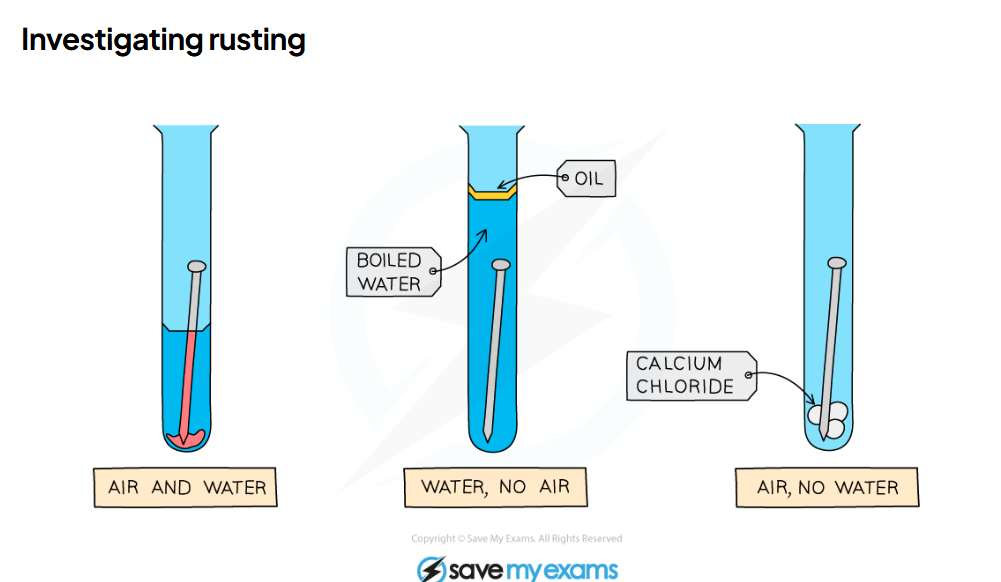
In the rusting experiment, why is the water in one test tube boiled before the nail is added?
Boiling removes dissolved oxygen from the water.
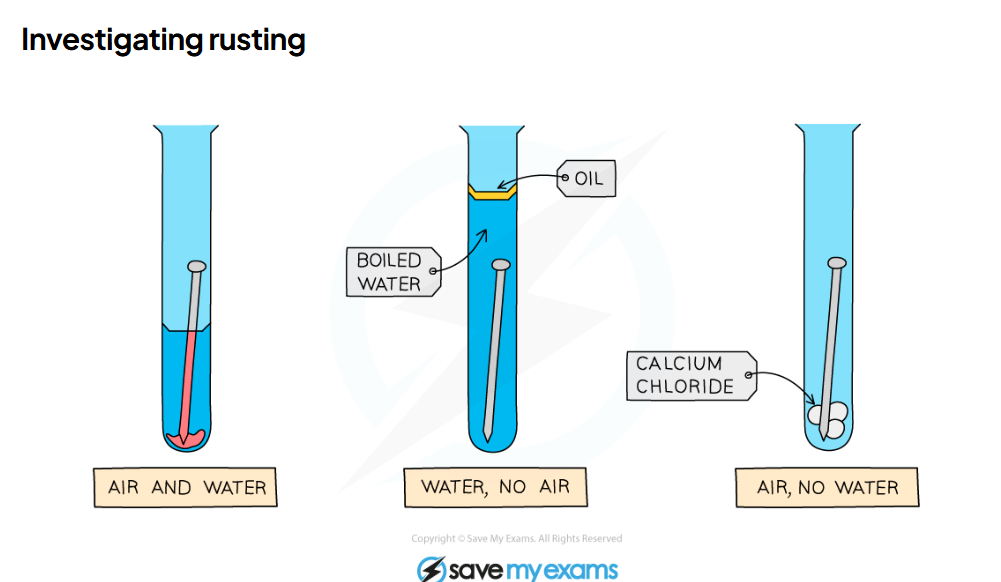
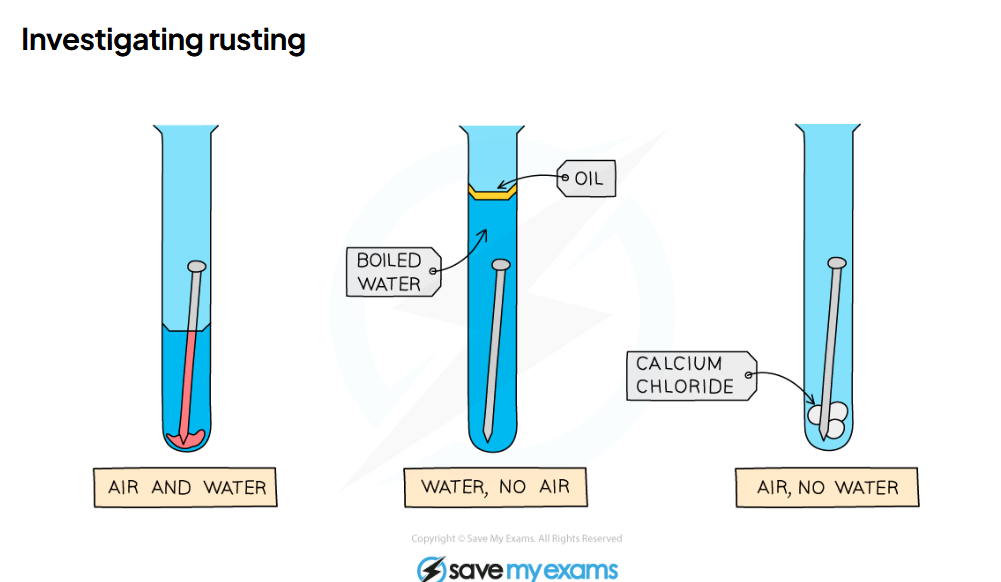
In the rusting experiment, why is a layer of oil placed on top of the boiled water?
The oil stops oxygen from the air diffusing back into the water.
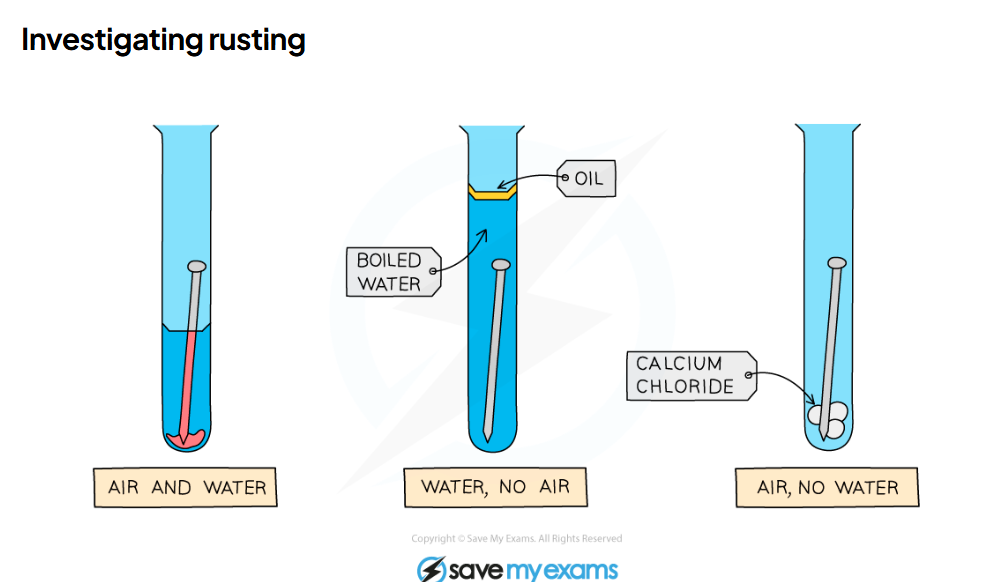
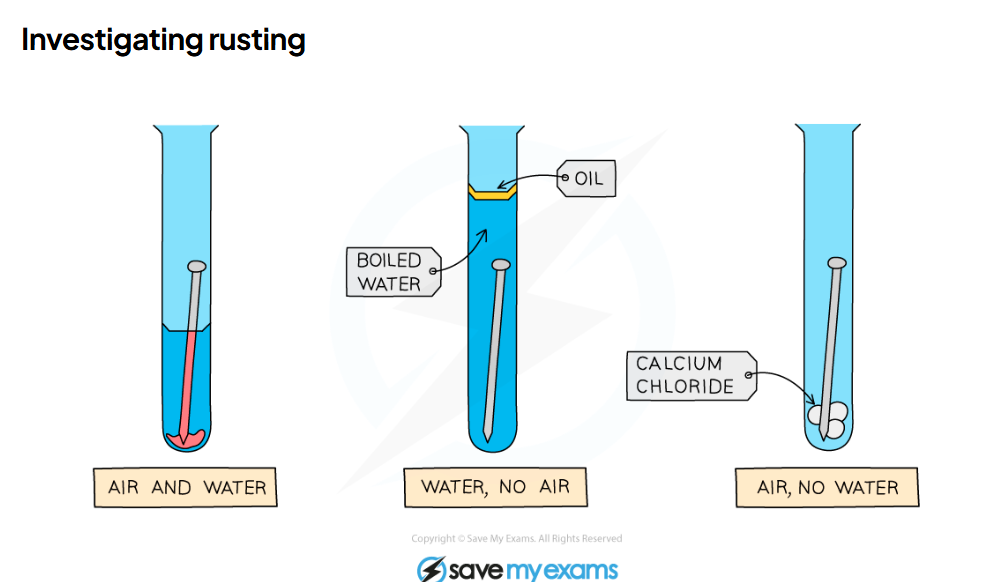
In the rusting experiment, why is calcium chloride placed in the dry test tube?
It absorbs water vapour and keeps the tube dry.
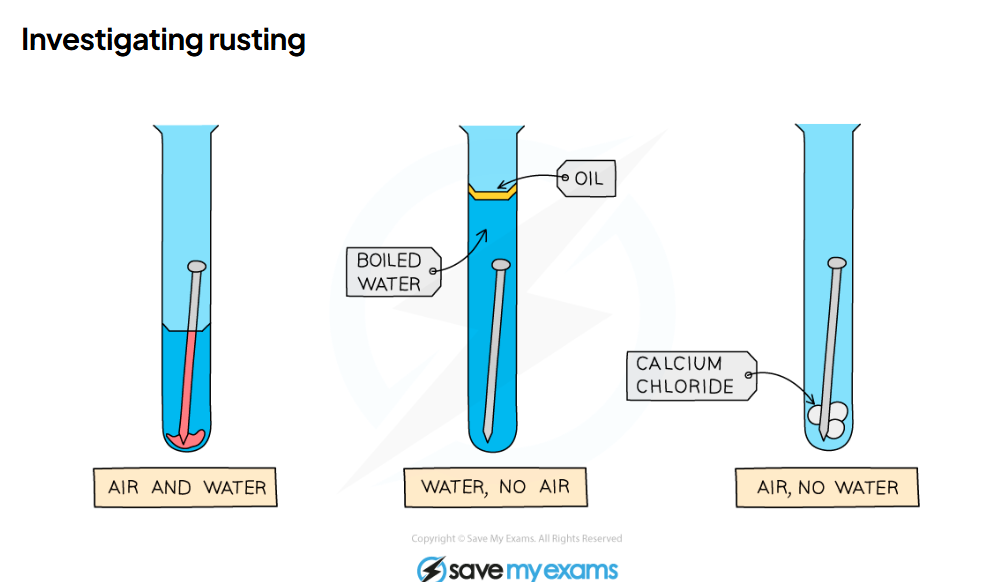
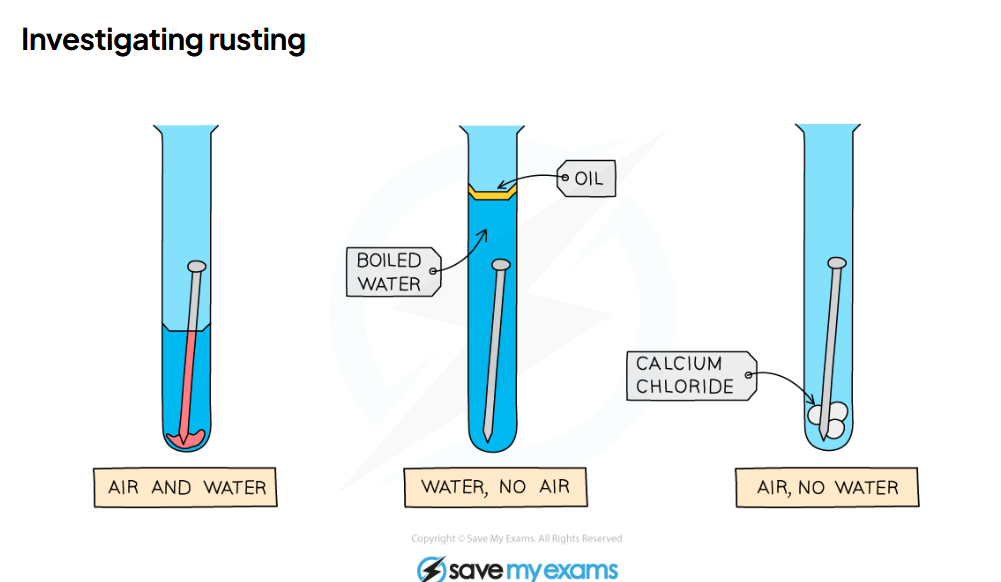
In the rusting experiment, why does the nail in the tube with air and water rust?
Because it is in contact with both oxygen and water.
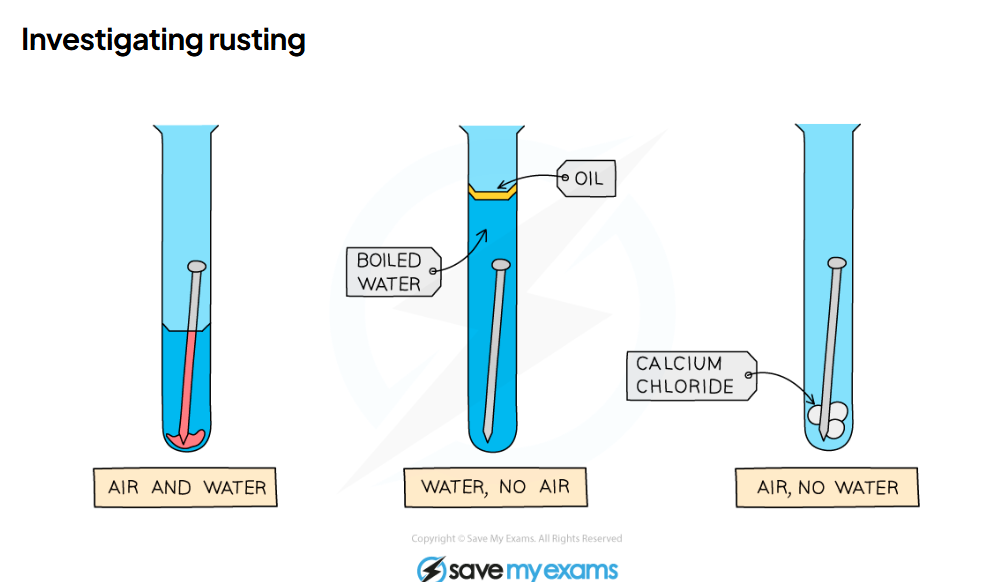
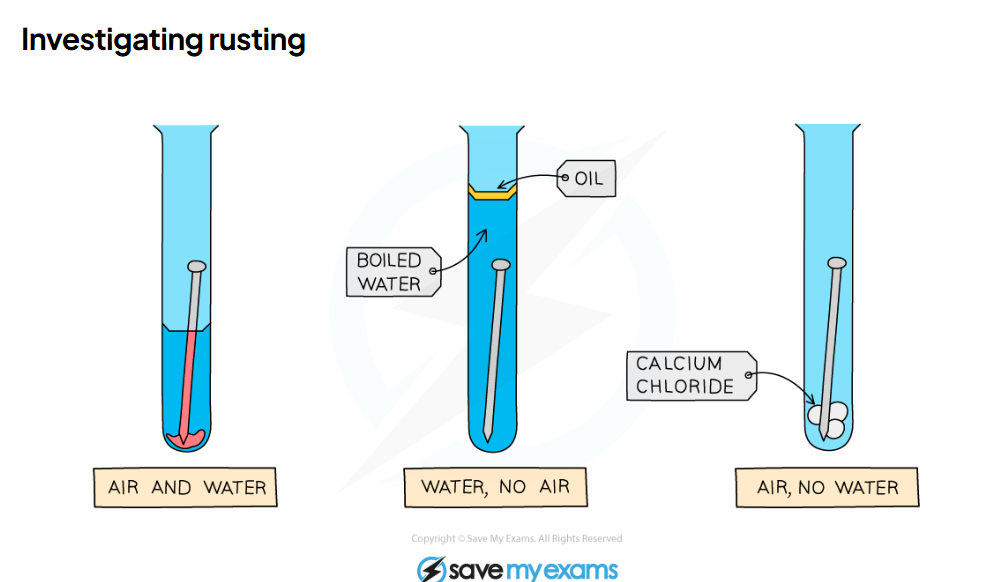
In the rusting experiment, why does the nail in boiled water with oil not rust?
Because there is water but no oxygen.
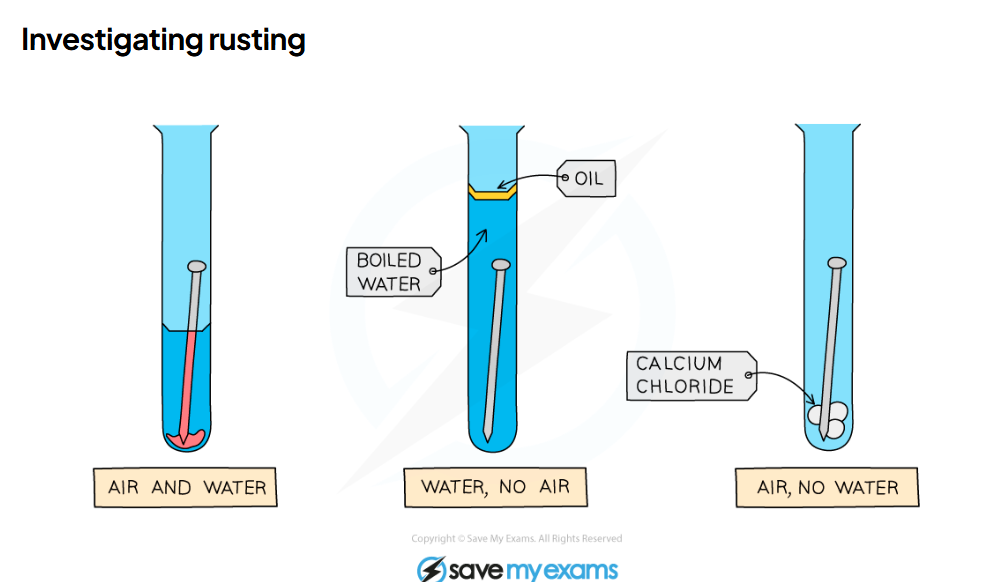
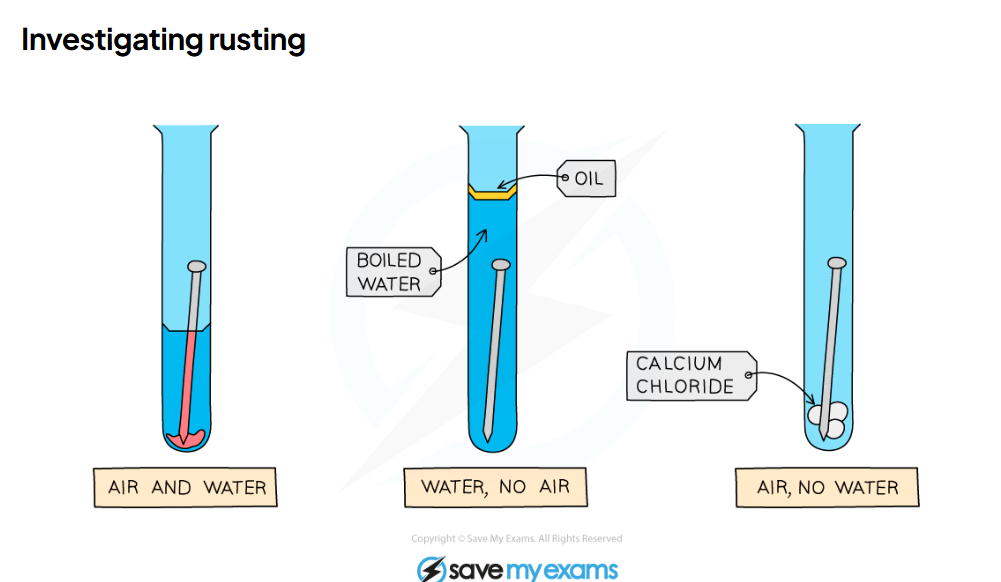
In the rusting experiment, why does the nail in dry air with calcium chloride not rust?
Because there is oxygen but no water.
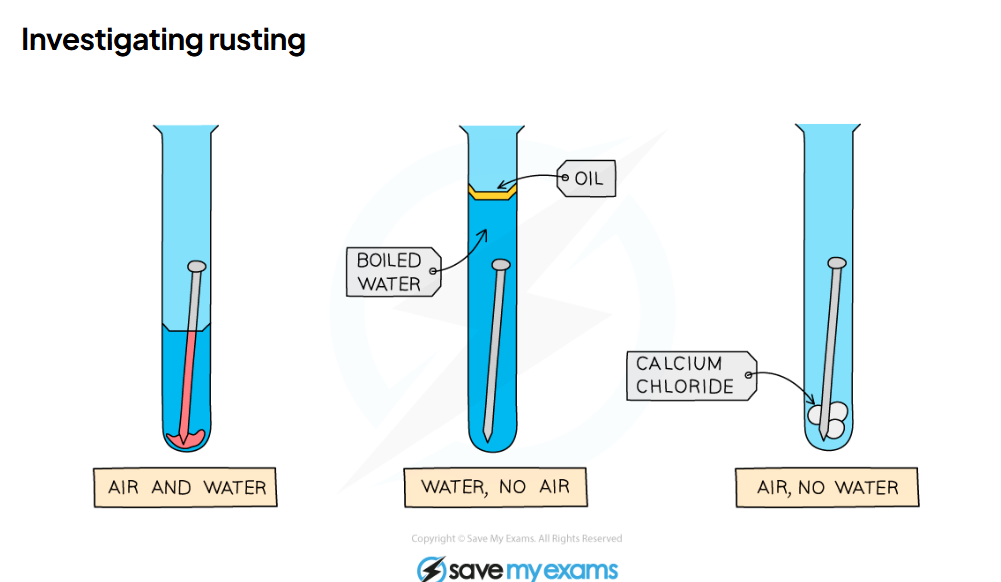
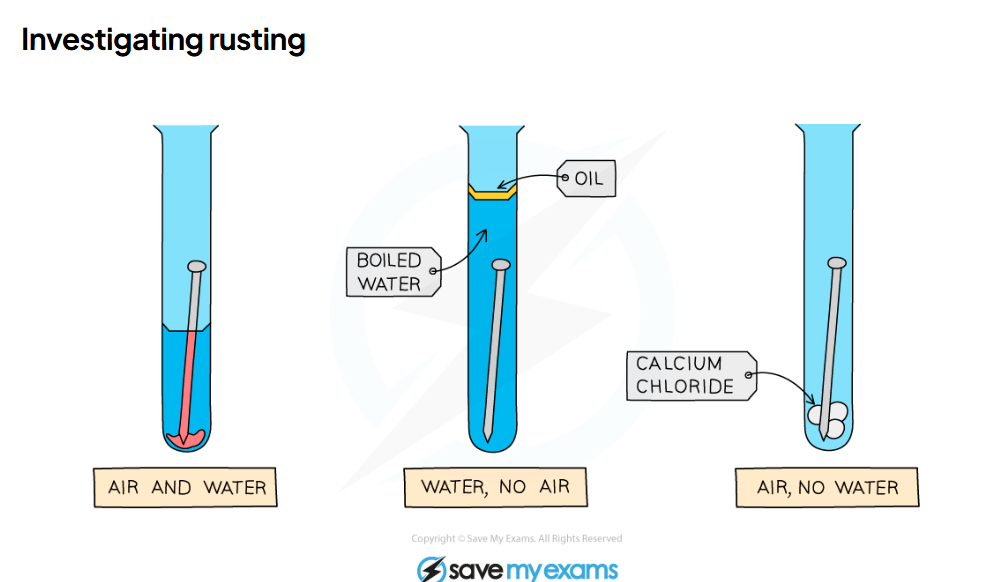
What does the rusting experiment prove about the conditions needed for rusting?
Both oxygen and water are needed for rusting to occur.
What is rust?
Rust is a soft solid substance that forms when iron reacts with oxygen and water. It flakes off the surface easily, exposing fresh iron underneath, so over time more iron rusts and the structure becomes weakened.
How does barrier method prevent rusting?
Barrier methods prevent rusting by coating iron with a layer that stops oxygen and water reaching the metal. Common barrier methods include paint, oil, grease and electroplating. If the coating is scratched or washed away, the iron is exposed again and will rust.
Why do iron structures become weaker over time when they rust?
Rust is porous
This means water and oxygen can pass through it
They reach the iron underneath
So the iron keeps rusting
Over time, more and more iron is lost from the structure. This makes the structure weaker.
Explain Sacrificial protection
Sacrificial protection is used to prevent iron from rusting by attaching a more reactive metal, such as zinc, to the iron. The more reactive metal oxidises more easily, so it corrodes first instead of the iron. This protects the iron from reacting with oxygen and water. The zinc must be replaced before it completely corrodes. This method is used on steel ships.
Explain galvanising
Galvanising is when iron is coated with a layer of zinc to prevent rusting. The zinc acts as a barrier, stopping oxygen and water from reaching the iron. If the coating is scratched, the iron is still protected because zinc is more reactive than iron and will corrode first. The zinc can also form zinc carbonate in air, which helps protect the iron further.
Explain how rusting can be investigated and how it can be prevented.
Rusting can be investigated using three test tubes containing iron nails. In one tube, the nail is in air and water, so it rusts. In the second, boiled water is used and oil is added on top to stop oxygen entering, so the nail does not rust. In the third, calcium chloride is added to absorb water, so the nail does not rust. This shows that both oxygen and water are needed for rusting. Rusting can be prevented by barrier methods such as paint, oil, grease or electroplating, which stop oxygen and water reaching the iron. It can also be prevented by sacrificial protection, where a more reactive metal such as zinc is attached to the iron and corrodes first. Galvanising is another method, where iron is coated with zinc.
What is the Chemical name of rust?
hydrated iron(III) oxide
What is oxidation in terms of oxygen?
Gaining oxygen
What is reduction in terms of oxygen?
Losing oxygen
What is a redox reaction?
Why can oxidation not happen without reduction?
Because electrons/oxygen must be transferred, so both processes occur simultaneously
In Zn + CuO ——→ ZnO + Cu what is oxidised?
Zinc, because it gains oxygen
In Zn + CuO ——→ ZnO + Cu what is reduced?
Copper(II) oxide, because it loses oxygen
What is an oxidising agent?
A substance that oxidises another substance and is itself reduced
What is a reducing agent?
A substance that reduces another substance and is itself oxidised
In the zinc and copper(II) oxide reaction, which is the oxidising agent?
Zn + CuO ——→ ZnO + Cu
Copper(II) oxide
In the zinc and copper(II) oxide reaction, which is the reducing agent?
Zn + CuO ——→ ZnO + Cu
Zinc
What is oxidation in terms of electrons?
Loss of electrons
What is reduction in terms of electrons?
Gain of electrons
Write the ionic equation for magnesium reacting with copper(II) ions.
Mg + Cu2+ ———→ Mg2+ + Cu
What are spectator ions?
Ions that appear on both sides of an equation unchanged and do not take part in the reaction.
Write the half-equation for magnesium being oxidised.
Mg ——> Mg2+ + 2e-
Write the half-equation for copper(II) ions being reduced.
Cu2-+ 2e- ———> Cu
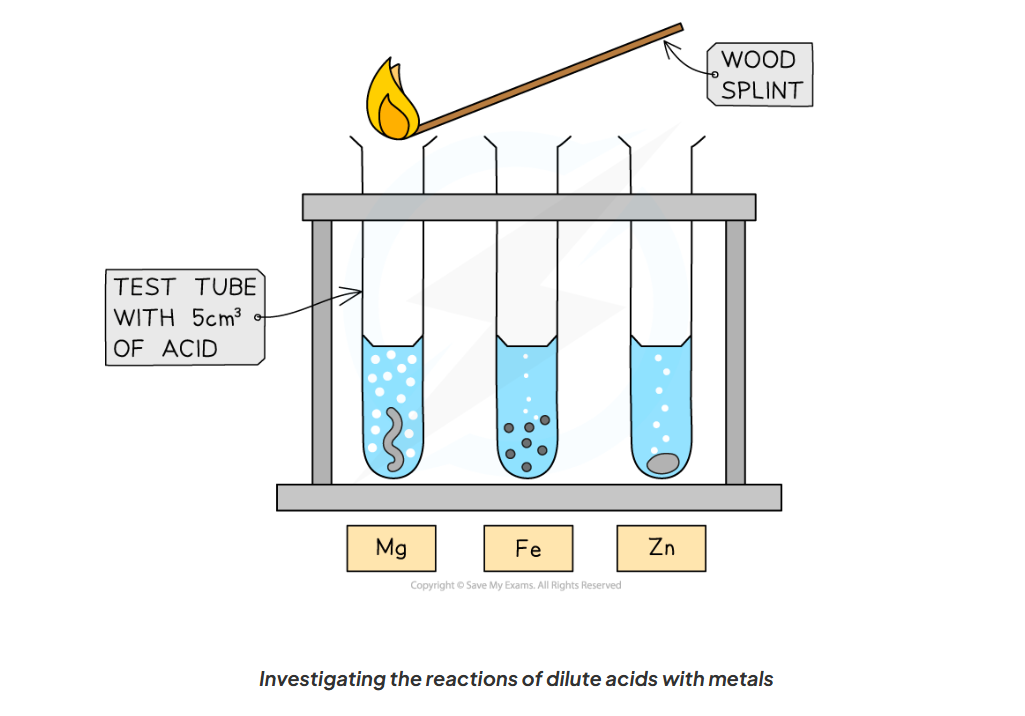
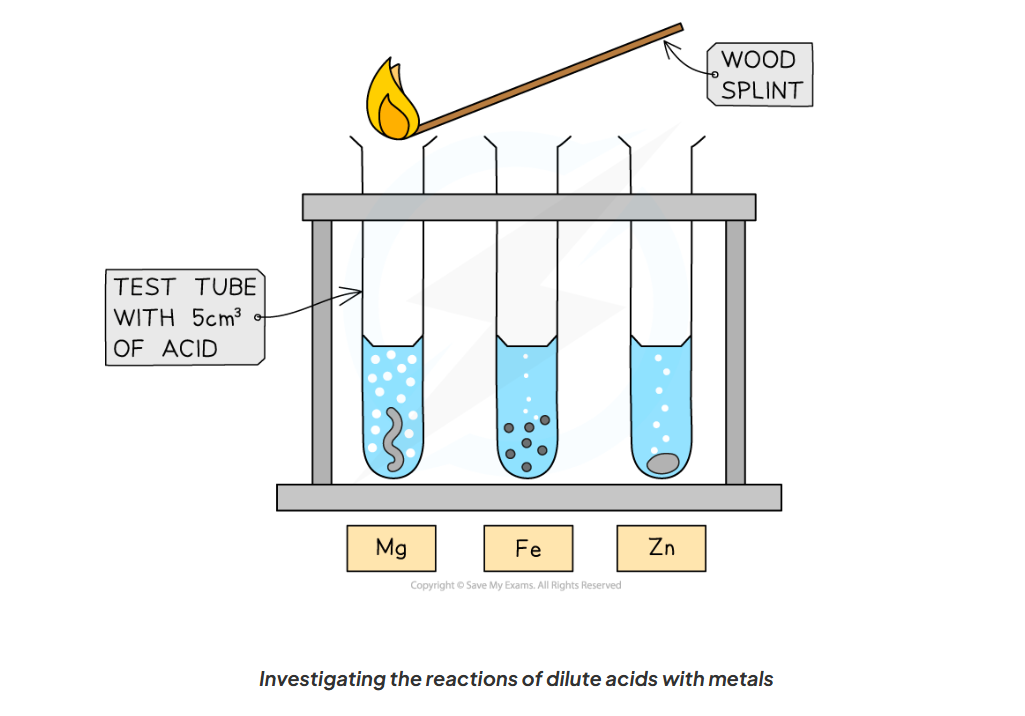
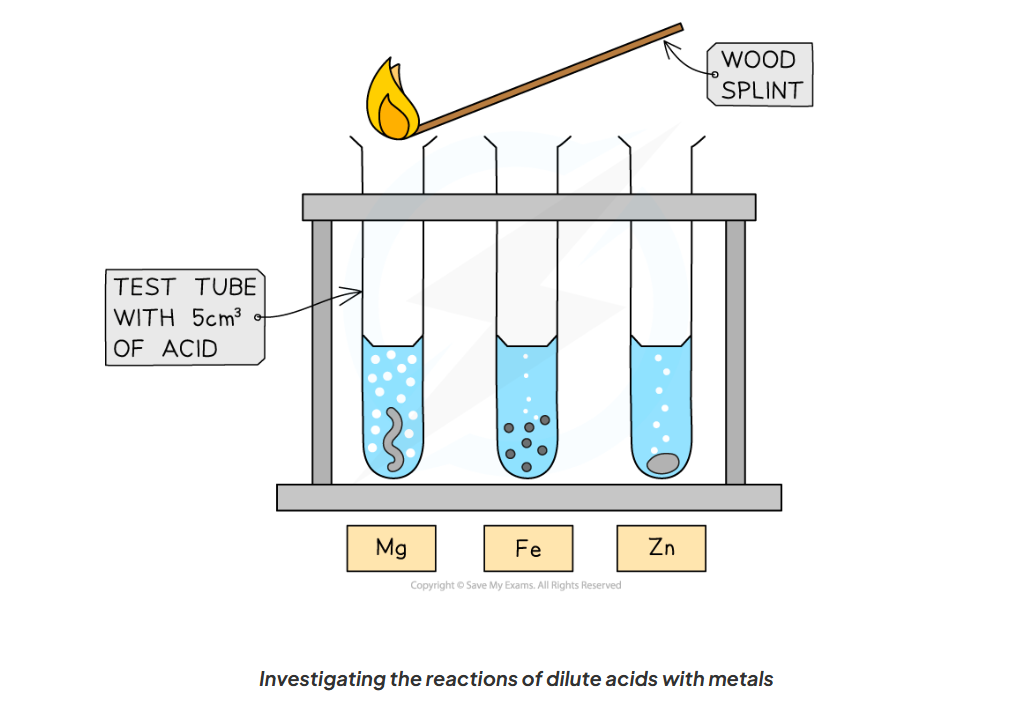
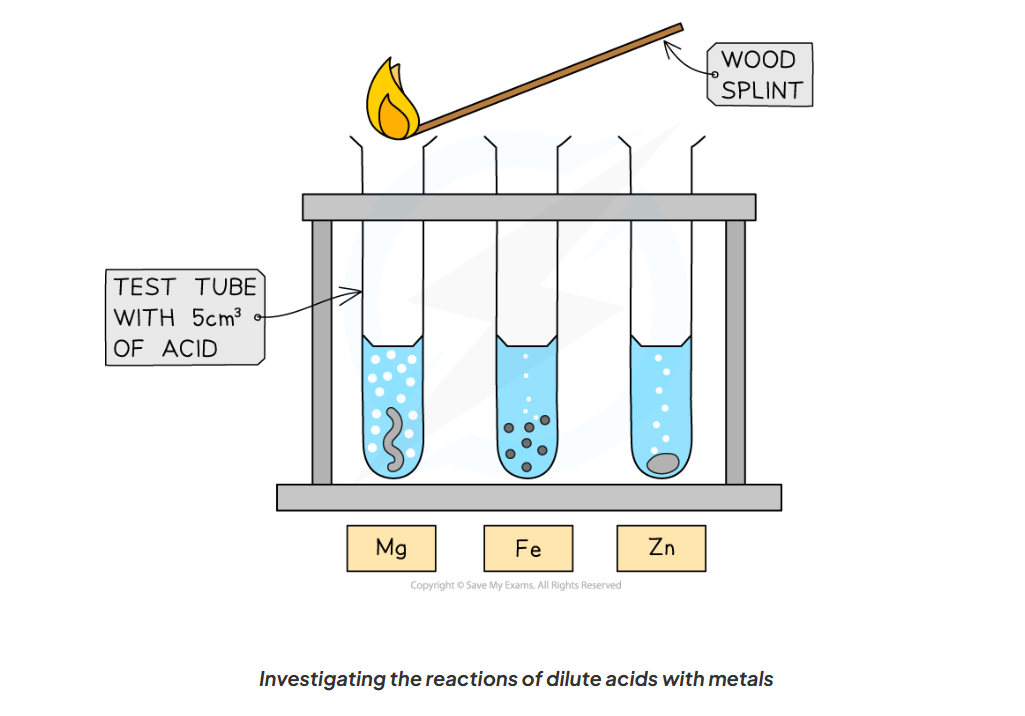
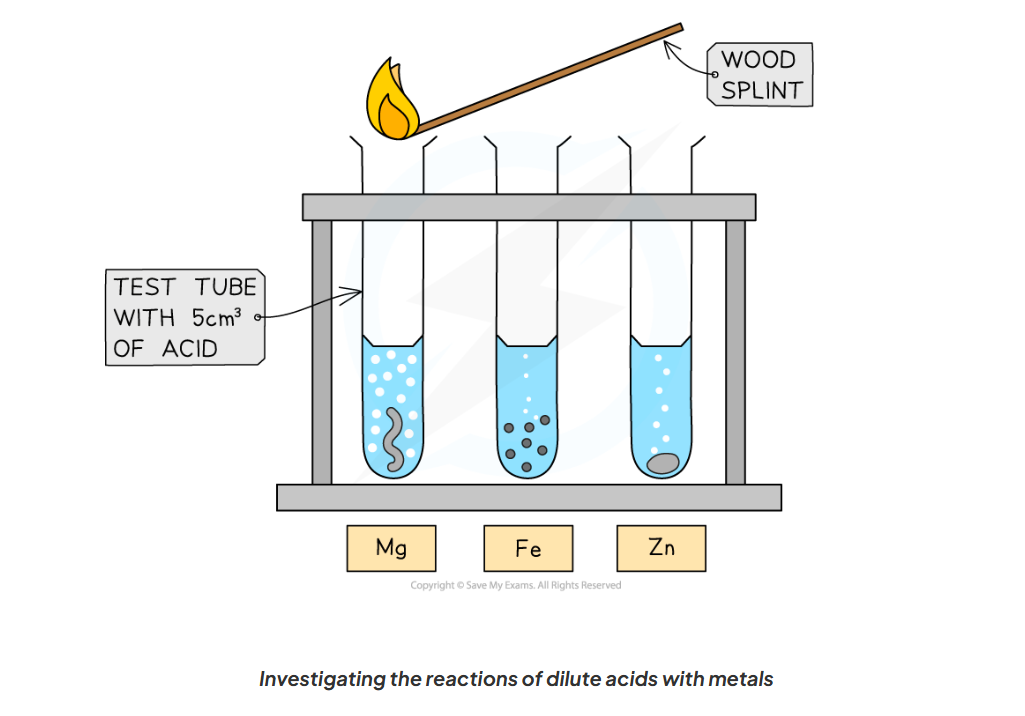
What is the aim of the practical?
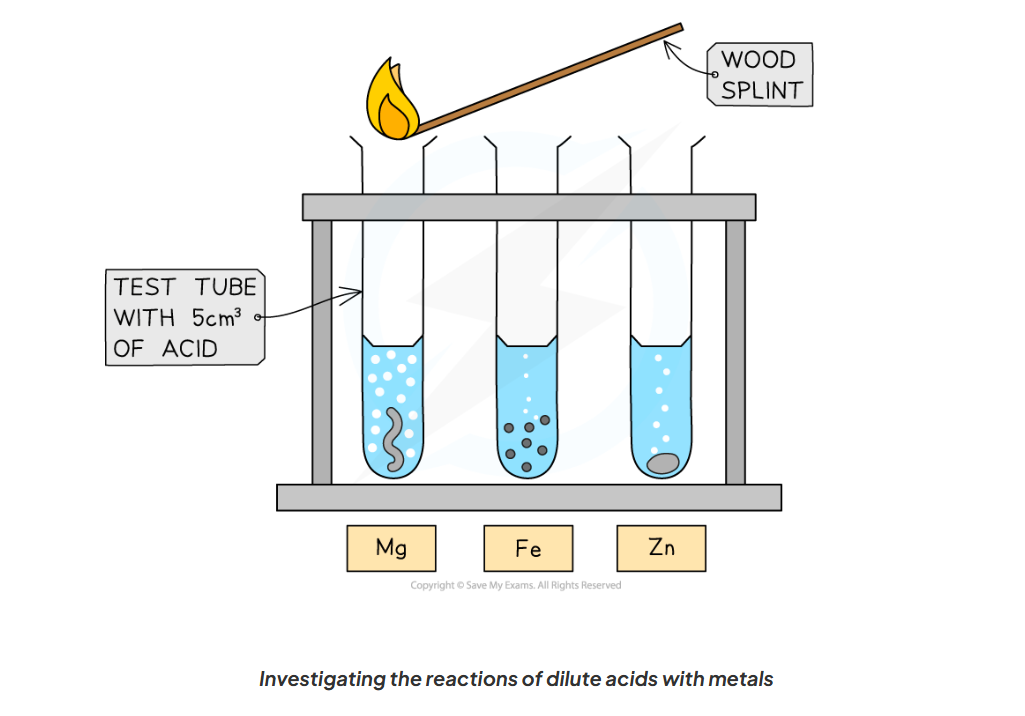
To investigate the reactions between dilute hydrochloric acid and sulfuric acid with magnesium, iron and zinc. You are comparing how different metals react with acids. This helps you see the reactivity series in action.
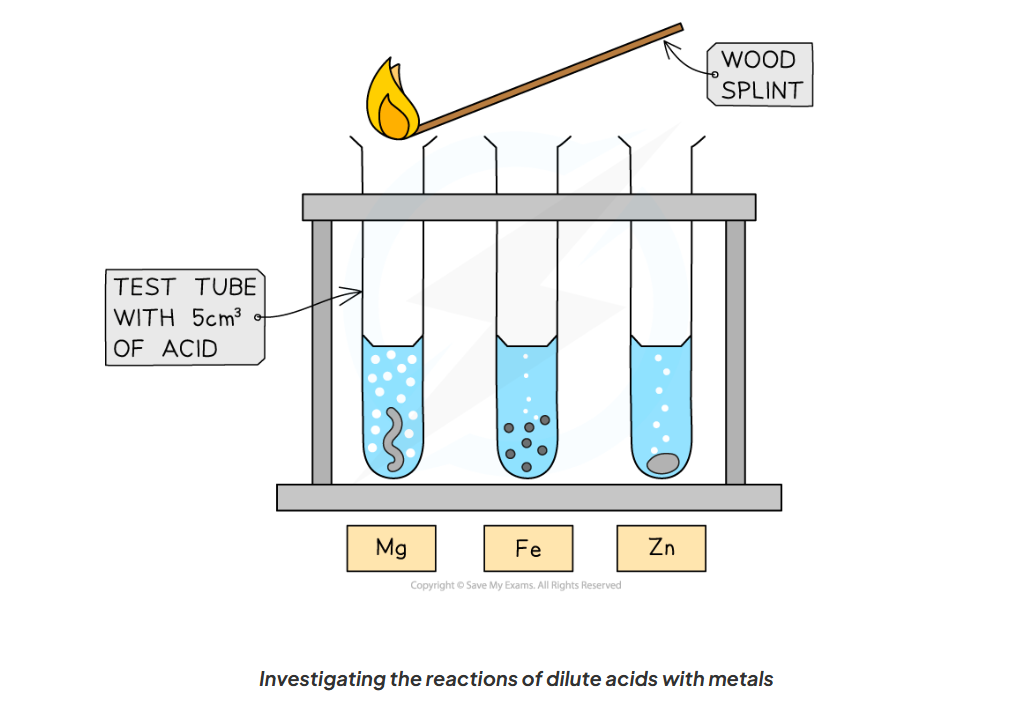
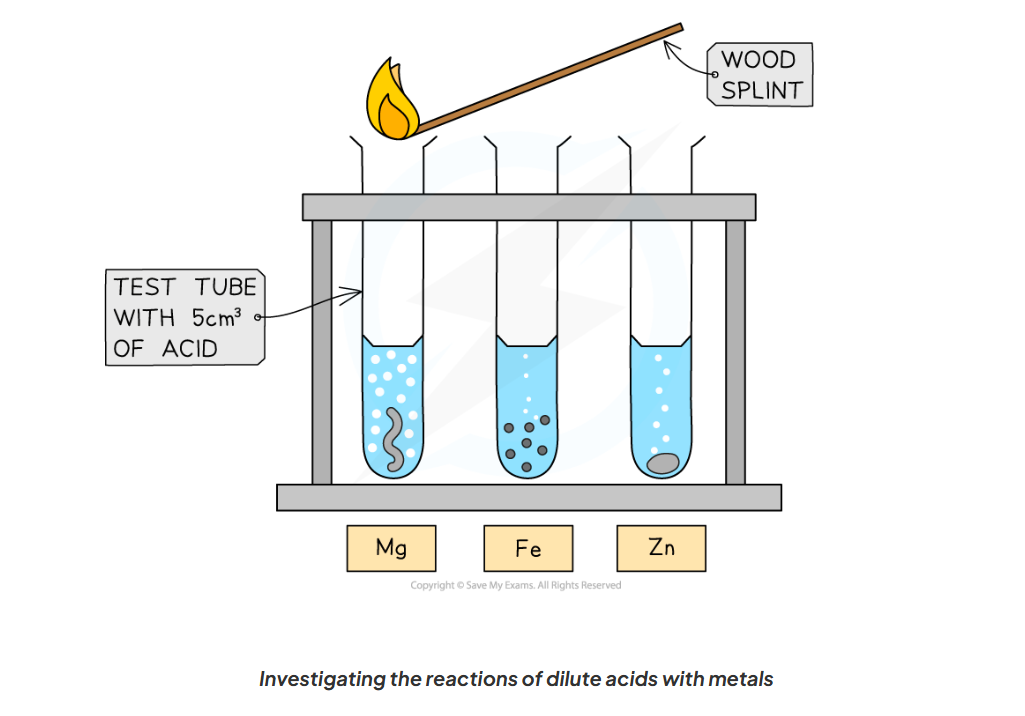
What safety precaution should you take before starting the experiment?
You should wear safety glasses before handling the acids. This protects your eyes from acid splashes. Safety is important because acids can be harmful.
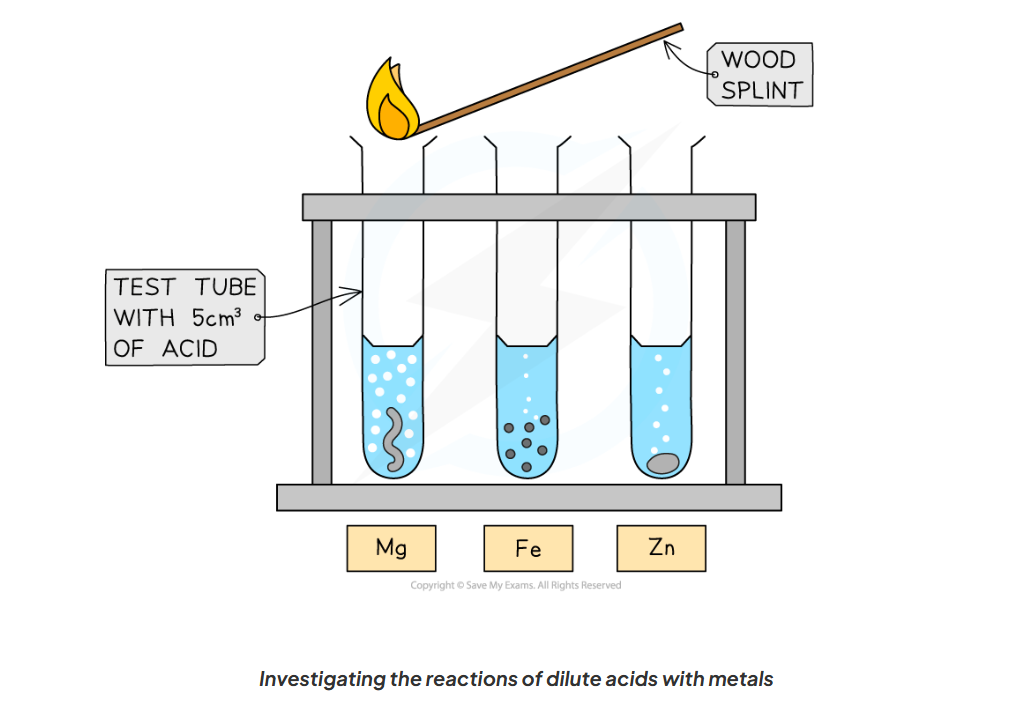
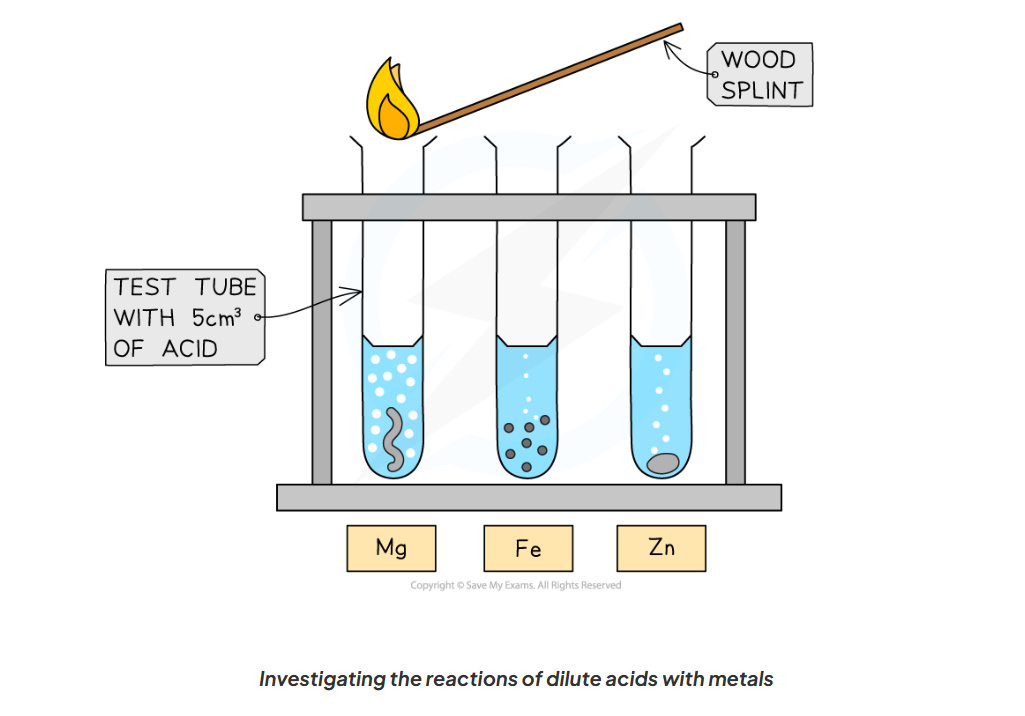
How much acid should you add to each test tube?
You should add 5 cm³ of dilute hydrochloric acid to each test tube. The same volume is used so the test is fair. You then repeat it with sulfuric acid.
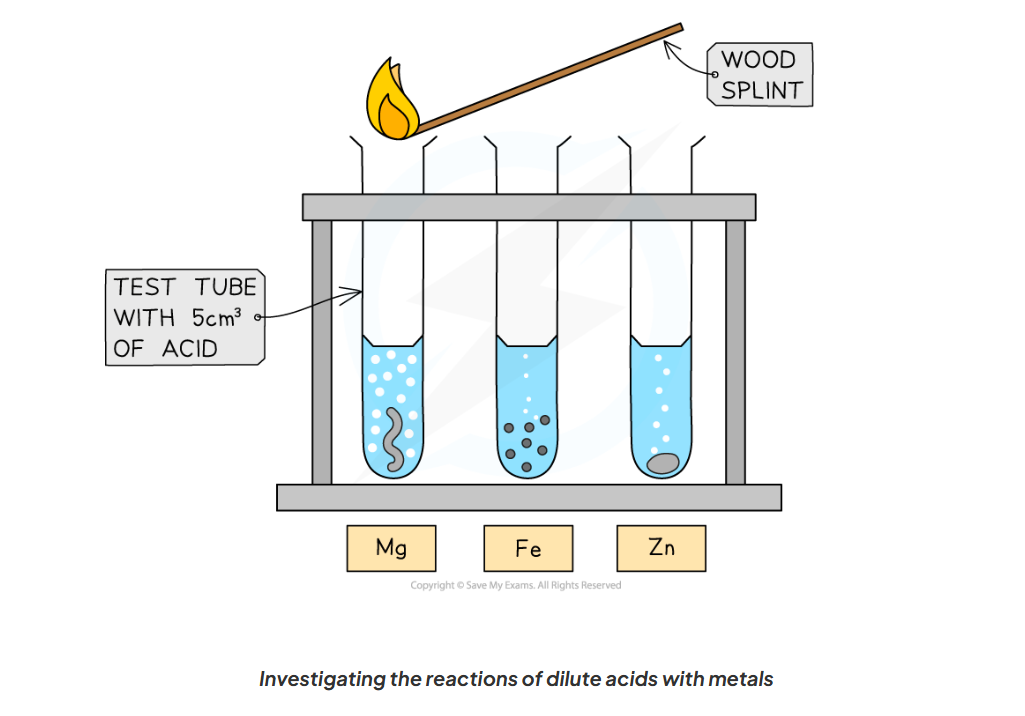
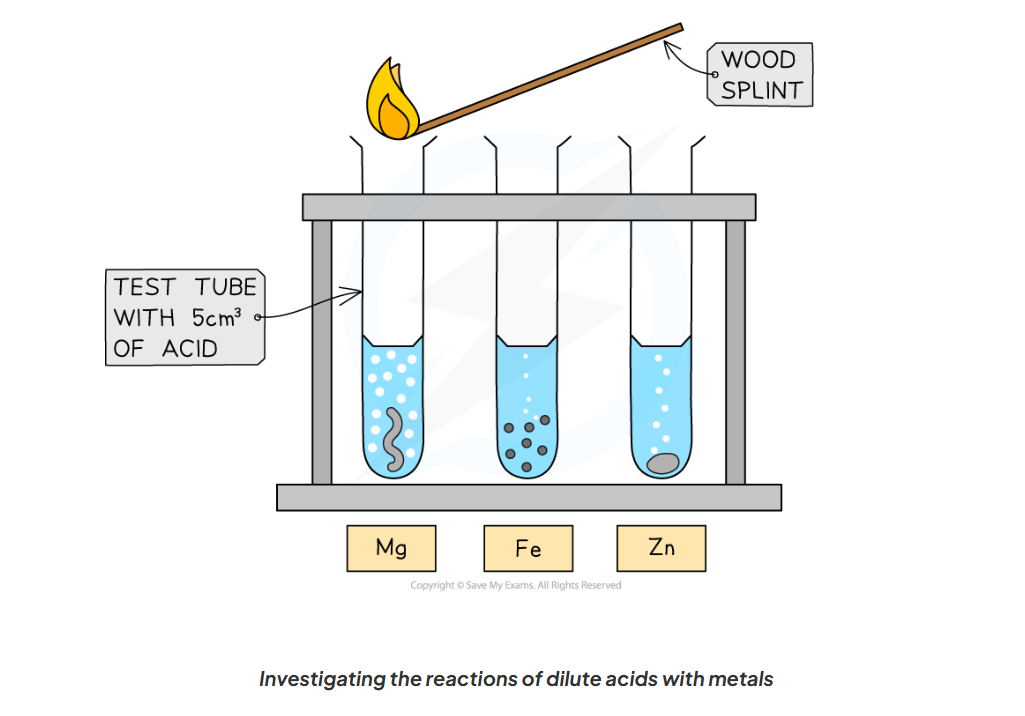
In this experiment what should the controlled variable be?
the volume of dilute acid (hydrochloric or sulphuric acid)
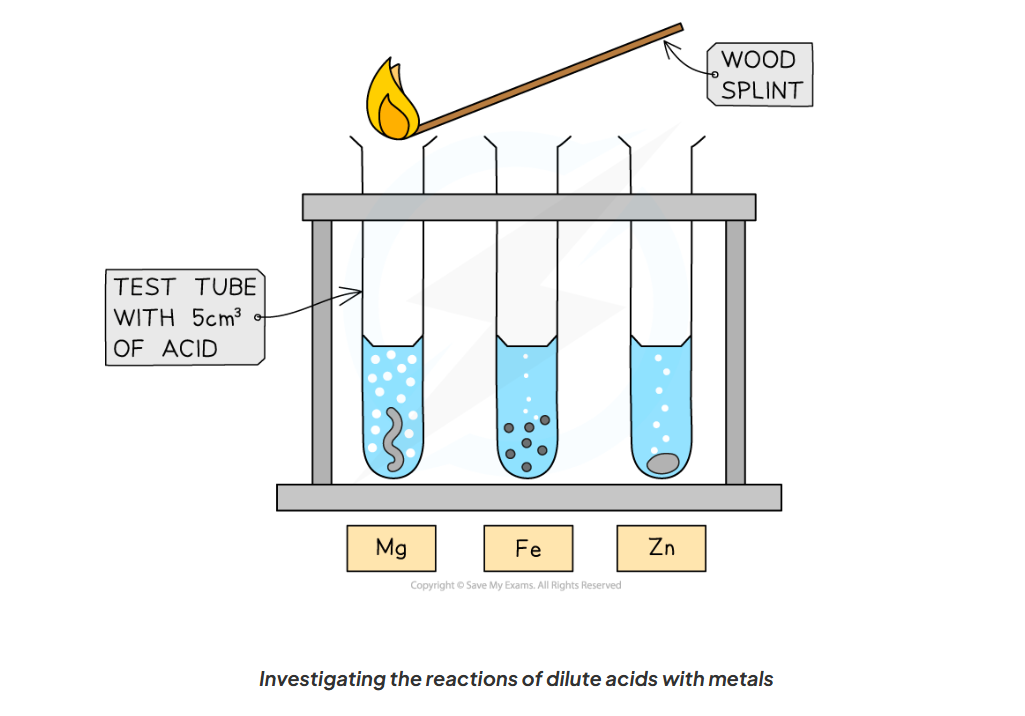
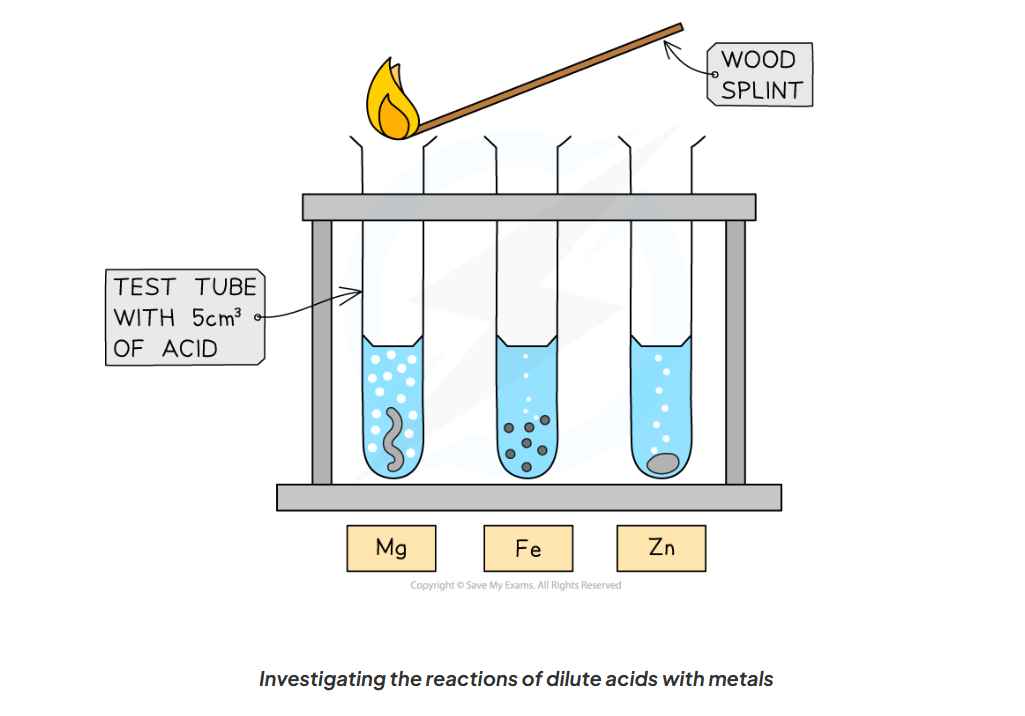
What metal is added to the first test tube?
A 1 cm length of magnesium ribbon is added to the first test tube. Magnesium is used first because it is the most reactive of the three metals tested. You then observe the reaction.
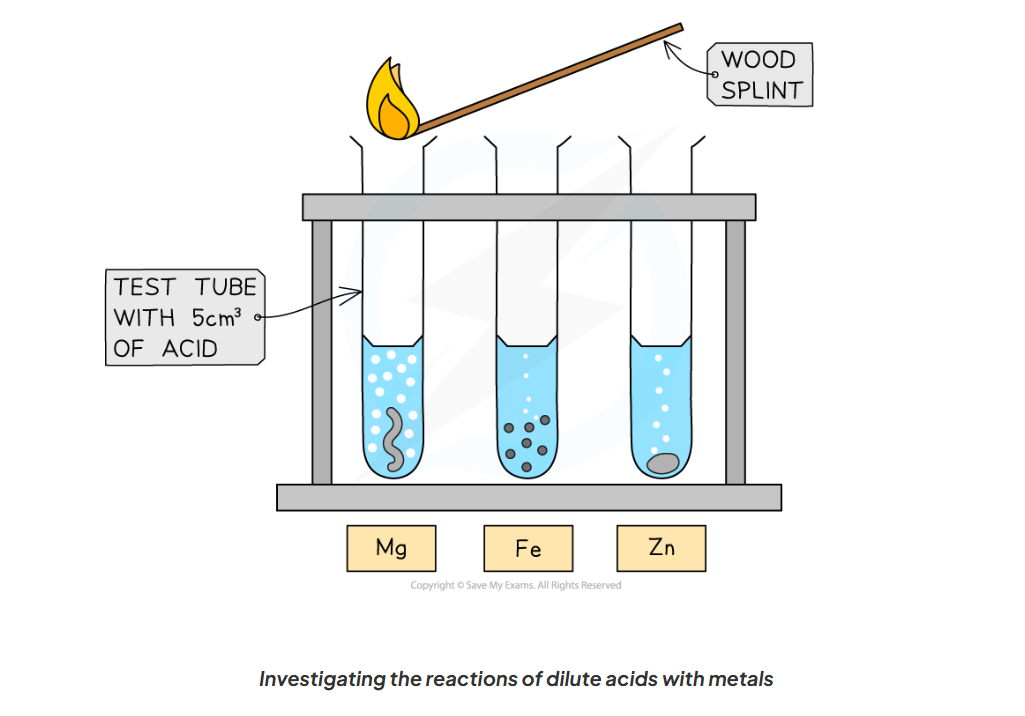
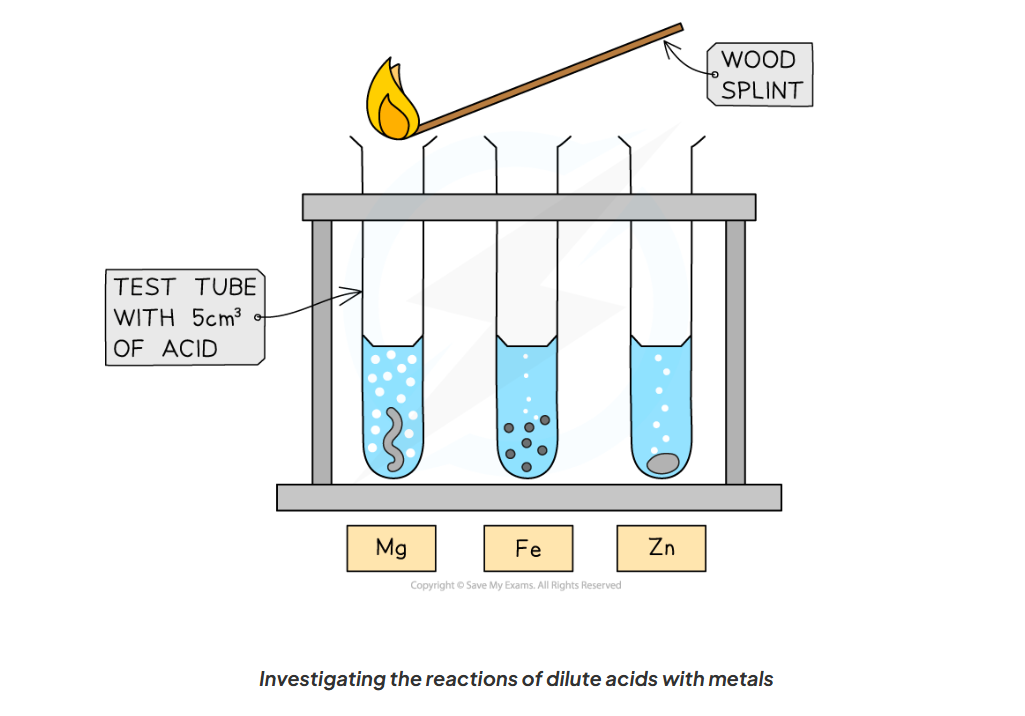
What do you do after adding the magnesium to the acid?
You observe what happens and note down your observations. You then use a lighted splint to test any gas given off. This tells you whether hydrogen is produced.
What is added to the second and third test tubes?
A few pieces of iron filings are added to the second test tube and zinc turnings to the third. These are tested in the same way as magnesium. You compare the reactions.
Why is a lighted splint used in this experiment?
It is used to test for hydrogen gas. If hydrogen is present, it gives a pop sound. This confirms that a gas has been produced in the reaction.
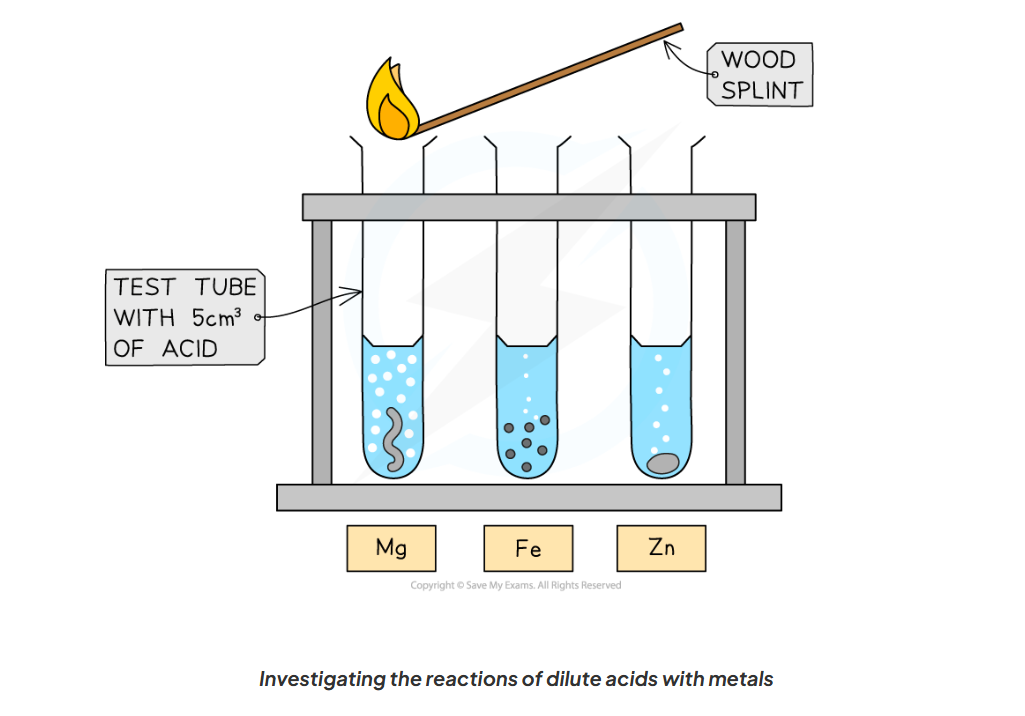
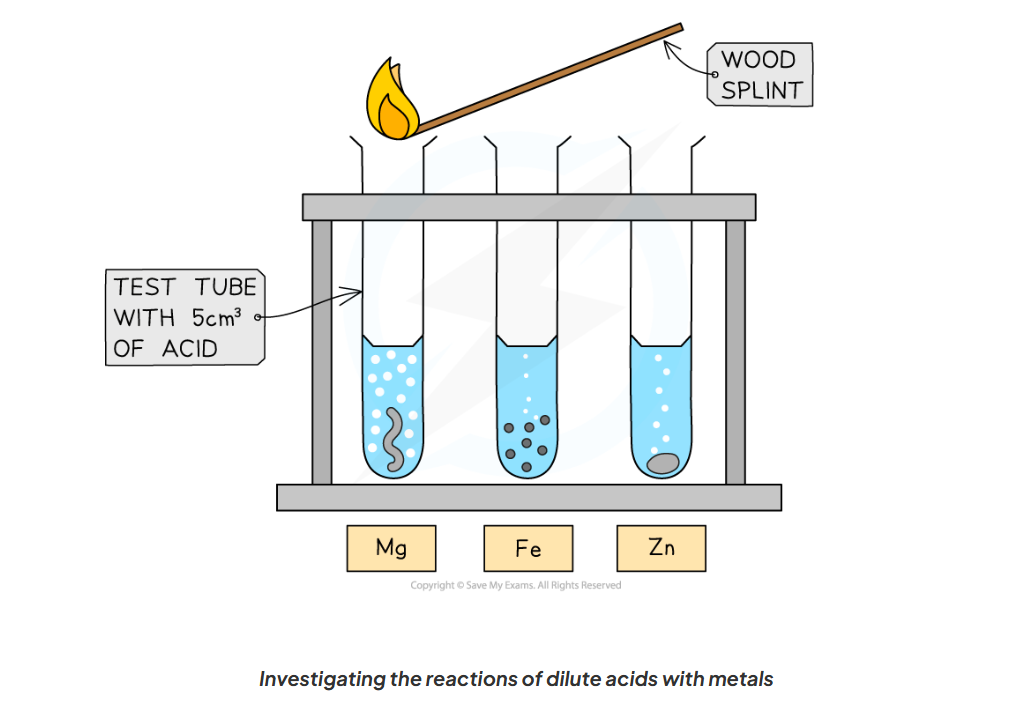
What happens when magnesium reacts with dilute hydrochloric acid/sulphuric acid?
Hydrochloric acid :- Magnesium dissolves quickly, the mixture gets hot, and gas is given off. The gas goes pop with a lighted splint. A colourless solution is left behind.
Sulphuric acid :- Magnesium reacts rapidly, with bubbling and a pop with a lighted splint. The metal dissolves. This shows a fast reaction with acid.
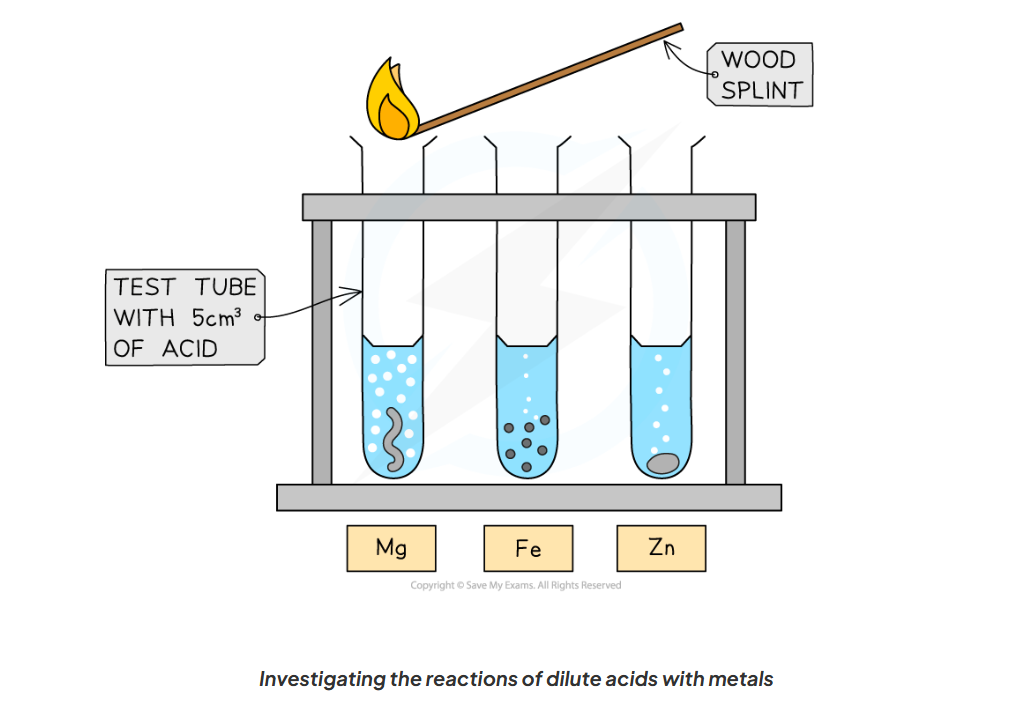
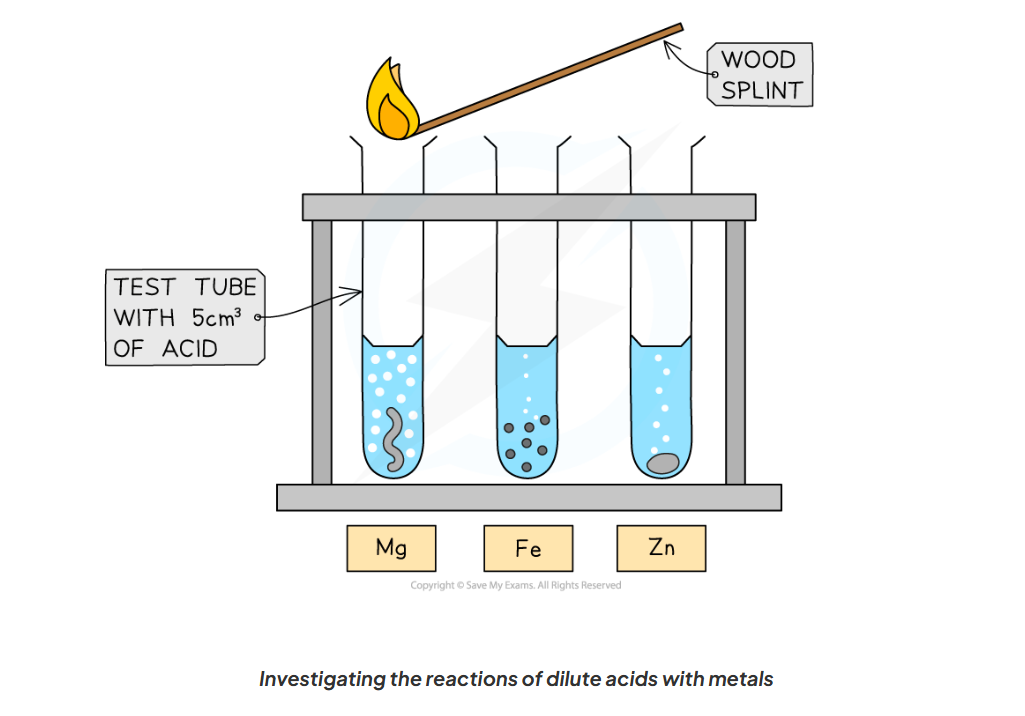
What happens when iron reacts with dilute hydrochloric acid/sulphuric acid?
Hydrochloric acid :- Iron shows very slow bubbling. The reaction is much less vigorous than magnesium. This shows iron is less reactive.
Sulphuric acid :- Iron reacts slowly, with small bubbles seen. The reaction is weak compared with magnesium and zinc. This shows iron is the least reactive of the three.