bl213 exam 2 (bones terms and cells)
 Call Kai
 Learn
Learn Practice Test
 Spaced Repetition
 Match
Match Flashcards
 Knowt Play
1/25

There's no tags or description
Looks like no tags are added yet.
Name | Mastery | Learn | Test | Matching | Spaced | Call with Kai | Chat |
|---|
No analytics yet
Send a link to your students to track their progress
26 Terms

feedback loop for high blood calcium?
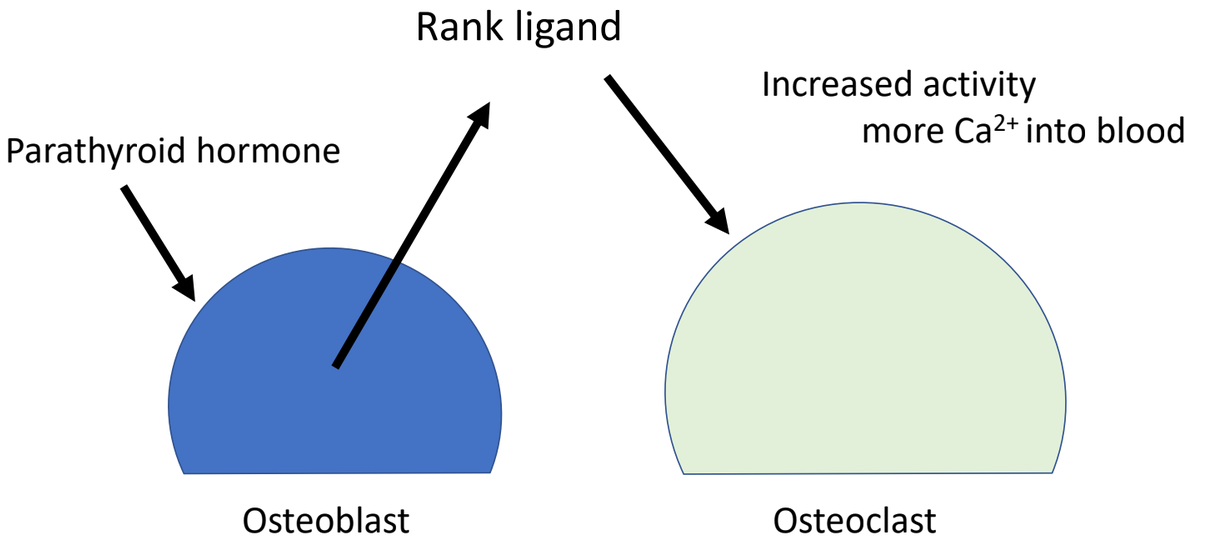
feedback loop for low blood calcium?
What is average balance range of calcium in the body?
9-11 mg / 100 mL blood
How much of calcium is in blood?
99%
below 9 mg of calcium is
hypocalcemia *Seizures, spasms
above 11 mg of calcium is
hypercalcemia *Vomiting, kidney stones
traits of cartilage?
Avascular & no nerves, terrible at healing, strong but flexible
3 types of cartilage
hyaline, fibro, elastic
Mesenchymal stem cells
stem cells that copies itself through mitosis, a copy, and an original.
They can become osteoblasts, chondrocytes, adipocytes,
Found in cartilage
OSTEOGENIC CELLS
Created by mesenchymal cells, the osteogenic cells create new bone associated cells.
OSTEOBLASTS
Osteoblasts secrete osteoid, the building blocks of bone.
OSTEOCYTES
Osteoblasts that got stuck, they live in mature bone. They serve a maintenance function where they help maintain mineralized matrix from inside the bone. (LIVE INSIDE BONE)
mesenchymal cells -> become osteogenic cells (osteoprogeniter) (produce other bone cell types) -> osteoblasts bone builders that secrete osteoid, if they become trapped they become osteocytes -> osteocytes maintain the bone and function, and maintain matrix from inside the bone (where they are trapped) -> Osteoclasts are another cell, they chew bone and break it down for repair or growth or maintaining.
process of bone cells lol
appositional
interstitial
two types of bone
compact and spongy
traits of compact bone
Filled tightly with mineralized extracellular matrix leaving very little open space, save for microscopic channels and cell spaces.
traits of spongy bone
made of trabeculae tissue, the hollow spaces are for red marrow, a very vascular substance where blood is produced.
microscopic compact bone anatomy
Basic building unit (osteon)
Osteon look like circles, each having a central canal where blood vessels use (Haversian canals)
Haversian’s are connected by Volkmann’s (perforating canals)
osteon
(Haversian systems): Organized into functional cylindrical columns that run parallel to the long axis of the bone to handle stress.
lacunae
Tiny cavities within the solid matrix that house mature bone cells called osteocytes.
canaliculi
Miniature canals that connect lacunae together, allowing nutrient and waste transport through the dense matrix
Hematopoiesis
production of blood, only done by spongy bone.
lamellae
(individual rings,) the collagen fibers making up these tissue run in the opposite direction (slanted and opposing each layer) in order to resist twisting forces
Inorganic resists?
compression (heavy weight)
organic material in bone resists?
tension (moreso pulling on the bone)